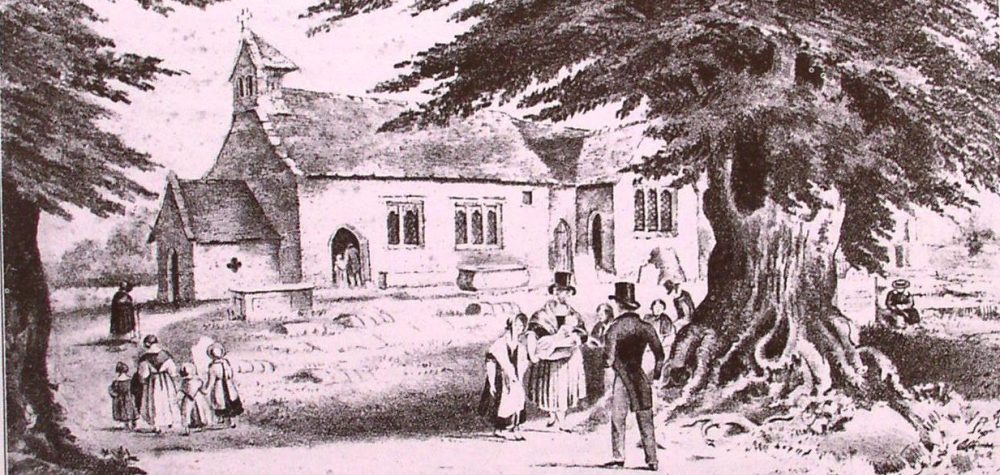
No. 380 on the 1841 tithe map – originally a very old cottage with a walled garden, often referred to as Goytrey Cottage.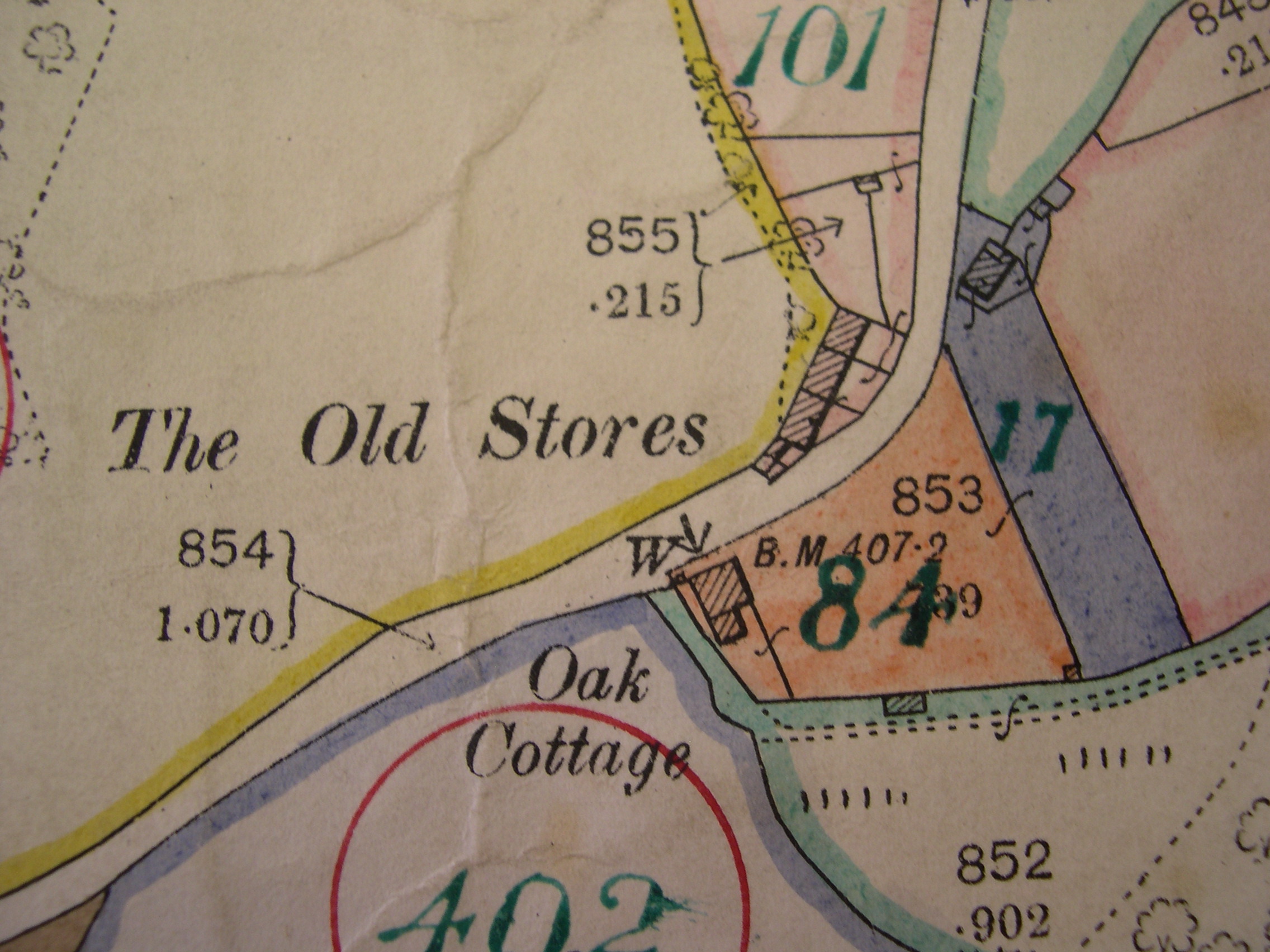
Oak Cottage was privately owned, there is a lease dated 1774 between George Lowman, Thomas Wellings and Thomas Webster by virtue of a common recovery suffered in that half of the hereditaments and premises granted unto Thomas Wellings for 1000 years peppercorn rent.
It appears to be used by the Cooke family as there is a mention in the parish overseers account mentioning Thomas Wellings doing so in the years 1801-2.
In 1803 the overseers account says the property is now let to Mr Phillips. The Earl of Abergavenny survey in 1821 says the occupier is John Phillips who is also paying land tax for the same year.
By 1829 Thomas Griffiths is in occupation of Oak Cottage, this changes in 1830 to Rice Davies, the parish valuation says he also owns the brake (probably Foss-y-bach.)
The new owner of Oak Cottage by 1841 is Mrs Evans, the wife of the Rector of Llanover. She is paying 1 shilling 10 pence to the rector of Goytre. The census of 1841 says Mary Gabb 35 of independent means along with Baker Gabb and a servant, 15 year old Hannah Williams are in occupation. (This is the well known Gabb family of solicitors based in Abergavenny.)
In November 1842 Frances Anne Farquhar Evans, the daughter of Mrs and the Rev. John Evans, vicar of Llanover, married George Kingston, a sailmaker at Bassaleg Church. They had two daughters Sarah Ann Baptised at Trevethin Church on 2nd May 1844 and Kate Marion in 1847.
(Frances Ann was known as Anne not Frances, her mother was born in Scotland, the daughter of Robert Farquhar, the owner of Blaendare Iron works, Pontypool.)
Mary Gabb, died in 1843, sometime afterwards Oak Cottage was taken by John Gwynne Herbert Owen, the son of John and Elizabeth Gwynne.
His parents John Owen and Elizabeth Gwynne (nee Lewis) both widowed, were married at Trevethin Church by license on November 20th 1801. Elizabeth Gwynne was the widow of Sackville Gwynne of Glanbane, Llanvair-ar-y-bryn, Carmarthenshire, they had married in 1793, Sackville Gwynne was the sole inheritor of his father’s estate.
John Gwynne Herbert Owen was born in 1803 at Llantilio Pertholey. In 1821 he had signed a 5 year agreement to serve Burgess Bryan as an apprentice attorney. He married Mary Ann Bennett at St Marys de Crypt, Gloucester on 22 May 1823. Mary Ann died in 1844.
John Gwynne Herbert Owen was known as the poor man’s attorney, he had represented several chartists at the Monmouthshire assizes after the uprising in Newport in November 1839.
At some point after the death of his wife John Gwynne Herbert Owen developed a friendship with Anne Kingston wife of George, they took occupancy of Oak Cottage.
On the census of 1851 he was 46, his son John (son of Ann Kingstone) was 3, living with him are three servants. I cannot find Ann Kingston on the census.
Letter from Thos Evans to Earl of Abergavenny – August 9 1853.
My dear Sir
The bearer William Jones is a respectable inhabitant of Goytrey & one of my singers and communicants and therefore one with whose wishes I cannot help complying in this instance. He holds a little place under Mr Evans of Llanover and he has just had notice to quit. Mr Evans has given him notice to quit because he intends giving up the little place to his daughter, who has for years lived and is at present living with Mr Owen in this Parish to the great annoyance of all the well conducted portion of the parishioners. (This property is Maesyberryn.)
I feel in common with the Bird family, who are most anxious to prevent Mr Owen and his disreputable party coming down into the midst of the people deeply concerned to find that we shall have so great a nuisance on the side of the path from Goytrey House to our Church.
Jones has told Mr Evans in plain terms that he will not be under Mr Owen and that he will not give up the place to him in order that it might go into the hands of his daughter and thinking Owen may have offered him a sum for giving it up I was induced to offer him myself £20 for his chance of renewing the lease, on condition that you approve of the arrangement, not that I want or covet it, but I am really and also Miss Bird & Captain most anxious to prevent the leaven of Mr Owen’s bad example from spreading in this quiet & (comparatively speaking) on the whole well conducted moral Parish. It is in your power to put your veto on such a movement – which I earnestly trust you (sideways) will do and so confer on me and the Bird family who perhaps may have to spend our days in the Parish, a very great obligation, in addition to others so kindly bestowed. You will I am sure forgive me for thus obtruding on your attention such a subject & ascribe my anxiety to the deep concern I feel for preserving & promoting the tones of religious and moral feeling among my parishioners.
Mr Evans daughter now lives Owen & has a family of children by him and there is another married woman separated from husband & children, living in a little cottage by the great Oak, who is I am told visited. It is horrifying to think that we shall have such a set located in the centre of the parish. I will not enter into further particulars than to add that Owen’s Brother often comes to Goytrey of whom the words of Horace are descriptive
“Here him is longs satiate he do” – Apologising for thus troubling you & with hope, I remain my dear Sir
Ever Very Sincerely Yours
Thomas Evans
At Monmouthshire assizes on 18 July 1854 William Mason a sailor was accused of stealing a shawl, the property of John Owen solicitor.
The following census of 1861 the family are living in Smith Street Cardiff, (John GH Owen had several properties in various parts of the county including Brecon), John GH Owen is now 56, still an attorney, Ann Kingston is 37, sons John 12 and David 9, John was born in Pontypool, David in Goytrey.
Disaster came in 1863 when John Gwynne Herbert Owen collapsed and died outside the courtroom in Pontypool.
Free Press April 18 1863 – AWEFULLY SUDDEN DEATH OF J. G. H. OWEN, ESQ, SOLICITOR.
An awful instance of the uncertainty of human life occurred in this town on Tuesday last. On that day Mr. Owen proceeded to Cardiff to attend our County Court. He alighted from the train at the Clarence Railway Station, and went to the Clarence Hotel, where he partook of some refreshments, and afterwards proceeded towards the Court. Alas! Who would have thought before he reached the Court of Justice, before which he had business to transact, “the strong arm of Death” would arrest him, and that the next Court before which he would plead would be that presided over by the Judge of All? But such was the case? Upon ascending the steps in front of the Town hall, Mr. Owen fell and expired almost instantaneously. He was removed into the Reading-room of the Literary Institution, and medical advice instantly summoned. After the lapse of a few minutes, Mr. Lawrence and Mr. Essex were upon the spot, but their services were of no avail, life being quite extinct. The friends and relatives of the deceased were communicated with by telegraph, and in the course of a few hours, his brother, Mr. David Owen, surgeon of Newport, arrived upon the scene, at which he seemed deeply affected. About eight o’clock in the evening, deceased was laid in the shell of his coffin, and on the following day, about two o’clock, was removed to the residence at Goytrey, where an inquest was fixed to be held this day (Friday). It is the opinion of the medical men that the deceased died from either disease of the heart or apoplexy. We understand that for some time past he had complained of pains in his chest, and that he had a presentiment that he would die suddenly from disease of the heart. Indeed, some days before his decease he sustained a fall from his horse, in consequence of an attack of the disease which is supposed to have caused his death.
Mr Owen, who claimed decent from the royal blood of old Cambria, (the celebrated Owen Glendower, the last Prince of Wales, being amongst his ancestors), was, we believe, born in Abergavenny, from which place he was removed in infancy to Monmouth, where he was articled to the legal profession, and where he practised for some time as a solicitor. He first brought himself into notice during a serious and protracted strike among the colliers on the Hills, by his earnest advocacy of their cause; and by continuing this course of conduct he eventually succeeded in obtaining their confidence so entirely that he was appointed their “Attorney-General,” and their untied contributions furnished a very considerable emolument for his services. Having once established a reputation as the friend of the poor man, he had no lack of clients among the humbler classes, whose cases he was always ready to undertake; and his experience, tact, and confidence often enabled him to gain their cause when it seemed almost hopeless. His increased practice led to his removing from Monmouth, and for many years he has resided at Goytrey, having also a residence in Cardiff and offices at Newport, Pontypool, and other places, and an extensive practice throughout the mining districts. We are glad to hear that his family are not unprovided for, Mr. Owen having in addition to other means, insured his life for £1000.
Mr. Owen’s appearance is too familiar to need a description, but we may state that he was apparently in the prime of life, though in his 60th year and that he was 6ft. 3in. in height; and proportionately bulky, he had a pleasant look and a bold, commanding presence; and no man inherited a greater right from nature (judging from his phrenelogical developments), to plead, in palliation of any particular foibles to which he may have been liable, the deprecatory language of Robert Burns : –
“Thou know’st that thou has formed me
With passions wild and strong
And listening to their witching voice
Has often led me wrong.”
He was buried in the family vault in St Teilo’s church Llantilio Pertholey. His will stated all monies to his children and Mrs Kingston provided she remains with them which she did, after his death she moved to Cardiff where she referred to herself as Mrs Owen, a widow. On the census of 1901 she is living at 127 Seven Road Cardiff with son David, a staith foreman ( supervisor in charge of loading coal from a train onto a boat or barge) daughter Agnes born in 1858 in Bristol and her sister Mary E Morgan. Ann died in June 1908, being laid to rest In Cathays, Cardiff.
A new lease was granted in 1870 for :all that freehold messuage known as Goytrey Cottage, now Oak Cottage half an acre in occupation of Col. Byrde, now of Edward Bowen, also a second Cottage, (Cae Sech) , and stable in occupation of Mr Rosser plus two perches of meadow.
The census of 1871 says Edward Bowen is a stone mason, he married his wife Margaret Lewellyn in Trevethin October 1868, both Edward and Margaret were born in Trevethin in 1848, Edward is 22 as is Margaret, they have a son David who is one year old. By the census of 1881 their family has increased, their sons are David 11, Edward 5, Charles 1, their two daughters are Elizabeth 9 and Margaret 5, living with them is Margarets brother Charles Llewellyn 38, he is also a mason by trade.
Elizabeth, Margaret and Edward Bowen had all been attending Goytrey school, all leaving when they reached the age of 12 or 13.
The tithe update in 1888 says the owner is still Mrs Evans, the census of 1891 says living at Oak House is still Edward and Margaret Bowen who are now both 43, son David is 22, he has followed his fathers profession and is also a stone mason, Edward is 15, a mason’s labourer, Charles 12, Thomas 9, Mabel 7 are attending school, Florence 4, Lewis Richard 2 and three month old Mary complete their family.
Daughter Margaret Bowen married John Henry Probert at Llanvair Kilgeddin church
on 1st June 1899, they made their home in Llanvihangel Gobion where John was a carpenter working on the estate.
In 1916 Lewis Richard joined the Royal Engineers, he was shot in his left foot, the record says he didn’t suffer any complications and no operation was necessary. He married Elsie Elizabeth Prosser in January 1917, the same year Margaret Bowen’s brother Charles Llewellyn died aged 73, he was buried in Mamhilad churchyard.
Edward Bowen died in May 1920 following a long illness (in obituaries) he was buried at Mamhilad churchyard, Margaret his wife died a few months later in September she was laid to rest with Edward. in Mamhilad churchyard.
By the census of 1921 Lewis Richard was a widower, Elsie Eliza his wife died on 20th March 1920, they had a baby who was baptised after her death at Mamhilad church on the 25th April 1920 called Elsie Joyce, I cannot find a cause of death for Elsie Eliza Bowen.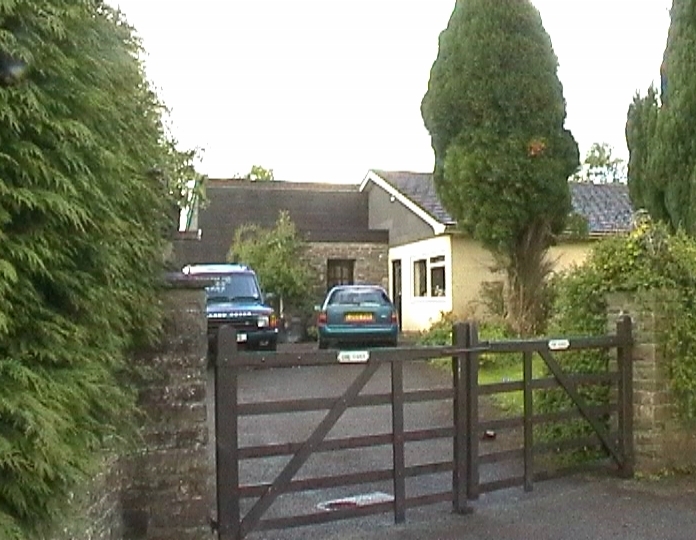
The census of 1921 shows Lewis Richard 32, living with him is his sister Frances Mabel Morgan who is 37 a widow, she is a music teacher, Frances has two daughters, Pearl and Mary residing with them.
Frances Mabel Bowen had married Horace Morgan a male nurse dispenser, they had lived in Ash cottage, a few steps away from Oak cottage. Frances died in March 1924, she left the sum of £80 to her brother Lewis Richard, daughter Pearl died a few years later in April 1927 aged 18 whilst living at Croesnypant, she was buried in Mamhilad churchyard. Lewis Richard Bowen having left Oak cottage died in January 1931, also being buried in Mamhilad churchyard.
In 1928 Richard Bracey and his wife Olive (nee Clements) from Bristol had taken occupation of Oak cottage, Richard and Olive had married at St George’s church Bristol on 21st December 1913. He was a pasty chef and along with other people had started a company called The tea-time dandies co. ltd., unfortunately the company was not successful and went into liquidation with Richard Bracey owing £900 and declaring himself bankrupt in 1929. He went to court in July 1930 to apply for discharge of the offence which would be granted in two months.
The electoral register of 1931 says Thomas and Temperance Coombes are in occupation followed by Stanley and Florence Lucy Williams in 1933.
In August 1936 and advert appeared in the Free Press for the sale of Oak cottage and 5 acres, anyone interested should apply to R. Rosser, Victoria Village, Garndiffaith. The advert says it has 6 large rooms with every convenience, a kitchen garden, ideal for pigs or poultry, convenient for buses and will be available in October.
The 1937 electoral register says Frederick and Evelyn Dando are residing at Oak cottage.
There are no electoral registers during the Second World War, the final occupier I can find is Ernest and Fanny Gregory in 1945.