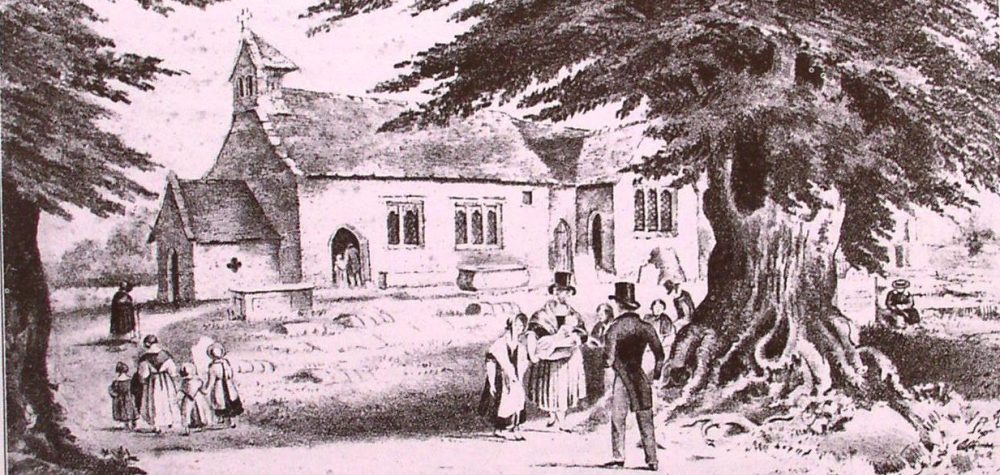
Lower Cae Coed
The earliest reference currently identified appears in the 1832 electoral register, where Walter David is recorded in connection with Cae Coed. By the time of the 1841 tithe survey, ownership was divided between Walter David and James Roberts. A valuation undertaken in August 1844 confirms that Walter David owned two cottages, known as Upper and Lower Cae Coed.
The 1841 census provides the first detailed glimpse of life at Lower Cae Coed. The occupier was James Roberts, a 48-year-old timber haulier, living with his wife Tammy Roberts, who had been born in Trevethin. Also in the household were their sons Thomas Roberts, William Roberts, and young John Roberts, together with six-year-old grandson John Cooke. The family reflects the importance of timber hauling and transport in the local economy during this period.
The Roberts family appears again in local court records. In March 1857, a case was heard against Thomas Watts of Ynyspwcca, accused of stealing £6 2s 0d from John Roberts of Goytrey, one of James Roberts’s sons. Such cases offer rare glimpses into the everyday challenges faced by working families in rural Monmouthshire.
James Roberts remained active in parish affairs and took part in local elections. In 1860 he voted for William Harris in the contest for Highways Assessor, although Harris was unsuccessful. Later life proved less fortunate. James died in the Pontypool Workhouse in 1877 and was buried at Trevethin. As was common practice, workhouse inmates who died there were usually buried in the parish associated with the institution rather than being returned to their home parish.
The occupants during the 1860s are uncertain, but by 1871 Lower Cae Coed was home to the Morris family. William Morris, originally from Kidderminster, lived there with his wife Martha, who was born in Pembroke, and their children. Their daughters Ann and Mary worked as a dressmakers while their son Morris was employed as a weaver, illustrating the variety of occupations found within rural households.
A further change of tenancy occurred by 1891 when Jonah Waters, an agricultural labourer born in Goytre, occupied the cottage. Living with him were his wife Elizabeth Waters, who came from Talgarth, and their daughter Catherine Waters, born in Abersychan.
The most enduring association in the twentieth century appears to have been with the Hanbury family. Alan Hanbury appears on the electoral roll in 1900 and was recorded in the 1901 census as living at Lower Cae Coed with his wife Rachel Hanbury. Both had been born in Goytre, giving the property a continuing connection with long-established local families.
By 1910 Alan Hanbury was recorded not only as occupier but also as owner. The property then had a gross value of £5 15s and a rateable value of £4 10s.
The 1911 census provides a final snapshot of family life at Lower Cae Coed. The cottage contained four rooms and was occupied by Alan and Rachel Hanbury, who had been married for seventeen years. Their three children, Irene Hanbury, Ivor Hanbury and Beatrice Hanbury, were all living at home.
Alan Hanbury is still at Lower Car Coed on the 1921 census, he is 47, born in Bryngwyn and working at Baldwins as a sheet worker, although he says he is out of work at present. Rachel his wife is now 51, born in Goytre.
Although just a cottage, Lower Cae Coed represents the history of ordinary working people in Goytre. From the Roberts timber-hauling family of the 1840s to the Hanburys of the early twentieth century, the cottage provides a valuable record of the labourers, craftsmen and local families whose lives formed the backbone of the parish community.