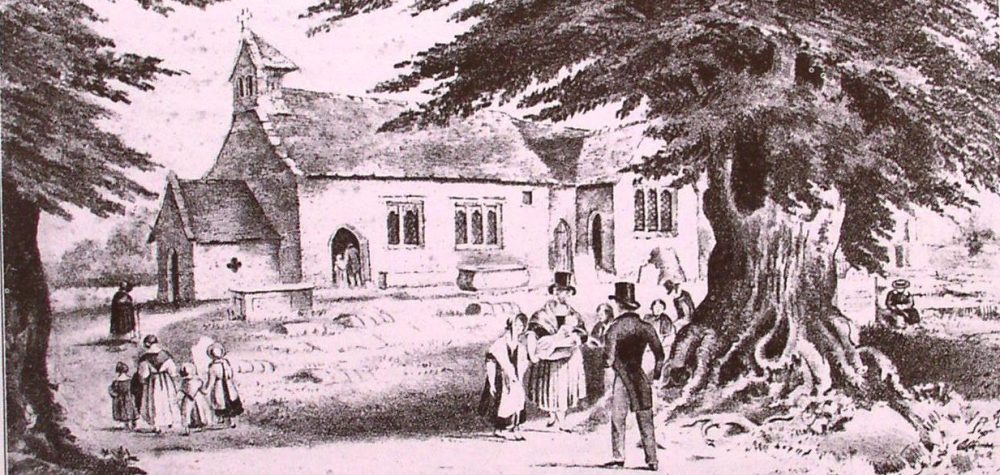
Gwenffrwd Factory
Gwenffrwd translates as the whole or clear stream.
A great deal has been written about Gwenffrwd and the woollen industry so I am just going to give a brief outline about the family.
There is a lease in 1840 from Benjamin Hall, Llanover Court, to Ann Harris to lease the land on which she built the dwelling house and Gwenffrwd Factory.
Samuel Franklin Harris, son of Ann, married by license on the 20th March 1845 to Miss James, the daughter of Thomas James, Goytre farmer, at The Independent Chapel, Castle Street, Abergavenny.
Lewis Edmund, the local builder wrote in his diary of January and February 1855 that he spent a great deal of time at Samuel Harris’s lathing the dairy, making mortar, plastering and whitening inside and out.
In 1865 Samuel Harris was the Secretary of the Welsh Flannel Trade Union, the chairman was Henry Anthony of Caerphilly, it is mentioned that Samuel Harris is holding the lease of a dwelling house, a woollen factory and pieces of land.
In 1879 Samuel Harris was in arrears, Turner, Lady Llanover’s agent, had written concerning the £300 mortgage on Gwenffrwd and that he was having difficulty getting money from Harris.
Following the letters of July and August 1879, Turner, Harris and Lyne (Lyne being Lady Llanover’s solicitor) went to Llewellin Solicitors in Newport. At the meeting Samuel Harris agreed to pay £300 to the Llanover Ancient Britons Club.
Samuel Franklyn Harris died in 1889 aged 73.
There is a mention in 1890 regarding the fact that Samuel Franklin Harris has land in Goytre and Llanover and the use of a stream with power to place a dam across.
By 1909, the factory was owned by Herbert of Llanover and operated by John Jones. A detailed letter written in November 1909 reveals a business struggling against both economic and structural difficulties. D. Watts, writing to Mrs Herbert after speaking with John Jones, reported that the tenant was finding it increasingly difficult to continue operating the factory under existing conditions.
According to Jones, the loss of the adjoining Pantglas land would make it impossible for him to continue. He believed he could claim compensation because of promises made when he took over the premises. More importantly, he argued that the factory itself required extensive renovation before it could operate properly. He estimated that restoring it to full working order would cost between £300 and £400, a considerable sum at the time.
The problems extended far beyond ordinary maintenance. Parts of the machinery had already become unusable because the building itself was unstable. Jones had previously received an allowance of £10 per year in compensation for this loss, but further breakdowns had occurred for which no compensation had been paid. As a result, he was regularly forced to refuse orders because the machinery could not produce enough cloth to meet demand. He believed that if the factory were fully operational he could employ additional weavers and increase production significantly.
Jones also complained that earlier alterations carried out under E. Plummer Davies had damaged the factory’s layout and reduced its efficiency. The factory’s water supply, vital for powering machinery, was another serious concern. The watercourse had fallen into disrepair, leaving insufficient water during summer months and preventing regular operation. Jones urged Mrs Herbert to send an inspector to assess the property’s condition, noting that the windows, ovens and gates all required attention.
Despite these difficulties, Jones defended his management of the factory and argued that he had operated it as successfully as any comparable factory in the region. However, he also pointed to a wider crisis within the Welsh woollen industry. Within the previous decade, factories at Pontsenny, Defynnog, Llangattock, Clydach, Gilwern and Llangynidr had all ceased production, while Abercarn Factory was also believed to be Gwenffrwd was sold by Samuel’s children, Franklin James Harris in agreement with William Ivor and Mary Franklin Harris, to Lady Llanover for £894.
There is, at Gwent Archives an Inventory book for Gwenffrwd, the first Inventory taken on the 4th July 1890, where the value of goods is given as £90 0s 4d. The second dated 1894 where the value of goods and machinery amount to £168 3s 0d.