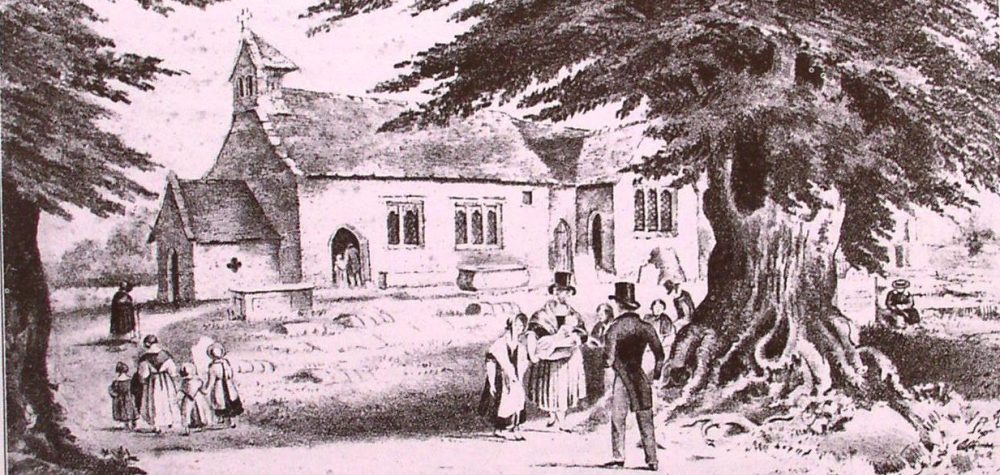

Recorded as holding number 402 on the 1841 tithe map and containing just 31 perches, the Old Cider Mill was a small but long-established property in Goytre. Although little survives concerning its original operation as a cider mill, parish records and census returns allow its history to be traced from the eighteenth century through to the twentieth.
The property belonged to the Earl of Abergavenny and was held under lease by Thomas Jenkins in 1757. Thomas was an important figure within the parish, serving both as Constable and Overseer of the Poor. He remained associated with the property until his death in 1778, when he was buried at St Peter’s Church.
After this early reference, the documentary trail falls largely silent until the 1841 Tithe Survey, when Thomas Jones was recorded as occupier and paid one shilling tithe to the rector. The 1841 census shows Thomas, a 45-year-old farmer, living at the Old Cider Mill with his wife Jones and their children Ann, Susanna, Thomas, Eliza, Sarah, Caroline and Robert.
The family remained there for at least another decade. By 1851 Thomas was described as a sixty-year-old labourer born in Clytha, while Eliza came from Bettws Newydd. Most of the children had already left home, leaving only Sarah and Robert living with their parents.
Thomas Jones died sometime before 1859, although his burial has not yet been identified. His widow appears to have experienced financial hardship, as parish records show that “Mrs Jones” of the Old Cider Mill received charitable assistance from the parish on several occasions during 1860 and 1861. Eliza later moved to Rhydlofan to live with her married daughter.
A new family arrived in 1861. George Coles, a 67-year-old labourer originally from Somerset, occupied the cottage with his wife Susanna Coles, daughter of Thomas and Eliza Jones. In a sense, the property remained within the extended family, as Susanna had grown up at the Old Cider Mill, Susanna is 42 their children are George 8, Thomas 4 who were born in Trevethin.
During the 1870s the cottage became home to John Steel, a railway porter from Herefordshire, and his wife Hannah Steel. When the lease records were updated in 1880, Richard Hewlett held the lease, previously held by Thomas Jones, but the property continued to be occupied by John Steel as a sub-tenant.
John Steel died in the autumn of 1885 aged eighty. Hannah remained at the cottage, appearing in the 1891 census with a lodger, William Lindsay, an agricultural labourer born in Goytre. By 1901 she was still living there alone at the age of seventy-seven. Beyond this point, little more has been discovered about her life.
The tithe update of 1880 says Richard Hewlett now holds the lease, previously held by Thomas Jones.
Although he had the lease he was subletting to John Steel, who is still residing at Old Cider Mill on the 1881 census.
The property reappears in the records in 1911 when it was occupied by David Jones, a railway platelayer from Cwmyoy, and his wife Clara Jones from Llantilio Crossenny.
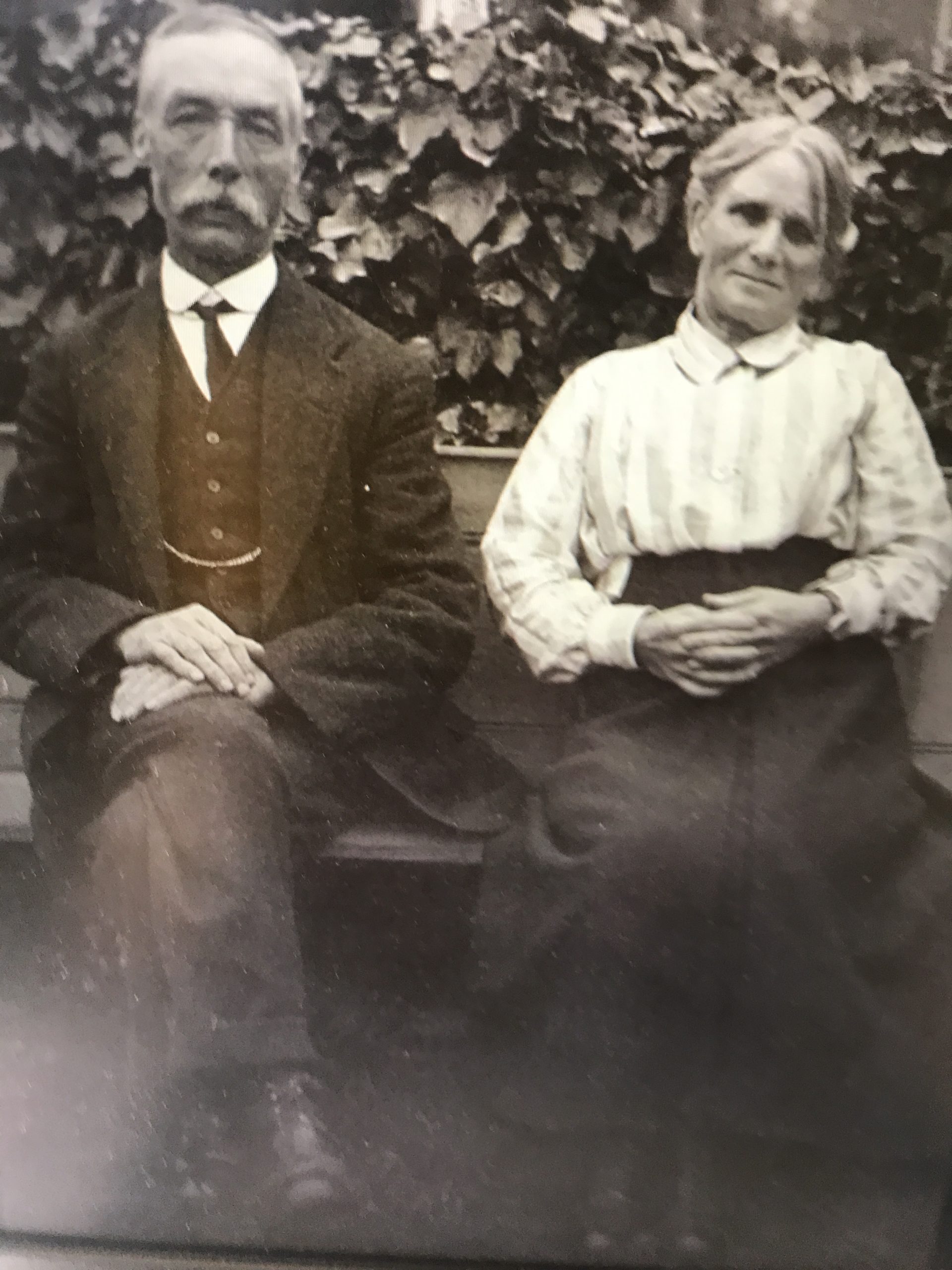
David and Clara Jones.
Married for twenty-eight years, they had raised fourteen children, nine of whom had survived. Three children were still living at home.
A major change occurred in 1920 when the Earl of Abergavenny sold his estate holdings. The Old Cider Mill, offered as Lot 11, included 3 acres, 2 roods and 29 perches of land. David Jones remained the tenant, paying an annual rent of £14. At auction the property was purchased by John Ball for £330. [
The Ball family soon became associated with the property. One of the most poignant episodes in its history occurred in 1927 when James Ball, a milk vendor living at the Cider Mill, suffered what was believed to be a heart attack while out with his horse and cart near Goytre Hall. He was discovered in great distress and died a few days later.
By 1930, Doris Irene Ball was recorded on the electoral register at the Cider Mill. The following year she married Jones, and the couple remained at the property. Their daughter, Jones, was born there and baptised on 25 February 1931. [
After this period the documentary record becomes uncertain. No occupants are listed in the 1939 Register or in the electoral registers of 1945 and 1946, although references survive to families living at a property known simply as “The Mill.” It has not yet been confirmed.