“I have investigated the above complaint as taking evidence and the foregoing does very accurately represent one of the statements made…”
A clear date appears:
26th July 1829
Several signatures follow.
One section appears to read:
“(Signed) Hugh Tytler”
“Acting Superintendent”
Lower down another endorsement appears:
“… examined this 26th January 1831”
and references:
Henry Charles Bird
with additional official signatures.
This suggests the document predates the plantation agreements and may relate to Bird’s acquisition, title, or administrative claim.
This page seems to be a narrative memorandum concerning land, cultivation, and possibly title disputes.
Among the more legible fragments:
“… in the year 1828 …”
“… application …”
“… cultivation …”
“… land …”
“… cleared …”
“… acres …”
“… coffee …”
There are repeated references to acreage and expenditure.
The overall character is that of a justification or historical statement explaining how land had been occupied, improved, or cultivated.
Survey
of a tract of land belonging to
Lieut. Henry Bird and 2nd Lieut. Charles Augustus Cobbe, both of the Ceylon Rifle Regiment
situate in the district of Oodapalata within the Central Province
…
Containing 150 Acres
Surveyed 14th July 1830
by G.W. Van Houten, Surveyor
Boundaries shown
The land is bounded by:
- Gallalaye/Hathalaye Illé (river or stream name, spelling uncertain)
- Lunapo Kandura (stream)
- Flood Hill Bond (or similarly written boundary)
- Property of another owner on the western side
The plan contains contouring or elevation markings, with heights marked:
- 200
- 300
- 400
- 500
- 700
- 900
- 1000
- 1200 feet
This suggests a surveyed upland coffee property in the Kandyan region.
DSCN2085 – Same Survey Plan (reverse orientation)
This second photograph confirms the reading.
The title is clearer as:
Survey
of a tract of land belonging to
Lieut. Henry Bird and 2nd Lieut. Charles Augustus Cobbe
both of the
Ceylon Rifle Regiment
situate in the district of
Oodapalata
within the
Central Province
Containing 150 Acres
Surveyed 14th July 1830
by G.W. Van Houten
This is likely the survey referenced in the 1831 partnership agreement.
DSCN2086 – Execution and Witnessing Page
This is the most important legal page so far.
Main heading
The centre section states:
Memorandum of Agreement
and references:
Henry Charles Bird
and
Charles Augustus Cobbe
The date appears to be:
4th August 1831
(or very close to that date)
Left witness panel
I can read portions as:
Signed and delivered by the within named
Henry Charles Bird
in the presence of …
followed by signatures and a seal.
Centre panel
Contains additional witnessing and registration signatures.
Right panel
Appears to read:
Memorandum of Agreement made on the 4th August 1831
between Henry Charles Bird and Charles Augustus Cobbe
followed by:
Signed sealed and delivered…
with further witness signatures and an impressed wax seal.
Historical reconstruction
With these latest pages the sequence now becomes much clearer:
1830
Survey created for:
- Lieut. Henry Bird
- Lieut. Charles Augustus Cobbe
- Ceylon Rifle Regiment
Property:
- Oodapalata District
- Central Province
- 150 acres
Surveyor:
- G.W. Van Houten
1831
Formal agreement executed between:
- Henry Charles Bird
- Charles Augustus Cobbe
regarding development of the surveyed land as a coffee plantation.
1835
Estate accounts:
- Labour costs
- Coffee yields
- Sale of cattle
- Sale of elephants
- Cash receipts and expenditures
1836-1837
Lengthy management correspondence concerning:
- Gampola estate
- Mortgage obligations
- Sir Edward Barnes
- Turnour family interests
- Coffee marketing
- Estate debt
- Plantation recovery efforts
April 1837
Estate assessed as:
potentially highly profitable if another season succeeds,
but otherwise likely to be sold.
Genealogical note
The names appearing repeatedly throughout the collection are now firmly established as:
- Lieutenant Henry Charles Bird
- Charles Augustus Cobbe
- Sir Edward Barnes
- Turnour
- Major Braybrooke
- Boyd
. of young plants which will come into
bearing next year if kept properly
cleaned & 50 acres more where the roads
are perfect but the trees are in very bad
order.
The rest of the plantation consists
of jungle in other fields under the trees
but they will never be worth anything
more than to pick the coffee that comes
on them.
I have very little doubt that
if we get over this year well the Estate
will eventually be a very profitable
one. If we do not the Estate will very
likely be sold.
Dated April 28th 1837
This dating is particularly important because it places the conclusion about a year later than many of the preceding entries.
Interpretation
The writer’s final assessment can be summarized as follows:
Positive factors
- Young coffee trees are approaching productive age.
- Approximately 50 additional acres are being prepared.
- Roads and infrastructure appear to be in good condition.
- The author believes the estate could become highly profitable.
Negative factors
- Many older trees are in poor condition.
- Significant portions of the estate have reverted to jungle.
- Some areas are considered beyond economic recovery except for occasional harvesting.
- The estate remains financially vulnerable.
Key concluding statement
The most significant sentence is:
“If we get over this year well the Estate will eventually be a very profitable one. If we do not the Estate will very likely be sold.”
That line neatly captures the precarious condition of many early Ceylon coffee ventures during the 1830s.
DSCN2079
This appears to be only the marbled paper cover of the notebook or wrapper. No readable text is visible.
DSCN2080
This page continues the historical narrative found in the “Lewis’s Account” section.
Some clearer passages include:
… Uncle continued here doing as he could for some time until at last he gave it up …
Major Braybrooke does not I may think that any dishonesty can be charged to Uncle …
… there certainly must have been great faults on both sides …
… Henry came out then Mr Turnour said he would not advance money on Sir Edward’s account …
On the opposite page:
Providentially there was a good crop that year.
If there had not been the estate would have been sold.
Henry set about cleaning & manuring the best part of the property …
… Mr Turnour refuses to advance more than £300 …
… the debt to Sir E.B. at the end of the year …
… I trust that the present crop will enable us to pay …
… there is a great deal of coffee on the trees …
… about 50 acres which Henry manured and has replanted between the rows of the old trees …
Overall significance of the manuscript
From all the pages you’ve shared, the notebook appears to contain:
- Financial accounts (1835)
- Receipts and expenditures.
- Coffee crop revenues.
- Sales of cattle and elephants.
- Bond debt accounts.
- Estate correspondence (1836-1837)
- Detailed letters about the management of Gampola Estate.
- Discussions of mortgages, debt, and coffee sales in England.
- Agricultural observations
- Importance of shade trees.
- Effects of deforestation.
- Manuring and cleaning practices.
- Crop estimates and yields.
- Estate history
- Problems following the death of an earlier proprietor.
- Falling coffee prices.
- Management disputes.
- Attempts to rescue the estate financially.
- Final conclusion (April 1837)
- The estate remained viable but was at a turning point.
- Success depended on the upcoming crop and continued investment.
- Failure would likely force a sale of the property.
Taken together, these pages form a remarkably detailed firsthand account of an early Ceylon coffee plantation during the coffee boom of the 1830s, combining financial records, agricultural practice, and estate management in a single surviving manuscript.
… took him and Sir Wm
wrote for it however.
How or what became of it
only he can point out
in some liabilities.
Main account
“Sum paid to Mr Turnour’s estate on account of Bond Debt”
| Year | Description | Amount |
| 1831 | By Mr Bird from balance in Guardian | £143 4s 2d |
| 1832 | Interest from coffee crop from Gampola | £194 11s 4d |
| 1833 | By ditto from same | £288 1s 1½d |
Total: appears to be approximately £625 2s 6½d
The figures are reasonably clear, although I would want a higher-resolution image before certifying the amounts.
DSCN2076
This page begins:
Lewis’ Account
The writer appears to be describing how Lewis became manager after another person’s death.
Readable sections
I have had the management of the Estate
since … with a salary of £4 10s a month.
What I have been able to gather with
respect to the Estate is this:
On my father’s death the property seems to
have been in a flourishing condition…
Further down:
… the crop of that year sold at a low price…
… upwards of 100 men…
… he would not sell the coffee because the price was so low…
And later:
… the consequence was that fine grass grew and choked the trees…
… the coffee that was in the store was spoiled…
Interpretation
This is an important narrative passage. The writer is looking back historically and explaining:
- The estate was prosperous when inherited.
- Coffee prices then fell sharply.
- Large labour costs continued.
- Coffee was withheld from market because prices were poor.
- Maintenance suffered.
- Grass and weeds overtook parts of the plantation.
- Stored coffee deteriorated.
This reads almost like an explanation of how the estate’s financial troubles began.
DSCN2077
This is the continuation of the same account.
Left page
Among the clearer passages:
… economy before rule…
… assistance to Perry and Lewis as they needed.
Last year I may not be on the spot but by that time I trust Lewis will have gained so much experience of the concern as to render my supervision less necessary.
The great advantage is to know Singalese…
… and be able to write the language.
I would have accepted a situation of Assistant Engineer which would give me an addition of 4/6 or 3/- per day, but I will not let go Gampola till every debt is paid…
This is one of the clearest personal statements in the manuscript.
Right page
The writer continues:
… every debt is paid.
Lewis is not in any way my servant.
I again entreat that you will use every means in your power to send him here…
… he has a brother who will then be abroad with him…
… I have a comfortable home for him.
I do not apply for him because for his passage from the estate, but if it can be procured I will be answerable for it.
I engage that if he paid with regular attention…
… it would double …
The last portion becomes difficult to read, but the general sense is that the author is strongly recommending Lewis, wants him sent out, and is personally willing to support or sponsor him.
. after all the trouble
and anxiety I have had
to get the coffee down in time
that it cannot go and that
he does not know when to
put it. He gives me no expla-
nation so that I do not know
the reason why it cannot.
He puts on Boyd and the Teign-
mouth, as it must be in full time
with respect to the consignment.
Some people think he ought to send
the coffee to Mr Barnes and
that Mr Turnour should still
provide funds for the operation
of the estate and in that
case the money having been
lent in Ceylon it will be at
Sir Edward’s option to change
the difference of the rate of…
Right page
… exchange to the estate when
Mr Bolton sells the coffee
in England.
My brother is bound to make all con-
signments to Major Boyd
while he owes any debt to
that house and it has hitherto
been done.
… that debt is actually to the
house. I am sure should
not mind waiting a short
time longer as he has
9 per cent interest to Sir E.B.
whereas our debt is only at
five per cent and Turnour
would not be justified in
not complying with Sir E.B.’s
instructions…
… next year if we have a blossom
crop it will be entirely cleared
off…
Interpretation
The writer is discussing:
- How and where the coffee crop should be consigned and sold.
- Debt owed to a commercial house connected with Major Boyd.
- A dispute about whether proceeds should be directed to Sir Edward Barnes.
- Different interest rates (9% versus about 5%).
- Hope that another good crop could clear the remaining debt.
DSCN2073
Left page
This page is particularly interesting because it discusses the cultivation of coffee under shade trees.
I hope I have given you a
clear idea of the present state
of the concern.
I wish you to understand the cause
of failure which is the want
of forest trees…
… the ground requires constant clearing
and manuring, which
under the shade from the
constant falling of leaves
keeps it moist, manures it and
prevents the grass from
growing.
This is a remarkably early observation about shade-grown coffee and soil management.
Right page
… there being
the necessity of all this,
and that I would now write
it as the whole matter is essential for here
and abroad on the property.
If properly attended to
I hope you will be able to make him see
the manifest advantage it
will be of to all concerned…
…
100 now is worth as much to Gampola
as 500 will be in a few years.
Interpretation
The writer argues that:
- The estate’s past problems stem largely from clearing too much original forest.
- Shade trees improve moisture retention and fertility.
- Proper investment now will create much greater future value.
DSCN2074
Left page
The state of affairs is so favourable
that while the property looks
as well as under all circum-
stances as it does, your money
is perfectly safe.
There is now no doubt but that
together they will manage
the concern…
…
Mr Turnour has been advising me not
to spend too much money
on the present plantation
as it will be better at once
to clear and plant the forest…
Right page
… ground which will pay
much better and be under
cultivation.
A further great consideration is
the comparative freedom of
this end of the advantage to
the colony.
…
then there will be no difficulty
in effecting being myself
Government Agent
…
while the old plantation is
made the means of clearing
itself and bringing in the
new one, which in three years
would bring in a comfortable
income and be some recompense
for the disappointment
Gampola has occasioned.
Feby 22nd
I have just received
a letter from Braybrooke…
Historical significance of these pages
Taken together, the pages reveal several themes:
- Financial restructuring
Ongoing attempts to use coffee proceeds to pay mortgages and debts. - Colonial coffee commerce
Discussions of consignments, shipping, commissions, exchange rates, and sale of coffee in England. - Agricultural insight
Repeated emphasis on the importance of forest shade, leaf litter, and soil conditions for coffee production. This is striking because later coffee failures in Ceylon were often linked to poor cultivation practices and environmental degradation. - Estate transition strategy
The writer increasingly advocates developing new forest land while using the existing plantation to finance expansion. - Named individuals
- Sir Edward Barnes
- William Turnour / Turnour family
- Major Boyd
- Braybrooke
- Bolton
- Bird (estate manager)
- Gampola estate
These pages are turning into a coherent letter or memorandum on the management and finances of a Ceylon coffee estate in early 1836. With the pages you’ve provided so far, it’s possible to reconstruct much of the estate’s business history and the author’s views on coffee cultivation.
.. of 1836 for which my lands
are upon my arrival, I say
considering all this that
there is fully £40 to be taken
from the proceeds. The crop
of 1835 is coffee [?]. This is
much upon the whole as done,
for one year’s return towards
liquidation of the debts, after
deducting freight the whole will
be paid off if Sir Edward Barnes
in Turner’s drawing against
it now at 5 or 6[?] the remainder
paid to Sir Edward in England.
The true object of this is that
as the money was drawn here
it is surely it should be paid
here as bills are selling at a
discount of 4 per cent but
Burnbrooks can draw under
some arrangement he has
made with C. Hamilton.
. at your wish which now will do
and pay the cash to Turner so
what they lose one way we gain
another by diminishing the
capital at once and setting
the interest. It is of great object
to Sir Edward to be paid the
money here and it is just
that it should be done however.
There is no shade. The tree gradually
die off, which 300 acres but after
4 years have done the 100 acres
which are now productive with
attention may be made to
pay off the debts with a little
help from a fresh plantation,
which coming into full bearing
in 4 years will then yield a
recompense for all the expense,
the trouble and anxiety Sampayo
has caused us. I am going to
commence clearing and planting…
DSCN2070 (left page)
… as soon as I am under the preli-
minary arrangements
I do not intend to neglect the
present trees but get as much
out of them as possible,
but it is quite clear that
wherever there is want of shade
the trees will only yield a
crop for two or three years.
This has been proved over & over
again.
February 25
I am just returned from Gampola.
The last rain has improved
the appearance of the trees very
much and thrown many of
them out in full blossom, being
exactly resembling a field of snow
especially where I have manured;
the leaves are assuming a healthy
green. I do not think the crop will
be so good as the last but it is yet
impossible to form a fair judgement.
Right page
Turner in a letter from J.C.B.
has desired to foreclose the bonds
and bring the estate to a sale.
Under the impression that the
property was entirely neglected,
knowing my branch had often
missed it, and he adds by
which having been to visit the
family of Col. Bird and Mrs Bird
and found them living apparently
in consequence induced by return,
Gampola in their hands, but
if the contrary, you had better
secure the mortgage by selling
it.
Sir Wm. [William] Turnour has both
lent and retained doing
under the present favourable aspect
of affairs, in answer to Sir Edward
they say young Bird has the
management of the estate and
while he performs the material
part of it badly in his own way, still
a great deal is done though many…
This page is difficult, but the reference to young Bird managing the estate is fairly clear.
DSCN2071 (coffee crop calculations)
Left page
This page contains crop estimates.
Good ordinary 10 bags
each 6 parrahs equal
to 40 parrahs each
bag weighing 140 lbs
equal to 5600 lbs roasted
Thus No. 1
Gampola Coffee
Crop 2 1835
First sort three bags
each 4 parrahs equal
to 12 parrahs each
bag weighing 125 lbs
equal 375 lbs roasted
Thus No. 2
Gampola Coffee
Crop 3 1835
So that the whole quantity
of coffee amounts to
52 bags of 6 parrahs
in each bag weighing
23,548½ lbs of coffee.
(The final figure is reasonably legible though not completely certain.)
Right page
22½ lbs. Their being totally
calculated at 88 so that
the crop may be estimated
to be worth at least £800.
Prospects say are more
than 60 per cent but
should coffee crop in
the safe side believe
certainly is not a
certainty, but the
stem is something
good in the way of
clearing away the
load that has been our
greatest particular
consideration.
Considering that
the money actually
advanced … is
not less incurred on the
crop up to January last,
including that for cleaning
& partly picking the coffee…
Expenditure for 1835
- Pay lists for January and February
- Coffee pickers for December
- April pay list
- May, June
- August & July
- Picking 964 pounds
- September pay list for picking
- Picking 699 lbs coffee
- October pay list
- Tools & other work
- Blacksmiths
- Cart duty etc.
- Sale of elephants
- Picking of 836 pounds of coffee
- Purchase of 2 carts
- Pay list for October
- Cash in hand
Total: approximately £220 3s 0d
Opposite page
Extract of letter from Ceylon with an account of … 24th June 1835
Readable portions:
Land in bearing 45 acres
Plantation 24 years old 50 …
Cleared and fenced round, partly planted with cinnamon
150 acres forest ground
300 acres waste lands
The money to be spent monthly ought to be £50 to do it justice
Further down:
Receipts and expenditure during the year up to the end of October
Receipts include:
- Cash from Turnour
- April
- July sale of cattle
- August cash from Turnour
- September
- October sale of cattle
- Sale of two elephants
- … sale of cattle
Total: about £220
Dated 20 February 1836
This page is much clearer and appears to be a letter discussing a shipment of coffee.
Partial transcription:
February 20, 1836.
Shipped the coffee off yesterday afternoon from Tangalle in Howard’s, and am now putting Dogi’s work in a letter. It will, as far as marketing of it in London goes, disappoint expectations, nor do I sincerely hope it will be in time, for not one shall lose an advantage by being the first plantation coffee in the market…
… Your brother has sent you from Ceylon by this a general sample of fine coffee …
Right-hand page of the letter
The most legible section reads:
… beautiful specimen and ought to fetch the very highest price in the market. I have received my statement of the quantity, and although not what it is very great, it arrived as we can expect from the production.
Part of the plantation, as they comprise a very small portion of what was originally planted, there are 7 fields but 159 bags each …
… weighing 157½ lbs equal to 21,873½ lbs …
At the bottom:
Sample coffee crop of 1835.
Third image
The loose label appears to read:
Ceylon Paper
and a smaller slip marked:
T 215
… took him and Sir Wm
wrote for it however.
How or what became of it
only he can point out
in some liabilities.
Main account
“Sum paid to Mr Turnour’s estate on account of Bond Debt”
| Year | Description | Amount |
| 1831 | By Mr Bird from balance in Guardian | £143 4s 2d |
| 1832 | Interest from coffee crop from Gampola | £194 11s 4d |
| 1833 | By ditto from same | £288 1s 1½d |
Total: appears to be approximately £625 2s 6½d
The figures are reasonably clear, although I would want a higher-resolution image before certifying the amounts.
DSCN2076
This page begins:
Lewis’ Account
The writer appears to be describing how Lewis became manager after another person’s death.
Readable sections
I have had the management of the Estate
since … with a salary of £4 10s a month.
What I have been able to gather with
respect to the Estate is this:
On my father’s death the property seems to
have been in a flourishing condition…
Further down:
… the crop of that year sold at a low price…
… upwards of 100 men…
… he would not sell the coffee because the price was so low…
And later:
… the consequence was that fine grass grew and choked the trees…
… the coffee that was in the store was spoiled…
Interpretation
This is an important narrative passage. The writer is looking back historically and explaining:
- The estate was prosperous when inherited.
- Coffee prices then fell sharply.
- Large labour costs continued.
- Coffee was withheld from market because prices were poor.
- Maintenance suffered.
- Grass and weeds overtook parts of the plantation.
- Stored coffee deteriorated.
This reads almost like an explanation of how the estate’s financial troubles began.
DSCN2077
This is the continuation of the same account.
Left page
Among the clearer passages:
… economy before rule…
… assistance to Perry and Lewis as they needed.
Last year I may not be on the spot but by that time I trust Lewis will have gained so much experience of the concern as to render my supervision less necessary.
The great advantage is to know Singalese…
… and be able to write the language.
I would have accepted a situation of Assistant Engineer which would give me an addition of 4/6 or 3/- per day, but I will not let go Gampola till every debt is paid…
This is one of the clearest personal statements in the manuscript.
Right page
The writer continues:
… every debt is paid.
Lewis is not in any way my servant.
I again entreat that you will use every means in your power to send him here…
… he has a brother who will then be abroad with him…
… I have a comfortable home for him.
I do not apply for him because for his passage from the estate, but if it can be procured I will be answerable for it.
I engage that if he paid with regular attention…
… it would double …
The last portion becomes difficult to read, but the general sense is that the author is strongly recommending Lewis, wants him sent out, and is personally willing to support or sponsor him.
The manuscript now provides a fairly complete picture of the estate’s history:
Estate finances
- Bond debt owed to the Turnour estate.
- Income from successive coffee crops used to service debt.
- Ongoing concern with mortgages and interest payments.
Estate decline
- Coffee prices fell.
- Coffee was retained rather than sold.
- Estate maintenance suffered.
- Grass and weeds overtook parts of the plantation.
- Stored coffee deteriorated.
Management
- Lewis appears to have served as manager or assistant manager.
- The writer has direct supervisory responsibility.
- Knowledge of Sinhala (“Singalese”) is considered a major advantage for estate management.
Personal tone
The narrative is now less like an account book and more like a long explanatory letter defending management decisions and outlining a recovery plan for the Gampola coffee plantation.
Of all the pages you’ve shared, the “Lewis’ Account” section may be one of the most valuable historically because it explains why the estate got into difficulty, rather than merely recording the finances.
No. 04
Articles of Agreement made at Kandy in the Island of Ceylon on the fourteenth day of May in the year of our Lord one thousand eight hundred and thirty one…
The parties appear to be:
Lieutenant Henry Charles Bird
and
Charles Augustus Boyd, coffee planter of Ceylon.
Subject of the agreement
The document concerns coffee land situated at:
Pussellawa (spelled similarly to Pussellawa/Pussellawa district)
and refers to land granted by government on:
22 August 1830
Acreage
The agreement refers to:
262 acres, 1 rood and 2½ perches (best reading)
and later:
150 acres
of adjoining land.
Nature of the arrangement
The document establishes a partnership or joint undertaking whereby:
- Bird contributes land.
- Boyd undertakes to admit Bird into a coffee planting enterprise.
- The land is to be jointly cultivated as a coffee plantation.
- Profits and produce are to be shared.
- Costs of preparing, planting, cultivating, and improving the land are to be borne according to agreed terms.
Important names recovered
From this page alone we can identify:
- Lieutenant Henry Charles Bird
- Charles Augustus Boyd
- Kandy
- Pussellawa
- Date: 14 May 1831
- Government grant dated 22 August 1830
A coffee estate in Oodapalata (Central Province, Ceylon), associated with the surveyed tract of:
150 acres
surveyed on:
14 July 1830
for:
- Henry Charles Bird
- Charles Augustus Cobbe
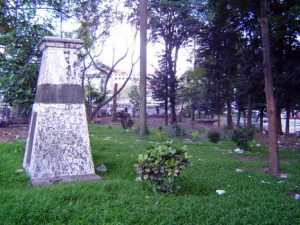 A completely stripped monument to Henry Byrde (1837-1907).