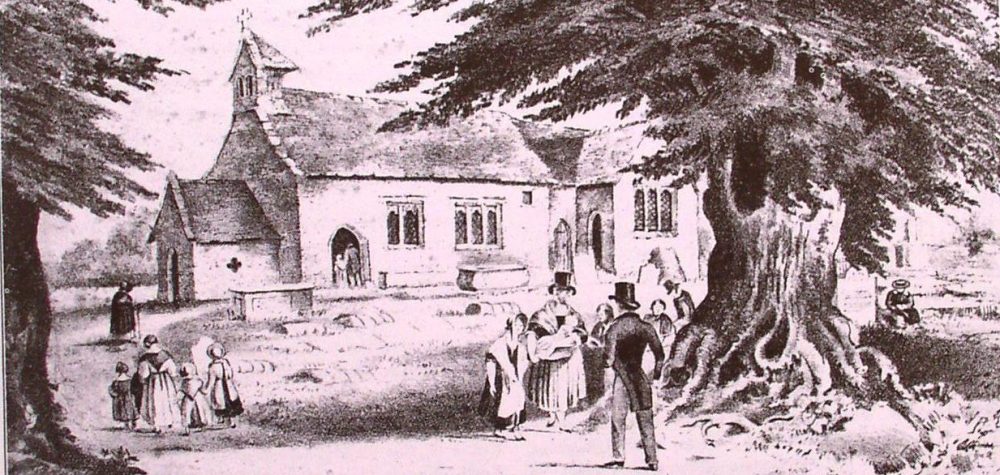
CHAPEL ED, GOETRE.
BY MR. ABRAHAM MORRIS F.R..HIST.S., NEWPORT.
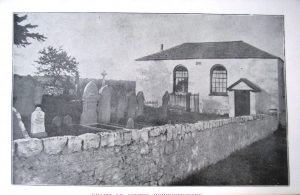
CHAPEL ED, GOETRE.
Chapel Ed was erected in 1807 by the followers of Howell Harris and his Methodist movement. Another chapel was erected at Llanmartin in 1794, and there the Societies of the Ford, the North Row Farm, Redwick, and the Chapel farm, Penhow, foregathered to worship God until the erection of the present Chapel. Chapel Ed was not erected until 1807, and the Cause has been carried on, on the same site without a break to the present day, first as a Welsh Cause until the late Seventies of the last Century but since that time as an English Cause.
Perhaps the name may be a puzzle to many of our readers, but it has the stamp and authority of Holy Writ upon it, and shows the respect and thoughtfulness which the old fathers had for the sanction of Scripture in all they did. “and the children of Reuben and the Children of God called the altar Ed; for it shall be a witness between us that the Lord is God” (Joshua xxii., 34). This little sanctuary has most certainly verified its name through all the generations. It has been an “Ed”—a witness, to the protecting care of the Divine for His people, notwithstanding changes and great difficulties, which threatened extinction. It has been at times, especially in the transition period from Welsh to English, “a bruised reed,” but has never been broken, and “a smoking flax,” but not “quenched.”
As a Connexion we have had another Chapel Ed in our annals, one of an earlier foundation as a structure than that of Goetre, and which takes us back to the time when we lost Groeswen and the New Inn (Pontypool) as Methodist causes, because of the opposition of the Leaders of that time, to ordain ministers to pastoral care of Churches. In the closing years of the Eighteenth Century the church at Groeswen was under the spiritual care of William Edwards, the famous bridge-builder, who was a recognised exhorter of the Methodists. While he was its overseer the Church was more Methodistical than Independent, and as in the case of Morgan John Lewis of New Inn, application was made to the Association that Edwards should be ordained to the full work of the ministry. But it was peremptorily refused in consequence of the old fathers’ diffidence to separate themselves from the Established Church. It is a well-known fact that during the oversight of Groeswen by William Edwards, the preachers of our Connexion occupied that famous pulpit as frequently and with equal regularity as did the preachers of the Independents. When William Edwards died Groeswen Church was for a considerable time without a pastor, until Griffith Hughes of Crugybar, an eloquent and powerful preacher was asked to become the pastor.
The Methodists Section of the Church saw that the fraternity was becoming more and more Independent, so they deemed it advisable to sever their connection with Groeswen and it’s Methodist associations. They erected a Chapel in the parish of Bedwas, and called it “Chapel Ed.” But the cause was in no wise a success, and indeed it was not likely to thrive as long as such an eloquent and popular preacher as Griffith Hughes held sway at Groeswen, not far distant. The Cause at Chapel Ed, Bedwas, was therefore discontinued and a move was made to Ystrad Mynach, on the Glamorgan side the Rhymni River, and there the work has continued to this day. The old ruins of this Chapel Ed are still in existence.
From the Trevecca MSS we learn that Howel Harris frequently visited Goetre before the differences arose between him and Daniel Rowland, and that the cause here was under the care of Morgan Jones, who with Morgan John Lewis of the New Inn, in close proximity, had the oversight of the Societies in Monmouthshire. In Morgan Jones’s report of the Goetre Society to the Association, he records as follows in 1743 :—
“They are thirteen members with one overseer who is a very faithful Xtian. There are only two brethren members in the Church and these are married. There are others who I believe are Christians, but have not yet joined the Society. The members have experienced a fair share of religious freedom, and an indication that they have been justified by grace, some more, some less . . . . They manifest great openness to one another, and to Stephen Jones, the private exhorter. I feel sure that the Lord has blessed my labours among them.”
There is also report on the Glascoed Society of nine members, not far distant from Goetre, which was also under the care of Stephen Jones. There is no Methodist cause at Glascoed now.
On September 19th, 1744, Howel Harris and his wife visited Goetre, and preached there on a Monday night. He was on his way to Watford Association.
Upon one of his visits here, at a Church Meeting held in April, 1747, he admonished the members for their negligence. His Diary records :—
“I showed them what lethargy possessed them, that they came not to the New Inn, to the public meetings. By such conduct they hampered the great work. They were, too, guilty of absenting themselves from the services of the Parish Church, and the Holy Communion, that they weakened his hands, and if they did not reform, he would not come among them again. Then I spoke of the Blood and its efficacy, and the Spirit was poured out upon us, and we were refreshed.”
Early in January, 1748, Harris stayed a night at Goetre, while he was on his way to the West of England. On the second day of the New Year he preached at the New inn, and it appears pretty certain, though there is no record, that the members of the flock at Goetre were there in goodly numbers, after the gentle reprimand administered to them on the previous occasion. The reason for his visit to the New Inn this time was an important Monthly Meeting, held to restore William Edwards of Groeswen, who had been prevented from preaching for a time on account of heterodoxy in doctrine. Howel Harris put only two questions to the defaulting exhorter. The first was
:—“Could he sincerely worship the Child Jesus?” And the second was :—“Did he believe that the spiritual revelation of Christ was obtainable in other way than by the written and inspired words of the Bible?” Edwards answered the questions to the entire satisfaction of Harris, and he was restored to his place as an Exhorter.
Harris came at all times to Goetre. It is recorded that on 24th of January 1749, he came from Trevecca intending to proceed to Gloucester to meet George Whitefield. He reached Goetre at 3.0 a.m., having travelled all night. “I reached here at three in the morning” says he, “and rested in my clothes for two hours; it was necessary to go on to meet Mr. Whitefield at Gloucester, as the work of the Master called for haste and determination.”
On 31st of January, 1750, a Quarterly Association was held at the New Inn, where Howel Harris, Howell Davis and Daniel Rowland were in attendance. The Association was opened by sermon from Daniel Rowland, which in its doctrine did not please Harris. He seemed to think that Rowland had been caught by the influence of John Wesley in regard to “perfection.” Harris has placed upon record in his “Diaries” some critical comments upon the sermon, and it seems that the two men parted company on this occasion without coming to an agreement.
In the following June, Harris was again in the neighbourhood, and at New Inn, Morgan John Lewis and David Williams of Groeswen attack him great vigour, concerning some of his religious opinions. He, however, closed this visit at Goetre, and there writes in his “Diary” :—
“I learnt that a combined attack upon me concerning the doctrine of the Blood, was intended. I knew nothing of it until I came here (Goetre); then I saw it clearly”.
After the rupture on matters doctrine between Howel Harris and Daniel Rowland, it does not appear that the former visited Goetre again in a public capacity. This was the time when the New Inn Church on the advice of Daniel Rowland, ordained Morgan John Lewis to the full work of the ministry, and made themselves an Independent Church, and became of necessity lost to uses a Connexion. In later years says the Rev. J. Morgan Jones in th “Tadau Methodistaidd,” Morgan John lewis returned to the Methodist fold, and preached to our Communion until his death.
We have collated the above few visits to Goetre by Howel Harris out of a wealth of facts which we might have given our readers, if space permitted, to show that this little fold was greatly blessed in its early years by the visits of the pioneers of Calvinistic Methodism. But what is a great puzzle to us is, that there are no traditions in the neighbourhood, of the numerous visits of this great leader of Methodism, while his Diaries are full of them. Where did the Society hold its weekly meetings? How many of the farmsteads of this beautiful neighbourhood, were privileged to shelter this Man of God? There are none of their descendants here to-day to shed any light on these questions, and none of the old folk who live here that can give us any enlightenment. It would have added to the interest of our story, if we knew what houses were, at all times, open to the great reformer, for from the Diaries we learn conclusively that Goetre was to him a kind of City of Refuge, where he came for rest, succour, and consolation. But these sources of information are closed to us to-day, and we have to fall back upon old deeds, which give us the names of old leaders, who we feel sure succoured the fold in its early days, particularly those immediately following the inception of the cause.
Three homesteads figure largely in the story of the Cause for several generations, viz. :—the Tump Farm, in the parish of Bettws, the home of the Powells, Parcybrain, the home of the Jones’s and Tynmawr in the parish of Mamhilad. These were in an especial manner homes of Calvinistic Methodism until a quarter of a century ago. Then we have a fourth in Coedcae, on which the Chapel no stands. We shall refer to these in their turn later as we proceed with the story.
Although the Calvinistic Methodists did not separate from the Established Church until the first ordination in 1811, yet they erected many places of worship before that date in various parts of the country. In Monmouthshire there are Llanmartin, St. Mellons, Newport, Risca, Goetre, and perhaps one or two others in the north of the county. The Rev. David Jones, Llangan, was a great chapel-builder. It was he, through Miss Blanche Evans and Edward Coslett, that inspired the friends at St Mellons to correct their first chapel. Howel Harris too made himself responsible for the erection of Alpha Chapel, Builth, the first of our Chapels in Breconshire. He also pleaded for contributions towards its cost, in his various journeyings in all parts of the country. He, however, it is said, refused to accept the people’s offerings personally when he made his appeal, that the enemy should not have cause to say that they contributed out of respect for him, or under the influence of his eloquence, rather than in faith.
From 1768 to 1811 there was a pious vicar of Goetre named Hanbury Davies, whose father was an official of the Hanbury’s at the Pontypool Ironworks. The Reverend gentleman was greatly touched by the Methodist Revival, and showed great sympathy with its beneficent objects. He did what the saintly vicar of Llangan did, viz., encouraged his parishioners to build the first chapel at Goetre. In the chronicles of our earliest Associations he is often referred to as “Davies y Goetre,” and the late Rev. John Davies, Pandy, used to tell us that he left an endowment for the Cause. What has become of it we cannot, up to the present, find out. It is probable that the little flock had settled down to worship regularly in the large kitchen of the Coedcae homestead many years before the close of the century. Our earliest document pertaining to Goetre in the County Connexion Safe is a reference to a lease granted by Indenture on 8th November, 1788, by William Matthews of Coedcae, who had been in possession of the tenement of “two acres or thereabout” since the year 1743, under a lease of 1,000 years. On 25th of May, 1815, a new release was granted containing the original terms in the names of new Trustees. From this lease of 1815, we learned that the ground rent asked for was “a pepper-corn if demanded.”
The Trustees of the original 1788 lease were Joshua Davis, of the Parish of Goetre, Clerk (he was the Curate of the Parish and became later Vicar of Dingestowe, dying in 1820); John Perrott, of the Parish of Goetre, Yeoman; Richard Jones, of the Parish of Goetre, Farmer (this is Richard Jones of Parcybrain, whose initials R.J. may be seen on the old pulpit chair now at Goetre); William Jenkins of the Parish of Llanfair-cilgedyn, Labourer, and Oliver Jenkins. The Trustees of the 1815 lease were Richard Jones of Parcybrain, one of the original Trustees, the Rev. John Williams of Llanfair-ar-y-bryn, Carmarthenshire, Clerk (The son of the sweet hymns of Pantycelyn), Rev. Morgan Morgan of the Parish of Cwm Iau, Clerk (another of the Methodist clergyman), Rev. Evan Evans of the Parish of Llanwrtyd, Minister of the Gospel, Edward Coslett of the Parish of Marshfield, Minister of the Gospel, Henry Jones of the Parish of St. Mellons, Minister of the Gospel, Evan Williams of Goetre, Minister of the Gospel, George Reese of the Parish of Penhow, Esquire, William Watkins of the town of Brecon, Surveyor of Roads, and William James of the Parish of Talgarth, Breconshire, Cordwainer.
It will be observed that the choice of Trustees in the above document is not limited to the County or Monthly Meeting of which the Church was an integral part. There were reasons for this a century ago, but which we shall not pursue in this article. When thirty years later a new deed was prepared in the form of an Assignment, arising out of the demise of nearly all of the former Trustees, the choice was limited to the Monmouthshire Monthly Meeting. This Deed of Assignment is dated the 15th of April, 1845, transferring the property from Richard Jones, George Reese and William Watkins, the surviving Trustees, to the Revs. Morgan Howell, Tredegar, Rice Jones of Bishton, William Williams of Mynyddislwyn, Daniel Jenkins of Tredegar, all Ministers of the Gospel, Wm. Jeremiah of Goetre, Farmer, Daniel Lewis of Newport, Preacher of the Gospel, William Bowen of Pontypool, Preacher of the Gospel, Morgan Thomas of Mynyddislwyn, Agent (father of “Islwyn”), Evan Williams of Trevethin, shopkeeper, Philip John of Newport, Shopkeeper, and Edward Coslett of Castleton, Blacksmith (son of the old preacher of that name).
It is not necessary to proceed further with an inquiry concerning the old legal documents of the cause. Sufficient to record is the fact that the veterans of the 1845 deed have long years ago passed to their reward, after serving the Master with great faithfulness. Nearly three generations of leaders have served the Church and the work in the County since then, and each has his role of honour in our records as a Connexion in Gwent.
As before stated, for many years before the building of the Chapel, the services were held in the large old kitchen of Coedcae, which is now the Chapel house of the Cause. After the Chapel was built in 1807, upon special occasions when the sanctuary became overfull, a wooden partition between it and the house was removed, to enable the overflow to occupy the kitchen-space. Some of the older members tell us that as the service proceeded, the careful wife and mother of the household would busy herself stirring the fire, re-arranging the utensils thereon, in preparation for the mid-day or afternoon meal, following the morning or afternoon service. At present the division between the cottage and the Chapel is a permanent fixture, consisting of a four-and-a-half inch brick wall.
The first of our regular ministers to make Goetre is home was the Rev. Evan Williams. He was one of the Trustees in the 1815 deed, and was a native of Breconshire, being known there as of Cwm Iau. He spent many years at Goetre, and died in the year 1822. His remains were buried in the little graveyard of the Chapel.
Like many others of our small rural Churches in the first decades of the last century, Goetre Church was blessed with a fine company of stalwarts. They possessed great spiritual fervour and manifested great zeal and unfaltering faith in the work of the little sanctuary. They were too, men of substantial worldly means, and consecrated their wealth in a remarkable manner to the service of the Lord in His vineyard. The care of the Church at all times seem to be their first and supreme thought. Among these we have John Moses of Tynmawr, Richard Jones of Parcybrain, and John Powell of the Tump. The last place was at least four miles distant from Chapel Ed, but it is said of John Powell and his large family of children that they came that long distance to all the means of grace in all sorts of weather. The Tump stood on the opposite bank of the river Usk in the Parish of Bettws, and there was no bridge at that place to cross the stream. John Powell, however, had provided himself with a coracle, which was kept nestling in a cove on his own freehold land. He might have been seen leading his children to the water-edge, and he would lift two of the little ones into the coracle, and paddle them across to the opposite bank. He returned in this way three or four times until all his children had been brought across. They then proceeded to Goetre along a steep and lonely road. Their path has been made sacred to many generations of worshippers at Chapel Ed since those early years.
John Powell rendered a life-long service to the furtherance of the work at Goetre. He died in 1840 at the great age of 84 years. Many of the great leaders of the past found a hospitable roof at the Tump and when the cause was started at Mozerah, under Dr. William Rowlands of New York, it received every encouragement from John Powell and his godly wife who survived him many years.
The most remarkable of his family was his daughter Elizabeth, who received her education at one of the Ladies Seminaries at Oxford. After completing her education there she came home and opened a boarding school at Ivy House, Goetre, where many of the sons and daughters of the leading Calvinistic Methodists of the county as ministers and laymen were educated. When leaving Oxford for the last time, we are told by a relative of hers that she strung together the following rhyme :—
“Good-bye chairs, good-bye stools,
Good-bye to all Miss Bantam’s rules;
Good-bye Churches, good-bye steeples,
Good-bye to all the Oxford peoples.”
Perhaps the finest testimony of the spiritual character of the old leaders of Chapel Ed, we have seen, is in an appreciation of the Rev. Thos. Rees, Taff’s Well, but then of Pontypool, to Evan Williams of Pontnewynydd, the son of the Rev. Evan Williams of Goetre, referred to in preceding pages. Evan Williams was under the conviction of sin when a lad of sixteen, but he was so convinced in his own mind, that he was totally unworthy to be a member of the same communion as the God-fearing men that Chapel Ed was privileged to contain, that he made it in those young years a matter of earnest prayer. It is recorded that he went to his usual work on the farm in the early morning, and that when all alone under the shadow of a hedge a great fear and trembling seized him. He fell on his knees to ask God to make him pure and clean, to be worthy of the saints in the little communion. No light was vouchsafed him, so he continued the whole day wrestling with the unseen like Jacob of old. By the going down of the sun a fearful storm raged in his breast; the guilty sinner had shown himself in his soul, and he experienced as he had never done before the wickedness of his heart. Before many days had elapsed he was blessed with the healing rays of the Sun of Righteousness shining in his heart, and it became clear to him that his place was among the brethren.
The next trio of elders to hold a place of honour in the Church were William Jeremiah of Parcybrain, John Ballard, a retired collier who lived in the cottage near the gate to the graveyard, and Thomas Thomas of Tynmawr, who came here from Llantrisant, in Glamorgan, immediately after the death of John Powell. William Jeremiah was the veteran and when he died in 1865, had reached the great age of 88 years. These three were typical old Welsh elders with peculiar and interesting characteristics. They were elected deacons in 1864, when the English tongue had made great inroads into the district, and there was at times a great desire for English services. Thos. Thomas was far-seeing enough, as the leading deacon, to advocate an English service every Sunday in order to preserve the continuity of the Cause. For this, Lady Llanover facetiously called him “The Welshman” for her household attended the services regularly from “Y Llys.” On one occasion it is said the Rev. Thomas Edwards of Ebbw Vale, but then of Deri, was preaching at Chapel Ed, and the deacons had asked him “to give a little English.” The reverend gentleman proceeded with his sermon in the vernacular, making no signs of obliging the English folk of the congregation. Thos. Thomas quietly signified to him to oblige, but the preacher ignored the signs. Presently the old deacon from the corner of the altar seat in an audible whisper uttered “English, English!!” But the preacher proceeded in his usual strain quite composedly, and took no notice. Losing all patience the masterful deacon in a voice to be heard by all the audience said, “Preach English man, Preach English man!” causing not a little surprise. But the preacher in cool voice replied, “Fedra i ddim”—I cannot and proceeded to the close of his sermon as though nothing had happened.
It is not often that such interruptions occur during the delivery of a sermon, but the old fathers were nothing if they were not abrupt and sudden in their mode of expression, and oftentimes bordered upon forceful in their manner of expressing themselves. All honour to them, they were genuine and sincere in their service to the sanctuary.
There never was a kinder heart than Thomas Thomas. The ministers of a past generation had cause to think kindly of him. Saturday afternoon of every week saw him at Pontypool with his pony to escort the servant of the Lord to Tynmawr in readiness for the Sabbath duties, and as the Rev. Glanllywd Powell in The Treasury of 1882 says of him :—
“as a Deacon he fully corresponded with the description given by Paul in his Epistle to Timothy of what such an officer should be. He was stern and generous, honest and benevolent, a man of firm decision and great kindness. He was always ready with hand and heart and means to help the cause of Christ. His house for the last 30 years was open to the Ministers who frequented Chapel Ed and his hospitality was as hearty as it was beautiful.”
In 1861 the church invited David Hargest of Trevecca to become its first pastor. Mr Hargest brought with him his sister to keep house for him. She became the wife of Mr. John Wilks, the Ironfounder of Little Mill, who with his family is now the mainstay of the Cause, and his house at Penperlleni is always open to all those who serve the Lord, and “break the bread” to those who worship in this famous old sanctuary. Mr Hargest and his sister were direct descendants of one of the large family of Trevecca gathered together and cared for in a communal fashion by Howel Harris. Mr Hargest’s father was the cordwainer of that great family.
The Rev. David Hargest came to his duties at Chapel Ed full of the spirit of the Master, and did a great work among the humble folk who worshipped there. He was great in his missionary spirit among the navvy folk who were constructing the railways, and would use every means to bring them to the services. On one occasion it said of him that he entered the cottage of one of the navvy fellows with a large family, who was in no wise imbued with a desire to join with the humble folk in Divine worship. The wife gave him permission to take the children as a start. He at once took off his coat, rolled up his sleeves, and commenced to wash them, in order to take them clean to the Sunday School. That was only a beginning. His wholeheartedness fully won the sympathy of the parents, and they joined their children in frequenting the little sanctuary.
His love for children was unbounded, and their affection for him was beautifully reciprocated. They would crowd to him and encompass him like bees round a flower. He led their affections for serving the Lord in such a manner that has left his name as a sweet savour in the neighbourhood and as one of the most treasured memories in the story of the little Church. He remained here for seven years, and during the whole of the time, it is said that he read the lesson of scripture at the opening service but twice. One or other of the little ones invariably recited a portion of scripture at all the services during the whole time he was pastor. What a grand pattern he must have been, and how far removed we are at the present time from the great example bestowed upon us by this man of God in his cares for the young generation of his time. How true are the words of the Master, “Simon Peter, loves thou Me?” “Feed My lambs.” David Hargest loved his Saviour, and he testified to it by feeding his lambs.
He went from here to Pembrokeshire in 1868, and from thence in 1872 to America, settling down in Ohio, where he soon became one of the leading Calvinistic Methodists in the States. He was honoured with the honorary title of D.D., by one of the great American Universities. He spent 37 years in the great country across the Atlantic, and passed to his reward in 1909 at the age of 72 years.
During the Hargest pastorate the interior of the Chapel was reconstructed, and the floor was raised in terrace fashion from the altar seat to the rear of the building as we see it to-day.
There succeeded him as pastor in 1869, the genial medical preacher, the Rev. Evan T. Davies M.D. (Dryswg) of Cardiff, as he was known in his later years. He was from Ebbw Vale, and among the preachers of the county he was ranked as a bold and clear thinker. This was a great honour when the Monmouthshire pulpit contained such lights as Daniel Jenkins, Islwyn, and Dr. Cynddylan Jones, then of Pontypool. He, however, changed the course of his career at Goetre ?????? went in for the medical faculty, entering Glasgow University where he obtained his M.D. degree. But he preached ????????? pulpits to the end of his days.
Two years was his sojourn at Goetre, and in that time he did useful work. With the aid of Col. Bird of ????????? House, he established a British School in the neighbourhood under the Education Act of 1870. He was an ????????????? worthy of the best in the history of Calvinistic Methodism. He was as anxious to foster the spiritual instincts of his flock as the first exhorters of the Connexion were, and he has methodically recorded their spiritual progress in the old ?????? of the Church, as the following excerpts testify:—
“William Thomas .. .. A humble character.
Richard Williams .. .. Good signs of conversion.
Emily Evans .. .. Mild disposition, very promising.
John ans Maria Phillips .. Phillips has been a rough character
— now like a lamb.
Elizabeth Powell .. .. Hynod mewn duwioldeb.
Margaret Owen .. .. Loving the truth as it is
Jesus.”
Etc. Etc.
The last, Margaret Owen, was a daughter of the Rev. John Owen, Ty’nllwyn, the great North Wales preacher. She was private Secretary to Lady Llanover. There was another remarkable character a member of the Church. She was Miss Bridget Dafydd. To give her, her proper name, it was Bridget Cadwaladr, daughter of Dafydd Cadwaladr, Y ????????. She had a sister named Elizabeth, the Balaclava Nurse, whose memoir was written by Jane Williams, Ysgafell, in two volumes, and which, years ago, had a wide circulation. She changed her name to Elizabeth Davis, because of the “murdering” of Cadwaladr by English-speaking folk.
Bridget died at Llanover, and was buried in the little graveyard attached to Chapel Ed. her tombstone and grave are kept in spick span tidiness. The inscription reads as follows :—
“Er Cof am | Bridget Dafydd | merch Dafydd Cadwaladr e
Benrhiw, Bala | (Cyfaill Thomas Charles o’r Bala | Bu farw yu
Llanover | Mawrth 21ain 1878 | yn 83 oed | Bu fyw lawer flyny-
ddau yn Llundain | Yn ngwasannaeth Arglwydd ac Arglwyddes
Llanover | Yr oedd yn ffyddlon, gonest, a chywir | Yn aelod e
Gyfundeb y Trefnyddion Calfinaidd trwy ei hoes |.