Gwenffrwd Factory

Gwenffrwd Factory

Gwenffrwd translates as the whole or clear stream.

A great deal has been written about Gwenffrwd and the woollen industry so I am just going to give a brief outline about the family.

There is a lease in 1840 from Benjamin Hall, Llanover Court, to Ann Harris to lease the land on which she built the dwelling house and Gwenffrwd Factory.

Samuel Franklin Harris, son of Ann, married by license on the 20th March 1845 to Miss James, the daughter of Thomas James, Goytre farmer, at The Independent Chapel, Castle Street, Abergavenny.

Lewis Edmund, the local builder wrote in his diary of January and February 1855 that he spent a great deal of time at Samuel Harris’s lathing the dairy, making mortar, plastering and whitening inside and out.

In 1865 Samuel Harris was the Secretary of the Welsh Flannel Trade Union, the chairman was Henry Anthony of Caerphilly, it is mentioned that Samuel Harris is holding the lease of a dwelling house, a woollen factory and pieces of land.

In 1879 Samuel Harris was in arrears, Turner, Lady Llanover’s agent, had written concerning the £300 mortgage on Gwenffrwd and that he was having difficulty getting money from Harris.

Following the letters of July and August 1879, Turner, Harris and Lyne (Lyne being Lady Llanover’s solicitor) went to Llewellin Solicitors in Newport. At the meeting Samuel Harris agreed to pay £300 to the Llanover Ancient Britons Club.

Samuel Franklyn Harris died in 1889 aged 73.

There is a mention in 1890 regarding the fact that Samuel Franklin Harris has land in Goytre and Llanover and the use of a stream with power to place a dam across.

Gwenffrwd was sold by Samuel’s children, Franklin James Harris in agreement with William Ivor and Mary Franklin Harris, to Lady Llanover for £894.

In 1892 Franklin James Harris married Mary Margaret Jeremiah of Goytre at Llantilio Pertholey.

There is, at Gwent Archives an Inventory book for Gwenffrwd, the first Inventory taken on the 4th July 1890, where the value of goods is given as £90 0s 4d. The second dated 1894 where the value of goods and machinery amount to £168 3s 0d.

Letter re- Cpt. Birds properties – Detroit 1797

T???

Detroit 11 June 1797

Mr Major Bird’s American Claim

Mr Little forwarded to me some time ago power of substitution from you to act in Cpt. Bird’s matters here which I shall attend to.

I shall state to you the situation in which they now stand and shall be glad to have your advice in the business.

In the first place the lot of land of the mouth of this river claimed by Cpt. Caldwell, Col. Mcfee, Cpt. Elliot viz on an old morain grant and I believe verbally confirmed by the commander chief that at least I have never heard of any deed that was obtained from it. The front of Cpt. Bird’s farm unfortunately comes within the lines of defence of the garrison of Heratbury? Which also takes in three fourths of Cpt. Caldwell’s farm. Mr Hazel was disposed about 12 months ago when the fortifications were first about to be erected and both Cpt. Bird’s houses have been turned to military purposes, one of them is occupied by the Barracks Master and the other by an officer of the Rangers – Col Mcfee and Cpts Elliot and Caldwell finding that their Indian deed were insufficient have lately petitioned the administrator for a new deed which has been granted to the two first but 200 acres in the front of Cpt. Caldwell has been reserved until the Commdr Chief’s pleasure shall be known. Within a yard of the confines of the garrison. Capt. Bird’s land however lays nearest to that reserved for governmt and it is not probable that he will get a deed for that part as the blockhouses are built upon it. The back land will however be valuable but might be well obtained by the government for that the compensation for 200acres in point taken for the use of the govt. I am to ask of the four lots contains 1000 acres. This house and lot in this town stands in this situation, it was until by W Macomb to a Mr Tarry? Then who died, soon after let by his heirs to a Mr Martcliffe – Mr Macomb’s sudden death and the interval which was equally sudden, a person was empowered to act for his estate and rent being regularly made his affairs were put into the hands of Mr Macintosh a merchant who had made a demand some considerable time ago of rent from Mr Martcliffe who since the late change of Governt. In this place not only refused to pay unto or leave the house but won disputes. Capt. Birds letter to Mr Roux alleging that it was built by the Detroit Goods and belonged to Wm., states Mr Macintosh bought at auction against him but for the singularity or particularly of these counts such was suspended.

(The page now has pieces missing)

Must go to the Supreme Court

Alex Duff

Letter to Charles Blake

Laswern/High House

Laswern or High House


Laswern was built sometime between 1873 and 1881 in the garden of Vine Tree Cottage by the then owner Enoch Waters.

On the 1881 census Enoch is 44, a labourer, born in Goytrey, his wife Emma is 42 and was born in Llanover.

He was charged several times with encroaching on the highway, always insisting that it was waste land. On one occasion he encroached by 9 feet to the centre of the road where he had a heap of manure and had, about a month previous planted potatoes in it, then fenced around it.

On another occasion he was charged with building a new wall outside a shed and was ordered to pull it down. Each year he encroached a little more until, on the 9th January 1891 a letter instructed Enoch to pay costs incurred for the proceedings against him.

The census of 1891 says Enoch is now 57, an agricultural labourer, Ellen is 51, living with them on census night is their grand-daughter Nellie Marsh.

One night in April 1897 Enoch was woken by noise made by some young lads as they were walking up the lane, so he fired his gun at them, one of the lads was William Humphries from Penystair. For this offence Enoch was bound over.

On the census of 1901 Enoch is 66, a broom maker, Ellen is 70.

The rateable valuation of High House in 1910 is given as £3 15s.

On the 1911 census the property has 4 rooms, Enoch is a beesom maker, he and Ellen had been married for 48 years and had one child. William Morris, 25 and an agricultural worker from Withington was also living with them.

Sadly Ellen died in 1914 and was buried at Saron Chapel. Enoch died in 1926 and was also buried at Saron Chapel, alongside Ellen.

The census of 1921 says Enoch is 86 a retired haulier, his sister Ruth is living with him, she is 81, they have two visitors on the night of the census, Leonard and Cecil Treharne, both born in the forest of Dean, Leonard  39, a coal hewer at Navigation Colliery Crumlin, Cecil is 6. i

A newspaper article about his life said at the age of 10 he commenced to fend for himself by working on a farm.

He was the oldest inhabitant in the parish and a remarkable character, born and bred in the village. He was a member of Saron Chapel and a staunch liberalist.

The following year, 1927, James Williams’s name shows in occupation of High House on the electoral register and in the year 1931 it has the names of James, Gertrude, Edward, Thomas, Edward and Ethel Williams.

Edward Williams married Irene James in August 1932 at Saron Chapel. (full article in the Free Press.)

The funeral of Flora Edwards aged 80 of High House, Goytrey was held at St Peter’s in April 1934.

High House was sold by auction held at the Goytrey Arms on the 21st May 1937 at 4.30. It was said to be a very attractive smallholding of 2 acres. The description says a substantial stone house with two reception, three bedrooms and kitchenette with ample buildings and considerable fruit including a number of apple and pear trees,  I am unable to find the purchaser.

High House is not listed on the register of 1939, the electoral register of 1945 gives the names of Flora Edwards and Frank Edwards.

Ty Hir

Ty Hir (Long House) – No. 692 on the 1841 Tithe Map


Ty Hir was an Earl of Abergavenny property, the lease in 1726 was held by William Mathews, the same year he is mentioned as constable for Penpedderhewle.

William is mentioned in the parish overseers records twice, in 1750 as an overseer of the poor for his lease, and again in 1755.

On August 5th 1759 at the house of William Mathews, a license application was made for Ty Hir to become an independent meeting house, attending this meeting was John Waters, Lewis Richard and Harry Thomas; this application, numbered 219 was endorsed and registered on November 20th 1760.

William Mathews died aged 63 in 1765, seized of a lease of 10 acres on Pellennigg common, Ann his wife aged 73 had also died, the remaining name on the lease was that of one year old Joseph Morgan.

In the meantime Richard Jones of Park-y-brain had married Sarah Mathews, daughter of William, she died at Ty Hir in 1790.

1791 overseers of the poor says Richard Jones, late Mathews.

In 1792, Richard Jones, the widower of Sarah remarried in Llandogo to Mary Evans, their children were born at Ty Hir, Ann in 1794, John in 1798 and Richard in 1800.

In 1802 Richard Jones is paying the poor rate for Capel Leigh’s Park-y-brain and Ty Hir and land tax for the late William Mathews, Lord’s land.

Richard Jones resided at Park-y-brain  but held the lease for Ty Hir, a death entry in St Peter’s register shows 56 year old Mary Williams of Ty Hir being buried on the 15th June 1814. Another entry a year later in the overseers records says Richard Jones, late Wm. Mathews. Richard Jones was also overseer of the highways for the years 1815-1817.

By the 1821 Lord Abergavenny’s survey, Henry Lewis has taken occupation of Ty Hir, although Richard Jones is very much involved with the property , still paying the land tax.

By 1831 Richard Proger has taken occupation of Mathews property and pays the Lord’s land tax.

John Watkins is paying the land tax for Ty Hir in 1832 and finally obtains the lease from the Earl of Abergavenny in 1837:

29th September 1837, lease given to John Watkins for life of lessee, Ann his wife, 35, James, son of David Watkins of Penchurch, Hereford, carpenter, brother, aged 12 and Ann, wife of Benjamin Williams.

This same year John Watkins was the surveyor of the highways for his lease of Ty Hir.

The tithe for 1841 says the owner is the Earl of Abergavenny, John Watkins, Ty Hir dwelling, barn and gardens, containing 14a 1r 19p.

The census of 1841 does not give much information other than John Watkins is 55, his wife Ann is 35 and Ann Jenkins also 35.

John Watkins died in 1847, he didn’t leave a will but Ann his wife, swore an oath to receiving his goods and chattels.

Living at Ty Hir by the time of the census of 1851 is Lewis Lewis, a 75 year old farmer of 14 acres, born in Trevethin, along with his son-in-law, 42 year old William Williams from Panteg, and his daughter Elizabeth, 33, born in Glascoed.

By 1854 the name in occupation had changed to John Lewis, (his son?) but his name is mentioned over the next 16 years in connection with Ty Hir as surveyor of the highways, land tax collector and overseer of the poor.

The next mention, on the census of 1871 is that of James J Lewis as occupier, he is 28 and a farmer of 14a, born in Mamhilad, he is married to Sarah 27, who was born in Worcester.

This had changed once again by 1874, to William Morgan junior, tenant of the house and land, Ty Hir, (William’s father, also William, lived at the Wern.)

Two of William’s children are registered on the school log living at Ty Hir. Mary, born in 1875 and Clifford in 1874.

By the end of 1875 William and his family had left Ty Hir, the new tenant was Robert Feltham, the census of 1881 says he is 60 and was born in Somerset, a farmer of 16 acres, his wife Mary is 65 and was born in Pontypool.

Robert Feltham of the “Long House” was on the constables list in 1882 and on the electoral register in 1889, he remained there and shows on the 1891 census as being 72, a farmer, born in Bristol, Mary is now 75, Robert remains at Ty Hir until 1895.

By 1897 the new tenant is William Walker, his 11 month old son William Charles died and is buried at Chapel Ed the same year.

In 1900 two names appear on the electoral roll at Ty Hir, William Walker and Percy Graham, but only the Walker family are listed on the census the following year when William is a 34 year old farmer born in Llangattock, Mary his wife, 33 was born in Llangwm.

William Walker placed an advert in the Free Press July 1909 for the sale of a cow and calf.

In 1910 the owner is still the Earl of Abergavenny, the gross value is £4 10s and the rateable value is £4.

In 1911 William is 44, a farmer and market gardener, Mary is 43, they had been married for 18 years, had 6 children, one of which had died (William in 1897.) Living with them are their children Evan 18, Mary 15, Ethel 13, and Gladys 11. They were all born in Goytrey.

William Walker moved to Penwern to farm. He was involved in an accident on the railway line in November 1914 in which he died.

Thomas Robert Messenger had become the new tenant at Ty Hir by 1915.

On February 4th 1918 at St Peter’c church Arthur Ernest Messenger, 27, of Ty Hir married Florence Louisa Crump of Holly House Goytre.

The Earl of Abergavenny’s power of attorney sold all his properties in the parish in 1921, lot 28, a small farm, known as Long House or Ty Hir, containing 14 acres 1 rood and 2 perches, in the tenancy of Thomas Messenger, was purchased by Thomas for £1,000.

On the 1921 census Elizabeth Messenger, a widow, is head of the family, she is 67, born in Goytre. Living with her is Thomas Robert her son who is 34 and was born in Llanvihangel, Robert is a cold roller in steel sheet works for M/s Baldwins but was out of work at the time.

The electoral register for 1924 shows Thomas Messenger as the owner and Arthur and Annie Davies as occupiers, by 1930 this had changed to Alice Davies.

The 1939 register says Charles, Clara and Godfrey Vaughan, along with Annie, Albert Alan and Laura Davies are in residence.

Goytre House Farm

Goytre House Farm  – No. 444 on the 1841 Tithe Map.

This beautiful farm house is now a listed building.

Edward James is holding a lease from the Earl of Abergavenny for Goytre House Farm, he is paying land tax in 1806 but the lease is dated 1807, he is 50 years old, also mentioned are William, 15 and daughter Elizabeth, 13 who are lease for lives.

Edward had married Rachel Jenkins in August 1792 at St Peter’s Church.

Although he was holding the lease, Edward James was not living at the property; it was occupied by Catherine Jenkins (nee Morgan) who married Roderick Jenkins in 1782.

This is the same Catherine Jenkins for whom the overseers of the poor took the decision to build a house at the expense of the parish, and on land belonging to the parish, for her to live in. (Edward James shared in making that decision.)

Catherine moved to the house built by the overseers, Nyth Catty, where she died a pauper in 1812.

The 1821 parish survey shows Edward James holding lease No. 60 from the Earl of Abergavenny.

On the next survey, ten years later, Edward is holding two leases, Goytre House Farm and Maes-y-berran.

Edward died in 1838 aged 81 he was buried on October 13th at St. Peter’s church.

The census of 1841 shows a new family in occupation, William Tuffley, he is a 35 year old farmer, Hannah his wife is 45, they have three children, James 10, (James is living at Blaengwenffrwd Farm, Upper Llanover where he is employed as a farm servant,) William 8, and Hannah 3.

Hannah was baptised at St Peter’s church on January 19th 1838, her parents’ names are William and Anna Mariah.

The tithe of 1841 gives the owner as the Earl of Abergavenny with Rachel Jenkins holding the lease of a cottage and 3a 1r 3p, paying 9s 2d to the rector.

The census at this time now shows Edward James’s brother John now living at Maes-y-berran.

In 1841 William Tuffley, a 35 year old farmer and 45 year old Hannah, his wife, along with their children, William 8 and Hannah 3 are living at Goytre House Farm.

In December 1842 William Tuffley was convicted of stealing and leading away a horse, the property of John Meredith of Goytrey.

William was found guilty by W H Little and sentenced to ten years transportation.

I have searched and found the following about William Tuffley.

After his conviction he was first held in a prison in Wales, then sent to England. His records show he was a model prisoner. From England he was sent to Gibraltar where he served the remainder of his time on a hulk boat, a floating prison. Due to his good behaviour he was given his ticket of leave after 7 years and returned to England. I have found him and his wife Hannah on the census of 1851, they are living in Barton Street, Gloucester, with them is their 11 year old daughter, also Hannah, born in Goytrey.

Daughter Hannah married Charles Dyer and lived in Gloucestershire for the remainder of her life and strangely at a place called Tuffley.

By the census of April 1851, Isaac Wilks and family had moved in to Goytre Farm House. Isaac was a blacksmith, his wife Elizabeth is 28, their children are John 9, Elizabeth 6, William 4, and 2 year old Mary.

In September 1851 Col Henry Byrde takes the lease previously held by James and Rachel Jenkins, for the lives of the Prince of Wales, Alfred Price, and P Arthur.

Isaac Wilks had moved down into the village by 1857, John Phillips was now in occupation.

The next mention of Goytre House Farm is on the 1871 census. The census of 1861 is missing for this part of Goytrey.

William Jenkins, Col. Byrde’s farm bailiff is now in occupation with his wife Anna. William is 46 and Anna is 41, they were both born in Trevethin, staying with them is their 8 year old nephew, Thomas Turner, also from Trevethin.

In November 1877, Col. Byrde held a sale of farm implements at Goytre House Farm.

A dreadful accident occurred in March 1878 when a horse fell on and killed William Jenkins, whilst coming over Park-y-brain canal bridge.

Anna Jenkins had left the property by 1881,  Col. Byrde’s new farm bailiff is John Jenkins, 51, also from Trevethin. Emily, his wife is 38 from Cardiff, and their children, are John, 15, born in Goytrey, Rachel 13, Elizabeth 10, and Charles 7  were born in Glascoed.

The census of 1891 says John Preece from Dingestow is in residence with his family, he is 51, and a farm bailiff. Elizabeth, his wife is 49, their children are Mary 11 and Esther 8 and 19 year old William, a farm servant.

The electoral register of 1894-1900 shows Alfred Jones in residence. On the 1901 census he is 32 years of age and a farmer, Mary, his wife is 33, she was born in Pontypool, their 4 children, Florence 8, Dorothy 5, Cecilia 4, and one year old Reginald were all born in Goytre.

Alfred and Mary had another child, Emily Jane, who died when 3 hours old on the 29th December 1903, this is entered in the child death register of Usk.

At the Goytre local produce show in 1905 Mrs Jones of Goytre House Farm took second place with her poultry.

Alfred Jones held a sale of live and dead stock on the 10th May 1907 prior to leaving the premises.

In 1910 Col. Byrde still held the lease, the new occupier is Frank Scudamore, the gross value of the property is £14, the rateable value is £12 5s.

The 1911 census says Frank is 32, a farmer from St Leonard’s, Amy is wife is 33, they have been married for 3 years and have one child, Sidney, who is 10 months old. Goytre House farm has 4 rooms.

From about 1915 William Edgar Davies was farming here and was in occupation when in 1921 Goytre House Farm is put up for sale by auction at the Angel Hotel, Abergavenny. It is purchased by Mr C F Morgan of Newbridge for £800, the land attached is 19 acres, plus 33 acres leasehold.

The 1921 census says William Davies is 53, a farmer born in Llanthewy Rhytherch, his wife is 55 year old Sarah Ann born in Brecon, their son Edgar is 23 born in Govilon, he is assisting his father on the farm.

William Davies remained at Goytre House Farm until he committed suicide in 1926 when he sadly shot himself in the stable attached to the farm.

Following this from 1931 John William Morgan, Stanley Adin Morgan (from Maes-y-beren) and Lilian Margaret were in residence.

The 1939 register shows Reginald Hamer, a dairy farmer at Goytre House Farm, with him is Florence Prosser and Christmas Edwards; by 1945, Reginald and Florence had married.

Goytre House Farm is now a listed building.
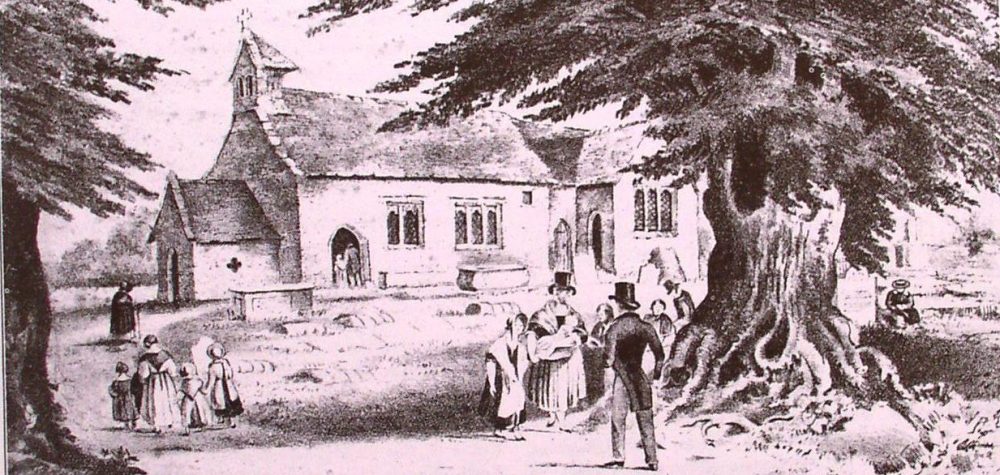
Star

Star – 888 on the 1841 Tithe Map

The first mention I can find is on the 1841 tithe. The owner is John Williams of Llanover, the property contains 7 acres 2 rood and 30 perches.

The information says there is a garden of 17 perches, a cottage and garden of 37 perches, a barn and meadow of 1 acre 3 rood 20 perches, a wheat field of 2 acres 0 rood 3 perches, Cae Garw 1 acre 3 rood 18 perches, Castle field of 2 rood 20 perches and a Little field of 3 rood 24 perches.

On the census of 1841 Philip Phillips is the occupier, he is 35, a farmer, his wife Amelia is also 35, they have a six month old daughter called Ann.

By the time of the 1851 census Philip Phillips had left, John Williams is still the owner, the new family in residence is 37 year old William Edgar born in Llangibby, William is a labourer, Caroline his wife is 39, their children are Caroline 20, who was also born in Llangibby, their other two children, Mary Ann 12, and John 7, were born in Mamhilad.

Another change happened by 1861 when John Bevan from Llanover had move to “Star House”, his wife Eliza was 33 from Glascoed, their children are May, who was born in Monkswood, Ann 6, Eliza 2 who were born in Goytre. John says he is a farmer of 9 acres.

John Bevan is mentioned as an overseer of the poor in the accounts of 1868.

On the electoral register of 1870 William Williams from Blaenavon is the owner, the occupier still being John Bevan.

In 1871 it is now referred to as the Star Inn, John Bevan is now 40 and a basket maker, Eliza is 41, their children are Ann 15, Eliza 13, John 9, Moses 7 and Abraham 4, all the younger children still attending school.

Mentioned in the court case of the Vicar and the Well is Mr Berrington who says he owns the Star well on Mr Bevan’s land.

Lewis Edmunds, the local builder from Llanover wrote in his diary in January 1880, “at the Star Goytrey, repairing and making mortar.”

By 1881 John Bevan and his family has moved to Llanfrechfa where John was now farming 94 acres.

The new family at Star Cottage on the 1881 census is James Scammell and his family, James is 65, a farm labourer from Wiltshire, Eliza, his wife is 55 and was born in Llandogo. Daughters Alice, 21, is a general servant, Susan is 14 and Annie 4. Their sons are Thomas, 19, William 17, and Charles 11. Thomas and William are farm labourers.

Lewis Edmund was at the Star again on the 10th November 1881, he wrote in his diary “at Star, seeing to the repairs wanting to be done on the shed adjoining the house.”

James Scammell and family remain at Star until sometime between 1891 and 1901 when they moved a few yards up the road to Twyn Shinney.

Richard Jenkins is now the occupier in 1901, he is 43, a farmer and miller (at Nantyderry) and was born in Clytha. His wife is 34 year old Martha who was born in Llansoy, they have two children, Henry 4 and Gladys 1. Living with them is a very young servant girl, 13 year old Mary Davies from Glamorgan. By 1911 Richard was paying £1 1s 7d tithe to the rector.

There is another change by 1911, 77 year old David Williams and his 70 year old wife Charlotte are now in residence of the four roomed house along with their 30 year old son David, a carpenter. David was born in Gwehelog, Charlotte in Dixon and William in Kemys Commander. David and Charlotte had been married 47 years, had 8 children, seven of which had survived.

The property was sold by the Marquis of Abergavenny in his 1920 property sale to Mrs Stinchcombe for £180

David Williams died in February 1914 aged 77, he was buried at Kemys Commander Churchyard. Charlotte remained at Star until her death in 1924.

Charlotte is head of the family on the 1921 census, she is 81 years old and a retired market gardener, her son David Charles aged 41 is a master carpenter on his own account, grandson Raymond is 20, he was born in Porthcawl and is an apprentice chemical engineer at the Celtic colliery Maesteg.

On the electoral register in 1925 is David Charles and Ella Williams, followed in 1932 by Charles and Martha Price.

School House/Cottage – Nantyderry

School House Nantyderry

School House in now a Grade II listed building.

I have a copy of a letter from L.S. Whitehead as Representative body of the Church in Wales, it is a reply to a letter dated 25th October 1932 from The Rev. HCP Belcher when he had made enquiries about the property.

The letter says the then Rector of Goytre, (the Rev. Thomas Evans) was given permission and there is an attested copy and draft conveyance under the schools act by Capel Hanbury Leigh dated 15th March 1852 and the Archdeacon of Monmouth, for a site of half an acre for the use of the Church day school.

Living at the Parochial School on the 1861 census is 31 year old married schoolmaster John Williams.

By 1871 my great, great, grandfather Jones Jones, the parish clerk and sexton, was occupying School Cottage, he was a 44 years old widow. He is a farm labourer, employed by the Rev. Thomas Evans. At School House is Thomas Bright the under schoolmaster.

On the 19th March 1877 schoolmistress Rachel Evans is called on behalf of a welsh speaking vicar for the parish. It is about this time that Nantyderry school ceased to be, most children in the parish were now attending British school in the village.

At the National School in 1881 is Richard Bowen, he is 29, a stone mason and came from Pontypool. Elizabeth his wife is 28, and was born in Mansel Lacy, Herefordshire, their children are 6 year old Elizabeth, Harriet 4, and one year old Frances, all born in Goytre. The schoolmistress, 33 year old Annie Powell is the sister-in-law of Richard Bowen, she is also in occupation of the property.

The census of 1891 says the School House in unoccupied but the census of 1901 gives 41 year old engine driver Thomas Evans along with his wife Elizabeth living at School Cottage.

Hutchinson family outside Nantyderry School House c1906.

This wonderful photograph taken outside the School house is from Luned James, it was taken in approximately 1906. The only persons noted are the two ladies on the left, one Aunty Bella, the other Aunt Lizzie (Elizabeth Evans.)

The rateable value in 1901 for the School House was £3 10s 2d.

The census of 1901 shows at No.1 are Thomas and Elizabeth Evans, and Elizabeth’s mother Hannah Jenkins. Elizabeth and Hannah are laundresses. This family continued to live here for many more years.

At No. 2 is Charles Rudge, a 28 year old railway goods guard, Elizabeth his wife is 32 from Hereford, their children are Amy 6, and Gwendoline 3, both born in Goytre.

Again on the 1911 census there are two families living here, one at the School House and School Cottage.

At the 3 roomed Cottage is 52 year old Thomas Evans a farm labourer, born in Goitre and his 56 year old wife Elizabeth, born in Llanover, they had been married 13 years but had no children.

At the 4 roomed house is George Jones a 50 year old mason’s labourer from Newport, his wife is Clara Ann, 33, they had been married for 6 years and had one son Percy aged 5 who was born in Goytre.

In School house cottage on the 1921 census is George W Jones aged 58, he was born in Newport his occupation is a mason’s labourer for David Bowen builder, Mamhilad, Clara his wife is 43 from Llangwm, their son Percy George is 15, a gardener’s labourer for Mr Butler Nantyderry Gardens, Percy was born in Goytre.

Elizabeth Evans died aged 72 at School Cottage in April 1926, she is buried at St Peter’s Church. Thomas outlived her by more than 20 years until January 1947, still living at the same home.

Ivanhoe

Ivanhoe

The first mention of Ivanhoe is on the 1933 electoral register when Ivor and Doris Hopkins are in residence.

Ivor was born in Monmouth in 1897. On the 1911 census he is living at Cinderhill Street Monmouth with his parents William and Matilda and nineteen year old brother Joseph. William and Joseph were both farm labourers.

Ivor married Doris Badham in 1921 at Monmouth. Their children are Cyril Ivor born 1921, Joan 1923, and Leslie John in 1926.

The 1939 register gives Ivor as a roadman, and Doris as an unpaid domestic servant. Living with them at Ivanhoe are Leslie John who is at school, Catherine Arnold who is 8 years old, and William Badham, a contractors general labourer. (I assume William is a relation of Doris.)

In 1944 Leslie John was fined for stealing from Hilda Maud Gill of Nantyderry and again in 1945 for the theft of a chicken. (Full stories in the 1944 Free Press  and 1945 Free Press.)

In October 1945, 24 year old Airman Cyril John Hopkins wins the DFC for his numerous operations against the enemy in which he displayed the utmost fortitude, courage and devotion to duty. Cyril was educated at Abersychan Secondary School and before going to war was employed by Dean tailors in George Street, Pontypool. He now lives in Llandefeilog, Carmarthen with his wife and three children.

Ivor and Doris remained at Ivanhoe, the last details I have are in 1947.

Ivor Hopkins died in December 1970, followed by Doris in 1990.

T26 – Samuel Bird Cash Account

T26 – Cash account of Samuel Bird

1792
Aug 10th Paid interest to James Hutchinson 280 00
Aug 17th To paid Thomas Clare 1000 00
Aug 17th To paid Wm Pearce costs in the
Chancery suit 141 13
23rd To paid James Hutchinson the like 59 19
Dec 31st To paid Joseph Bird principal int.t 336 12
Balance due to Samuel Bird and which, since
His death hath been paid to his widow and
administration as will appear in Mrs Bird’s
administration account 2443 16
Title with the account general at the time of his death

1791
Jan.y by cash received of Isaac Leferne 352 3
20th By received 6 months dividends on the
£4666 13 4d South Sea Stocks to 5th Janry

1791 – £1 13 4d
July 23rd
By 6 months to 5th July 1791 £1 13s 4d

1792
Jan 20th – by 6 months due 1st Jan £1 13s 4d
July 23rd – by by 6 months due 5th July £1 13s 4d
Aug 6th – By receipt of James Hutchinson 100£ being
So much directed to before 100£ allowed by the master.
Aug 15th – by received on sale of 1190 10s part of the above South Sea Stock
Aug 25th – by cash received of Isaac Leferne £462 4s 0d

Statement of the stock received for Mr Samuel Bird’s share of the legacy bequeathed to him by Mr Elias Bird’s will and the manner they have been appropriated.

1790 Dec – By South Sea Stock transferred into Samuel Bird’s name
£466 13s 4d

1792 Aug 8th – transferred to James Hutchinson £2000
15 sold out to pay off debts £1190 10s

Mrs Bird hath received the dividends of this stock upton July 1794 and will appear in her administration account since which she hath transferred the stock as follows:
One half therof into her own name £733 17s 4d
One eighth to Henry Bird Esq., £100 9s 4d
The like to Wm Symons Esq
The like to W H Winstone
The like to Miss Elizabeth Bird

1793 Aug
By stock interest transferred into Mrs Bird’s name £3676 17s 11d
September sold out to pay debts £1300
Mrs Bird hath also received the dividends of this stock up to 5th July 1794. I carried them to the administration account since which she hath transferred the principal.
One half in her own name £4000 0s 11d
One eighth into the name of Henry Bird, Wm Symons, Wm Winstone and Miss Elizabeth Bird each receiving £297 2s 3d

1794 July
By bank 37pc by annuities transferred into Mrs Bird’s name in two sums £1205 12s 2d and £106 11s 9d together which in thus appropriated £1312 3s 11d

One half remaining in her own name £656 1s 11d

One eighth transferred to as above each receiving £164 0s 6d

1795 Aug
By more South Sea Stock transferred into Mrs Bird’s name who is thus appropriated £3019 0s 9d
One half remaining therof in her own name one eighth transferred to the like as before.

T214 – Coffee Plantation Partnership, Kandy 1840

T214

27th May 1840 Kandy

Between Lieut Henry Charles Bird and 2nd Lieut Adjutant Charles Crabbe both of her Majesty’s Ceylon Rifles.

Charles Bird holds 262a 1r 250/100 square perches situated in Pulsellawe in district Udapa purchased by deed from the government dated 3rd August 1838.

To go into a partnership with Charles Crabbe of 150a bounded on the north by the Galpatayshe Ella on the east and south by Laneapohunebura on west by property of Henry Bird.

To share the profits.

Cost of partnership £37 10s sterling paid to Henry Bird.