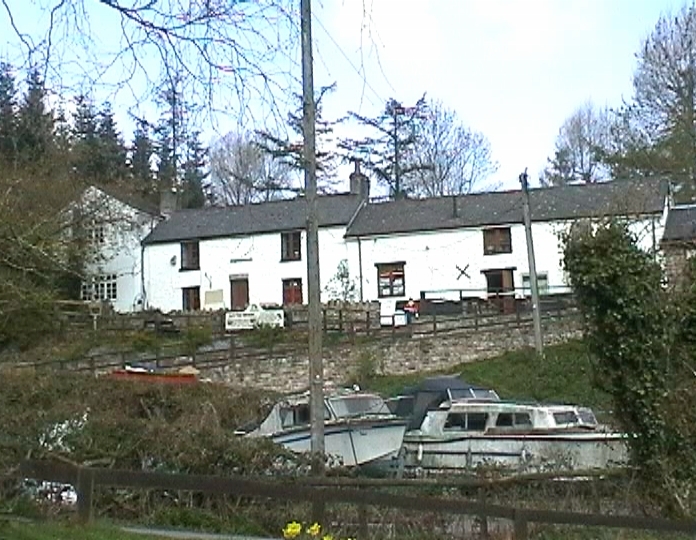
No. 306 on the 1841 Tithe Map.
Goytre Wharf was built on land previously belonging belonging to Mr Sparrow but sold to the Brecknock and Abergavenny Canal Company in 1810. On February 9th the same year a decision was made for a new coal and lime kiln wharf at Goytrey in Mr Sparrow’s wood.
In 1809 John Wilks was employed as a counter on the canal to keep check on labour and attend to the execution of the unfinished part of the canal under the engineer. He was paid £75 per year. John Wilks was about 35 years old and came from Northgate in Gloucestershire.
Canal cutter Thomas Dunn was to complete the Goytre section of the canal by November 1811 at a total of 7060 yards at a cost of £2280.
In June 1810 John Wilks salary was increased to £90 as the other counter, David Jones, is dismissed. In July Mr Crossley is ordered to proceed with building the wharf at or under the estimate.
Thomas Dunn’s name first appeared the the parish overseers account in 1811 stating he was the agent for the wharf and he be empowered to purchase Richard Pruett’s house on the Goytrey wharf provided it does not exceed twenty guineas.
Morgan Francis was appointed machine clerk on the 26th June 1812 at a salary of 14 shillings per week plus house rent and small firing, Thomas Phillips was appointed to erect another two kilns identical to the first two.
John Wilks applied for an alehouse license in 1812, the surety of £5 was paid by Thomas Lewis and David Thomas, the alehouse or Inn to be called the Kings Arms, the license was approved for one year from September 18th, the surety had increased from £5 to £10, this was paid by Thomas David. The license for the alehouse was rescinded in 1815, no alehouse being allowed on the premises.
An iron weighing machine was purchased from Whitmore and Sons in September 1812 at a cost of £103 2s 6d.
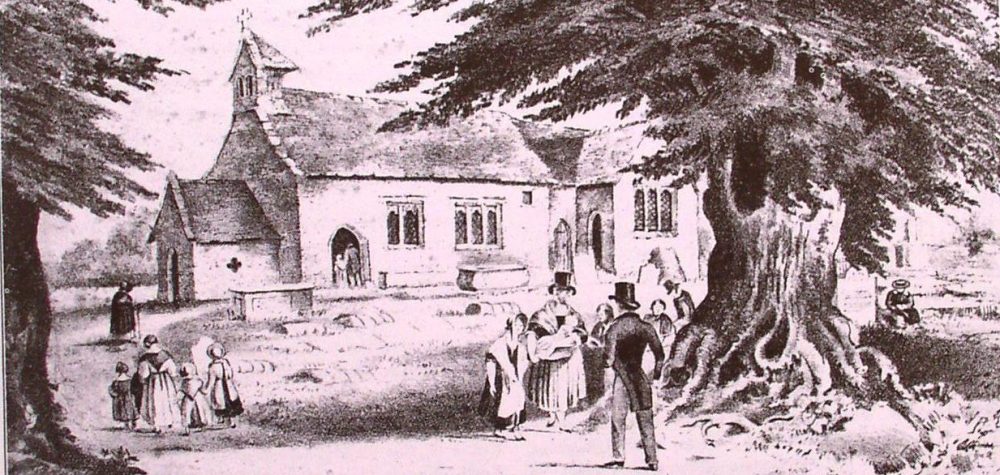
In 1812 John and Eve Wilks had twins, Enoch and Elias baptised at St Peter’s Goytrey on December 6th, sadly both twins died, Elias at two months and Enoch at 3 months.
Wharfinger Morgan Francis and his wife Elizabeth had a son baptised also at St Peter’s in 1814. The same year Ann, daughter of William and Ann Edwards, coal and lime agent, was also baptised at St Peter’s.
In February 1815 Thomas Dunn was permitted to occupy the house which he had erected on company land at the wharf and be allowed to build a wattled workhouse and stable between the cottages now occupied by William Edwards and John Wilks, and 15 yards of garden. The same year Thomas Dunn is said to be in debt and is now advertising his boats and wagons for sale.
Susannah, a daughter of Morgan and Elizabeth Francis was baptised at St Peter’s in 1816.
John Farquhar took a seven year lease on the wharf in 1817, at a cost of £50 per year, it was to include Machine House, the limekilns and the cottage occupied by Thomas Dunn but not the house occupied by John Wilks, he also had to pay an extra £25 to build a stone wall to separate the coal and timber yards.
By 1818 Thomas Dunn had left the area, John Farquhar is the out-occupier, he requested secure fencing to separate the wharf from the canal, the request was refused.
Morgan Francis in 1818 is being paid £28 for a quarter year, John Warner, machine man, is being paid £40 per year in 1822.
John Farquhar’s lease expired on December 31st 1824, he is given notice to repair the premises. Prior to this on the 28th September, the premises were put up for lease at The Greyhound Inn. This new lease for the premises was taken by John Mound, it is said that repairs were needed for one part of the counters house.
A new name appears at the wharf is 1826 when John and Elizabeth Prosser have their child John baptised at St Peter’s church, the church register says John Prosser is a labourer at the wharf. The following year their son William is baptised, also at St Peter’s.
After working at the wharf for eighteen years John Wilks is discharged from his post with one month’s notice. He remained living at the wharf until his death in February 1835, and he was buried at St Peter’s, (Eva, his wife died in Abergavenny in November 1855.)
Following the death of John Wilks his son Samuel took the position of coal merchant at the wharf. He and his wife Mary had several children, Samuel, William and Mary but sadly Mary died at a young age of 29 in April 1839.
The census of 1841 says Samuel Wilks is 35, a coal merchant, living with him are his children William 4 and two year old Mary (two other children had died, Samuel and Eliza) servant Hannah Williams and 15 year olds Elizabeth Lewis and Mary Evans. The tithe says the wharf is owned by the Monmouthshire Canal Company.
In 1843 William Williams from Llanvihangel is at the wharf, it is from this date he starts his accounts book, the following year he married Susan Gould from Lanvair Kilgeddin, Susan had been a servant at the rectory.
In 1850 William Williams signed the petition against the police (there was no reason given for this petition) he said his religion was a dissenter, (a member of a non-established church.)
The census of 1851 says William Williams is 43, a coal merchant, his wife Susan, 39, is from Devonshire, their children, all born in Goytre, are Mary 6, George 5, James 3 and John 2, living with them are servants Thomas Eatons 25 from Llanellen and Thomas Brooks 17 from Clytha.
At the wharf number 2 on the 1851 census is Margaret Jones 26, wife of a baptist minister with her son Edwin, one year old; a servant Mary Jones 16; and visiting her on the night of the census was E Williams, a minister born in Peterchurch
William Williams was paying tithes to the rector for the wharf and three other properties.
Edmund Lewis, the local builder wrote in his diary in 1852 that he was slating the thrive at the wharf for William Williams and that he was also slating and whitening inside.
William Williams left the wharf in 1854 and moved to Park-y-brain.
Richard Prosser became the new tenant from year to year starting from the 25th March 1857 for the wharf, a cottage at Brecon and a warehouse at Abergavenny at a cost of £87 p.a.
Martha Jarret, a 79 year old widow was living at the wharf on the census of 1871, she was a straw hat maker born Mary Lewis in Goytre, she had married Abraham Jarret of Llanfrechfa on the 9th May 1813 at St Peter’s church.
There is an entry in St Iltyds Mamhilad church records in September 1872 which says Henry Jeremiah, son of William Jeremiah of Goytre wharf married Hannah Thomas,
In the mid 1870’s the Gwatkin family had moved to the wharf, his children, Alice and Edwin were attending Goytre British school, an entry in the school log on 1st May 1878 says Edwin fell into the canal and was nearly drowned but was rescued by the Misses Byrdes.
On the 1881 census Edwin Gwatkin is 34, a master carpenter employing one man, his wife Louisa is 35, their children are William 9, Edwin 7, Annie 4, Laura 2 and William Parry a 53 year old carpenter.
Edwin Gwatkin and his family are still at the wharf on the 1891 census, he is now an overseer for the parish, living with him is his wife Louisa, children Edwin 14, Annie 12, Laura 8 and Mabel 7.
New families are living at the wharf by 1911, at number 1 is Arthur Ffoyd, a signalman from Ledbury with his wife Lizzie from Cardiff, their children are Annie Maud 7, Ronald Arthur 6 and 2 month old Gordon Raymond.
At No. 2 is William Evans a farmer from Cheltenham, Mary his wife and daughter Elizabeth.
This had changed again by 1921 when Henry Probert and his family are at No.1, Henry is 55 a farmer from Hereford, Emily his wife is 56 born in Mamhilad, living with them is Mary Evans 78, from Biships Castle.
At No. 2 is Henry Probert’s son Alf who is 25, he is working for David Bowen as a plasterer, his wife is Gladys 24, born in Mamhilad.
The electoral register of 1945 gives Florence Jones at No.1 and Esther Phillips at No. 2 the wharf.