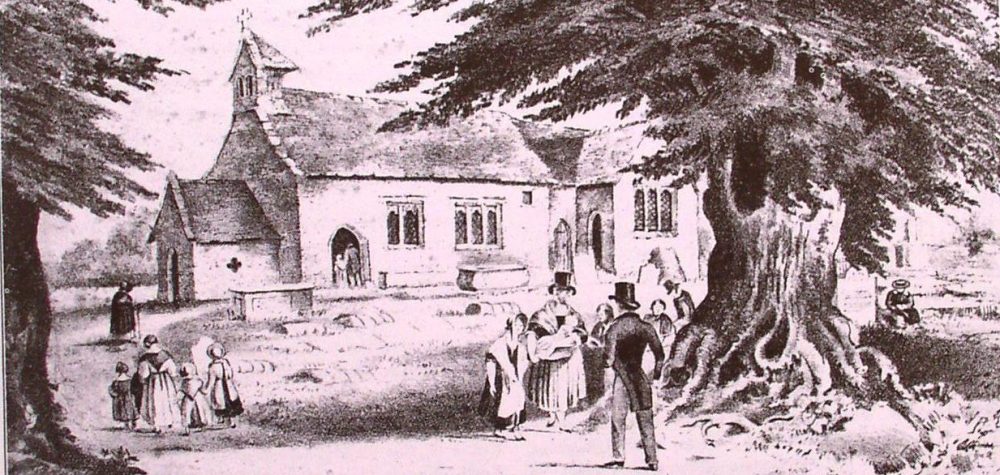
The Heroine of Goytre Well
Charlotte Morgan was charged with using violent threats towards Louisa Waite.
Complainant was the woman who figured in the notorious “Goytre Well” dispute; and defendant was wife of the man who had been convicted of poisoning the Berddyn Brook at Mamhilad.
Complainant said that the defendant had called her bad names and threatened her, so that she was afraid of her.
Defendant said that ever since the Quarter Sessions Louisa had been pointing at her, and making accusations, but her character was far better than Mrs Waite’s, “the dirty hussy.”
The ladies then changed places, and Louisa was charged with threatening Charlotte. Each swore she was in bodily fear of the other, and they were both ordered to be bound over to keep the peace.
Mrs Morgan consented, and was bound over having to pay 5s 6d. Louisa declined and was told she must be committed for contempt. When the business was ended, however, she was bound over and had to pay 5s 6d.
Free Press Saturday Jan 3rd 1874
THE GOYTRE WELL CASE – The course adopted by the Rev Thomas Evans, rector of Goytre, inclosing against the public the celebrated “Well in the Narrow Field” will be the subject of an action in the Law Court at Monmouth Assize. The writ has been served on him by Mr Gardener, solicitor, of Usk.
Free Press Saturday Jan 24th 1874
GOYTRE
On the 8th inst., in the National School-room, a testimonial was presented to the Rev Thomas Evans, rector of Goytre. The parish of Goytre is a rural district in Monmouthshire, of considerable extent, with a thinly scattered population of 600. The testimonial consists of a beautiful silver tankard bearing the following inscription: – “Presented to the Rev Thomas Evans, rector of Goytre, as a token of affectionate respect from his parishioners, January 8th, 1874,” and a very handsome gold pen and pencil-case. The address is beautifully illuminated, after the style of the fifteenth century, and in Gothic letters, as follows: “Reverend Sir, – We, the undersigned, parishioners of Goytre, and members of the congregation, beg to present you with the accompanying small token of our sincere respect and affection to you as a Rector, of blameless life, and of 30 years’ standing amongst us. We at the same time want to express our deep sympathy with you under the attacks which have been lately made upon you, and which we know to be as unjust as they are undeserved. It is our earnest hope and prayer that your useful and valuable life, as well as that of your estimable partner, may long be spared to be in many ways a blessing amongst us. Signed, on behalf of 160 subscribers, William Nicholas and John Harris, churchwardens; Isaac Lewis, farmer, Henry Matthews, farmer, and David Bowen (committee),”
The subscription list was altogether confined to the parishioners and those attending Goytre Church, and was also limited to persons over 16 years of age. The testimonial was exhibited at Mr Evan’s, jeweller, of Pontypool, who procured the same. A private list of all subscribers was on the occasion handed to the rector, by Mr Nicholas, of Yew Tree Farm; accompanied by very warm expression of respect, affection and good will, which met with met with a hearty response and loud cheers from the 50 or 60 of the subscribers who were present. The rector briefly, but very feelingly, thanked his people for their kind and valued offering.
Free Press Saturday Jan 31st 1874
[ADVT]
To the Editor of the Free Press
Sir, – An account appeared in your paper of last week concerning a presentation made to the Rev T. Evans. It appears by that account that the parishioners have a great respect for the gentleman (?) and subscribed in large numbers. Will you kindly find space for the following: – There are 14 of his own tenants that subscribed, and who are rated at £145 5s. There are 15 subscribers who are not his tenants, who are rated at £130 3s, many of whom gave their names, but no money. Three farmers, viz, H. Matthews, J. Lewis, and Wm. Nicholas, subscribed, who are rated at £158 (and whose teams were employed for days for days in filling up the well), and three of the rector’s workman, who are rated at £25. The rateable value of the parish is £4740 6s. The total value of the rates of those who subscribed is £458 8s, leaving a balance of £4281 18s representing rates of people who have not subscribed a farthing.
- GWATKIN, Asst. Overseer.
JOHN WILLIAMS.
THOS. JAMES.
BENJ. JEREMIAH.
JOHN WILKS.
ISAAC WILKS.
[ADVT]
To the Editor of the Free Press
Sir, – Will the originators of the testimonial to the Rev T. Evans explain this little circumstance? Why was Mr Fabian going round asking people for “A penny and your name, or your name without a penny,” towards the above laudable object, a week after the testimonial was presented to the rev. gentleman? And why was the private list of subscribers, which was handed to the rector on the memorable occasion, not made public? I suppose the cost of advertising such a large number of names was beyond their funds. How very particular they were in stating that the subscriptions were limited to persons above the age of sixteen. Who said it was not the case?
Hoping you will find me a small space for these few words,
I am yours truly,
JOHN WILLIAMS
Penwern, Goytrey, Jan 27th, 1874.
Free Press Saturday Jan 31st 1874
A GOYTRE MAN IN DANGER, – However great the want which leads the parish of Goytre to ring with the cry of “Water! water!” one man from the locality, at all events, had enough of that invaluable element on Saturday night, when he was discovered in the Monmouthshire Canal, near Pontymoil, almost utterly exhausted. A short time longer and the immersion would have proved fatal. How he got in there we know not; but we hope that he has reached home in safety and that he will not soon have such another ducking.
[ADVT] appears frequently along with subscription advert
THE GOYTREY WELL CASE
To the Editor of the Free Press.
Sir,- We, the undersigned, having read the Rector of Goytrey’s letter in the FREE PRESS for the 9th inst., wish to state that we can prove what he said is true, both as to there being NO WELL to pollute, and as to his having had nothing to do with the matter. –
We are yours truly,
HENRY MATTHEWS,
DAVID BOWEN.
Saturday, February 7th, 1874
[ADVT]
To The Editor of the Free Press
Sir, – Two letters appeared in your paper last week, one bearing the name of John Williams alone, and the other that of five names, besides John Williams. Each of these letters is an attempt on the part of an unimportant faction in the parish (who endeavour to make up in noise what they want in influence,) to throw ridicule on a testimonial of respect which was lately presented to the Rector by some of his friends. We, the undersigned members of the committee, wish to contradict one or two statements in those letters. Neither John Williams nor any others of those who put their names to the letter could know the names of all persons who subscribed. They may imagine that they know some of them. Therefore, anything they may say on that subject can have but little weight. No person’s name was added without a subscription FROM THAT PERSON. One at least of those who signed the letter would have shown better taste than in not doing so, after the forbearance of the rector towards him, when that man was found one evening disturbing public worship, by shouting bad language in the church porch, and smoking; and that, too, on one of the advertised days for collecting money to open the so-called well, that person being one of the advertised collectors of the same. Further comment on this is unnecessary.
We are, sir, yours truly,
WILLIAM NICHOLAS,}
JOHN HARRIS, } Churchwardens
HENRY MATTHEWS,
ISAAC LEWIS,
DAVID BOWEN
Saturday, February 7th, 1874
[ADVT]
To The Editor of the Free Press
Sir, -Your paper for the last week contains two letters having a reference to the testimonial of respect lately presented to the Rev T. Evans, Rector of Goytrey, one signed by Mr John Williams, of Penwern Farm, and the other by five members of the British School Committee/.
It is such an unusual thing to have any hostile notice taken of a testimonial, that I should have let the letters remain unanswered, were it not that their profound ignorance would lead the writers to imagine that their questions and arguments were alike unanswerable, and they might thus perhaps be led on from one folly to commit another.
Now, Mr Editor, as Mr John Williams asks for information, I will, with your permission, answer his questions.
First, Mr Williams asks, “Why was Mr Fabian going round the parish asking people for a penny and their name, or their name without a penny, a week after the testimonial was presented?“ My answer to this is that I did nothing of the sort. On the evening of the annual concert , when the testimonial was shown (about 200 persons being present,) many expressed surprise at not having been asked, and the committee then resolved to keep the subscription list open for FOUR days longer in order that no friend should be passed by. The result of this was, that sufficient money was subscribed to purchase a massive gold watch key and seal, which may be seen at the shop of Mr Evans, Pontypool, – that being additional to the first portion of the testimonial. If Mr John Williams means deliberately to state that I asked any person for their “name without a penny,” I mean to say just as deliberately that he is guilty of a falsehood. In no single instance was a penny offered; sixpence was the lowest sum subscribed, except in one instance, of a very much respected old person lately deceased, and who gave threepence. Secondly, as to the printing of the names – 150 out of 600, as Mr John Williams terms it, and that is one-fourth of the whole population, adults and infants, and it must be borne in mind that the whole number of the subscribers were adults; we found that though every person, when asked, expressed good will towards the Rector, some few shrank from giving their names, except in a private manner to that gentleman; and as it was for a private object, the committee considered it right to agree to their wishes.
Now for a few words for the British School committee. Their letter is simply a tissue of falsehoods and misstatements from beginning to end. All thinking persons, Mr Editor, outside the parish, must have seen before now that the disturbances are merely created by the upholders of the British School, and ALL can now see for themselves that fact, when a letter appears signed by six members of the British School clique.
This letter deals principally with figures, and when the parish pays £30 per annum to an assistant overseer for dealing with parish figures, we should naturally expect accuracy from him in those matters Is this the case? Now, the rateable value of Goytrey, according to the latest Union Abstract is £2986; whereas Mr Assistant-overseer-Gwatkin gives it at £4740 6s, thus erring by the large sum of £1734 6s, to try and make light of the rateable value of the friends of the Rector. A fine Assistant Overseer!
Again, by some marvellous process, originating, no doubt, originating in the active brain of the same man of figures, the writers proceed to an analysis of the numbers who subscribed. They say fourteen of the Rector’s tenants gave. Ten was the amount; and as neither Mr Assistant-overseer-Gwatkin nor any of the others had any opportunity of seeing the list, any assertions they make are as false as they are audacious. It is also said that many gave their names but no money. There are at this time three sums to collect, all others whose names are on the having given money. This statement, therefore, is false, like the rest.
Mr Gwatkin, in talking with me on the matter, said he was sure Mrs Evans gave the money. Why was not that assertion made by the side of the others? It would, I think, have fitted in well with the rest. Or, perhaps, he had a pretty shrewd idea that the word of a few of the straightforward men, who gave, would carry greater weight than the word of those six doubty men whose names appear at the end of the letter.
Great stress is laid upon the rateable value of the subscribers. What has that to do with the giving of a testimonial of respect to the Rector, confined to his parishioners and those attending his church?
Such a challenge with regard to any Testimonial is surely and unheard-of thing, and proves the malice of those who make it. As an instance of this malice, and the littleness of the minds who conceive it, I may here state, that although I was at Bristol at the time of the so-called well-pollution, yet ever since I have worked with the committee for the testimonial, I and my wife have been hooted and yelled at by the
End missing from photo
Saturday, February 7th, 1874
THE GOYTRE WELL DISPUTE .
ACTION ABOUT THE RECTOR,
At the Usk county Court on Tuesday, before Judge Herbert, an action was brought against the Rev Thos. Evans in connection with the Well in the Narrow Field. The plaintiff was John Collins. The plaint was set forth as follows: “This action is brought for that the plaintiff was possessed of a cottage, and by reason thereof was entitled to a right of way over and through a certain close or field of the defendant to a certain well or spring of water, for the purpose of getting water from the said well or spring, and that the defendant hath prevented the plaintiff from using the said way and having thereby access to the said spring, and still hinder or prevents him therefrom, and neither the annual value nor the yearly rent of the lands, tenements, and hereditaments, in respect of which, or on, through, or over which such casement is claimed, exceed the sum of twenty pounds, and the plaintiff claims £20 damages.” ……
Mr Mottram, barrister-at-law, instructed by Mr Gardner, solicitor, of Usk, appointed for the plaintiff; and Mr Gabb, solicitor, of Abergavenny, appeared for the defendant, who was present in person ………Mr Mottram asked that a special day might be appointed for the hearing of this case, as he had 20 witnesses, … Mr Gabb asked if the Judge had jurisdiction to try the case. He questioned this, inasmuch as the filed over which the easement was claimed was only a part of a large estate of 70 acres. … Some discussion ensued on this point; and the judge held that he had jurisdiction, and added that if a public right had been claimed for all the inhabitants, he should undoubtedly have jurisdiction as shown in the case Lloyd v Jones, quoted in 6 Common Bench Reports, 90, in which the people of Bala asserted their right of way over certain lands to Bala Lake …. Mr Gabb said this was only a claim by two or three parties Mr Mottram was afraid that his friend on the other side did not know much about it, and would be astonished by the witnesses who would be brought forward. In answer to an observation by the judge. Mr Mottram said that the plaintiff could put in a second plea, or he would amend the plaint … Mr Gabb then objected to his Honour hearing the case on the ground that a writ had been issued out of a superior court to try the same issue. ….. The judge said he need not take any notice of the writ ….. Mr Mottram said that his Honour ought not to do so, for Jones might issue a writ, and so might Smith …. Mr Gabb: They are really the same plaintiff, … His Honour: How can that apply? … Mr Mottram: and we might have gone into a question of assault by the rector and the old woman (laughter) ……… His Honour thought that the case was one that should have a special day devoted to it .. Mr Gabb hoped it would not be earlier than a month hence, as he had not had time to get up his case….. The Judge thought it was a case about which there should be no hurry …. Mr Mottram said that the other side could not say that they had had no time. He should have thought that the rector, before taking this step would have been prepared with evidence to defend it; but it seemed that he took the step first and thought afterwards …. Mr Gabb asked that the hearing might be deferred until after the assizes …… Mr Mottram: No we can’t; we have got no water! (Laughter and applause) … Mr Gabb: If the case is adjourned till after the assizes, Mr Jones might bring his action … Mr Mottram: I merely used those names for illustration; but Mr Jones happens to be an old lady …. The Judge: If that be so, the action will probably be carried on with all the more spirit: the moment a woman comes into the case it derives more vigour … Mr Mottram: I don’t think that the rector will have the slightest chance against Mrs Jones …A suggestion was made that the case might be taken in the beginning of April; but the Judge observed that from what he had heard of it, it would be a curious case for Holy Week (laughter). The question seemed to turn and resolve itself into a very narrow compass, into simply a question of right to the water. The Judge added a humorous observation about old women and pot water. .. Mr Mottram: This is much worse than pot water; it smells much worse (laughter and applause) ….. After some further remarks, it was agreed that the hearing shall take place on the 3rd of March, the question of costs being reserved, and Mr Mottram undertaking to give notice to the other side of any alteration in the plaint.
Saturday, February 21st 1874
[ADVT.]
To the Editor of the Free Press
A letter appeared in your newspaper of a week before last, signed by a person of the name of Fabian. I have a few words to say in answer to that gentleman, and hope you will give me space for them.
- He says it is “an unusual thing to have any hostile notice taken of a testimonial of respect.” Granted, but when it is such a trumped-up affair as the one he speaks of, and only got up to mislead the public, it is time it should be taken notice of. One reason for my saying this is that, although the affair is mentioned as coming from the parishioners of Goytrey, persons from the following parishes, viz, Glascoed, Monkswood, Mamhilad, Llanvair and Llanover gave money or their names. It is quite possible the gallant little Fabian will deny this; but he is such an adept a falsehood that it will not surprise me.
- He denies that he went round asking people for “a penny and your name, or your name without a penny,” and accuses me of falsehood in saying so. I again say he did so, and I have abundant proof that what I say is true. He also says that in “no single instance was a penny offered.” That may be true, but it does not prove that in “no single instance was a penny asked for.” I emphatically repeat that he did go round asking for “a penny and your name, or your name without a penny,” and in one case at least he offered to pay the penny himself. It is wasting words on such a man to inform him he is telling a monstrous falsehood when he denies my assertion. Mr Evans had at last found a fit tool, and is making the most of him.
- Now this remarkable sustenance in his letter occurs: “We found that though every person, when asked, expressed good will toward the rector, some few shrank from giving their names, except in a private manner to that gentleman. This speaks for itself. It says as plainly as possible that some were ashamed to have it known that they had any connection with such an affair or with such a person as the rector has proved himself to be.
- He now has a “few words for the British School Committee.” I would advise him to keep a few words for his own committee, to look after his school, and try and get more scholars than he has at present. He has certainly created no little stir since he has been in Goytrey, for not only has the Sunday-school been closed altogether, (a disgrace to the parish), but the day-school will, in all probability, soon go the way of the Sunday-school, if he manages it as “Brightly” as he does now. A pretty schoolmaster truly, and one who, by his own account, has had fourteen years’ experience in teaching. (Of course, he will deny all that I have said.)
- He further says, “Mr Gwatkin, in talking with me on the matter, said he was sure Mrs Evans gave the money.” This is quite as probable as many of Mr Fabian’s own statements. Or, perhaps, the lady was one of the private subscribers who objected to their names being made public.
Lastly Mr Fabian complains of being called after and annoyed. What else can he expect when he has any connection with such a dirty party as he now acknowledges himself to belong to, and who have conducted themselves in a manner which is “a disgrace to a civilized country.”
As to the letter signed by those great men – Henry Matthews, Isaac Lewis, and David Bowen, it is almost as bad as Mr Fabian’s for “simplicity.” Those three gentlemen had better take their advice and mind their P’s and Q’s; or, as I dare say one of them will understand, mind their “ducks and drakes.”
I am, yours truly,
JOHN WILLIAMS.
Penwern, Goytrey, Feb. 18th, 1874
Saturday, February 21st 1874
GOYTRE
The entertainments which have been held in the National School-room, in the above named parish, during the past three or four months, were brought to a close for this season on Monday last, when a programme of considerable length was most successfully rendered by a large number of performers to an audience of upwards of 150 persons. In the earlier part of the performance, the audience had a specimen of what the inhabitants of the neighbouring premises are capable of, as the sons of Mr Gwatkin, of Church Farm, aided by the sons of Mr Jeremiah, the butcher, and by the sons of John Preece, were outside yelling, until one of them became so hoarse as to be able to do nothing but croak; but, with an energy worthy of a better cause, he most pluckily held his own with the rest until they were routed by some of the audience, who went out for that purpose. The program of the entertainment inside the room was as follows:
Overture, Pianoforte, Grand Duchess Maria March….Mr Evans
Duet…I know a Bank…Misses Evans
Song….The Englishman….Mr Fabian
Song…Sunshine after rain…Mr R. Bowen
Song…Little Cares…Miss Evans
Song…That’s where you make the mistake…Mr Ralph
Duet…The stream and the willow…Misses Evans
Song…Children’s voice…Miss E. Bowen
Song…Seventy-two…Mr Ward
Pianoforte solo…Heather bells…Miss Rosson
Song…Happy be thy dreams…Miss Lizzie Evans
Song…The Village Blacksmith…Mr Fabian
Song…The Bridge…Miss E. Bowen
Duet…Over Hill and Over Dale…Misses Evans
Song…Wait till the Moonlight…Mr Ralph
Duet Pianoforte…Punch and Judy Quadrille…Mrs and Miss Evans
Song and Chorus… Little Footsteps…Mr Ward
“ Smile your sweetest smile…Mr Ralph
“ Kiss me, mother…Mr R Bowen
“ Before the baby wakes…Mr Ralph
“ Call her back and kiss her…Mr Fabian
“ Bob Ridley…Mr Ralph
God save the Queen -(Correspondent)
Saturday, February 28th 1874
[ADVT.]
To the Editor of the Free Press
TESTIMONIAL TO THE REV. THOMAS EVANS
Nantyderry, Abergavenny, Feb. 24th, 1874.
Having seen an unworthy insinuation in a letter in the last PONTYPOOL FREE PRESS, Mrs Evans begs to state to the Editor that she, never directly or indirectly gave anything towards the rector’s testimonial, neither did she use any influence on a single parishioner.
It was no “trumped up affair,” but a bona fide expression of the love and respect of his people and congregation towards a Rector who had resided amongst them.
Much more could have been collected, had not the subscription list been severely to the parish and congregation.
[ADVT.]
To the Editor of the Free Press
Sir,- A letter signed by John Williams appeared in your paper for last week which I suppose HE calls an answer to one that I sent in reply to a few questions he and others put relative to my share in the late testimonial to the rector of Goytrey, but which I regard as nothing but low abuse.
Its bitter spirit towards me has already been accounted for. Ridicule is the weapon of contemptibly small minds.
The extreme ignorance shown in the letter reminds me of the mouse that having always lived in a tub, one day crept up to the brim, and, looking around, said, “Dear me, how large the world is!”
Now as John Williams says I will probably deny his statements concerning the testimonial, “as I am such an adept at falsehood,” I do not think I shall give him that amount of gratification, as it is a matter of profound indifference as to what either Williams, or the party he represents, thinks of the affair; and it is only their conceit that causes them to think we trouble ourselves about his opinion.
As regards the schools, I never mentioned the British Schools in my letter; – I simply said that a letter appeared in the Press, signed by six members of the British School COMMITTEE, which is a different matter.
I am quite satisfied with the state of my school, and so is the rector. I should prefer having but one child in attendance, and that a respectably conducted one, than a hundred of such of a few specimens that pass by my gate to and from the British School; nor would I allow such boys as I had the HONOUR to write about to Mr Byrde to come into my school, which boy, by the way, that person had promised to expel. I have no particular desire to drag the vile details before the public, neither have I any particular wish to withhold them, if necessary.
As for being the tool of the rector, – supposing, for the sake of argument, that this IS the case, I should be the tool of a clergyman against whose private character nothing can be said. The rector however requires no tools.
But, I will ask, who is it that is the tool of a woman who drenched his wife with water?
It is well known that John Williams is incapable of penning a letter for the press. I therefore hope he will call to his aid, not only his self-confident scribe, whose small mind might be as narrow as his body, but also the learning and lofty genius of that committee, of which he is the fit, though noisy, chairman.
I am, yours truly,
A.C.FABIAN
Saturday, March 7th 1874
GOYTRE
On Wednesday, February 25th, another “service of song” (The History of Joseph), was given in the British schoolroom to an audience numbering about 250. It is a very interesting service, and it was recited in a way that gave general satisfaction. Mr Baker, vicar of Usk, read the selection from the scripture narrative. At the close, Mr Carbonell made some very interesting remarks, as did also Mr Cook of Mamhilad. The evening hymn was then sung, and at the same time a collection made, which was unusually large. Hearty thanks are due to Colonel Byrde, for the interest he takes in these sacred meetings, and to Mr W. Wilkes, who led the singing; he has evidently spared no pains to make it as attractive as possible.
Saturday, March 21st 1874
FRIENDLY SOCIETIES
William Gwatkin, of Church Farm, Goytrey, was charged with refusing to allow the sum of £1 due to Josiah Lewis of Blaenafon, from some friendly society with a Welsh name. Mr Gwatkin said that the club were in doubt as the meaning of rule 45. Complainant said that of the 11th of January he had an accident, and declared himself on the club; he was unable to work for three weeks in consequence of a broken bone, and he produced a medical certificate to that effect. In the face of that certificate, the bench held that the club were bound to pay, and they made an order accordingly.
Saturday, March 28th 1874
Saturday, April 11th 1874
CAPEL-ED was, on Good Friday, as in by-gone years, the resort of a large number of people. The tea in the chapel was of the best quality; and the amusements in the field were kept up with spirit, but the wet in the evening damped the enjoyment.
Saturday, April 11th 1874
NEW OVERSEERS – The following gentlemen have been appointed as overseers in the following year in this district: Goytre, Mr Henry Crump and Mr Walter Jenkins.
THE NEW GUARDIANS for the Pontypool Union are as follows: – Goytre, Mr William Harris.
GOYTRE
On Wednesday, March 25th, a concert was given in the British School-room to a large audience. The following was the programme:-
Overture (piano) – Miss Campbell
Song – Ash Grove Mr W Wilks
“ Brighter Hours Mr E Evans
“ Could I live my time over again Mr Turner
“ She wore a wreath of roses Miss R Payne
Duet The wreath Misses Campbell and Williams
Song The Jolly Miller Mr T Davies
“ Charge of the Light Brigade Mr Essex
“ Maid of Athens Mr Turner
“ Swan’s Sunday Out Mr Levo
Medley The Tichborne Trial Mr W Wilks
Duet Country courtship Miss Williams and Mr Gardener
Selection (piano) Miss Campbell
Song Who have been friends Miss R Payne
“ Look at home Mr E Evans
“ I’ll meet thee in the lane Mr Davies
“ The Englishman Mr R Essex
“ The Pilot’s Daughter Mrs Williams
“ The Railway Porter Mr Levo
“ Miss Campbell
“ Walking in the Zoo Mr T Davies
God Save the Queen
Saturday April 25th 1874
Local Intelligence
GOYTRE
FIRE – MRS LOUISA WAITE’S HOUSE BURNED DOWN
The house of Mrs Louisa Waite, the woman of has figured so conspicuously in con…..ing with the rector about the right to the celebrated Well-in the-Narrow Field. (Now called), was burned down on Monday evening. About a quarter-past six o’clock, one of her children, about eight years of age, while playing with a fire-brand, set fire to some straw, and this lighted the thatch. The furniture was got out of the premises as quickly as possible, with the exception of a couple of bed-steads, and, as the wind blew strongly, in a short time the place was completely gutted, and only the blackened walls left standing.
Saturday July 18th 1874
Police Court
JEALOUSY
Ann Twissell was charges with assaulting Emily Phillips, at Mamhilad.
Mrs Phillips said that the defendant’s children were breaking a hedge, and she reproved them, when defendant rushed out and struck her, threatening to rip her guts out.
Elijah Gethany deposed that Mrs Twissell struck Mrs Phillips with such violence as almost to send her down.
Defendant said she merely pushed Mrs Phillips for calling her children thieves.
Jane Roberts was called for the defence, but she said she did not go out of the house when she heard the row, and therefore did not see whether any blows were passed.
The Bench said that the woman acted in a very sensible manner by remaining indoors.
Samuel Twissell, the husband of the defendant, came forward and made a round-about statement, in which he admitted that his wife pushed Mrs Phillips. It appears that Mrs Twissell was jealous of Mrs Phillips.
Fined 15s
Saturday July 18th 1874
GOYTRE
THE WELLS AND NO WATER !!!! – A very indignant parishioner of Goytre wishes to make known the grievous privation under which he and many other are suffering. He waxeth poetical, and exclaiment –
“Preaching, although in oily tones,
Is not with piety compatible,
When God’s great blessing ‘neath the stones
To quench our thirst is un-come-at-able.”
We can’t say much for his poetry but in prose it comes to something like this – that there are three wells in Goytre, but that two of these are dry, and the third, (the notorious one in the “Narrow Field”), served like some unfortunate nun – put under the holy ban of the Church, built up and buried alive. This our informant states, is the only well in the neighbourhood that could be depended on to supply the pressing need of water in this protracted season of heat and drought. We hope the question of the public right to this well will shortly be set at rest, and the much needed water be set flowing – like the Gospel – free and unpolluted. We understand the case will come on for trial at Monmouth Assizes on the 4th of August next, the parishioners having paid into court £150 for the purpose of having their claim firmly and finally settled.
Western Mail August 10 1874
NISI PRIUS COURT
(Before Baron Pigott)
The court opened at ten o’clock, and the examination of the witnesses for the plaintiff in the Goytre Well case was at once resumed. The first called was
Charles Watkins, who said he was a servant in the employ of the Rev., Thomas Evans. By his master’s orders he had the well in the narrow field filled up with stones. When it was re-opened he had it filled up again by his master’s orders. The well was about a foot deep.. The well was opened by the neighbours, and they then went to it again for water. He had to get it filled up again several times. The last time was on the 17th August. On that day his master said he was to bring the men and get the stuff from the little houses to put into the well. He told Mr Evans he hoped he would not do that, and Mr Evans said he was determined to do it; they had annoyed him so. He objected to do it, and so did the other workmen. Nest day he found the well had been filled up with stones. It was done by the workmen he supposed. The workmen kept piling up stones on the well for six or seven days.
Cross-examined by Mr Huddleston: Was bailiff to Mr. Evans at the time, and received 15s. per week. He left after that and went to Col. Byrde, at 18s per week.
Mr Huddleston: Who was present when Mr Evans told you to put the stuff from the water closets into the mound?
Witness: The other workmen.
Mr Huddleston: What were their names?
Witness: James Lewis, William Price, and John Jones. He said the same to them as he did to me.
Mr Huddleston: What did he say to them?
Witness: He told them he wanted them to get some stuff to put in the well.
Mr. Huddleston: What then?
Witness: They objected to do it, and Mr. Evans, said, “You must strike then,” and they did strike.
Police-constable Allen, No 19 M.C., said he was present two or three times when the well was opened. He saw it being filled up in June. Saw a large stone put in that was nearly enough to fill the well. Did not hear Mr. Evans give the stone any name. He was present on the last occasion when the well was opened. It appeared to have been filled with privy soil, horse dung, broken glass, and bushes, over that had been a heap of stones. It was a large heap and some people said there must have been a thousand tons there.
Cross examined: Was present at the well at request of Mr. Evans, for the purpose of keeping the peace.
Mr. Jeremiah said he was a butcher, living at Goytre, and for 40 years had known persons to use the well. He saw the stones removed from the well three times, and every time the water was there as before.
Cross-examined: Married John William’s sister. Used to supply the rectory with some butcher’s meat – to the extent of £80 or £90 a year at one time. He did not know exactly when he ceased to supply the rectory.
This was the plaintiff’s case.
Mr. Huddleston, in opening his defence, gave a total and positive denial to the imputations which had been made against Mr. Evans. There was no proof of any private right. He submitted that there was no public right proved. And said he did not believe there was any spring at all. After going through and commenting upon the points of the evidence given by the witnesses for the plaintiff, he stated the nature of the evidence he intended to call, and said an affidavit made by Rees Rees to the effect that he occupied the Walnut Tree Farm, and was living there thirty years ago. While there no one claimed a right to go across his land to the pool in the narrow field. There was no entrance to it from the road. The only entrance to it was through a field gate by the side of the brake. People had asked his permission to go into the field to get water from the well, and he occasionally gave them permission.. The learned counsel pointed out how that corroborated the evidence of Owen Davies, who had said he never went to the well for water until he had asked permission to do so.
The following witnesses were then called:-
Mr. Thomas Dyne Steel said he was an engineer, carrying on business at Newport, and he had known the parish of Goytre for more than thirty years. The plan produced was made in his office and it was a copy of the tithe map. He had himself marked the wells on the plan, also the situations of the houses. There were plenty of spring wells in the parish, and he knew the position of a good many of them. There was no village in the parish. The houses were scattered all about. The distance from this cairn of stones to the farthest boundary of the parish was about two miles. There were houses very near the boundary. He examined this spot last Monday. There was now a heap of stones and if a permanent spring existed there it would show through the stones.
His Lordship: That would depend how high the water rises. There has been no evidence that this spring ever overflowed.
Witness: The ground around the cairn was all dry, but there were appearances of a boggy nature. He examined the mouth of a drain at the bottom of the field, said no water was coming from the mouth of that drain.
John Hodgson said he was assistant to Mr. Steel. He has measured the distance from the plaintiff’s cottage to the different wells. There was a well at 720 yards, another at 35 yards from it on the same road. From the cottage to the cairn of stones was724 yards. From Penperllene to the wooden shoot carrying water over the railway was468 yards. There was an ample supply of water when he was there. From Penperllene to the cairn of stones was 720 yards, measured from the school. From the same spot to the black well was 763 yards. There was also plenty of water there and at the other places he had mentioned.
Cross-examined: Did not know that the black well was out of the parish.
Mr Huddleston said he had been told it was a yard or tow out of the parish. (Laughter.)
Cross-examination continued: It was more than a mile from Wait’s cottage to the black well. Had never carried a bucket of water a mile.
Thomas Edmund George said he was a land valuer at Newbridge. In the autumn of 1870 he was instructed by Mr. Walters to make a valuation of the Walnut Tree Farm. He took a tracing of the farm from the parish map, and then went over the land in company with the tenant. In a pasture piece numbered 687a, he found water for cattle, but no spring. A break separated this field from the next. There he found water for cattle; also in the next field close by the railway. The tenant told him there was water at that spot all the year round. He afterwards sold the land to Mr Evans. For £1,800 and something. (print difficult to read here. He found no spring there and there was no footpath from the road into the field. Where there was a pool for watering cattle.
Cross-examined: He could not recollect any stones at either of the places where he saw water. Did not notice a holly tree.
William Jones, labourer said after the well had been opened three or four times he had to assist in filling it up again. They first of all got two or three buckets of soil from under an archway, where cattle went through, and they put that stuff in the pool or reservoir that had been opened. Mr. Evans had not given them instructions to put that filth into the well. They did that without instructions.
Cross-examined: He was one of the men who went in the night to do something well, Bowen and Harding were also there. He volunteered to assist in filling up this well. Did not know when Mr. Evans asked him to volunteer. And did not know that he was asked to assist because John Jones and other men had refused to do what other men had refused to do what Mr. Evans wanted. He believed that a quantity of the broken glass and the filth that was put into the well came from Nantyderry House (Mr Evan’s). It was his own idea, that of putting the filth from under the arch. He did it because he had been so annoyed by the children hooting him and crying out “water, water.” They did it, he supposed, because he was a tenant under Mr Evans. He had beer given him by Mr. Evans whilst he was filling up the well.. There was no bad smell from the stuff from Nantyderry House.
Re-examined: Mr Evans had nothing at all to do with putting the filth into the well.
Richard Bowen said he was with the last witness when the well was filled up. Mr Evans never gave any instructions about putting in the filth.
Cross-examined: Had No been given him by anybody on the Sunday night and he was not drunk when he filled up the well.
John Harding, indoor servant, said he helped to carry a bucket of filth from under the arch and put it in the well. His master knew nothing about that.
Cross-examined: Mr. Evans gave general order to himself about filling up the well.
Thos. Evans, the defendant, said he was rector of the parish of Goytre, and had been for upwards of 30 years. It was not with his knowledge or consent that the filth was put into the well. Watkins’s statement about the nightsoil was a monstrous falsehood. He purchased the Walnut Tree Farm in 1871. Had known the narrow field for 30 years. Never known of a footpath to the waterpool. There was no trace of a footpath from the road to the pool when he bought the farm. Never heard of any right to go to that pool for water. The field was a very boggy one, and there was a wet brake below when he bought it. He cleared away the brake, and proceeded to drain the land. He began these alterations about April, 1872. When the draining was begun his attention was called to this pool. It was close by the brake and the brake was full of holes. There was no spring in this pool because he tried it. He found that the water from the pool came from an old land drain, and he was told if he cut off that drain he would soon find no water in the pool. He diverted that drain and found that no water came. He had what water that remained taken out as close as possible, and then he was satisfied there was no spring. He finished the fencing in about a year and a half after the completion of purchase. In April 1873, John Williams called on him to get a bill settled, and he then said he hoped witness would not close up that place so that it could not be open in dry seasons. He told Mr Williams it was not his intention to do xo. It would be filled in such a manner that it could be re-opened. He never had any claim of a right. In June of the same year he saw plaintiff getting over his fence. Asked her what she wanted and she said she was going for water. Asked he if she had permission. She said “No, and she did not mean to ask for any.” He turned to Price, and asked him if he heard that. It was the first he had heard of any right, and he told the woman she should not under those circumstances go there for water. The conversation then took a different turn, and he accused her of ingratitude. She said something about his not giving her work, and he told her that if he gave her work she could send her children back to school. She then said she would not. He had the pool filled up the same night. It had been closed up before that, but he had it re-opened for the cattle.
Cross-examined: by Mr. Matthews: It was by cutting off the drain he got rid of the water from the pool. He never examined the place before June, 1873. He could not tell that there had been an unfailing supply of water in the pool for 50 or 60 years during the driest summers. The pool had been shut up once before. He saw the water bubbling in it and was told that it came from a drain he had previously put in. The closed was closed up again within a week, and it was only opened once again after that; but he did not examine the pool again. Did not know that on the 18th of August his men were going to fill up the well very early in the morning. He had not been round to the workmen about it on the previous Saturday. He gave general directions to his servant. He saw the broken bottles that were taken to the well from his house. He did not see any of the filth with the bottles that had been spoken of. So far as he knew, there was no such filth. He ordered the broken bottles to be put into the heap of stones, to produce a deterrent effect on those who said they would open it 100 times. He did not cause it to be known that the broken bottles had been put there. He had never seen anyone fetching water from that place, but he had they did so in dry seasons. He heard it from the tenant. He did not know that it had been used as a public well. He re-opened this pool in the narrow field because he could not get enough from the well in the bank. He did not think there was a bucket of water in the pool when it was last covered in. He did not think he told Mrs Wait she should go to the well if she should send her children back to the parish school. He did say something to her to test her sincerity. He promised she should have water if she would withdraw the right she had set up. What he said to the woman about sending her children to school had nothing to do with the question of water. The height of the heap of stones would be about nine feet.
Thomas Prosser said he was a small farmer. His grandfather bought this cottage that Mrs Wait lives in. The cottage has been his since his grandfather’s death about ten years ago. He has known the cottage all his life. The cottagers used to be supplied from the well in the Wern, a field on the opposite side of the road to the cottage. After that was stopped up the cottagers used to get water from the Black Beech well. Never knew of a well in the narrow field or of a footpath to it. Never knew the well at Black Beech to be dry until now. He knew no right that his tenant had to get water from the narrow field.
William Phillips, farmer and valuer, said some years ago he made some valuation of land in Goytre parish, for railway purposes. He made a valuation of the narrow field. There was water in the field. He did not consider it a well, but he gave compensation for the loss of water. Any part of the field was a swamp, but there was no well there.
William Bevan said he used to live at Coalbrook Cottage. He used to get water for his parents from the well in the Wern and the Black Beech well. Never went to the narrow field for water.
Cross-examined: Had never in his life seen the well in the narrow field.
Mary Ann Morgan, Elizabeth Bowen, William Matthews, William Williams, John Harris, Wm. James, and Hannah Jenkins and were also called to prove there was an abundant supply of good water in the other wells, and that they had never known of any pubic right to, or common use of, the water in the narrow field.
Thomas Waters of Caerphilly, owner of the farm before Mr. Evans, said during the time he knew the farm, over thirty years, he never heard of any public right to take water from the narrow field.
The deposition of Rees Rees, of Cwmbran, was put in, he being too ill to appear. He stated that he occupied the Walnut Tree Farm eleven years, and left about 30 years ago. During his tenancy there was no path to the well, and no right of public way to it. Occasionally in dry summers people had asked him for permission to take water from the pool in the narrow field. There was a well under the ask tree by the bank in the adjoining field, and it was from that well his household obtained their supply.
The court then adjourned.
SATURDAY
(Before Baron Piggott)
On the opening of the court this morning, it was announced that the special jury case, Williams versus the Great Western Railway must be made a remanet, to the next assize, and that it had been agreed that the last common jury cause – an action for breach of promise to marry – should be tried at Gloucester.
THE GOYTRE WELL CASE
The examination of witnesses for the defence was resumed.
Alfred Fabian, schoolmaster, of Goytre, said, in July, 1873 he was present when the well by Black Beech was tested. They found eleven springs running into the well, and there was a yield of about 3 ½ gallons of beautiful pure water every five minutes.
Nathanial Price, aged 72, said he had known the parish 40 years, and was formerly servant to old Capt Byrde. He knew the narrow field and had been there with Capt Byrde many times when he was shooting. He had since drained the field for Mr. Evans and found no spring there. He had never known people to go to the narrow field for water. There was a well of good water by the Black Beech., and he had never known it fail. He was one of the men who worked with Charles Watkins as stated, but he never heard the rector give any directions about putting night soil into the well.
John Jones said he helped to get stones to put in the well, and he never at any time heard the rector giving directions to put night soil into it.
William Edgar said he had lived at Goytre 25 years, and he never heard of any right to take water from the pool in the narrow field. There was a track for the creatures, but no bound path. He never saw a well at the narrow field and never saw anyone going there for water. He had seen Louisa Wait, and the tenant who preceded her, going to the other well for water.
Edmund Dixon, another old resident, was called to prove that 15 years ago he put in a drain which let the water from the upper ground into the pool. The pool was in a boggy place.
His Lordship said if they could have gone to the spot and then examined the evidence at the nearest public-house, they might have settled this matter in about six hours.
Mr. Huddleston expressed his willingness to leave the whole question to his lordship’s decision. He thought it the only way of restoring peace.
His Lordship said he must decline to take it out of the hands of the jury, but if he had known what was coming, he should have suggested a visit to the spot.
Mr. Huddleston said he was afraid whichever way the verdict of the jury, might go it would only lead to more trouble, but if his Lordship would consent to settle what should be done, there might be an end of it.
Nothing could be arranged, and the case proceeded.
William Pardoe spoke to working with the last witness in draining this land for Mr Logan about 16 years ago. He gave very similar testimony to that of Dixon.
James Dix, an elderly gentleman, said he was a connection of Colonel Byrde’s, and forty years ago he used regularly to go shooting over this narrow field. It was an awfully wet place. A gutter across the lane conveyed the water into it from the wood above. He recollected the place very well, because on one occasion his horse put a foot in the gutter and fell.
This was all the evidence.
His Lordship made certain suggestions to counsel and after a consultation.
Mr Matthews said his clients had decided to consent to the withdrawal of a juror and to waive all question of victory or triumph, if Mr. Evans would agree to provide a good and sufficient supply of water for the use of the parishioners, at his own expense, and upon terms to be decided by his lordship.
Mr Huddleston said his client was perfectly satisfied to leave the matter in the hands of his lordship, who had heard the evidence of both sides. Whatever his lordship might think fair and reasonable, and even generous, Mr. Evans would be willing to do, and would have in all probability have done before if he had been appealed to in a proper spirit. If this was agreed to Mr. Evans would leave the court without any feeling of hostility towards anyone, and he hoped that no such feeling would be shown towards him.
His Lordship thought it better for all parties that these arrangements should be made, and that no verdict should be given. It did away with the sense of triumph or victory, and brought out the good feeling of both sides. His suggestion was that Mr. Evans should trace back the water supply to the higher ground, and put in a place by the end of the old culvert where it joined the road. H thought water might be found there in sufficient abundance for all the wants of the parish, and a dipping place might be made for a sovereign or two if there was such an abundant spring as had been spoken of. He quite exonerated Mr. Evans from any participation in the matter of putting filth into the well, and thought that in all probability some injudicious but to ready instruments thought they were doing what was extremely clever when they were doing a very bad act. If Mr. Evans had a right to stop up the well, he had the right to put over it a cairn 9ft or 90ft high, if he so pleased. Whether there was water in that place from the time of Richard I was a difficult question to solve and it had not been solved there, so that no one could go away and say they had solved it.
A juror was then withdrawn, and the matter was made subject to a judge’s order.
His Lordship promised to draw up that at Gloucester.
The Court then rose.
Mon Merlin 14th August 1874
Nisi Priius Court – Thursday, before Baron Pigott
The Goytre Well Case – Wait v Evans
Action for trespass to try the right to the water in a certain well at Goytre.
Mr. Mathews, Q.C. and Mr. Griffiths for plaintiff
Mr. Huddlestone, Q.C., Mr. Dowdeswell, Q.C., and Mr. Lawrence for the defendant
Witnesses were ordered out of court.
Mr. Mathews opened the case. He said the question for the jury to try was whether the inhabitants of the parish had a right to use the water of a certain well on a farm belonging to the Rev. Thomas Evans.
The village was near to Pontypool, and consisted of a number of scattered houses. The plaintiff, a poor woman, claimed the right, as occupier of a cottage and as an inhabitant of the parish, to fetch water from a well known by a Welsh name, which translated meant “The Well in the Narrow Field.”
It was an ancient well. In all time that witnesses could go back to there had been a well at that spot. On the bank above the well was a large holly bush, from which the well was sometimes, called “The Holly Bush Well.” It was almost the only well in the parish which supplied good drinking water at all times of the year, and they would find that so constant was the use of this well that several things had been done to make it convenient.
Stones had been placed round the sides to keep the water clear, and on one side was a flat stone to stand pitchers and water vessels on when people went to draw water.
Access to the place was through an opening in the hedge, which divided the field from the road: In this opening was a barrier of drop rails. There was also a footpath and cart track up to the well. The footpath was always used by parties going to the well. Cattle were sometimes turned into the field and the tenants always used to make arrangements to keep the cattle from fouling the water in the well. Hurdles were put over the well and a pool was dug below for cattle to drink at.
This state of things existed until 1871 when the defendant, the Rev. Thos. Evans, rector of the parish, bought the Walnut Tree Farm. Mr. Evans has been for twenty or thirty years in the parish, and therefore one might have thought that his position and all the associations of his life would have induced him to guard the rights of his humbler parishioners with the utmost care.
Shortly after his purchase however, he thought fit to take down the drop rails and shut off all access to the well. In the summer of that year, he thought it was on the 21st of June, Louisa Wait went to fetch water from the well morning and evening, as she had been accustomed to do all her life, when she went in the morning she met a man employed by Mr. Evans, and she was warned that she must not come again for water. She said she would, and returned again in the evening, when she met Mr. Evans, when an altercation ensued. Mr. Evans told her in effect that she must not go to that well for water. When she asked why not he said, “You have taken your children to the opposition school” – there is a British school in the parish, which for reasons best known to Mr. Evans, seemed to be very obvious to him – “and” the rector added, “unless you send your children back to my school, you shall not come here for water.” Mrs. Wait said she would, and Mr. Evans told her to go to Halifax.
A day or two after that, by Mr. Evans orders, the well was stopped up by stones being put into it. Mr. Meyrick and another gentleman went to Mr. Evans and remonstrated with him about shutting up the well, as it had always been open to the parish. Mr. Evans replied that there are other wells, and he mentioned a well in a wood. They went at once to look at it, and Mr. Evans then admitted the water in it unfit for domestic use. It was only a hollow that had been scooped out for cattle, and in dry weather there was no water in it. Mr. Evans told them the people could go to Mr. Berrington’s well, and when asked if there was any public right to go there he said he did not know. After this the people caused the stones to be moved and the well opened.
Mr. Evans had the well filled up again, and again it was re-opened. This process he believed went on for five times, larger quantities of stone being piled on each successive time. On one occasion the rector was seen directing some men to place a large stone over the wall, and this stone he called “the purgatory stone.” Why it was so called the learned counsel could not say, but the stone was placed over the mouth of the well.
On the 17th August the well was closed for the last time, stones were piled up on it to the extent of some hundreds of tons, so as to prevent all access to it; not only were stones put in, but also refuse of every kind, broken glass, cow dung, and even night soil were thrown into the well, as to pollute it and make the water unfit for use.
Now, he said, amongst the things which, according to the Goins were not included in the right of war was water – “wells must not be poisoned.” It appeared that Mr. Evans had a different view, for he had thought fit to pollute the well as already stated.
The inhabitants after this assembled; they were called together by a police notice, and a copy was served on Mr. Evans. They assembled by this well on the 25th October to re-open it. A mass of stones was removed, and the presence on this filthy matter ascertained beyond all doubt whatsoever. He believed that was the last of the attempts at personal redress and that the inhabitants felt that they must have recourse to law.
Louisa, being the first person with whom this matter first began, the action had been brought in her name by subscriptions raised thoughout the county. The principal question for the jury would be whether the inhabitants of this parish had, from time immemorial been in the habit of going on to this Walnut Tree Farm for water.
If that were proved, he thought the jury would be told by the Lordship that a right was acquired by user and that they might infer from such use that a former owner of the land granted the privilege to his neighbours to take water from that land.
The following witnesses were called:
Louisa Wait said that she was a widow and lived at Goytre. She had known the parish for 28 years and for 11 years lived at the cottage which was burnt down last May. She knew the Walnut Tree Farm. On a field on the farm, and near to her cottage was a well whi.ch she remembered for 28 years. She had been there thousands of times. Mr. Huddlestone here objected that wrong done to a well as a public or parish well would give no cause of action to a private individual; it must be done on information by the Attorney General, and therefore the evidence was inadmissible. His Lordship thought there was cause of action where private injury was done by a public wrong and he should rule that the evidence was admissible for some purpose, if not for all.
Mr. Huddlestone said he made the objection so that his Lordship might enter it on his notes at the earliest possible moment.
Witness continued, she had fetched water from that well thousands of times for all cottage purposes; she used to go to the well during her mother’s life; all the other cottagers did the same at all times when they required.
To his Lordship: The houses were all scattered about along the road: there is no cluster of houses: there are many parish roads.
Examination continued: the defendant, the Rev. Thos. Evans, was rector of the parish, and he bought the Walnut Tree Farm. She never knew anybody stop or interrupted in getting water there before last year. On a Saturday in June of last year she went to the well for water. As she went the rector met her, and objected to her going. She had always gone to the well through a five-barred gate, which divided the field from the road. It was the way used by all parties who went up to the well. The well was about 60 yards from the gate. It was in a long field with furze and grass, and cattle were turned into it.
On the Saturday in June referred to she found the gate blocked up with a hurdle, and she got over the hedge. The rector asked her how she got to the well and she said she had followed her neighbours. He said because others did, she had no right to. She asked why, and he said “because you have taken your children to the opposition school, you bring them back and you shall have water.” She told him she should not. She was turned back on that occasion and couldn’t get no water. The well had been blocked up with stones. Over above the well was a holly bush. She had never known the well to be dry. Since it had been blocked she had been obliged to go twice as far for water, to a well on Squire Leigh’s property.
Mr. Huddlestone examined witness at considerable length as to the position of her cottage in relation to the other wells in the neighbourhood, and as to the water they contained. She said the other wells were frequently dry, and the water in them was not so good as the holly bush well. She would swear there had always been a path to the well as long as she had known it, and she had never remembered the gate to have been fastened.
Re-examined she said she had seen water hauled it for her father’s cows, pigs, poultry, etc.
William Jenkins said he was a gardener living at Goytre. His father was at one time tenant of the Walnut Tree Farm. He had known the place 40 years. There had always been this well in the narrow field. He had been with his father many times when they cleaned it. They put rail poles round the well from bush to bush to keep the “creatures” from going to the spring, people going to the well could get over the rails. There was a place below for the creatures to drink. There was a flat stone by the side of the well to put pitchers on. He remembered when there was a workhouse about a mile from the spot. The paupers used to go to this well for water. People from Black Beech way used to go there for water. The inhabitants from about 15 cottages used to fetch water from there, amongst them were the Bevans, Lewis’s, Cobner’s and others. He never knew the water to fail there. It was beautiful water: it bubbled up and the sand with it. His father lived on the farm 70 years, and left it in 1843. There was a path to the well. He had never known anyone going there to be stopped. The well had never been stopped up, and there was now about 1000 tons of stone atop of it. (Laughter)
Cross-examined: Had not been in the field that he knew of since his father left the farm. His father might have been overseer of the parish at the time the paupers fetched water from the well. The persons he had mentioned as fetching water from the well used to fetch it during his fathers’ time. He had spoken of no-one who had gone there since his father left. His father never promised to let a man named Williams have water from the well for 2 days work. Water was open to all.
John Williams said he was a farmer living in Usk formerly he had lived in the parish of Goytre, in Mr. Logan’s farm, (Penwern) he had known Goytre 87 years and knew the well. Everybody in that neighbourhood used to go there for water. The first he remembered going there was a man named Prosser of Pellenny. He used to go to the well with a barrow and a cask. When he lived at the Penwern Farm he used to take his horses and cattle to water at the pool near the well. He had never known the water to fail there, and never in his time was there any objection to persons going there for water.
Mr. Evans ran a drain through the well, draining the land above and below that was about two years ago. He went to Mr. Evans about it in January 1873 and said to him” I hope you don’t mean to stop the well, as it is the only water to be had.” Mr. Evans said he did not intend to stop it after that his tenant, (young Collins) and others continued to get water from the well. In April or May 1873 the well was stopped, and he went with Sir Joseph Bailey’s agent, (Mr. Meyrick), and met Mr. Evans on the ground. They found the gateway leading to the well stopped. They got over the hedge and met Mr. Evans. Mr. Meyrick asked Mr. Evans why he had stopped the well up, and Mr. Evans said “because of an impudent woman.” Mr. Meyrick hoped Mr. Evans would not stop up the public right and Mr. Evans said he should – he would spend £50 over it. Mr. Meyrick said no doubt Sir Joseph Bailey would look after his rights. Mr. Evans then said he had got another well and took them to a pool some distance off. When questioned Mr. Evans admitted the water was not fit to drink or to cook with. Mr. Meyrick asked him what the people were to do and Mr. Evans said they could go to Mr. Berrington’s land to the Star well. When asked if the public had a right to go there he said he did not know and then he told them he meant to dig a well in a spot that he pointed out.
On the 18th August he saw Bowen the parish clerk with some labourers putting rubbish into the well. It smelt very bad. Whilst they were there Mr. Evans cart went to the well, Mr. Evans’s indoor servant was with the cart. He saw them tip the contents of the cart into the well. It consisted of glass and cow dung. He had never known the gate leading to the well to be blocked or fastened up.
In cross-examination by Mr. Dowdeswell, he said when he went to Penwern Farm there was a pool in one of the fields, just opposite Wait’s house. It was not a well supplied by a spring. He never remembered the people in Waits cottage going to that pool for water. He levelled the ground there and the pool was filled up.
Mr. Dowdeswell: What has been done here?
William Williams said he was over 78 years of age, and was born in the cottage over against the well in dispute and his father and grandfather lived there before him. He could remember the well for 70 years, and people had always been in the habit of going there for water. They could not get water anywhere else during the dry season. His father put down the stone for his father to stand on when they went to dip in the well.
Cross-examined by Mr. Huddlestone, was about 8 years old when the stone was put down. His father was in the service of old Mr. Jenkins, who was then tenant of Walnut Tree Farm.
Ann Jenkins said she was 81, and had lived in Goytre all her life, and was never more than three miles from it till now. She had known this well and had drawn water from it for seventy years. She had never known it to be dry and it had always been public.
William Williams 64, Ann Daniel 70, Charlotte Morgan52 and Isaac Wilks all gave similar testimony. The later is cross-examination said there was a good supply of water from the shoot but it was never pure. There was also a good supply of water at the Black Well, and he had never known it to fail, but when other wells were dry he had always used to go to the well in the narrow field because it was nearer and from the Black Well it would have been uphill.
Owen Davies, father of the plaintiff said he was 86, and had known the well in the narrow field for 80 years. 40 years ago he used to go to it for water. He remembered once asking permission of r. Rees, the tenant of the farm at that time, to go to the well for water, and he said “there is the well for anybody who likes to go to it.”
When the well was stopped up he went to the rector and told him it would be a very hard thing for the poor if the well was stopped up. Mr. Evans said it should be shut up if his daughter did not send her three children to his school.
Ann Evans who lived for 11 years in the house occupied by the plaintiff before the latter went there, Thomas Roberts, Abraham Williams, James Cobner and Mary Davies also gave evidence of the public use of this well at various times in the past 50 years.
Lieut. – Col. Byrde said he had lived at Goytre and that he was a J.P. of the County. He knew the well up to 1834 and since 1860. He had seen many people going to the well, and looked upon it as a public well.
Mr. Huddleston: You and Mr. Evans are the only two gentlemen resident in the parish?
Witness: we are
Mr. Huddlestone: and you are not on very good terms with each other?
Witness: Mr. Evans is not on very good terms with me, I don’t confess to be on bad terms with him, (laughter)
The Court was then adjourned.
FRIDAY – before Baron Piggot
The Court opened at 10 o’clock and the examination of witnesses for the plaintiff in the Goytre Well case was at once resumed.
The first witness was called.
Charles Watkins who said he had been a servant in the employ of the Rev. Thos. Evans By his masters orders he had the well in the narrow field filed up with stones. When it was re-opened he had it filled up again by his masters’ orders. The well was opened by the neighbours and they then went to it again for water. He had to get it filled up again several times. The last time was on the 17th August. On that day his master said he was to bring the men and get the stuff from the little houses to be put in the well. He told Mr. Evans he hoped he would not do that and Mr. Evans said he was determined to do it, they had annoyed him so. He had objected to do it and so did the other workmen. Next day he found the well had been filled up with stones. It was done by the workmen he supposed. The men kept piling up stones on thee well for five or six days.
Cross-examined by Mr. Huddlestone: Was bailiff to Mr. Evans at the time and received 15s a week. He left after that and went to Col. Byrde at 18s per week.
Mr. Huddlestone: Who was present when Mr. Evans told you to put the stuff from the water closets into the mound?
Witness: The other workmen.
Mr. Huddlestone: What were their names?
Witness: James Lewis, William Price and John Jones, he said the same to them as he did to me.
Mr. Huddlestone: What did he say to them?
Witness: He told them he wanted them to get some stuff to put in the well.
Mr. Huddlestone: What then?
They objected to do it, and Mr. Evans said, “You must strike then, so they did strike.”
P.C. Allen no. 19 M C said he was present two or three times when the well was opened. He saw it being filled up in June. Saw a large stone put in that was nearly enough to fill the well. Did not her Mr. Evans give the stone any name. He was present on the last occasion that the well was open.
It appeared to have been filled with privy soil, horse dung, broken glass and bushes. Over that had been a heap of stones. It was a large heap and some people said there must have been a thousand tons there.
Cross-examined: Was present at the well by request of Mr. Evans for the purpose of keeping the peace.
Mr. Jeremiah said he was a butcher living in Goytre, and for forty years had known the people use the well. He saw the stones removed from the well three times, and every time the water was there as before.
Cross-examined: Had married John William’s sister. Used to supply the rectory with some butcher’s meat, to the amount of £80 or £90 throughout the year. Did not know when he ceased to supply the rectory.
This was the plaintiff’s case.
Mr. Huddlestone, in opening his defence to the jury, said he had in cross-examination carefully avoided going into personal matters that were beside the issue and he must ask the jury carefully to disabuse their minds of any prejudice which might have been made by anything they had heard outside
The statements made by Charles Watkins he denounced as infamous and scandalous, and said he should call Mr. Evans and he hoped some of the men who Watkins said were present to prove that there was no pretence for the statement. He could not help thinking they must look at Watkins’s motives.
He was a tenant under Mr. Evans, and he was bailiff to Mr. Evans, at 15s a week until he left to go into service with Col. Byrde at 18s per week, and then he received notice to quit his cottage.
Col, Byrde as we know, was not on good terms with Mr. Evans, although he wanted them to believe the animosity was on the side of Mr. Evans. If they could only get to the bottom of the well, he thought that they should find a good deal of nasty little feelings in this matter.
Coming to the cause of action he said the claim was two-fold. It was said in the first place that all the inhabitants of the parish were entitled to take water from this well for domestic purposes. That was to say they set up in the first count what was called a custom. In the second hand it was alleged the right to take the water was attached to the cottage that was formerly occupied by the plaintiff.
If the plaintiff had failed to prove these issues that was an end to the case. Plaintiff had first to prove that there was the custom for all of the parish to take water from this place; and if she failed in that she must prove the right which he said attached to the cottage.
The custom, to be a good one, must be universal, and it must be certain; therefore the jury must be satisfied that it was not a custom limited to a certain person, but one that all the inhabitants had to exercise and for which every single inhabitant felt himself injured by the stopping of the well could, according to his Lordships ruling, bring his action.
The custom, as it was intended to be proved, had entirely failed, and he should show them how limited had been the proof. The utmost which had been arrived at was that persons need to go there when other springs fail. That would not be a certain custom, and it could not therefore be a custom at all.
With regard to the private right claim he said the whole of the evidence was compressed within twenty years – consequently that entirely failed. After again referring to the immense amount of feeling which existed in this case, and repeating it had nothing whatsoever to do with the questions at issue, the learned counsel continued to deal with the evidence that had been given, and urged that the jury would have to discount that evidence very liberally, as out of a population of 610 persons occupying, he did not know how many cottages, there was only one of these cottages, and that the plaintiff’s cottage from which they had any complaint of actual damage.
He should lay before them the deposition of Rees Rees, a tenant of the farm 30 years ago. In that it was stated that during his (Rees’s) time he knew of no right of way to this well, and that no one ever went to it except with his permission.
When Mr. Evans purchased this property in 1871 he had never heard of a public right to this water, and he had lived in this parish as rector over thirty years. He drained this field, turned two other fields into it, put his fence and his gate right and levelled the ground. He found no spring there. He would have been glad if there would have been, for he thought this spot would make an admirable place for a house. A better and more beautiful certainly would be hard to find, and Mr. Evans would have been delighted to find a spring there.
When the land was drained Mr. Evans attention was called to this pool. He tried it and found there was a drain running into it. He turned the drain off and then he found no more water came. He tested the place thoroughly, and quite satisfied his mind that there was no such spring there as some of the witnesses had described.
Then came those unhappy differences with the plaintiff, and they thought they would find that the truth of the matter was the women became very insolent, and the rector became so annoyed about it that he said she should not gave the water; it was his right, and he would stop it up.
The rector was merely defending his right and if he had been asked he would rather have sunk a well that the poor should have been inconvenienced than having to go to other wells at a greater distance. Then came the stopping and unstopping of the well and the allegations which had been made about his putting offensive matter into the well.
He had felt very much hurt by those charges, for he had strongly discountenanced any such procedure; and when it was in some way suggested to him, he said, “for goodness sake, don’t put in anything that might be prejudicial,” or in the language of the grounds, forcibly quoted by the learned counsel on the other side he might have said, “don’t poison the well,” (laughter.)
For himself he should prefer the more trite, but in his opinion equally applicable of English saying “leave well alone.” Another expression put into the mouth of Mr. Evans and about which he was very much pained was that about the “purgatory stone,” interlaced in the opening case. Nothing had been proved in reference to it, so that did not much matter. He was at a loss to know what it meant, but a learned brother had suggested to him that the meaning of the words was, “no water there.” (Laughter.)
The learned gentleman having stated the nature of the evidence which it was intended to bring forward.
The following witnesses were then called.
Mr. Thomas Dyne? Steel said he was an engineer, carrying on business at Newport, and he had known the parish of Goytre for more than thirty years and the plan produced was made in his office and it was a copy of the tithe map.
He had himself marked the wells on the plan, and also the situations of the houses. There were plenty of spring wells in the parish and he knew the position of many of them. There was no village in the parish. The houses were scattered all about. The distance from the cairn of stones to the farthest boundary of the parish was about 2 miles. There were houses very near the boundary; he examined this spot last Monday, there was now a heap of stones, and if a permanent spring existed there it would show itself through the stones.
His Lordship: this would depend how high the water rises. There has been no evidence that this spring ever overflowed.
Witness: the ground around the cairn was dry, but there were appearances of a boggy nature. He examined the mouth of the drain at the bottom of the field and no water was coming from it. Looking to the direction of the drain, which appeared to pass close to the cairn, he would expect that if a spring existed there to find water coming from the mouth of that drain.
John Hodgson said he was an assistant to Mr. Steele. He had measured the distance from the plaintiff’s cottage to the different wells. There was a well at 720 yards, another at 85 yards from it on the same road, and from the cottage to the cairn of stones was 724 yards; from Penperllene to the cairn of stones was 700 yards (measured from the school) from the same spot to the well was 763 yards. There was always plenty of water there, and the other places he had mentioned.
Cross-examined: Did you know that the Black well was out of the parish? Mr. Huddlestone said he had been told it was a yard or two out of the parish (laughter.)
Thomas Edmund George said he was a land valuer at Newbridge. In the autumn of 1870 he was instructed by Mr. Waters to make a valuation of the Walnut Tree Farm. He took a tracing of the farm and then went over the plan in company with the tenant. In a pasture numbered 687 he found water for cattle but no spring. A brake separated this field from the next. There he found water for cattle; also in the next field, close by the railway. The tenant told him there was water at that spot all year round.
He afterwards sold the land to Mr. Evans for £1,800 and something. He found no spring, and there was no footpath from the road into the field 687 where there was a pool for watering cattle.
Cross-examined: He could not recollect any stones at either of the places where he saw the water. Did not notice a holly tree.
William Jones, labourer, said after the well had been opened three or four times he had to assist in filling it again. They first of all got two or three buckets of soil from under an archway where cattle went through and they put the stuff into the pool or reservoir that had been opened. Mr. Evans had not given them instruction to put that filth into the well. They did that without instruction.
Cross-examined: he was one of the men who went in the night to do something to the well. Bowen and Harding were also there. He volunteered to assist in filling up this well. He did not know when Mr. Evans asked him to volunteer. Did not know that he was asked to assist because John Jones and other men refused to do what other men wanted. He believed that a quantity of glass and filth that was put into the well came from Nantyderry House, (Mr. Evans’s.) It was his own idea that of putting in the filth from under the arch. He did it because he had been so annoyed by the children booting him and calling out “water, water.” They did it, he supposed, because he was a tenant under Mr. Evans. He had beer given him by Mr. Evans whilst he was filling up the well. There was no bad smell from Nantyderry House.
Re-examined: Mr. Evans had nothing at all to do with putting the filth into the well.
Richard Bowen said he was with the last witness when the well was filled up. Mr. Evans never gave any instructions about putting in the filth.
Cross-examined: had no beer given him by anybody on the Sunday night, and he was not drunk when he filled up the well.
John Harding, indoor servant, said he helped to carry a bucket of filth from under the arch and put it into the well. His master knew nothing of that.
Cross-examined: Mr. Evans gave general orders to him about filling up the well.
Rev. Evans, defendant, said he was rector of the parish of Goytre, and has been for upwards of thirty years. It was not knowledge or consent that the filth was put in the well. Watkins’s statement about the night soil was a monstrous falsehood. He purchased the Walnut Tree Farm in 1871. Had known the narrow field for thirty years. Never knew of a footpath to the water pool. There was no trace of footpaths from the road to the pool when he bought the farm. Never thought of any right to go to the pool for water.
The field was a very boggy one, and there was a wet brake when he bought it. He cleared away the brake and proceeded to drain the land. He began these alterations about April 1872. When the draining was begun his attention was called to the pool, he was close by the brake, was full of holes, there was no spring in the pool because he tried it.
He found the water in the drain came from an old land drain, and he was told that if he cut off that drain he would soon find no water in the pond. He diverted that drain and found that no water came. He had had what water remained taken out as close as possible and then he was satisfied there was no spring. He finished the fencing about a year and a half after the completing of purchase.
In April 1873 John Williams called on him to get a bill settled and he then said he hoped witness would not close up that place so that it could not be opened in dry season. He told Mr. Williams it was not his intention to do so. It would be filled in such a manner that it could be re-opened. He never heard of any claim of a right.
In June of that year he saw the plaintiff get over the fence, asked her what she wanted and she said she was going for water. Asked her if she had permission. She said ““no,” and she did not mean to ask for any. He turned to Price and asked him if he heard that. It was the first time he had heard of any right, and he told the woman she should not, under those circumstances go there for water. The conversation then took a different turn, and he accused her of ingratitude. She said something about not giving her the work and he told her if he gave her the work she could send her children back to school. She then said she would not. He had the pool filled up the same night. It had been closed up before that. He had had it re-opened.
Cross-examined by Mr. Mathews: It was by cutting off the drain he got rid of the water from the pool. He never examined the place before June 1873. He could not tell that there had been an unfailing supply of water in the pool for sixty or seventy years in the driest summers. The pool had been shut up once before. He saw the water bubbling up in it and was told it came from a drain he had previously put in. The pool was closed up again within a week, and it was only opened up again after that but he did not know that on the 18th August the men were going to fill up the well early in the morning. He had not been round to the workmen about it on the previous Saturday. He gave general directions to his servant. He saw the broken bottles that were taken to the well from his house. He did not see any of the filth with the bottles that had been spoken of. So far as he knew there was no such filth. He ordered that the broken bottles to be put into the heap of stones to produce a deterrent effect on those who said they would open it a hundred times.
He did not cause it to be known that the broken bottles had been put there. He had not seen anyone fetching water from that place. He had heard they did so in dry season. He learned that from the tenant. Did not know that it had been used as a public well. He re-opened this pool in the narrow field because he could not get enough water from the well in the bank. He did not think there was a bucket of water in the pool when it was last covered in. He did not think he told Mrs. Wait she should go to the well if she would send her children back to the parish school. He did say something to her to test her sincerity.
He promised her she should have water if she would withdraw the right she had set up. What he said to the woman about sending her children to school had nothing to do with the question of water. The height of the heap of stones would have been about 9 feet.
Thomas Prosser said he was a small farmer. His grandfather bought the cottage that Mrs. Wait lived in. The cottage had been his since his grandfathers’ death about ten years ago. He had known the cottage all his life. The cottages used to be supplied by a well in the Wern – a field on the opposite side of the road to the cottage. After that was stopped up the cottagers used to get their water from the Black Beech well. Never knew of a well in the narrow field or footpath to it. Never knew of a well at Black Beech to be dry until now. He knew of no right that his tenant had to get water from the narrow field.
William Phillips, farmer, and valuer said some years ago he made a valuation of some land in Goytre parish for railway purposes. He made the valuation of the narrow field. There was water in the field. He did not consider it a well, but gave compensation for the loss of water. Any part of the field was a swamp. There was no well there.
William Bevan said he used to live at Coalbrook Cottage. He used to get water for his parents from the well in the Wern and at the Black Beech well. He never went to the narrow field for water.
Cross-examined: Never in his life seen the well in the narrow field. David Bowen, Mary Ann Morgan, Elizabeth Bowen, William Mathews, William Williams, John Harris, William James, Hannah Jenkins, were also called to prove that there was no footpath running up to this pool and back. The parishioners were not in the habit of using water from it. People went sometimes by permission.
Thomas Waters said he lived in Caerphilly. He succeeded his father as the owner of Walnut Tree Farm, and sold it in 1871 to Mr. Evans. Mr. Wm. Jenkins was the first tenant he could remember. Rees Rees took it off him in 1843, and in 1854 Tedman succeeded Rees. He visited the farm every year. The narrow field in Tedman’s time was partly a brake and partly grass, there was a pool in the field. It was a very muddy pool, there was no path to it. He never knew of any right to the water of that pool except the rights of his tenants.
Rees Rees of Cwmbran was to ill to appear in Court, and his evidence as taken before a commissioner was now read over. It stated that Rees Rees occupied the Walnut Tree Farm for 11 years and left it about 30 years ago. He knew the field in which was this well. In his day it was a very swampy place. There was no right of public way to the well when he lived on the farm, and there was no entrance to it from the road but by a field gate at the side of the brake. People had asked his permission to go into the field and get water from the well, and occasionally in dry summers he had given them permission. There was a well under an ash tree in the adjoining field and that was the one which supplied his house. Opposite Black Beech there was a well in a wood, and that was the well the cottagers used. When he had the farm he considered he had a right to stop people from claiming a right to go there.
The Court then adjourned.
SATURDAY
The Court re-opened this morning at ten o’clock and the examination of witnesses for the defence in the Goytre Well case was resumed.
Alfred Fabian said he was the schoolmaster in Goytre. In July 1873, he attended with others to test the well near Black Beech. After emptying the water from the well they tested the supply of water from the springs and they found they yielded about 31/2 gallons in five minutes. There were eleven springs leading into the well. It was beautiful and pure and they all drunk of it.
Nathaniel Price said he was seventy-two years of age and had lived in Goytre all his life. He knew the narrow field, but had never heard of any public right to go there for water. He knew the Black Beech well. It contained good water and he had never known it dry. He drained the field for Mr. Evans and found no spring there. He used to work for old Cap.t Byrde, and had been with him many times when he had been shooting. There was water by the roadside opposite to the narrow field, about a little more than a field breadth from the Walnut Tree farm. The narrow field was a boggy place. He was one of the men working with Charles Watkins. He never heard the rector give directions to put night soil into the place.
John Jones, another of the men who worked with Charles Watkins, and had assisted in filling up the well, said he never at any time heard the rector give order to put night soil into the place and he never saw any put in.
William Edgar said he had lived twenty-five years in Goytre. He had seen Louisa Wait and Mrs. Evans, who lived in the same cottage before Wait, go to the Twynshiney well for water, but have never seen them or anyone else go to the narrow field for water. He never heard of a well at that place. There was a pool and a track to it for the creatures. The track led into an adjoining field.
William Dixon said he normally worked for Capt. Byrde, afterwards went to live on some lands adjoining. Knew the narrow field, but never saw a well in it. There was a pool containing nasty water. He helped to clear the land on the upper part of the narrow field by the side of the road. When he cleared it some drains were put in and that led the water through the lower ground and into the pool. It was all a wet bog by the pool. The pool might be a yard and a half wide.
His Lordship: If the pool was full where would the water go?
Witness: Into the lower ground.
His Lordship: Well, you drain in your own fashion of course.
Examination continued: There was no field in the path anywhere.
While that witness was being examined his Lordship said he had doubt if they could have gone to view the spot and then heard the witness at the nearest public house, they may have got rid of this case in about six hours.
Mr. Huddlestone wished that could have been done.
His Lordship said he would have suggested it if he had seen what was forthcoming.
Mr. Huddlestone stressed his willingness to leave the matter to his Lordship to say what should be done.
His Lordship declined to do that, the jury were the constitutional authority.
Mr. Huddlestone wished his Lordship would undertake it. He believed it would be the only means of settling this matter and restoring peace to the valley.
His Lordship he must not do that, he did not know if they might not have suggested what should be done. If they could do that he would decide on the evidence what were the rights.
Mr. Huddlestone said that would lead to difficulties; one would be suggesting one thing and another something else, but if his Lordship would undertake to decide it he believed it would settle the matter finally and restore peace to this happy valley.
His Lordship, then we must go on.
Mr. Matthew’s then proceeded with the cross-examination of the witness Dixon William Pardoe, who was also employed by Mr. Logan about 16 years ago in draining this land, gave similar testimony.
Charles C. Dix, and elderly gentleman, said he was a connection of Col. Byrde’s and 40 years ago, during Capt., Byrde’s time, he used to stay regularly at Goytre House during the shooting season. He used frequently to be shooting in the narrow field; it was an awfully wet place. (Microfilm damage from here to end.) The water from the wood above used to be carried across the lance by a gutter into the brake. He had a very good reason to recollect, because one evening his horse put his foot into this gutter and threw him off.
Cross-examined: He ceased shooting there in 1851, and did not go there much afterwards; but he had recently been over the land again.
This was the whole of the evidence. A consultation then took place between his Lordship and the learned counsel, and after they had communicated with their clients.
Mr. Matthew’s said they would be perfectly willing to waive all question of victory or triumph in this case if Mr. Evans would agree to be bound by terms to be settled with his Lordship to supply a good and sufficient supply for the use if the inhabitants, equal to what they have had and that it be done at his own expense.
Mr. Huddlestone said, that after consulting some of his friends had said he was perfectly satisfied to leave the matter in the hands of his Lordship who had heard the evidence of both sides. He thought it most desirable on all hands that the discussion which had existed should cease, and he hoped his Lordship would feel that Mr. Evans had …a..vol himself from the disagreeable allegations that had been made against him.
Mr. Evans, like a great number of persons, who had right, no doubt felt punctilious about these rights. He was now willing, under his Lordships direction to provide good and sufficient supply of water, and no doubt he would have done so at first if he had been appealed to in a proper manner. What he suggested was the withdrawal of a juror and his Lordship should consider what course and had best be adopted. Whatever his Lordship might think fair and reasonable and even generous on the part of Mr. Evans he would gladly do. When he left the court he would entertain no hostile feeling towards anyone and he trusted on the other hand that no one would feel any hostility towards him.
His Lordship: I think it right to say a word or two on the matter because an important question has been raised between these parties, and there was a great deal of feeling no doubt. How it originated, I express no opinion at all. I do not know enough about it, but I am quite sure a better feeling is now setting in, and I believe s-l-e’y to prevail. I think it is in the interest of all parties and for the peace of the place that this arrangement could be made than the case should have gone to a jury. I am not going to express any opinion about the rights, I think it would have been a question for the jury and not an easy question to solve. The evidence today has caused my mind to undergo a great revulsion, if I may say so on that subject; but I do not see a a-ev-el, and clear view either way. It would have required to review the evidence of what passed a few days ago before one could come to a clear opinion about it, but in the result I think it better for the rights of the parties and I think it better for the peace of the place, that there shall not be a verdict.
I also think it better, because it has drawn out the good feeling on both sides. They are both willing to be conciliatory the one to the other, and both willing to put themselves into the hands of a third person whose mind is unimpassioned and free from every feeling. I think that is all for the good, and much better than a verdict with costs or anything of that kind. In the result, I understand that my suggestion that Mr. Evans should supply a water-place is rather more in the way of his adopting my advice rather than that I have put upon him, in this first instance, an absolute order. It is to take the form of an absolute order, because he is willing that it shall do so, and it is the only way to secure the interests of the parties on the other side; but, upon the whole, it seems to me. Having heard what I have heard, that it will be the easiest thing in the world, supposing this place to be supplied either by nature or art with a continual spring of water, to trace that source back further to the higher grounds, and, as I understand it, the higher ground turns on the other side of the road; and I think at the mouth of the culvert on the other side of the road which has been talked about today, there will be a place where water will be in abundance; and at that point it will be very easy to put in, not an expensive place, but a simple pure supply surrounded with a few stones for catching the water. And making a dipping place there that will supply as much as this narrow field well has ever supplied.
At all events, I recommend that experiment to be tried, that is the point, and it should be free from much expense. In my judgement, if this is a true case about a natural spring it want neither pump, nor expense, nor anything to store the water there; and I should like to have the water stored there in a separate well, a very modest depth for a year to see how the well supplies itself. Then it might be determined, having been tested sufficiently, and there would be an end of it. If you really ask me, I believe a pound or two will accomplish the object which you have in view, if you could only trace back where the water came from that went down the cairn; and I believe will be found at the other end of that stone drain – whether nature pumps it in or not I do not know, but at the other end of that stone drain if you dig a moderate well you will find the water pouring in there; and if you do you will have got the source of the supply.
I am bound to say I do not think Mr. Evans had anything to do with putting filth into the well, which has been suggested. Injudicious and too ready instruments set themselves to work and thought they were doing something clever when they were doing an extremely bad act. I say nothing short of that. But if Mr. Evans had a right to stop up that well he had a right to put not only 9feet of cairn, but 90 or 900 if he liked.
That left the question open whether there was a right to dip water there right from the time of Richard the First is a question that we cannot solve today, and it is a question upon which I do not, whoever solves it could come away and say “I am quite sure I have solved it in the right manner.”
Therefore it is quite right in a matter like this that peace should find its way into the village that there should be no obstacle to it that both parties should move every obstacle that they know of, that there should be a juror withdrawn that there should be no triumph, that the people should have water, and that Mr. Evans, as much by way of an act of grace at a suggestion by me, but by necessary compulsion in order to secure good faith, should undertake that there should be water for dry times.
If it can be found by the roadside, and if a pump be necessary, he will put it. If a pump is not necessary he need not put it but undertake convenient dripping place where there shall be good water. That seems to me to be a good end of this case. And I am very glad that both parties have agreed by that decision. I only hope that I have misled no-one by suggesting it. It will therefore be subject to a judge’s order, which will be drawn up in terms at Gloucester, and given to counsel on either side.
Saturday August 15th 1874
CAPEL-ED, GOYTRE. – The anniversary service of the above place of worship were held on Sunday and Monday last. The sermons were preached by the Revs John Pugh Tredegar; John Davies, Pandy; George Watson, Pontypool;; and D Phillips, Swansea. On Monday the services were introduced by the Revs N. Thomas, Hanover; W.S. Owen, Abergavenny; George Thomas, Mozerah. The services this year were about the best that we have had yet at Chapel-ed – as to attendance, collection and quality of the ministry. We are sorry to say that this neighbourhood, like all other agricultural districts, have won the reputation of being at the bottom of the list in their contributions towards the maintenance towards the cause of Christ. In order to start a new era in its history, and enable it to win a better name than poor Goytre, our worthy and respected friends, the Rev Mr and Mrs Thomas, Hanover, gave a good example by contributing the honourable sum of £10. This was meant as a challenge, but we am sorry to say that no one took up the gauntlet, though we were told that some present who were able to do so. May the blessing of God rest upon this kind family at Hanover. – COR
Saturday August 29th 1874
The Goytre Well Case.
A Parishioner of Goytre anxiously inquires – What about the Well case? Is that beautiful spring to be forever withheld from the poor people by the clergyman of the parish? This is a trying season of drought and there is great scarcity of water, while the fountain underneath the heap of stones is flowing to waste through the pipes laid to carry it away deep beneath the surface where no one can touch it. Where is the considerate Judge to be found? Cannot his attention be called to this continued privation of the poor people? He expected that before this the water would be restored to them by the order he made, and still they suffer. What can be done?
Saturday September 5th 1874
GOYTRE
“THE RECTOR’S CAIRN” is still an object of attraction here, and few strangers come into the neighbourhood without inquiring its whereabouts and paying it a visit as if it were the shrine of some sainted benefactor of his species. It is to be hoped that the Reverend gentleman who erected this memorial will succeed in finding a good spring of water for the parishioners, without necessitating the removal of the interesting materials which have cost him so much and made him so famous; but most people here are of opinion that in some way or other the water of the covered spring must be got at, before a supply of the pure element can be obtained, as in time past, in never-failing abundance. If the result should unhappily be the overthrow of this mighty work, the fountain or pump which shall occupy its site ought to be made of the most attractive character, with a suitable inscription thereon, perpetuating the name and fame of the Rector. May I suggest that something like the following might be appropriate? –
Here, where the Rectors lofty Cairn once stood,
Now floweth freely, for the public good,
A crystal stream the type of Christianity
Transplant over malice, pride and vanity. A.W.
Friday September 30th 1921
Sale of Goytre Property On Tuesday at the Angel Hotel Abergavenny, Mr Montague Harris offered for sale the Goytrey House Estate and Lands, including the Mansion house and freehold farms.
For Goytrey House, situate about six miles from Abergavenny, together with stabling, garage and lodge and about 30 acres of gardens there was no bid. Goytre House farm, about 19 acres freehold and 33 acres leasehold sold to Mr C F Morgan, Bryn, Newbridge for £800.
Pasture land, about 2 acres and piece of pasture land about 1 acre sold to Mr Morgan, Bryn, Newbridge for £975.
Pantysgawn freehold farm and outbuildings about 66 acres sold to Mr John Williams Mamhilad near Pontypool for £850.
Two pieces of land, known as Cae Susanna 15 acres, sold to Mr Vaisey, Pontypool for £45.
Freehold of a piece of pasture land sold to Mr Albert Owen, Goytrey for £250 Piece of land, Penperllenny, Goytre, upon which is a stone built house held on lease for 60 years, let on an annual rent of £6 sold by private treaty to the tenant.
The freehold was sold by private treaty to the tenant.Smith’s shop and cottage and part of garden, held by Mrs Wilks, Goytrey, was sold by private treaty to the tenant. The freehold was also sold to the tenant.
Freehold of a piece of garden ground adjoining Penperllenny lot, 22 poles, was sold by private treaty to the tenant.Freehold of three pieces of pasture land and two houses, situate at Penpellenny, Goytre, about 4 acres, was sold to Mr D F Pritchard, Goytrey House, Goytrey, for £320.
Block of pasture and arable land Goytrey about 12 acres sold to Mr David Morgan for £42.Freehold of this lot sold to Mr David Morgan for £350.
Freehold residence and lands, Pentre Grange, Goytrey, let as a yearly tenancy to Mrs Jones, sold by private treaty to the tenant.
Freehold Llwyn Celyn Farm, Goytrey, together with 32 acres of land, sold by private treaty sold to Mrs Jones, Pentre Grange, Goytrey
Messrs Gardeners, Heywood and Grey were the auctioneers.
Saturday October 3rd1874
THE GOYTRE WELL AGAIN
To the Editor of the Free Press
Sir,- The rector has commenced a well by digging a hole on the side of the road adjoining Sir Joseph Bailey’s Wood, to catch its surface drainage, and not on his own land.
Is Sir Joseph Bailey then to be bound by the order of the Court to maintain a well “in perpetuity” on his land, as “a charge on his estate,” instead of the rector?
To shuffle out of it in this way will not satisfy Goytre men.
They all know there is no spring where this whole is dug, and it will not make amends to them for the natural spring of pure water of which they have been deprived.
They must be “up and doing again” if this is the way they are to be treated.
Does Judge Herbert indeed approve of this way of carrying out the Judge’s order?
Yours,
A GOYTRE MAN
Saturday October 3rd 1874
ACCIDENT.- On Saturday evening last a cart belonging to Mr John Bevan, Goytre, ran over a little boy named William Seymour, aged 3 years and 6 months, son of Mr Seymour, near Mount Pleasant Chapel, Nicholas-street . The little boy, however, sustained no serious injury, and is now quite well.
Abergavenny Chronicle Saturday October 17th 1874
Penwern Farm Goitrey – Midway between Abergavenny and Pontypool and close to Nantyderry Railway Station
Important sale of well-ended hay, straw, livestock and agricultural implements.
Mr James Straker has been favoured with instruction from the Rev. Thomas Evans, who has let the farm, to sell by Auction at the above premises by Auction on Wednesday the 28th October 1874 the whole of his LIVE STOCK and AGRICULTURAL PRODUCTS AND IMPLEMENTS, comprising:
PRODUCE viz: Rick of hay and clover, about 30 tons; rick of hay on Walnut Tree farm, about 20 tons; rick of oat straw, about 150 thraves of boltings.
HORSES viz; An attractive bay cart mare – brown cart sucker, promising two year old grey cart cold and a thorough-bred horse four years old by Sir James.
CATTLE viz; One cow in calf, five 2 year old Hereford and Shorthorn heifers in calf, pair of 2 year old steers, 21 yearling ditto, three calves, an excellent bull calf descended from the late Mr Logan’s bull and a 2 year old Hereford Bull.
SHEEP viz; 60 cross-bed Radnor ewes, 28 ewe lambs, 10 Radnor lambs, two rams.
IMPLEMENTS viz; Narrow wheel cart with Thripples, set of Cart Harness, set of G O ditto, Iron Cattle Crib, Cow Ties, Patent Land Souffler, Heavy Wooden Roll, Pikes, Rakes and Sundry other Tools.
LUNCHEON on the table at 11; Sale to commence at 1 o’clock.
Two months credit on secured security for sums of £20 and upwards.
Intending purchasers are invited to view the day on Walnut Tree Farm, prior to the sale.
Auctioneers offices, 2, Tiverton Place, Abergavenny
Abergavenny Chronicle Saturday November 21st 1874
Accident
A serious accident occurred Saturday last to Mr John Jones of Goytrey Great House. On Mr. Jones’s son going very early in the morning – about four o’clock – into the meadow to fetch the horses he discovered that one of them had become entangled in a horse rake which had been left out since last harvest. The son called his father, who hastened to the field and endeavoured to extricate the animal; but so firmly had the horse become fixed in the machine that the rake had to be taken to pieces. Suddenly the horse gave a plunge and struck Mr Jones a frightful blow on the upper part of the nose smashing it to pieces and inflicting a terrible wound from which the blood streamed to such an extent that it was feared he would bleed to death. He was carried into the house and Dr. Smythe was immediately in attendance. Had the blow fallen an inch higher death would have been inevitable. We are glad to learn that Mr Jones is improving as favourably from the severe shock which he sustained and the excessive loss of blood, might be hoped. The horse, which was a valuable one was injured about the leg and hoofs. Much sympathy is expressed in the neighbourhood where Mr Jones is greatly respected.