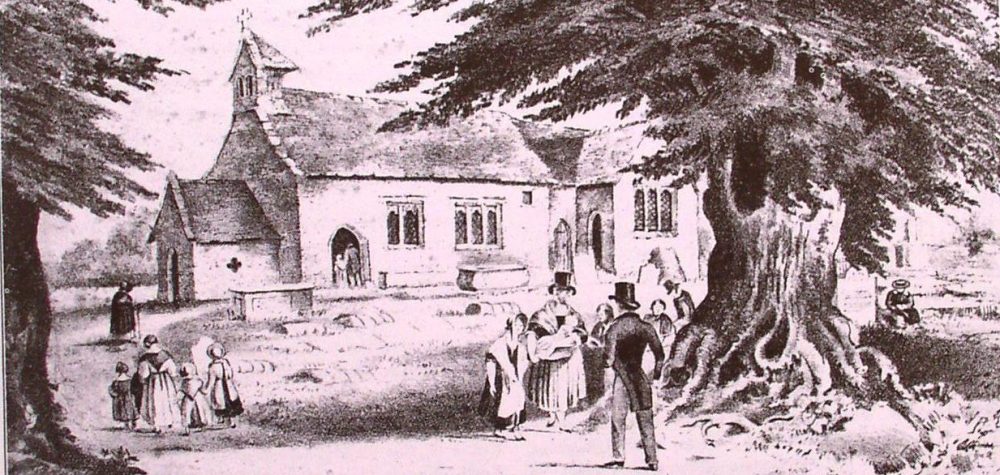
Morgan, Dr D E – USA 1935

February 15th 1935 – Pontypool Man’s Death in America

The death has occured in Phoenix City, U.S.A., at the age of 70 of Dr D E Morgan, a former Pontypool man who emigrated to America as a young man of 19.

Dr. Morgan was the seventh of eleven sons of the late William and Martha Morgan of the Wern, Goytrey, where a family tenancy of 60 years existed. Seven of his brothers survive him, the youngest being Mr David H Morgan of the Gwynedd, Goytrey. Three of the brothers are in America.

Dr Morgan was born in 1864 and in 1883 went to America, where he studied medicine and received diplomas from Illinois State University and the College of Medicine at Milwaukee, Wis..

He married in 1890 and is survived by his wife and two daughters. Two sons and a daughter are dead. He leaves six grandchildren and two great-grandchildren.

The respect in which Dr Morgan was held in the country of his adoption is proved by the obituary notices which appear in the local press. One states:-

Dr Morgan has resided in the Alabama community for so many years that he well may be termed a pioneer citizen. In years gone by, his drug store was a veritable community centre. He was closely identified with the history of his city in its growth and development. During his long, useful life-time, he made a multitude of friends, and he will be greatly missed.

Morgan, Mr C F – 1935

January 18th 1935

An Esteemed Resident of Goytrey. At Maes-y-beran, Goytrey, on Monday, Mr Charles, Francis Morgan passed away in the 80th year of his age. Mr Morgan was formerly a builder at Newbridge, but retired about eight years ago to take up farming at Goytrey, where he was a generous friend of every good cause and will be greatly missed.

For nine years Mr Morgan was a member of Abercarn U.D.C. and a member of the Parish Council. The funeral took place at Abercarn Cemetery yesterday, (Thursday afternoon)

February 15th
Re Charles Francis Morgan deceased. Late of Maes-y-beran, Goytre, Pontypool.

All persons having any claim against the estate of the above named deceased who died on the 14th day of January 1935 are requested to send particulars of same forthwith to us.

Everett & Everett, Pontypool.

1935 Free Press

January 11th – Lost

10s Reward, finder Wire-Haired Terrier, 3 months; missing since January 8th – Jenkins, Arrow Cottage, Goytrey.

For Sale

New modern house and large garden; freehold; suitable poultry; near Pontypool – Abergavenny bus route – apply J Owen, Goytrey.

January 18th – Mr C F Morgan (In obituaries)

February 15th – An Old Record

The following is an extract from the minutes of a parish meeting held on March 11th 1847.
Resolved that the Rev. Thomas Evans be elected guardian for the year ensuing and that Richard Pruett is to receive as salary henceforth for service and cleaning church the sum of seven guineas, to be paid out of the church rate.
And it was unanimously agreed to grant a rate of eightpence in the pound for the necessary repairs for the highway in the parish of Goytrey. – Thomas Evans Chairman: John Williams, Richard Pruett, Thomas Jenkins, Lan Farm, surveyor.

February 15th – Dr. D E Morgan, USA (In obituaries)

Goytrey Parish Council.
Goytrey Parish Council at their last meeting passed a vote of condolences and sympathy with the relatives of the late Mr C F Morgan, Maesyberan, who for the past two years was chairman of the Council.
Messrs A Jeremiah, Robert Logan, Edwin Watkins, John Evans, Harold Stinchcombe and the Vice-Chairman (Mr D H Morgan) spoke in eulogistic terms of their late Chairman supported by by Mr Thomas Jenkins, the oldest member of the Council.

March 8th – “Jones the Weaver” – Mr James Jenkins

In His 95th Year – Death of Goytrey’s Grand Old Man. We regret to record the death of Mr James Jenkins, after a comparatively
short illness at his home, Ty Lloyd, Goytrey on Sunday.

“Jones the Weaver”

The deceased gentleman was in his 95th year and was truly regarded at the “grand old man” of the district. His great age took him back to early Victorian days of which he had a very clear and vivid memory, for his descriptions of outstanding events which took place in the locality and county long ago were always interesting to hear, particularly of the Chartist Riots of 1839 in which his father took part and of the building of the GWR main line nearby, when his cottage was converted into a cider-house.

He had spent all his long life in Goytrey where he was well known and much respected especially by the older inhabitants who remember his gigantic stature when he stood 6ft 6ins tall and weighed over 18 stone.

As a timber cutter he had worked on the Pontypool and Llanover estates and many a stubborn oak fell beneath his sturdy stroke.

A Unique Family

It was remarkable that he had no illnesses before and he possessed all his faculties unimpaired to the last. As the youngest of several brothers, all of whom were admired for their stature and longevity he was the last of a unique family.

Until quite recently he could shoot as straight as the best marksman around and loved to follow the Monmouthshire hounds. His stories of old hunting days, when his woodsman’s tools were often thrown aside to join in the chase, were typical of late Victorian times. Even after his retirement from a life of strenuous labour in the woods, he was ceaselessly active with his orchard and garden and took a great interest in local and national affairs, though he could never read nor write.

He attributed his great age to the healthy surroundings, to plain peaceful living, abstention from modern luxuries and to fresh air exercise.

His wife, who survives him, is 93 and wonderfully smart for her age. In fact they have been an exceptional pair. The funeral was at Goytrey Churchyard on Thursday.

March 15th – Nantyderry

To Investors and Others
Attractive sale of four extremely well built, small, freehold messuages with garden ground and outbuildings, pleasantly and most conveniently situated adjacent to Nantyderry G.W.R. main line, midway between Abergavenny and Pontypool.

Known as, 1,2,3,and 4 Nantyderry Cottages, which J Staker & Son will submit to auction on Tuesday March 26th at the Greyhound Hotel, Abergavenny at 3 o’clock in the afternoon.

April 12th – Mrs M J Jeremiah (In Obituaries)

May 17th – Goytrey Celebrations

Bonfire, Tea, Sports and Fireworks, Captain and Mrs Whitehead’s generosity.
Goytrey Jubilee weeks celebrations commenced on Monday 6th by a display of fireworks at Goytrey Hall and the lighting of a huge beacon on the highest point of the estate. Mr Robert Logan and Mr E J Sobey were in charge and at the lighting of the beacon at 10pm loyal and delicious speeches were made by Capt., Whitehead and Mr A Jeremiah. Hearty cheers were given, a large company of parishioners and others being present.

On Wednesday, May 8th, the festivities were continued, a tea being given for the children attending Goytrey and Mamhilad Council Schools together with the mothers. This event was in the capable hands of a committee of Goytrey and Mamhilad ladies, and right well they did carry out the work.

The table decorations had been prepared by the children of Mamhilad school under the instruction of the headmistress, Miss Lilian Lewis. These looked charming, worked out in sprays of the National colours together with a lovely display of flowers sent by Captain and Mrs Whitehead which set off a double row of tables the whole length of the school, to the greatest perfection.

The Rector of Goytrey, (The Rev. T J Richards) was present at the teas and said grace.

The Sports
After tea the children were marched in relays to a field kindly put at the service of the Committee by Mr Stanley Morgan, Goytrey House Farm, where the genial Rector of Goytrey, with others, kept things going until the sports committee with Mr A Jeremiah (chairman) Mr W I Morgan (Lindhurst, treasurer) Mr Harry Owen, Mr Harvey, Mr John Williams (Clerk to the council) and others had arranged a splendid programme.

At the end a race was put on for married ladies and an unsuspected fleetness of foot was displayed by some competitors. Great enthusiasm was shown in this race as also in the tug – o’ – war which was won by the Mamhilad section.

A hearty vote of thanks to Captain. and Mrs Whitehead was moved by the chairman of Goetre Vawr Council who said that it was through their generosity that the function had been made possible. Mrs Whitehead defrayed all the expenses of the tea whilst Capt. Whitehead had given a substantial sum for the sports etc.

May 24th – Goytrey Motorist Fined For Carless Driving at Newport

Thomas Evan Jones, a Goytrey school-master, was fined £2 and ordered to pay 10s costs at Newport Police Court for having driven carelessly on the main road at Malpas and failing to stop afterwards.

PC Waddington said that he was standing near the police box, not far from the borough boundary, at Malpas, when he saw a cyclist riding towards Llantarnam. Jones was driving the car in the same direction, and seemed to drive right into the cyclist.

The running board of the car struck the offside pedal of the bicycle, he signalled to Jones to stop, but he did not pull up for 111 yards. “He did not seem to have proper control of the car,” said the officer.

The cyclist, Charles James Bright, a Lysaght’s workman said that he managed to put out his foot as he was falling and so saved himself. The car was driven “fairly fast.”

Jones said he was driving very carefully, and had passed several streams of traffic. He saw Bright wobbling about forty yards in from of him, and sounded the horn. There was plenty of room to pass and the course of the impact was the cyclists wobbling.

He did not see the policeman signal, but pulled up on his own accord. He was unaware at that time that he had struck the cyclist for the impact was slight.

A passenger in the car, Albert Higgs, of Goytrey, described Bright as zig-zagging across the road.

September 20th – For Sale

Piano . A really good German Overstrung for sale. Absolute bargain. – Please apply Mr C W Merrick, Goytrey.

September 27th – Served Before Time, A Goytrey Licensing Case

At Pontypool Petty Sessions on Saturday, Arthur William Joseph Jones, licensee of the Goytrey Arms, was summoned for supplying beer during prohibited hours, through his agent, Milicent Reardon, to Percy Philip, Gordon Whittingham (47) a Nantyderry farmer.
Reardon and Whittingham were summoned respectively for supplying and aiding and abetting. They pleaded not guilty.
Mr WHV Bythway, solicitor, Pontypool was for the defendant.

PC Ackland said that at 5.25 pm on Friday, August 16th, he saw Whittingham come out of the front door of the Goytrey Arms with something bulky under his coat. Asked what he had there, he said, “A bottle of hop bitters.” Witness examined it and found it was a bottle of ale. He interviewed the landlord, who said, “I was in the kitchen having my tea.” Reardon said “I supplied it, but it was paid for before three o’clock.” Whittingham said “I was asked to call for it.”

Half an hour too soon.
Mr Bythway: It appears that Whittingham employed a man called Bayliss to cut grass and Bayliss had asked him to call for a bottle of beer. Whittingham could have purchased the beer in Pontypool before three o’clock but as it had been paid for at the Goytrey Arms before three o’clock he called there for it on his way home in his car. There is no question of consumption. It was simply taken away half an hour to soon.

Jones has kept the house ten years without a complaint and I suggest that the magistrates will not consider that there has been a serious offence. Payment of costs was ordered in each case, Jones £1 and Reardon and Whittingham 10s.

December 6th – Sudden death

George Evans, 49, of Bryngwyn Farm, Goytrey, between Abergavenny and Pontypool, collapsed and died on Tuesday while waiting for the bus at Lapstone lane, Goytrey.

December 20th – Goytrey Farm Accident

Compensation Sequel at Pontypool County Court.

An accident on a Goytrey farm was the subject of a case at Pontypool County Court on Wednesday in which Richard David Joseph Williams, poultry farmer, of Coalbrook, Goytrey, was the plaintiff and Evan Davies, of Penywern Farm, Goytrey, the defendant.

Mr Howard Everett, Pontypool for the plaintiff, said the accident happened in December, 1934, when the workman was attending a chaff-cutting machine driven by a horse. His right leg became entangled in one of the shafts, and both bones of the leg were broken. There was a slight shortening of the leg and there was a question as to whether that was due to a certain paralysis from which he suffered before. His wages were low – 15s a week – so that compensation would amount to 11s 3d a week. he still suffered certain amount of incapacity.

The defendant had offered to pay £40. If his honour thought that an inadequate sum, Mr Everett suggested that an adjournment might be ordered to enable the parties to get together. His Honour said he thought £40 was inadequate, and that a sum of £100 would be more suitable. He ordered an adjournment of the case, as suggested by Mr Everett.

Wilks, Mr John – 1931

Full of Years and Honour –  Mr John Wilks

Little Mill Engineering Works Founder

60 years Deacon of Chapel Ed

Born at Penpellenny, Goytre on April 9th 1842 Mr John Wilks passed away at his residence there Friday April 17th 1931 full of years and of honour amongst his own people and of good repute amongst all of his acquaintances far and wide.

Mr Wilks has spent a long, active and useful life and won the affection and esteem of a large number of friends. The son of a smith, he commenced work at an early age, as was common in the days of his youth, and his first job was on the railway at the time when bridge work was in progress.

At the age of 22 he left Goytrey for Pandy, but at the age of 24 he returned home to start a small business of his own, from which has developed the engineering works of Messers Wilks and sons, Little Mill.

Mr Wilks helped the late Col. H Byrde in the works of building of the British School Penperllenny, and served on the committee of management. He was the first chairman of the Parish Council, a position he held for many years, and one in which his intimate knowledge of parochial affairs and business like qualities were of great value. For many years he was a trustee of the Council School.

The Oldest Deacon

For about 60 years Mr Wilks had been deacon at Chapel Ed, he was the oldest deacon of the Presbyterian Connection in the County and by his generosity and loyalty he had been able to keep the work going through storm and sunshine.

His house was an open home to ministers of all denominations and he was ever ready to help any good cause. His uprightness, integrity and good works placed him among the noblest and best of those professing the Christian faith.

In recognition of his great services at Chapel Ed in June 1923 Mr Wilks was presented with an illuminated address as a slight token of the affection and esteem in which he was held.

He took an active interest in the work at Little Mill practically up to the last, but in the latter months his failing health prevented him leaving his Penpellenny home. Amongst letters of condolence received by the family were one from Mr E J Bagley, secretary of the Hope Presbeteryn Church Pandy, and the Parry family at Glannant, and Col. R B Ford of Pontypool.

 The Funeral

The funeral took place on Monday afternoon, and was attended by a very large number of friends of the family from far and near who knew and revered Mr John Wilks as a man of Christian worth and a man of outstanding character in the countryside.

At the house a short service was conducted by the Rev. Thomas Probert, Pontnwynydd, and the Rev. Thomas Cooper, Abertysswg, after which the coffin was borne on the shoulders of relay men to Chapel Ed, which failed to accommodate all who attended.

Mr Charles Merrick presided at the organ and played ‘O Rest in the Lord’ as the cortege entered and ‘Handels Large’ as it left. The service which was conducted by the Rev William Jones of Mozerah commenced with the signing of the hymn ‘O God’.

Inquiry at Goytre on 19th March 1887

Following the death of the Rev. Thomas Evans a new Rector was chosen who could not speak welsh, this was not acceptable to the parishioners of Goytre who wrote to the Bishop of Llandaff requesting a welsh speaking vicar.

The following were called as witnesses on behalf of the welsh speaking inhabitants.

  1. Mary Evans of Capel Hedd
  2. Abraham Williams, Cefn
  3. Aaron Rosser, Kill Farm
  4. Mordecai Jones, Court Robin
  5. Thomas Morgan, Old Stores
  6. William Pugh, Upper Hendre
  7. David Thomas, Goytre House
  8. Evan Phillips, Trwydden Farm
  9. Thomas Jenkin, New Barn
  10. Edward Chapman, New Barn
  11. Joseph Morgan, Ty Ffynon
  12. John Jones, Abergwefflog
  13. Morgan Davies, Tyr Eros
  14. Thomas Davies, Upper Goytre
  15. Richard Morgan, The Penty
  16. William Walters, Penyrhiw
  17. John Harris, Lapstone Cottage
  18. Hy Jones, Penty
  19. George Watkins, ty Yew
  20. Ann Morgan, Penyrhoel
  21. Sarah Jenkins, Ty Nant
  22. Robert Bassett, Pengroesoped
  23. John Moses, Brynstyfrd
  24. Thomas Evans, Gwesty
  25. Rev David Davies, Rhydd-y-merch
  26. Dafydd Williams, Ty Eros Coedd
  27. David Compton, Road repairer

All the above appeared at the examination held at Ty Eros Y Coed on Monday 14th March 1887

The following gave evidence at the enquiry in November 1886 in favour of a welsh speaking clergyman but did not appear at the above examination

  1. William Roberts, Goitre House Farm
  2. Merrick Jenkins, Velin y coed House
  3. Thomas Thomas, Penywern
  4. John Jones, Penywern Cottages
  5. Edward Evans, Goiytre Church Farm
  6. William Williams, Penperllenny
  7. Elizabeth Rosser, Kill Farm
  8. John Evans, Saron Cottage
  9. William Price, Ty Cook
  10. William Lewis, Pencroesybeth
  11. William reece, Black Beech
  12. William Jones, Rose Cottage
  13. James Ralph, Nantyderry Station
  14. John Harding, Gardeners Cottage
  15. Rev. J H Powell, Curate in charge
  16. Joseph Williams

1763 – Goytre in the Diocese of Llandaff

The following statement was made by William Mathew and James Rosser, churchwardens.

  1.  Exclusive of cotts we have about 25 families that pay church and poor but most of ’em are very small farms. None of those are dissenters, nor is there any dissenting meeting house here.
  2. No public or charity school endowed or maintained in our parish etc.
  3. No almshouse, hospital or other charitable endowment, no lands or tenements left for the repair of the church or any pious use etc.
  4. In the absence of our rector, we, the churchwardens humbly beg leave to acquaint your Lordship that there is no house here for the Minister. Mr Hopton Williams Webb, our said Rector, lives in Devonshire at a place called Chumleigh and the reason of his non-residence as we apprehend is the incompetency and smallness of this living and also his not being to discharge the Welch duty.
  5. We have a Curate who resides conveniently, though not in the parish, whose place of residence is a computed mile from our Church. His name is Eli Williams, we believe him duly qualified according to the Canons in that behalf. No parsonage house here. We think this stipend is to be £12 per annum.
  6. We think our Rector does deserve another Church etc., Vid. quer 4th.
  7. We have Devine service and a sermon every Lords day, but not twice, that requiring a whole man for which the stipend is incomplete.
  8. We have the Holy Sacrament here twice monthly.
  9. We think there may be about thirty communicants or upwards and that some few short of that number pretty frequently receive.
  10. Our catechising is here in the spring of the year as often as they appear for that purpose. Many are negligent in sending their children and servants in that account.
  11. We have no Chapel for divine worship in our parish.

1873 Free Press (The Vicar and the Well)

July 19th 1873
Goytre
To the Editor of the Free Press

Sir, – A very worthy and estimable gentleman, the Rev T Evans, rector of Goytre, and Justice of the Peace, came before the public some time ago in the character of a disinterested person and one who was fighting for the good of his parishioners, by opening an old road which was almost forgotten and never used but by an occasional stray donkey.
This same good gentleman has now gone from “opening” to shutting.
A poor woman in the neighbourhood has three children, whom she originally sent to the British School. Mr Evans, who leaves no stone unturned (but in vain) to fill his school, induced this woman, by promises of help and work, to send her children to his school. It seems, however, the promises were not kept, and finding, besides, the children were learning little or nothing, the woman sent them back to the British School.
There happens to be a well near this poor woman’s house, from which, not only she, but all the neighbourhood round, get water. Mr Evans, having the right (?), it seems finding the children were taken away from his school, forbade the woman getting water from the well. Not being able to live without water, however, she disregarded Mr Evans’s word, and went to the well again. On finding this, Mr Evans, with a spirit which deserves high commendation, had the well filled up with stones, so that it was impossible for her or anyone else to get at the water, thus robbing not only one who had offended him, but his own tenants and other persons, of the only water within a long distance, and which in a very dry summer, is the only water to be obtained in the neighbourhood.
Some men at work in an adjacent wood, wanting water, removed the stones and helped themselves to the precious liquid. On finding that stones were of no use to guard this treasure, Mr Evans employed his men in the ennobling and gratifying work of emptying cartloads of earth in the water, and making the hollow in which the well is situated as level as the surrounding field, first of all having a mighty stone weighing 8 or 9 hundred weight hauled on the top of the water. The rev gentleman’s feeling then, on finding that the earth had been thrown out and the apparently impossible feat of rolling the stone from the mouth had been accomplished, must have been of a mild and peaceful nature; for not to be daunted, he again set his men to work, and now, after employing them two or three days, he has succeeded in covering the well, and some distance round it, with 130 or 140 cartloads of stones. The men, it appears, like the work very much, and heartily wish someone would open it again, for they are treated by their liberal employer with plenty of gin and sherry.
The glorious work is now supposed to be finished, so as to gratify his kindly feelings to one poor woman, the clergyman of the parish has taken from many families one of God’s free gifts – the blessing of water – and has closed a well from which water has been obtained (as can be proved) for 40 years. Further remark is unnecessary the facts speak for themselves.                 AQUA

BETTER LET WELL ALONE

I’ve heard of Holy Wells, and holy men
Delighting in well-doing to a brother;
But men who choke their neighbour’s well, and then
Prey for his welfare with a feign’d Amen,
Can they be holy men? – No wholly t’other!

WELL! WELL!                           (There is another much longer poem)

Saturday July 26th 1873
THE WELL AT GOYTRE
To The Editor of the Free Press

Sir, – Two persons Henry Matthews, and David Bowen, have the audacity to question the accuracy of my report of the proceeding

August 2nd 1873
THE CLOSING UP OF A WELL AT GOYTRE
To the Editor of the Free Press

Sir, – One tale is true until another is told.. “Aqua” had not the courage to give his real name. His tale is a tissue of misstatements and  presentations.
Who this scribe is, I know not; but if rumour be true, it is a misfortune to him and a nuisance to others that he is not a water drinker or a total abstainer, for, to my certain knowledge, when, not long since, invited by a friend to his tidy apartment one evening, this worthy poured forth on the fire place – to the disgust of the housekeeper – the entire and unsavory contents of what was once called in Chamber’s Journal “the internal genii” overburdened and in distress. Tell it not at Goytre, nor at Penpellenny.
“Aqua” evidently thinks himself promising, really clever, witty and poetical. The rules of Syntax and Prosally are nothing to him.   Probably by next July his mental development through total abstinence will be such as to enable him to rise to the dignity of a lecturer. The first of the series – a rich treat- will, of course, be delivered in the Town Hall at Pontypool,   on “The use and abuse of salads and liquids.”
The first paragraph in his letter speaks of me as “coming before the public, some time ago, in the character of a disinterested person and one who was fighting for the good of his parishioners by opening an old road, etc.”It is not true that I was “disinterested” in that matter; having a freehold farm with a Grist Mill upon it not far from the north end of the highway alluded to. What conexion, however, there is between the opening of this public road and the shutting up of a well on my private property, about the middle of my field at the Walnut Tree farm. I am unable see. This paragraph is full of personal abuse, and betrays as well the pugnacious ness of the writer as the ignorance and bad spirit of those who aided him.
The second paragraph runs thus: “A poor woman had three children, whom she originally sent to the British School. Mr Evans induced the woman by promise of help and work to send her children to his British School.   The promises were not kept. Finding the children were learning little or nothing, the woman sent them back to the British School.”There are here four sentences, and each sustenance contains a gross mis-statement. It is not true that the children were originally sent to the British School. They were sent originally to the Church School. The parents were for a long time church going people.   The father for a long time was one of my workmen, and nearly up to the day of his death. Hence, the children were so clothed by Mrs. Evans in her own children’s black dresses, hats, etc, that they presented a very respectable appearance at their father’s funeral, and our kindness in this and in other ways seemed to be for a time not a little appreciated. Why they left for the British School in the first instance I know not. There they remained until, some time ago, the mother was fined £3 for a violent assault, by one of the upholders of that school, who happened on that occasion, to be on the Bench and in the chair. In consequence of this circumstance the grandmother declared to me that the children should never again go to the British School, but should return to the National School.It is untrue, therefore, that I induced the mother by promises of help and work to send her children to my school. I had, at the time, no conversation with her on the subject, but with the grandmother. It is true that the latter asked me to give her daughter work. If she had come to Nantyderry to seek it, she would have had it. Why she did not come, I know not, unless she thought the guardian of the parish might reduce the pay for her and her children.
In the third paragraph is contained the point of the letter. – “there happens to be a well near this poor woman’s house, from which not only she, but all the neighborhood round, got water.” Mr Evans having the right (?). it seems, finding the children were taken away from his school, forbade the woman getting water from the well. She disregarded Mr Evans’s word and went to the well again. On finding this, Mr Evans (etc) thus robbing not only one who had offended him, but his own tenants and other persons of the only water to be obtained in the neighbourhood.”There are several wells in the neighbourhood – one in my wood over the road, nearer the cottages. I saw this said poor woman’s boy carrying a can of water from this well this week. She has never been forbidden this. She had, I am told, uniformly used it. It is her own fault that my well in the field, farther away from her and others, is now closed. It is not true that because “finding her children were taken away from my school” I had the well closed up. This is maliciously circulated to stir up feelings of sympathy on the part of the British School, and she has succeeded in doing so. But it is true that, when near the well with my workman, she boldly and insultingly disputed my right to meddle with the well at all, that she claimed a right from custom to come there, and expressed her determination to get water there is defiance of me and everybody else. Had I left the well pen after this, I should have abandoned my own right, and sanctioned what is now demanded, for the first time in the history of the property, as a prescriptive right. I am quite prepared with undoubted evidence to show that notwithstanding the occasional use of it for several years, no prescriptive right has ever been acquired. Within the last 20 years the gate opening to the field and consequently to the well, was locked against parties: and once against a person going to the well, and kept locked.The facts given above serve to show what reliance can be placed upon the accuracy and truthfulness of “aqua”.The well has been opened several times in the night; but on the 18th instant through the influence of Mrs Waites and Mr John Williams, who has taken a most active part in Mrs Waite’s cause and also asserts his right as tenant of the Blackbech to go to the well in question. A party of friends assembled in my field about 4 o’clock in the morning, to their shame be it said, to remove my stones and prevent the contemplated improvement of my property. There were present:William Gwatkin, Church Farm;Isaac Wilks, blacksmith, and son;John Williams, Velinycoed;Abram Pain, mason, Longstone, Lower House, LlanvairIt is observable that the master of the British School, with half a dozen members of his “committee”, were engaged in this lawless work. Fine guides for the young of the rising generation!It is also curious that John Williams of Penwern or of The Buildings, should be so anxious to secure water for Mrs Waites who has already made such bad use of it. When Mr Williams was driving his wife home from the market, Mrs Waites watched her opportunity, and threw a quantity of water over her, and was in consequence fined £3, as above stated. The marvel is still greater when we remember that the outrage produced results endangering the life of his wife, as certified by the doctor. – Yours faithfully

Thomas Evans, Rector of Goytrey.
Nantyderry, July 23rd, 1873.

SINGULAR FACT

To the Editor of the Free Press

Sir, – Being in the neighbourhood of the now notorious well at Goytrey, I took advantage of the opportunity to see and judge for myself. I found full evidence of the truth of “Aqua’s” statement that some 150 cartloads of stones had been thrown into and round about the well. A large quantity was piled over the well, to the height of a couple of feet, and an immense mass of stones surrounded this pile, so that the whole resembled some Druidical remains, the water circle apparently denoting the planetary system, and the inner circle representing the sun, as well by its central position as by its effect in drying up streams and ? excessive thirst. As these masses of stones could not be intended to improve the land (for the purposes stones are generally removed from ploughed fields rather than carted onto them). I have the theory that the worthy Rector is about to add astronomy to the other studies pursued at his school, and designs them for a practical lesson for his scholars, similar to the presumed object of the Druidical stones on Salisbury plain. It this is so it is a pity it is a pity that his purpose should be misconceived. I must, however, confess that he should have chosen some other site, as water is exceedingly scarce thereabouts, and a supply of that vital element is more important, in sultry weather than even the elements of astronomy. The stones themselves cry out against the closing of the well: they have actually combined themselves by strange coincidence, into a distinctly legible word in large letters, anything but complimentary to some one. The word is not Rector, but it is of exactly equal length and begins with the same letter. – Yours truly A WATER DRINKER

INSCRIPTION FOR THE REV. T. EVANS’S WELL AT GOYTREY, WHEN RE-OPENED.

O Traveler stay thy weary feet,
Drink of this fountain cool and sweet,
It flows for rich and poor the same,
Then go thy way remembering still,
The wayside well beneath the hill,
The cup of water in His name

August 9 1873
To the Editor of the Free Press

Sir, – Your impression for Thursday, July 19th, contains a letter from a person signing himself “Aqua,” in which an attempt is made to prove that the Rev. T. Evans, rector of Goytrey, closed a well on his property, thus depriving (according to “Aqua”) many persons of water, because a woman, who was in the habit of using the well, removed her three children from the National School, where they were learning nothing, and sent them to the British establishment.    Goytrey National School  To the Editor of the Free Press.Goytrey, August 5th, 1873.Mr Editor, – As you have put a letter in your paper from the rector of Goytrey about me, will you put a few lines from me in answer to it?When I went to get water from the well, Mr Evans was there, and asked me which way I came. I said “over the hedge,” as he had hedged up the gateway. He said, “You shall not have water here.” I asked him “Where shall I get water?” He said “You may go to Halifax for it. You send your children to that opposition school. You fetch your children from that school, and you shall have work from me and water. What more can I say?” I said my children are doing well where they are, and I will never take them from there again. “That’s enough,” said he, and prevented me from going water by standing between me and the well, and called up his men to fill up the well, and they filled it up with big stones. My father and mother have lived in this area for 40 years; and I have fetched water from that well for 30 years myself. It is the only good water about there. And the only spring that stands in dry summer; and it is the people’s right to have water from it. All the neighbours went to it for generations, till it was filled up. Mr Evans sent his man, John Jones, the clerk, round to the neighbours to tell them that if I took my children from the British School, he would open the well and they should all have water. He was to get them – Mrs Bowen, Mrs Collins, my mother and others – to work upon me, but I would not give in; so he keeps the well shut up with stones piled upon it.
LOUISA WAIT    T.G.LEVO (“Aqua”)
[We must now decline any further correspondence on this subject unless paid for at the advertisement rate.] – Ed.

F. P.. TUESDAY

John Preece, William Preece and Alexander Edgar gave evidence to the effect that John Preece was in the Bailey Glas public house, Mamhilad, on Sunday night,; defendants were there with a lot of other men, when Lewis asked John Preece to turn a glass upside down; an altercation ensued, and the defendants got up and struck him. William Preece interfered, and he was struck; John Preece was afterwards dragged out into a field at the back of the house and there he was kicked and beaten shamefully. Walters deposed that he had been seeing his niece home, and was returning when he saw the defendants and another man coming along the road; he heard them say, “The first b—– man we meet we’ll floor him.” When they came up to him they asked him for some tobacco, and Lewis then sat down in the gutter; he said he did not use tobacco, thereupon they struck him from behind and he fell down; Lewis jumped up and struck him, and they all went into him and drove him across the road; he fell down, and they beat him and kicked him.They were sentenced to two months imprisonment each.

Free Press August 23 1873 THE CLOSING UP OF A WELL AT GOYTRE 

The facts with regard to my wells are simple enough. Not content with this, one or two of them, for reasons best known to themselves, covert access to a more distant reservoir, situated in the middle of one of my fields and fed by one of my drains. But when a certain Mrs Waites, backed by her particularly intimate friend, Mr John Williams, boldly trespassed upon my property, and asserted a right to transgress without my permission, no course was left to me but to vindicate my title by closing the well altogether. If my right is really disputed, let it be tried in the usual way; but if the scum of the neighbourhood, led on by those who should know better, attack my property in an unlawful way, punishment will overtake them sooner or later. As to the attacks directed at my kindly dealing in the parish and neighbourhood, nobody knows better that they are unfounded than John Williams himself, except, indeed, those abettors of higher station, who keep themselves prudently in the background.

THOMAS EVANS, Rector of Goytrey.

To the Editor of the Free Press

Sir.- Mr John Williams and others, in writing about the “Well in the wood”, call it a “stagnant pool” and other hard names, and say it contains only surface water. This I should like to answer.To show that I am speaking the truth , I should be glad if you or your reporter could come here by the 3 o’clock train on Wednesday next, September 3rd, and I would undertake to empty the well for inspection. In fact, the more people there are to see it the better, and thus, as one of the first letters of attack says, “let fact speak for themselves.”

Nantyderry August 27th, 1873 – TRUTH OUT OF THE WELL

He thought both the Truth and the Well to bury,And the Well still flows, Ding-dong bell,Who threw it in? Who’ll take it out? “Dare to say we shan’t . The Rector’s a funny Divine: For their well, “Man alive! Turn’d your water, you see, into WHINE!” Also another longer poem.

SATURDAY THE RECTOR OF GOYTRE AND THE CLOSED WELL

Messrs John Williams, Wood Mill, Miller; John Williams, Penwen, farmer ; William Williams, farmer; Benjamin Jeremiah, butcher; Thomas James, farmer; Thomas James, junior, farmer; Isaac Wilks, blacksmith; John Collins, railway foreman; David Jenkins, labourer; and William Wilks, smith, all of the parish of Goytre, appeared in answer to summonses, in which they were charged with that they on the 16th of August, did commit wilful and malicious trespass on the property of the Rev. Thos Evans, contrary to the statute in that case made and provided. This extraordinary case has caused a great scandal in Monmouthshire. The facts are that the Rector has closed a spring of water in a field belonging to him, not far from Nantyderry station. The inhabitants of the parish claim this well as having been used by the public for at least the last 60 years, and there is no other pure water to be obtained within half-a-mile of the place. The cause of this act is that a poor woman, named Louisa Wait, who lives nearest to the well, has given offence to the rector, and she alleged that this is because she refuses to take her children from the British school and send them to his school. The rector, who has had the misfortune to be at variance with his parishioners on other subjects, has by this depravation of pure water greatly irritated the people; and they promptly opened the well again. He again closed it up, and offered instead of it, what he calls “the well in the wood,” which is nearer to Louisa Wait’s cottage, but instead of being a bubbling spring is a hollow, at the present time mainly, if not altogether, filled with dead, surface water, swarming with animalcules, and not fit to drink. The people asserted their right to pure water. And again broke open the closed well. This closing up and breaking up has been repeated about half a dozen times within the last two months. On Monday last, the rector again had it closed up, and covered with a cairn containing nearly 400 tons of stones of very large size. For taking part in one of the openings the defendants were summoned, and looked forward with glee to the prospect of getting the rector into the witness box, as they wished him questioned as to some queer and very filthy circumstances which they allege to be connected with the closing of the well. Mr Gardner said that his clients were 10 of the most respectable of the inhabitants of Goytre, and they had had no notice of withdrawal from the gentleman by whom the summonses were issued. It was true that a letter had been sent to two or three of them,. But he declined to acknowledge that on the part of the rest. They had been brought from their businesses to-day, and he wished to make a few remarks on the reason why. Mr Gardner said he must ask for permission to make a few remarks. Mr Gardner said his clients had been summoned to attend, and here they were; and they wished the matter gone into and to bring forward their evidence. Mr Gardner said his clients had received no such intimation. It was true that one or two had received a letter to the following effect: – Abergavenny 21st August, 1873, Yours truly,  Mr E. B. Edwards thought it was quite clear. Mr Gardner said the summons appeared to have been issued by Mr C. J. Parkes, whom he had the pleasure of seeing on the bench, and there had been no notice of withdrawal from Mr Parkes. He therefore asked the Bench to deal with the case before dismissing it, and grant his clients’ expenses.Mr Phillips observed it was quite within the province of the Bench to permit withdrawal; and he cited the practice in the County Court, and they could not allow the costs.

The Bench: Yes Same account as in the Free Press about the Police Court followed by:- THE BATTLE OF THE WELL AT GOYTRE The rector of Goytre’s letters of alarm sent to the Chairman of the Pontypool Bench and to Superintendent McIntosh, induced Mr McIntosh to visit Goytre on Saturday night last. He found everything quiet, and that there was not the slightest reason to warrant him sending over an additional police force to prevent a breach of the peace. The village inns had but few customers and were closed early, and the aspect of the police was more tranquil than ordinary. Even the usual indignant cry of “Water! Water!” was not to be heard. We are assured by respectable inhabitants of Goytre, that if any breach of the peace occurs, it will be on the part of the rector’s men, for the parishioners themselves, though determined to assert their right to the well to their utmost, will endeavour to do so without any violence. That they intend to undertake the herculean task of removing the huge cairn which the rector has piled at great expense over the spring, they wish distinctly understood; and they propose to do this not in any clandestine manner, but in open daylight and with the greatest publicity, and to that end it is probable that they will give notice of the day on which they will commence operations. As public sympathy seems to be with them throughout the county, there will probably be an immense gathering from all the neighbouring towns; and the parishioners desire that if anything unseemly takes place during the removal of the stones, the rector, and not they, will be responsible for it.

Police Court

Before Colonel Byrde, Mr C.J.Parkes, and F.J.Phillips Mr Gardner, of Usk, appeared for the complainant; and Mr T Watkins, for defendant.Cross-examined: This was about 10 o’clock, but I am not positive, as I did not notice the time, I came down by the 9 o’clock train from Abergavenny. I was not in any other inn at Nantyderry, except the Refreshment Room. I can’t say whether I had more than two glasses there or not; I don’t believe I had. I had drunk two half-pints in Abergavenny. I was quite sober. I refused to shake hands with Pritchard at the Refreshment Rooms because I am not in the habit of shaking hands with drunken people. He said “I suppose you are in a bad way with me about the filling of the well.” I said “Sit down.” I did not say anything about “nuisance.” I was not one of the crowd who were calling out “Water! water!” and throwing stones at the defendant’s house. I had heard that the well had been filled up that day. I was not one of a crowd who went and broke defendant’s door open. His wife came and challenged any two on the road, but I did not threaten to hit her B——- head off. When I received the blow, I did not see any one else present, but John Bevan and George Howard. Cross-examined: I can’t tell what originated this, because before this happened I was good friends with him and never did anything to “defend” him. I thought it was a very strange thing. There were a few people about that evening. I could not take my oath whether Preece went out of the Refreshment Rooms while I was there, but I never missed him. I was not among any people who went to Pritchard’s house that night. I have never heard till now that Pritchard’s lock was burnt off his door that night. I did not hear Preece threaten to strike Pritchard’s wife. Pritchard’s wife and daughter tried to get him into the house. George Howard deposed: I live at Nantyderry and keep an inn there. I remember the night of the 18th instant. I had gone to bed, but my wife heard a row, and I got up and went out, down to the railway bridge. There I saw John Preece and Bevan talking together. I said to John Preece, “What is this row about.” He replied, “I don’t know: there is a row down there.” Directly afterwards, three ran by me like horses, and I believe the blow was struck. I heard a blow, and turned round, and saw Pritchard, but did not see who it was that struck. There was a scuffle after that, and I walked away. Preece appeared to be sober, and so did Bevan. I could not say in what state Pritchard was. This was about 11 o’clock. I had closed my house and gone to bed. To Mr Phillip’s: I live about 100 yards from Pritchard’s house.Elizabeth Pritchard deposed: I am daughter to defendant, and live in his house at Nantyderry. About half-past 10on the night of the 18th, my mother had gone upstairs to bed, and we had taken off our clothes. We left father lying on the sofa downstairs with his clothes on. Mother and I had been in bed about three quarters of an hour, when we heard a great noise like a drum outside, and people hollering “Come out! And we will give you what for,” and the door was burst open. Father said “Wait till I put my boots on.” We then went outside. There were about 15 men there. Preece and the other witness was among them. (She was asked to point who she meant, and failed to recognise Bevan until he spoke to her). My mother took the broom stick and I took another stick. I had a great long, thick stick but it was not the stick that had been produced; nor did my mother have that stick. Father took the broomstick off mother, and hit one or two in the crowd. Preece had invited him to go to him, and he would give him what for; he had also used bad language, and kicked him on the legs. I did not see Howard there.To Mr Phillips: I am sure that neither mother or myself ever had that stick.Mr Parkes seemed to doubt this. To Mr Watkins: Father said “Is it thee, Preece,” just as he went out through the door. The scuffle followed quickly after.Colonel Byrde said that the magistrates considered that the offence proved, and the defendant was fined 40s, including costs, or 21 days. Supt. M’Intosh said he had received a similar letter from Mr Evans.Free Press September 21st 1872.
Colonel Byrde afterwards said that he had received from the Rev Thomas Evans a letter saying that he anticipated a breach of the peace at Goytre that night; he was aware there were such turbulent people at Goytre, and was sorry to hear of it; he handed the letter to Supt. M’Intosh, and requested him to take steps to prevent any breach of the peace.
The money was paid.
In answer to the Bench, P.C. Allen said that defendant was like a wild man when drunk, and four or five people had recently been assaulted by him, but he had not been convicted; and that Preece was a very quiet man, whose name had never been heard in question in any way.
To Mr Parkes: There was quite enough light to see who was there.
Cross-examined: They had my father down when we got to the end of the bridge. I don’t know any of the others who were there. I believe father struck three with the broom-stick, but not with the stick produced. Father said “Is it thee, Preece,” before he struck him. I caught hold of Preece round the middle and pulled him off father. I believe my father went there to protect himself. It is not 50 yards from our house to the place where this occurred. Father had been in the house three-quarters of an hour before this. I had never seen Preece or Bevan before that night. It was pretty dark.
For the defence, Mr Watkins said that something had been going on about the celebrated well at Goytre. Both parties adjourned to the Refreshment Rooms. Preece, by his own admission, arrived there at 9, and he evidently remained there till 11 o’clock, not 10 as he had stated. In the Refreshment Rooms, the blacksmith offered to shake hands with Preece. Preece refused, saying, “I shall not shake hands with a man who puts nuisances into wells.” The blacksmith went home and went to bed, and after 11 o’clock he heard stones thrown on his tiles, his door was burst open, and a crowd was outside calling “Water!, Water!” Pritchard then sallied forth; his wife had one stick and his daughter had another, and he took the stick from his wife and struck among the crowd who were attacking his house. He could not call the wife to prove this, but he could call the daughter.
Cross-examined: I heard a row, but did not know what it was about.
To Mr Phillips: The blow was not struck in the scuffle.
John Bevan deposed: I am a haulier, and live at Goytre. On the 18th of this month, between 10 and 11 at night, I was standing at the end of Nantyderry bridge, about 40 yards from Pritchard’s house. Preece was with me. I had not gone to Pritchard’s house before that, and I do not believe Preece had done so. He and I left the Refreshment Rooms together. While we were standing at the end of the bridge, Pritchard came up and gave me a blow on the side of the head. I believe his wife and daughter took him back. He came up again, gave me a slap on the shoulder and struck Preece, saying “Here is one of the b———.“ He aimed twice, but we caught the staff and prevented the second blow, and got the staff from him. I was sober, and so was Preece. I can’t say whether Pritchard was sober.
Complainant deposed: I live at Goytre. On the 18th of this month, I had been at Abergavenny, and when I returned, I called at the Refreshment Rooms at Nantyderry. After leaving that place, I was talking with John Bevan on the road, when Pritchard came behind us, and, saying “Here is one of the d—- b—–,“ up with a great stake over my head and struck me. I did not see him before I heard him speak. As he spoke, I saw the blow coming, and turned my head, and received the blow on the back of my neck instead of on my head. He struck at me with the stick a second time, but John Bevan and I caught hold of the stick, and got it from him. This is the stick, which I now produce (between 4 and 5 feet long and 6 inches round at the end). I had not touched him before that. When I went into the Refreshment Rooms, he rose and wanted to shake hands, but I refused to do so. I had left the inn about 5 minutes when he struck me.
William Pritchard, blacksmith, Nantyderry, was charged with assaulting John Preece.
THE DISPUTE ABOUT THE WELL AT GOYTRE
THE EXPECTED RIOT ON SATURDAY NIGHT LAST.
Free Press Sept 6 1873 Page 4
THE WELL DISPUTE – The Sanitary Board for the district has issued instruction that the sanitary inspector, Mr William Morgan, shall take cognizance of the well question at Goytre and an analysis will be made of the water of the “Well in the Wood.” In the meantime, the rector continued to have additional loads of stones piled over the ancient well, Ffynon-cae-y-meinon,” the closing of which has caused so much heartburning.
Abergavenny Chronicle August 30 1873
A conversation, however, ensued among the magistrates, and they decided that an entry should be made that the case was withdrawn.
Mr Gardener: Then I understand the summonses are dismissed?
Some conversation on the point ensued, and Col. Byrde observed: The case is withdrawn and dismissed.
Mr Parkes thought so, too.
Now that seemed to him (Mr Gardner) more like an adjournment of the case and a threat than a distinct withdrawal.
WALFORD & GABB Attornies-at-law.

Sir, – The Rev Thomas Evans has consulted us respecting a wilful trespass committed by you and others on his land at Walnut Tree Farm. Now we hereby give you notice on his behalf that in case of any such repetition of such offence, legal proceedings will be taken against you. We have advised Mr Evans to withdraw the summons already issued against you for the present, and to adopt another course.
Mr Phillips said that if they were inconvenienced they had their remedy in another way; but the case was withdrawn.
Mr Phillips replied that the Bench had nothing before them of which to listen to a speech.
Mr Phillips asked if it was not very irregular that an advocate should proceed – with an address when a case was withdrawn..
When the cases were called on, Mr. E. B. Edwards, clerk to the magistrates, said that the summonses had been withdrawn.

Before Col Byrde, C J Parkes, Esq., and E. J. Phillips, Esq.
POLICE COURT

‘Tis a miracle! I’ve
He says, when parishioners pine
A MODERN MIRACLE
Little Tommy Nant!”
“We!” the People shout;
The Rector? What a sin!
Rubbish in the well!
NURSERY RHYME FOR LITTLE RECTORS
And the Rector is mad, and the people are merry.
But Truth arose,
You’ve heard of the Rector of Nantyderry?
We also hear much about the thickness of the water. This I can easily account for, as on the evening of Friday I caught the son of Mrs Wait and the daughter of Collins stirring up the water, after first filling their cans with clear water. I have the stick in my possessions.   Thus again, “Facts speak for themselves.” I am, sir, yours respectfully, JOHN HARDING.
On Friday last I got a bucket and threw out the water that was in the well. Mr Fabian, the master of the National School, and Mr Isaac Lewis, of Glanwysk, farmer, were present. We found there were sufficient springs, to yield two gallons of water in five minutes. We drank of the water, and it was as good as ever I tasted.
GOYTREFree Press August 30 1873 Page 4
Nantyderry, 20th August, 1873.
I am, Mr Editor, yours faithfully,
If anyone is inconvenienced it is not by my wish, but by the unwarrantable encroachments of one or two ill-conditioned individuals.
Even here I was willing to act kindly and grant permission to those who sought it, to make use of these waters.
I have cleared out a well, at my own expense, for the accommodation of my neighbours (for whom by-the-bye. I am by no way compelled to provide,) and here there is an ample supply.
Sir.- I have neither leisure nor inclination for controversy with persons who deal simply in reckless assertions, utterly devoid of truth.
To the Editor of the Free Press

[ADVT]

Herbert Cowles inn-keeper, also gave evidence.

The prisoners were also charged with assaulting Enoch Walters.

Reece Lewis and William Rowlands were charged with assaulting John Preece and Wm. Preece and Alexander Edgar.

BRUTAL ASSAULT

Before Colonel Byrde and C. J. Parkes, Esq.

Police Court


Bristol, August 5th, 1873.

I am, yours truly,

Truly, Mr Evans should be able to make a fine lecture on “The Use and Abuse of Strong Drink,” for although the parties who opened the well were not stimulated thereto by such beverages, it must have cost the revd. gentleman some money for the quantity he dispensed to his workmen when they were engaged in their unholy work.

Sir, – The beastly impression against me in the first part of Mr Evans’s letter I pass over with contempt. He is too well known in the neighbourhood for his vile slander and abuse to carry any weight. It no doubt reads well to him, but it is a tissue of falsehood from beginning to end, and worthy of the man who penned it. As for the rest of the letter, although he makes out he has a right to the well, it does not do away with the fact that he has shut it, and thus done one of the meanest actions on record. And although the British teacher and member of his committee were present to aid in the opening of the well, does it look as bad to see a minister of the Gospel doing a thing forty times worse, shutting up the well?

To the Editor of the Free Press.

Your obedient servant,

Though a poor woman, it is hard that I should be deprived of water, when the oldest people in the parish have always had it. And that I should not be left to do my best for my poor children.

The other well Mr Evans writes about has been dry this summer, and the water is bad in dry weather.


I had my own reasons for taking my children from Mr Evan’s school. Mr Evans tried all he could to get me to take my children away the second time from the British School. He promised me work, and asked my father to beg and get me to do so. No one asked me to send them there.


P.S. The above letter was sent for insertion in reply to one which appeared in the PRESS for July 19, 1873, but the Editor refused to publish it otherwise than as an advertisement.

July 21st, 1873.

I am, sir, yours truly, A.C.Fabian.

I am not of course attempting to defend the rector, as that gentleman is far better qualified than I to answer such a puerile attack as that of “Aqua’s.”

Secondly, as to their learning, of course that does not affect me, as they were under my charge but one or two weeks; but from fourteen years experience, I am quite convinced that the work of this school had been carried on under the late master, to say the least, quite as efficiently as at the British. This seems, in my opinion, a cheap way of advertising the last-mentioned establishment.

My reason for wishing to expel them was that their conduct was so bad, that several of the most respectable of parents had informed me that it was simply a question of whether these children left or theirs.

With your permission, I should like to correct the erroneous impression which the above is calculated to convey. In the first place, “Aqua” is not correctly informed, or else he is wilfully mis-representing facts, as the children were removed by their mother to save appearances, as I had applied to the Rector to expel them, and of this I had informed them before the whole school.


[ADVT]


The wayside well beneath the hill,

It flows for rich and poor the same,

O Traveler stay thy weary feet,

INSCRIPTION FOR THE REV. T. EVANS’S WELL AT GOYTREY, WHEN RE-OPENED.

Sir, – Being in the neighbourhood of the now notorious well at Goytrey, I took advantage of the opportunity to see and judge for myself. I found full evidence of the truth of “Aqua’s” statement that some 150 cartloads of stones had been thrown into and round about the well. A large quantity was piled over the well, to the height of a couple of feet, and an immense mass of stones surrounded this pile, so that the whole resembled some Druidical remains, the water circle apparently denoting the planetary system, and the inner circle representing the sun, as well by its central position as by its effect in drying up streams and ? excessive thirst. As these masses of stones could not be intended to improve the land (for the purposes stones are generally removed from ploughed fields rather than carted onto them). I have the theory that the worthy Rector is about to add astronomy to the other studies pursued at his school, and designs them for a practical lesson for his scholars, similar to the presumed object of the Druidical stones on Salisbury plain. It this is so it is a pity it is a pity that his purpose should be misconceived.   I must, however, confess that he should have chosen some other site, as water is exceedingly scarce thereabouts, and a supply of that vital element is more important, in sultry weather than even the elements of astronomy. The stones themselves cry out against the closing of the well: they have actually combined themselves by strange coincidence, into a distinctly legible word in large letters, anything but complimentary to someone. The word is not Rector, but it is of exactly equal length and begins with the same letter. – Yours truly A WATER DRINKER


Nantyderry, July 23rd, 1873.


Members of the British School Committee

Benjamin Jeremiah, butcher;

Thomas James, jnr, Ty Cooke;

Mr Levo, master of the British School;

Police Court

Before Col. Byrde & C J Parker esq.

Pigs out for a Walk

William Williams was charged with allowing his pigs to stray on the highway, in the parish of Goytre. He said he knew nothing about it, as he was at home only once a week.

Mr Williams, surveyor to the Usk Highways Board, said he found the pigs on the highway near Penplenny, and Mrs Williams admitted they were hers; he had cautioned her about the same sort of thing before: this was the first case of the sort that he had brought forward at this court.

Col. Byrde said it was only right that people should have notice that they are liable to be summoned for this kind of trespass.

Defendant said he had not received such a caution; but he could not say whether his wife had.

Thomas Jenkins also of Goytre was similarly charged. He did not appear, and P C Williams proved service of the summons. The surveyor said this was a much worse case than the other, as Jenkins pigs were continually in the road.

Col. Byrde said that as these were the first cases of the sort, the Bench would require payment of the expenses only; 9s in the first case and 9s 6d in the other.


Abergavenny Chronicle Saturday, September 6, 1873

DSITRICT INTELLIGENCE.

PONTYPOOL

THE DISPUTED WELL AT GOYTREY – At the police-court on Saturday (before Colonel Byrde, Mr C.J.Parkes, and F.J.Phillips), a case of assault, arising out of the dispute respecting a well which the rector of Goytrey is alleged to have closed on his property, and thus deprived a portion of his parishioners of a supply of pure water. Putting the evidence given on both sides together, the facts seem to be that, on the night of the last closing of the well, a number of exited parishioners gathered around the house of a blacksmith, named William Pritchard, living near the Nantyderry railway-station, and because he had taken part in piling the stones on the well, set up a cry of “Water, water!” threw stones on the tiles and burst open the door. Previous to this Pritchard had visited the Nantyderry refreshment rooms, kept by Mr Williams, and there met with John Preece, and offered to shake hands with him. Preece refused, saying he did not shake hands with a man who put nuisances into wells. Preece and his friends deny that he left the refreshment room, and that he took any part in the demonstration against the blacksmith; and state that when they left to go home, Pritchard suddenly attacked them from behind in the road with a bludgeon about five feet long and six inches round (produced in court), and crying “there is one of the b———!” aimed at Preece’s head, but Preece saved his crown by dodging his head and received the blow on his shoulders. The weapon was raised to give another blow, when Preece and his friend seized it and wrested it from the blacksmith.

The statement on the other side was that Preece and his friend took part in the attack in the house; that Pritchard’s wife sallied forth with the broom handle and his daughter with another large stick, and that Pritchard, on being maltreated on issuing from his premises seized the broom handle from his wife, and laid about him in the crowd. This was flatly contradicted by Preece and his witness. Pritchard was described by Police-constable Allen as being like a mad man when under the influence of liquor and a very quarrelsome fellow, while Preece was described by the same authority as being a very quiet man, against whom nothing has ever been heard. The Bench fined Pritchard 40s, or 21 days hard labour.

After the hearing of the case, colonel Byrde said that he had received a letter from the Rector, stating that expect another row that (Saturday) evening, and that he requested that steps might be taken to prevent a breach of the peace.

Superintendant M’Intosh said that he had received a similar letter from the Rector and he intended to go over in the evening.


September 13 1873

THE DISPUTE ABOUT THE WELL AT GOYTE

The Rector of Goytre, the Rev Thos Evans, finding that finding that the parishioners who assert their right to the “Well in the Narrow Field” have expressed their determination to get at the spring, notwithstanding the immense cairn which he has piled over it, on Saturday recommenced hauling stones to add to the cairn, and on Monday several carts were busily engaged in their work. On Tuesday, our correspondent again visited the scene of the dispute. He found that within the past fortnight the Rector has gone to considerable trouble in improving the “Well in the Wood.” Indeed, the aspect of this well is altogether changed. The bottom has been cleaned out; the stones have been taken out and builded into a wall on one side; and a good drain has been cut through the field to carry off the water and prevent it from stagnating. By this means the accumulation of dead (or rather too lively) water which existed in the well on August 21st (when our correspondent carried away a sample which afforded a very interesting spectacle under the microscope) has been good rid of: and the water found in the well on Tuesday was of much superior quality, and a sample has been brought away. We are assured, however, by disinterested and important observers, that the springs in this “Well in the Wood” are very weak, and on Tuesday a quantity of green slime had again began to accumulate. The rector, we are told, intends to sink this well deeper, in order to further increase the yield. All this, however, does not appease the parishioners. They adhere to the great point on which they are at issue, the question of their right to the Well in the Narrow Field. On this, they have appealed for the interference of the authorities, and have embodied their complaints in a memorial very numerously signed. They have decided not to attack the cairn in the meantime; and to give public notice of the day on which they will commence operations, if the inquiry which is to be instituted results in their favour. They are the more determined to adhere to this question of right, as they say that Mr Henry Matthews, a farmer living on the other side of Penplenny (and who is one of the rector’s partizan’s) has begun to lock and fence with thorns his gate leading to the Black Well. To which they claim the right of usage, and which they assert is one of the main sources of supply in dry summers, etc. On the other hand, Mrs Jenkins, of Tydoman, has cleaned out for the public a branch of the Black Well (about 20 or 30 yards further) on her property, and thereby won their good word. Of course, these are matters that will cause subjects of inquiry, and we merely chronicle them without expressing any opinion on the rights of any parties. Our correspondent has carefully refrained from repeating the mass of racy information which the folk of Goytre are ready to pour into the ears of any visitor; and he maintains the accuracy of his reports.


Police Court

DISPUTED WALNUTS

William Watkins was charged with trespass, by taking walnuts, the property of Margaret Morgan, at Penplenny.

William Williams deposed that he was gathering the walnuts, when defendant came and picked some of them up and got a loader and went to another tree, and helped himself ; he told him he had better leave them alone, and he replied that he did not think that he had; defendant said that he had been working for John Harris , who told him that he could have as many of the walnuts as he liked; these trees formerly stood on the waste, but had been hedged in about 8 years; Harris threw the fence down, about 6 months ago; witness here handed in some documents, to prove his right, and printed notices had been fixed to the trees ; defendant tore on of these notices down and made fun of it.

Defendant denied that he took any of the walnuts.

Henry Jeremiah was called as witness for the defence, but he deposed that he saw Watkins knock the walnuts down.

John Harris deposed that the defendant put the ladder against a bough that overhung the public road; witness had pulled the fence down, by orders of the Earl of Abergavenny’s agent.

The Bench said that the trespass was clearly proved, and the defendant must pay 16s


Saturday, October 11th 1873


The Well at Goytre

_________________________________


THE STONES TO BE REMOVED

_____________________________


The parishioner of Goytre whish it to be

Be known that they have determined to re-

open the “Well in the Narrow Field,” on

Thursday next, October 19th. They at the

same time desire it to be understood, that

they wish for no disturbance.

THOMAS JAMES


October 11th 1873 – GOYTRE

A treat was given by the rector, the Rev. Thomas Evans, on the 11th ult., to the children of the National School, their parents and many other parishioners. The day was fine and the treats considered by all present a great success. Mr Bigglestone, of Abergavenny, supplied 200lbs of most excellent cake for the occasion. Mr Fabian, the schoolmaster, from Winchester training College, who holds a first-class certificate, and has 14 years of experience in teaching, exerted himself most praiseworthily (assisted by his wife) in amusing the children, and many nice prizes were distributed for races, etc. After which four balloons were sent off, and a very good display of fireworks finished the day’s entertainment. The rector chiefly at his own expense has succeeded, under many discouragements, so far in meeting all Government requirements and keeping a School Board out of the parish.


Police Court

DISPUTED WALNUTS

William Watkins was charged with trespass, by taking walnuts, the property of Margaret Morgan, at Penplenny.

William Williams deposed that he was gathering the walnuts, when defendant came and picked some of them up and got a loader and went to another tree, and helped himself ; he told him he had better leave them alone, and he replied that he did not think that he had; defendant said that he had been working for John Harris , who told him that he could have as many of the walnuts as he liked; these trees formerly stood on the waste, but had been hedged in about 8 years; Harris threw the fence down, about 6 months ago; witness here handed in some documents, to prove his right, and printed notices had been fixed to the trees ; defendant tore on of these notices down and made fun of it.

Defendant denied that he took any of the walnuts.

Henry Jeremiah was called as witness for the defence, but he deposed that he saw Watkins knock the walnuts down.

John Harris deposed that the defendant put the ladder against a bough that overhung the public road; witness had pulled the fence down, by orders of the Earl of Abergavenny’s agent.

The Bench said that the trespass was clearly proved, and the defendant must pay 16s.


October 4th 1873

Police Court

POT VALIANT

John Rosser was charges with assaulting John Watkins. Complainant said he lived in a house for which he paid rent to William Morgan, and the Rossers laid claim to these premises and attacked him on the road in consequence of the grudge engendered by the claim. Rosser was further charges with assaulting Thomas Watkins, son of James Watkins. The defence was that the Watkinses were the aggressors. James Watkins was charged with assaulting Martha Rosser. Some very foul language was used in describing the affray; and it seemed that some of the parties had been drinking until they were pot-valiant. A Mrs Crockett was called to show that the Watkinses were very violent; but Mrs Watkins who was with her husband and son, denied this.

The bench fined Rosser 20s, or 14 days, for assaulting James Watkins; and 20s, or 14 days, for assaulting Thomas Watkins; and dismissed the charge of assault preferred by Martha Rosser against James Watkins, and ordered her to pay the costs.


Saturday, October 18th 1873

THE EXTRAORDINARY PROCEEDINGS AT GOYTRE

The parishioners of Goytrey, yesterday (Thursday) carried out their expressed intention of opening the now renowned “Well in the Narrow Field,” which was closed against them by the rector, the Rev Thomas Evans, in May last. At five o’clock in the morning, some thirty-five farmers assembled at Penplenny, and marched from thence to the well. It was expected that a determined resistance would be made by men in the pay of the rector, and supt. M’Intosh and Supt. Freeman (Abergavenny) drove over to prevent any disturbance. P.c. Allen from Llanover, and P.c. Lawrence, who has for some weeks been stationed at Nantyderry at the rector’s expense was also present. The rector’s men had on the previous day hauled a great addition to the great heap of stones (now estimated to contain upwards of 1000 tons) which he had piled over the well, and had newly fenced the old approach by which the well was reached; and groups of them stood about the road yesterday morning, but they offered no resistance. The farmers were joined by others near the “Narrow Field,” and, without breaking down the fence, got over it and set to work in the most energetic manner. The first stone was removed by Mrs Waite, who has figured as the heroine of the matter. The stones flew rattling on both side and the noise as they rolled down the cairn was heard was heard at a considerable distance. Some idea of the vigour of the workman may be inferred from the fact that in five hours’ time the well was opened. And then the truth of the alleged pollution was then indisputable. After the great stones and the roots of trees had been removed so as to allow an approach to the long-hid spring, the attacking party came to a mass of broken bottles mingled with the filth, the existence of which had been denied.

The stench was abominable. A deputation was sent to get Colonel Byrde, a magistrate who lives near the place, to verify the truth of the discovery, but that gentleman had gone from home. Many inquiries were made for the local sanitary inspector, who was not present. About 1 o’clock, Mr Rogers, an elderly gentleman from Pontypool, expressed his regret at not being able to get over the fence and into the field and immediately the fence was torn away. Colonel Byrde and the Rev S. W. Gardner, rector of Llanfiangel-Gobion, both members of the sanitary committee, shortly afterwards arrived, and inspected the place. Mr Gardiner expressed his gratification that the proceedings had been conducted in orderly a manner, and added, emphatically, “I am a rector, but not a rector of Goytre!”   A ringing cheer from the assembled crowd followed. Mr Gwatkin, of Church Farm, then mounted the cairn, and said “I am about to make a bit of a speech, the well is opened, and we have all seen its imperfections. We will now leave the place with the gentleman, and go quietly to our homes. The rector has his remedy against us if he likes; and if he clears up the well again, we shall have our remedy against him. We will now leave the field, and other can come to see the place if they like.” The people then left the field in an orderly manner.

After leaving the field a crowd continued to hang about the road, and shortly before three o’clock, a man named Charles Llewellin, evidently tipsy, arrived on the scene, and occasioned some commotion. He was hailed as one of the men who put the filth in the well and the yelling and hooting that arose was by no means complimentary. He had the temerity to go down the cairn, and was invited to taste the abomination in the hollow. Some of the women talked of putting him into the well, and they evidently had much to do to restrain themselves. He was allowed to leave, but was followed by a mob, who hooted him along the road, he waving his hat in bravado the while. The police followed, but happily no breach of the peace occurred, if we may except a dog-fight, which was speedily stopped. It was said that Llewellin was sent as a scout to see whether the coast was clear, that the work of refilling the well might commence at once.

In the course of the afternoon, Mrs Edwards, photographer, of Pontypool, visited the scene and took two effective pictures of the cairn, one of them showing the entrance made yesterday.

Saturday, October 25th, 1873

THE EXTRAORDINARY PROCEEDINGS AT GOYTRE

The Rev, Thomas Evans, rector of Goytre, lost no time in having once more re-enclosed the renounced “Well in the Narrow Field,” the public forcible re-opening of which by the parishioners, and the verification of the fact or the revolting pollution of the springs, took place on Thursday last, October 16th. Mr Isaac Lewis of Glan Usk (the farmer in whose house the horrible mutilation of an infant by a servant girl recently occurred), acting on the instructions of the rector (who has for two or three weeks been absent from the parish), set a gang of men to work on Friday, at high wages and with plenty of drink (a feature which has distinguished the previous re-openings of the well), and the spring and the passages to it through the immense cairn which Mr Evans has had piled over it, are again filled up. It is said that instructions have also been given that the work of adding to the cairn (containing upwards of 1000 tons, and the immense size of which is shown in some pictures taken by Mrs Edwards, photographer, Pontypool) will be continued throughout the winter.


October 25 1873

Police Court

POT VALIANT

John Rosser was charges with assaulting John Watkins. Complainant said he lived in a house for which he paid rent to William Morgan, and the Rossers laid claim to these premises and attacked him on the road in consequence of the grudge engendered by the claim. Rosser was further charges with assaulting Thomas Watkins, son of James Watkins. The defence was that the Watkinses were the aggressors. James Watkins was charged with assaulting Martha Rosser. Some very foul language was used in describing the affray; and it seemed that some of the parties had been drinking until they were pot-valiant. A Mrs Crockett was called to show that the Watkinses were very violent; but Mrs Watkins who was with her husband and son, denied this.

The bench fined Rosser 20s, or 14 days, for assaulting James Watkins; and 20s, or 14 days, for assaulting Thomas Watkins; and dismissed the charge of assault preferred by Martha Rosser against James Watkins, and ordered her to pay the costs.


October 18th 1873 – Goytrey in the County Court

The latest phase of the Goytrey dispute took the form of proceedings in Usk County Court on Tuesday, against the rector, the Rev Thomas Evans, who appeared by his attorney, Mr Gabb (Walford and Gabb), Abergavenny.

In the first case, Mr John Williams, of Penwern Farm, sought to recover £2, for damage sustained by the cleaning and deepening of a ditch by defendant’s drainers ……Mr Gardner was for plaintiff ……… Mr David Roberts, of Llanbaddock, and Mr John Thomas, of Mamhilad, gave evidence as the amount of the alleged damage. Mr Roberts said it would take two carts, three horses, and three men a day to remove the soil thrown on the plaintiff’s land, and the cost of so removing would be about £3 3s …. Mr Thomas put the cost of removal: three horses at 8s each a day; three men at 3s each; making £1 13s …… The plaintiff said his witnesses contended that he had sustained further considerable damage, by the flooding of his land, and by risk to his stock through the dangerous ditch made. William Pardoe, examined for the Plaintiff said that he had been employed by defendant to drain the land, and that directions were given him, on defendant’s behalf, by Isaac Lewis and John Harding. The natural outfall was into the ditch in question. The clearing of the ditch was measured with other work, and paid for by the defendant …….. Mr Isaac Lewis said that defendant, when going from home, had asked him to direct Pardoe. Defendant himself knew nothing about the matter now complained of. He (Mr Lewis) could remove the soil from Plaintiff’s land in three cartloads …….. Mr Henry Matthews, farmer, Mamhilad put the cost of removal at 4s ……… Mr Gabb for the defence, contested that the action was brought out of vindictive feeling arising out of the “well” dispute, ….. His Honour: another illustration of the old adage, “Let well alone.” … Mr Gabb further contended that the work complained of was done by the workman without defendant’s knowledge … His Honour said that defendant would be responsible. He had no right to interfere with plaintiff’s ditch without his consent. The ditch might be the natural outfall for surface water from the defendant’s land, but this did not entitle him to under-drain his land, and so increase the flow of water in the ditch. He should give judgement for plaintiff for 15s, but if the Plaintiff was not satisfied with that amount then Mr Graham, the high- bailiff, would visit the place and assess damages. … This latter course was agreed upon … In course of the hearing His Honour characterised the case of the most trumpery ever brought before him.

There were about ten summonses taken out against Rev Thomas Evans by parishioners of Goytrey on which they sought to recover damages for loss on time in attending Petty Sessions at Pontypool, in answer to summonses which were withdraw by the rector … His Honour said they could not recover damages in the County Court; the magistrates might have granted expenses if they thought proper … Mr Gardner said it was hard that people should be drawn away from their businesses on a frivolous charge, and obtain no compensation … One of the magistrates at Pontypool had referred them to the County Court … His Honour: The magistrate at Pontypool cannot give me jurisdiction … The cases were then struck out.


September 6th 1873 – The Battle of the Well at Goytrey

The Expected Riot on Saturday Night Last

The rector of Goytre’s letters of alarm sent to the Chairman of the Pontypool Bench and to Superintendent M’Intosh, induced Mr M’Intosh to visit Goytre on Saturday night last. He found everything quiet, and that there was not the slightest reason to warrant him sending over an additional police force to prevent a breach of the peace. The village inns had but few customers and were closed early, and the aspect of the police was more tranquil than ordinary. Even the usual indignant cry of “Water! Water!” was not to be heard. We are assured by respectable inhabitants of Goytre, that if any breach of the peace occurs, it will be on the part of the rector’s men, for the parishioners themselves, though determined to assert their right to the well to their utmost, will endeavour to do so without any violence. That they intend to undertake the herculean task of removing the huge cairn which the rector has piled at great expense over the spring, they wish distinctly understood; and they propose to do this not in any clandestine manner, but in open daylight and with the greatest publicity, and to that end it is probable that they will give notice of the day on which they will commence operations. As public sympathy seems to be with them throughout the county, there will probably be an immense gathering from all the neighbouring towns; and the parishioners desire that if anything unseemly takes place during the removal of the stones, the rector, and not they, will be responsible for it.


The Dispute about the Well at Goytrey

Before Colonel Byrde, Mr C.J.Parkes, and F.J.Phillips

William Pritchard, blacksmith, Nantyderry, was charged with assaulting John Preece.

Mr Gardner, of Usk, appeared for the complainant; and Mr T Watkins, for defendant.

Complainant deposed: I live at Goytre. On the 18th of this month, I had been at Abergavenny, and when I returned, I called at the Refreshment Rooms at Nantyderry. After leaving that place, I was talking with John Bevan on the road, when Pritchard came behind us, and, saying “Here is one of the d—- b—–,“ up with a great stake over my head and struck me. I did not see him before I heard him speak. As he spoke, I saw the blow coming, and turned my head, and received the blow on the back of my neck instead of on my head. He struck at me with the stick a second time, but John Bevan and I caught hold of the stick, and got it from him. This is the stick, which I now produce (between 4 and 5 feet long and 6 inches round at the end). I had not touched him before that. When I went into the Refreshment Rooms, he rose and wanted to shake hands, but I refused to do so. I had left the inn about 5 minutes when he struck me.

Cross-examined: This was about 10 o’clock, but I am not positive, as I did not notice the time, I came down by the 9 o’clock train from Abergavenny. I was not in any other inn at Nantyderry, except the Refreshment Room. I can’t say whether I had more than two glasses there or not; I don’t believe I had. I had drunk two half-pints in Abergavenny. I was quite sober. I refused to shake hands with Pritchard at the Refreshment Rooms because I am not in the habit of shaking hands with drunken people. He said “I suppose you are in a bad way with me about the filling of the well.” I said “Sit down.” I did not say anything about “nuisance.” I was not one of the crowd who were calling out “Water! water!” and throwing stones at the defendant’s house. I had heard that the well had been filled up that day. I was not one of a crowd who went and broke defendant’s door open. His wife came and challenged any two on the road, but I did not threaten to hit her B——- head off. When I received the blow, I did not see any one else present, but John Bevan and George Howard.

John Bevan deposed: I am a haulier, and live at Goytre. On the 18th of this month, between 10 and 11 at night, I was standing at the end of Nantyderry bridge, about 40 yards from Pritchard’s house. Preece was with me. I had not gone to Pritchard’s house before that, and I do not believe Preece had done so. He and I left the Refreshment Rooms together. While we were standing at the end of the bridge, Pritchard came up and gave me a blow on the side of the head. I believe his wife and daughter took him back. He came up again, gave me a slap on the shoulder and struck Preece, saying “Here is one of the b———.“ He aimed twice, but we caught the staff and prevented the second blow, and got the staff from him. I was sober, and so was Preece. I can’t say whether Pritchard was sober.

Cross-examined: I can’t tell what originated this, because before this happened I was good friends with him and never did anything to “defend” him. I thought it was a very strange thing. There were a few people about that evening. I could not take my oath whether Preece went out of the Refreshment Rooms while I was there, but I never missed him. I was not among any people who went to Pritchard’s house that night. I have never heard till now that Pritchard’s lock was burnt off his door that night. I did not hear Preece threaten to strike Pritchard’s wife. Pritchard’s wife and daughter tried to get him into the house.

To Mr Phillips: The blow was not struck in the scuffle.

George Howard deposed: I live at Nantyderry and keep an inn there. I remember the night of the 18th instant. I had gone to bed, but my wife heard a row, and I got up and went out, down to the railway bridge. There I saw John Preece and Bevan talking together. I said to John Preece, “What is this row about.” He replied, “I don’t know: there is a row down there.” Directly afterwards, three ran by me like horses, and I believe the blow was struck. I heard a blow, and turned round, and saw Pritchard, but did not see who it was that struck. There was a scuffle after that, and I walked away. Preece appeared to be sober, and so did Bevan. I could not say in what state Pritchard was. This was about 11 o’clock. I had closed my house and gone to bed.

Cross-examined: I heard a row, but did not know what it was about.

To Mr Phillip’s: I live about 100 yards from Pritchard’s house.

For the defence, Mr Watkins said that something had been going on about the celebrated well at Goytre. Both parties adjourned to the Refreshment Rooms. Preece, by his own admission, arrived there at 9, and he evidently remained there till 11 o’clock, not 10 as he had stated. In the Refreshment Rooms, the blacksmith offered to shake hands with Preece. Preece refused, saying, “I shall not shake hands with a man who puts nuisances into wells.” The blacksmith went home and went to bed, and after 11 o’clock he heard stones thrown on his tiles, his door was burst open, and a crowd was outside calling “Water!, Water!” Pritchard then sallied forth; his wife had one stick and his daughter had another, and he took the stick from his wife and struck among the crowd who were attacking his house. He could not call the wife to prove this, but he could call the daughter.

Elizabeth Pritchard deposed: I am daughter to defendant, and live in his house at Nantyderry. About half-past 10on the night of the 18th, my mother had gone upstairs to bed, and we had taken off our clothes. We left father lying on the sofa downstairs with his clothes on. Mother and I had been in bed about three quarters of an hour, when we heard a great noise like a drum outside, and people hollaing “Come out! And we will give you what for,” and the door was burst open. Father said “Wait till I put my boots on.” We then went outside. There were about 15 men there. Preece and the other witness was among them. (She was asked to point who she meant, and failed to recognize Bevan until he spoke to her). My mother took the broom stick and I took another stick. I had a great long, thick stick but it was not the stick that had been produced; nor did my mother have that stick. Father took the broomstick off mother, and hit one or two in the crowd. Preece had invited him to go to him, and he would give him what for; he had also used bad language, and kicked him on the legs. I did not see Howard there.

Cross-examined: They had my father down when we got to the end of the bridge. I don’t know any of the others who were there. I believe father struck three with the broom-stick, but not with the stick produced. Father said “Is it thee, Preece,” before he struck him. I caught hold of Preece round the middle and pulled him off father. I believe my father went there to protect himself. It is not 50 yards from our house to the place where this occurred. Father had been in the house three-quarters of an hour before this. I had never seen Preece or Bevan before that night. It was pretty dark.

To Mr Phillips: I am sure that neither mother or myself ever had that stick.

To Mr Parkes: There was quite enough light to see who was there.

Mr Parkes seemed to doubt this. To Mr Watkins: Father said “Is it thee, Preece,” just as he went out through the door. The scuffle followed quickly after.

In answer to the Bench, P.C. Allen said that defendant was like a wild man when drunk, and four or five people had recently been assaulted by him, but he had not been convicted; and that Preece was a very quiet man, whose name had never been heard in question in any way.

Colonel Byrde said that the magistrates considered that the offence proved, and the defendant was fined 40s, including costs, or 21 days.

The money was paid.

Colonel Byrde afterwards said that he had received from the Rev Thomas Evans a letter saying that he anticipated a breach of the peace at Goytre that night; he was aware there were such turbulent people at Goytre, and was sorry to hear of it; he handed the letter to Supt. M’Intosh, and requested him to take steps to prevent any breach of the peace.

Supt. M’Intosh said he had received a similar letter from Mr Evans.


November 8th 1873


CHAPEL-ED, – The anniversary services of the above place were held on Sunday and Monday, November 2nd and 3rd, when the Revd W.G.Owen, Abergavenny; George Phillips, Norwich; Robert Thomas, Hanover; and D. Saunders, Abercarne, preached the sermons. The services were well attended throughout both days, and the collections were up to our expectation. We are glad to say that – though the people of this neighbourhood are prevented from partaking of the water of this life, from a certain well, by a certain clergyman, – the water of the Wells of Salvation ran more copiously than ever at Chapel-Ed on Sunday and Monday last. And the voice of invitation to the rev. gentleman who preached the word was like the voice of Him who, on the great day of the feast, stood and cried unto the thousands, saying, “If any man thirst, let him come unto me and drink.” And if we mistake not, we heard the voice of the “Spirit and the Bride say, Come.” So that many thirsty souls quenched their thirst in drinking from their living streams. We lond to hear such services again. Con.


November 15th 1873 – Hanover

The annual tea-meeting of the Sunday school of the above place was held on Thursday, Nov. 6th. The Hanover Sunday school treat is a well known fact in the county now: the people for many miles around look upon it as something that must take place, as the season of the year comes round. Though it was somewhat later this year than usual, still we are happy to say that the postponement did not affect it in the least. The day proved very favourable. If the sun did not shine, the clouds were scattered, and the moon of the night did us the kindness to light out path homeward. The gathering this year was equal to that of the previous one. We do not know the exact number of those who took tea; but a great number of children and their friends came together to partake of the excellent tea and cake, were served out in a manner that reflected great credit on the ladies who prepared and presided over it. After doing justice to the tea and cake, we retired to the chapel, which was beautifully decorated with flowers, evergreens, and appropriate mottoes. We were at once convinced that those who performed this part of the work are both admirers of both nature and art. At 7 o’clock, a public meeting of recitation and singing was held; Col. H. C. Byrde, Goytre House, in the chair. All who know Col. Byrde know him to be a warm advocate of Sunday school work. He is never more happy than when surrounded by children. His face was an index of the feelings of his heart on this occasion. We must say that the getting up of such a meeting as this incurred a certain amount of labour and perseverance on the part of both students and teachers. The singing was also rendered very effectively, under the leadership of Mr Lewis Jones. After a vote of thanks to the worthy chairman was proposed by the Rev W. F. Jones, Goytre, seconded by the Rev Robert Thomas, (minister), and the Benediction pronounced by the chairman, we returned to our homes, having enjoyed ourselves unto out hearts’ utmost desire.- Cor.


December 20th 1873

On Wednesday the 3rd inst., services – morning and evening – were held at the above church, thus keeping the day suggested by the Archbishop of the Province for a special prayer for a blessing on Christian Missions. The annual Harvest Thanksgiving service was included; and a collection was made in aid of the funds of the Church Mission Society, which amounted to £4 9s 3d. There was a fair congregation in the morning, and a very good one in the evening and both congregations were most attentive to the impressive sermons delivered by their rector


November 1st 1873

THE WELL AT GOYTRE

To The Editor of the Free Press

Sir, – Two persons Henry Matthews, and David Bowen, have the audacity to question the accuracy of my report of the proceedings at the reopening of the well at Goytre. Notice of anything emanating from these men is hardly necessary. They might employ their time to better purpose in seeking to regain the good will of their fellow parishioners than in denying facts of which there were so very many witnesses.


Yours faithfully

W H GREENE


November 8th 1873

[ADVT]

To the Editor of the Free Press

Sir, – The report which appeared in your paper for Saturday last, October 18th of the proceeding which took place in connection with the re-opening of the “Well at Goytrey” contains so many statements which are not correct, that we the undersigned, on the part of the rector, and of those who hold with him, feel compelled to write to you, requesting permission to say a few words on the matter.

First your report says: “That the parishioners carried out their threats;” and also that “Some thirty-five farmers and others assembled, etc.” It would have been more correct to have said, “The portion of the parishioners who gave notion of their intention to re-open the well carried out their threat on Thursday last, and a party, containing of some 4 or 5 farmers, together with a gang of boys, youths and boys, assembled at Penplenny, etc.” It is true the rector’s people offered no opposition, as they deemed it more prudent to remain at Nantyderry to protect the orchards and other portions of the rector’s property there, as one or two of the leaders of the party who re-opened the well made it a boast the day previous day that from four to five hundred men from all parts were coming to do their work.

Your report also adds that after Mr Gwatkin’s bit of a speech the working party dispersed: and secondly Chas. Llewellin was not tipsy, neither was he sent as a scout.

Your reporter must have but a poor idea of generalship to imagine that we should send a drunken scout. We might just as well imagine that you would send a drunken reporter as we should send a tipsy scout.

We are, sir, yours truly

HENRY MATTHEWS

DAVID BOWEN


December 20th 1873

LOCAL AND DISTRICT NEWS

GOYTRE

On Wednesday the 3rd inst., services – morning and evening – were held at the above church, thus keeping the day suggested by the Archbishop of the Province for a special prayer for a blessing on Christian Missions. The annual Harvest Thanksgiving service was included; and a collection was made in aid of the funds of the Church Mission Society, which amounted to £4 9s 3d. There was a fair congregation in the morning, and a very good one in the evening and both congregations were most attentive to the impressive sermons delivered by their rector.


Col Henry Byrde and the Rev Thomas Evans

The following is printed in booklet form by Col Henry Byrde to be distributed amongst his friends. It began when Col. Byrde chose a friend to be his Chaplain when he was made High Sheriff of Monmouthshire in 1864 instead of the Rev. Thomas Evans. It was the cause of bad feeling between them which was never resolved.

Correspondence between The Rev Thomas Evans
Rector of Goytrey

AND

Lieut. Col. Henry Byrde
Late High Sherriff of Monmouthshire

1865

For Private Circulation Only

“I’ll hallod!!
if he be friendly he comes well; if not,
defence is a good cause and Heaven be for us.”

Introductory Remarks

Introductory Remarks

My Friends,

In requesting your perusal of a copy of a correspondence between the Rector of Goytrey and myself, I will ask your indulgence in making a few preliminary remarks in reference to the motives which have at length led me to submit it to you, and at the close I will add a brief explanation of one or two matters which have become mixed up with it.

It is generally known that the Rev. Mr Evans took offence at not being appointed my chaplain as High Sheriff of the County; – his letters to me on that subject are expressed in a very strong and offensive language, which he refused to retract, although assured that no slight was intended towards him in selecting another clergyman for the office; and he retains the same angry feeling that he shewed in the first instance, and neither time nor circumstances seem to have had any influence in lessening it.

So far, however, this disagreement between Mr. Evans and myself did not seem to call for that publicity which subsequently circumstances have forced upon me.

I refer to the fact, that members of my family and household have, by Mr Evans, during my absence, been excluded from the Sunday and weekly Schools in the Parish;- Schools composed in a great measure of the children of my Tenants and workmen, in which, with the full concurrence of Mr. Evans, all my family have taken an active and special interest, and I myself, been particularly identified; and I feel as if I continued separation from them was impossible, for the teaching in the Sunday school has been the joy and rejoicing of our hearts since we have resided at Goytrey, and we have had reason to think that our interest both in the weekly and Sunday schools has been valued by the Parents of the children, as well as a source of pleasure to the children themselves; while there never has been the slightest opposition to any desire expressed by Mr. or Mrs. Evans, but on the contrary a careful compliance with every wish made known by either of them.

So public an act as our ejection from the schools, under these circumstances, following Mr. Evans’s insulting letters to me, caused a feeling of just indignation on the part of members of my family, and a desire that I should explain to my friends the reason of this severance from the children of our parish, lest by remaining wholly silent, a misconception of the cause should obtain belief; and it can only be done by circulating among those esteem we value a copy of the correspondence referred to.

I should not, in the first instance, have made this correspondence known beyond the limits of my own family, out of deference to Mr. Evans position as clergyman of the Parish, had he not told some of the parishioners that I had quarrelled with him, and by this means attempted to throw responsibility on me which wholly appertained to himself, and, without an explanation, it might have been thought that this was the case, whereas the supposed grievance was entirely an imagination of his own, followed by a refusal to accept the assurance that no offence could have been intended.

With this notice of my motives in at length placing this correspondence before you, I need only ask your patient reading, to enlist your sympathy with the members of my family and myself in being so undeservedly subjected to such treatment.

The following is the correspondence referred to:-

No1. From Rev. T Evans to Lieut. Col. Byrde

Nanty Derri, 8th February, 1864

Dear Sir,

I will thank you to let me know what I am in your debt for the bricks, &c., which you were good enough to spare me; and also to let your Mason with Wm. Jones (Mason Burgwm) value the paving stones I had from you. I trust you will soon attend to this my request as under existing circumstances, which have necessarily destroyed all friendly and neighbourly intercourse between us, I am naturally anxious to discharge at once every obligation to you however trifling.

I remain, yours truly

(Signed)    Thomas Evans

——————–

Answer No. 1 (From memory)

My Dear Mr. Evans,

I am quite at a loss to understand your note, and therefore address you as usual. Not being aware of any “existing circumstances” to destroy the friendly and neighbourly intercourse between us, I must beg for an explanation. I enclose a cheque for £4 as my school subscription, as I think it better to keep matters of this sort distinct from each other.

I am,

Yours Sincerely,

(Signed) Henry C Byrde

——————-

No. 2

Dear Sir, Nanty Derri February, 9th 1864

I am astonished you should have asked me for an explanation. I am the Clergyman of your Parish. Had I been appointed in 1863 and therefore a comparative stranger to you, had I been on bad terms with your family and yourself, had I rendered no services to you when it was impossible for you to serve yourself to the farms you now possess, I should not have felt so keenly the slight and public insult inflicted upon me by you in unconstitutionally passing by your own minister, and going to an adjoining Parish to select a Clergyman to officiate at the assize. If it be an honor to be selected for such a purpose, by the universal custom of the country, that honor is due to the Clergyman of the Parish wherein the Sheriff resides, unless a Clerical relation should be in the way, having the claims of consanguinity. Not that I craved the compliment, far from it.

I should have deemed the duties in some measure inconvenient. But I do care to find a Parishioner so utterly wanting in the common respect due to his parochial minister as you considered you to be incapable of doing. On Saturday evening your aunt, without a single comment on the subject asked me, who I thought was your chaplain, I said “Walter Marriott of course.” Having received no intimation of your intention, the natural conclusion I drew was that either Mr. Marriott or Mr. John Mais had been fixed on. On hearing that the neighbouring Clergyman was fixed on because he was an old friend, my poor wife, who said nothing, who has said nothing since, turned as pale as death, and felt as I did, that Col. Byrde ought to be the last man to treat her husband with such indignity. I never mentioned the subject to my wife, nor does she know anything about my communication to you. This circumstance is the greatest mortification she ever had and certainly the most humbling and painful one I ever endured, and it is the more keenly felt because it is occasioned by one from whom I had a right to expect at least exemption from a public slight, a slight in the county where I am pretty well known as the Rector of Goytrey, where Goytrey House is situate.

Had you fixed on a relative, my feelings would have been spared and you would have preserved an outward consistency, and shewn that according to the spirit of your Master you “know him who labours among you, and is over you in the Lord” &c. I want no praise, but what by custom is my due. I am aware that some do pass by their Clergyman of their own parishes in this way, this however is the exception and not the rule, and where it is the case, it is traceable to some paltry private pique, or to the reasons referred to. After so unfriendly, un-neighbourly, unchristian and unfeeling act on your part, to use a common term a cut in the most public manner possible, it is utterly impossible that any friendly intercourse can ever again subsist between us.

The insult I will bear as a Christian, and trust in the spirit of my Divine Master, and will not I hope resent it with any bitterness, but will feel it to be a duty I owe to myself as a man and a gentleman, and to my position as the Clergyman of the parish, to mark it with lasting censure and condemnation and to regard it as the strongest proof that could be given that Col. Byrde was my neighbour, my parishioner, my communicant, in a certain sense, but never in my sense a real friend of mine.

Words would not have been plainer, than those used by you at our station as regarded the full and fair share of your liability in securing £30 per annum for Mr. Whitmarsh, cottage included. I have acted as collector and paymaster. The receipt of £4 is therefore on account. Should you write to me again I shall thank you to do so by Post on account of my wife, who must not be excited.
Yours truly,
Thomas Evans

Answer No.2. – Goytrey House, February 10th 1864
Revd. Sir,
I was perfectly amazed at the subject and tenor of the note I received from you yesterday. You have not asked me for any explanation of a supposed “slight” and “insult”, but on the contrary the decisive terms in which you have announced the termination for ever of any friendly intercourse, naturally precludes any further reference to the subject which has called forth so abrupt a decision on your part. I am nevertheless actuated by a sense of duty to myself to counter the explanation that might have been asked previous to your condemnation, as well as to remove from your mind, if possible, the erroneous assumption that any slight or insult could have possibly been intended by me. In the first place when the Deputy Sheriff was asked, whom it was usual to appoint as chaplain, he replied that it was quite optional, and instanced the late Sheriff who selected an old school fellow, I expressed the strong desire I entertained to pay a tribute of respect to one friend of my youth living here, and he at once said that I could not, under the circumstances, make a more appropriate selection.

Had I known it was customary to select the Clergyman of the parish I would have explained to you the peculiar circumstances under which I was induced to set aside even the claims of consanguinity, in the choice I had made; at the same time you are fully aware of the strong feeling of attachment subsisting between Gardner and myself, and must approve of the motives which actuated me in selecting him, as you well know he was the only one near my own age, who during my sojourn in Goytrey, in my youth, thought it worth while to cultivate my friendship, and with the exception of Mr Grieve’s family I may say with justice, that but for Gardner I should have been without a friend, beyond the range of my own family.

This claim on me therefore was of so sacred a nature that it could not be set aside with propriety, and I should have thought that such a sentiment would have found a responsive echo in your own breast, instead of the unmitigated censure the supposed neglect of yourself has called forth: – That I have not forgotten an older friend than yourself, and friendship formed under peculiar circumstances should have been an earnest to you, that I was not unmindful of such sentiments, and I cannot avoid the conclusion forced upon me that the friendship you professed must have rested on a very shallow foundation, to have been so readily, so summarily, and so irrevocably terminated.

I remain, Revd. Sir,
Yours faithfully,
Signed Henry C Byrde.
P.S. In sending my usual subscription to the School I had no intention to depart from the pledge I gave to share the deficiency of salary guaranteed to Mr Whitmarsh.

No.3 – Nanty derri February 11th 1864
Dear Sir,

I have read your letter of explanation. You could not have been ignorant of the fact that your passing by of your own Clergyman not withstanding the circumstances referred to, and which gave him a special claim on you, was a departure from propriety, and a violation if that feeling of common respect and courtesy which in all civilised society I had a right, as the parish priest to expect from a parishioner. The choice, of course, is, and must be optional. But you are not ignorant of what is due from one Gentleman to another, and what is proper and right, and what you would consider due to yourself if you were in my place.

If you had an ardent longing to bestow the honour on your very old friend (whom I do not blame, whom I respect) the least you could have done was to express to me that longing on your part. I was not before now aware that your friendship for Mr. Gardner was of so very “sacred a nature” that you could not with propriety set him aside, rather his claim!

He has of course laboured for you, travelled about the country for you, spent much of his valuable time in your service, taxed his brains in writing to Mr. Mais, to London lawyers, to Mr. Jones of Clythas agent and others, negotiated with award vendors, in short has acted for a considerable period as your faithful agent most disinterestedly and zealously, and with such success as rejoiced your heart, and secured for you through dint of perseverance the broad acres in Goytrey that now give you as you consider, great local importance: having been thus so generously served by Mr Gardner, it would certainly have been the height of ingratitude in you to have withheld from him the tribute of respect which he so deservedly earned.

Having given you in deeds, and such deeds which in every respect are far more valuable than words, proofs of real not “shallow friend-ship”, you could not, I must admit, think for an instant, of ignoring so “sacred a friend-ship” that has so materially and favourably told on your position and importance in the parish and county, and of returning to him evil for his disinterested good to you.

Men are sometimes actuated by motives that are obvious on the surface, and sometimes by motives and feelings that are deep in the strong under-current. It is observed by a Divine, that he had never seen in the long run a lasting blessing on those who are capable of, and guilty of, slighting and deprecating by word or deed, one, who in the Providence of God is appointed to minister to them in holy things.

Yours faithfully,
(Signed) Thomas Evans

No.3 Nantyderri, January 9th 1865
Sir,
I beg to remind you that your subscription to the school for 1864 is not yet received and that the account referred to in the correspondence of February last is still unsettled. At your wife’s request, I paid for you a subscription of £1. 1. 0 to the Bible Society Auxiliary at Llanover. As you have shown and may yet shew the correspondence, truth and justice to myself demand that I should notice an expression in your last letter which escaped my observation at the time, and which seems to me calculated to convey an insinuation inconsistent with fact.

It is this “I should have thought that such considerations would have found a responsive echo in your own great” &c. When I lived some eight months with my brother and guardian who was the clergyman here, and subsequently in the neighbourhood, I am not aware that I was specially in-debted to any people (out of my own family) for their thinking it worth their while to cultivate an acquaintance, which as the minister’s brother I naturally formed in the parish and neighbourhood, nor am I conscious of having received at any time any particular favours or patronage, except from the late Earl of Abergavenny. When you next exhibit the letters (to this I have no objection) I trust your sense of justice will induce you to show this also.
I am Sir,
Your Obedient Servant,
(Signed) Thomas Evans

To The Rev. T. Evans
Answer No.3 – Steamer Nyanza, January 18th 1864

Sir, – Having received your note just on the eve of leaving home, I was unable to do more than hurriedly send Mrs Byrde’s donation to the Bible Society and my annual subscription to the school, and whatever may be further due on the latter account I shall be prepared to pay on being furnished with a statement of the account.

I did not bring your note with me, but if my memory of its contents is correct, you refer to the following expression which I made use of it in reference to the exercise of the motives which actuated my own conduct viz.”which I should have thought would have found a responsive echo in your own breast.”

The meaning contended to be conveyed being simply that which the words themselves imply: that I had given you credit for appreciating generous motives, as well as candour or accepting the assurance of them, though to my disappointment, I have subsequently found that you were incapable of either.

I can have no possible objection exhibiting or even publishing, should it be necessary, your last note, and this reply with the previous correspondence,

I am Sir,
Your obedient servant,
(Signed) Henry C Byrde

Copy of the Rev. T. Evans note to R.A. Byrde – Nanty Derri February 9th 1865

Sir, – In consequence of the rupture between me and your father and of which there is no prospect of its being healed, co-operation is become impracticable. Therefore it would be folly to put up a Finger Organ in the Gallery of Goytrey Church. I have therefore decided upon not allowing the Finger Organ to be put up and shall only retain the Seraphine which can be played under all circumstance.
I am Sir,
Yours Truly,
(Signed) Thomas Evans,
Rector of Goytrey

Rev T. Evans reply to letter of 18th Jane. 1865

No 4.      Nanty Derri, February 14th 1865

Sir, – Whatever meaning you attach to the words “responsive echo in your own breast” I maintain they are capable of being understood in the sense which I attached to them as being possible to be their meaning.

When equivocal language is used the writer must be prepared to receive a reply according to the various interpretations his words may bear, and my reply to this part of his letter has been more sparing than it might have been.

There may be distinctions here that I cannot unravel, a refinement of emotion which perhaps I am not able to fathom. But I hope with all my dullness that I am incapable of being blinded by plausibility. I hope I shall always be able to distinguish between pretence and reality, and between hypocrisy and sincerity; although I have not been abroad as you have been, still my knowledge of human nature is I trust, sufficient to detect affection, awesomeness and dissimulation.

I am reflected upon deeply in your last letter as to my capacity, and seems to be regarded more as a school boy than as a man or a minister. Be it so, I acknowledge my incapacity to under stand the matter in the extraordinary light in which you seem delirious to put it. It will take a long time to satisfy any man of common sense that there was any generosity of sentiment involved in the act of passing by your own Clergyman and appointing Mr. Gardner, particularly when that Clergyman had proved such a substantial friend in your absence. I acknowledge it was a kind of weakness in me to have written or said a word to you about it. I would have been perhaps more becoming in me and more dignified to have treated it with silent contempt, as clergymen do in general under such circumstances. My weakness however in this behalf will show perhaps that I am not so deficient in candour as you insinuate in your last.

To me indeed it would have been a burden and a nuisance to have been engaged as chaplain of the High Sheriff. Most probably I should have thought it necessary to decline it, had it been offered to me.

My fortune and position, I am thankful to say, are such that I could have nothing whatever to gain by an exhibition of myself on such an occasion, and what led me to notice the matter at all in my letter to you was that I could not brook dissimulation.

The entire absence of candour and generosity of sentiment as it appeared to me, and above all, of common gratitude in the transition was such as I thought at the time demanded of me either some written or verbal notice of it to yourself. When I at your special request from Ceylon devoted my time and attention for years in effecting the purchase of farms for you in Goytrey, many if not most of them still with or on heavy mortgages, indeed to the increase of the coolness which unfortunately but causelessly on my part existed between me and Lord Llanover, I was at a loss what motive could have induced you, under such circumstances to slight or pass over me, unless it was because you thought you might please Lord Llanover by it, or displease him by appointing me.

Whatever your motives were, it matters not to me, and I do not care what they were. But I look at the act itself. Ancient and “sacred friendship” has been put forward very emphatically in this correspondence, and in a very imposing manner. Mr. Gardner was known to you it seems 8 or 10 years perhaps before I was; as you have urged this point so very carefully that he was the friend of your youth &c., it is, I think a great pity that the people of this country do not give you credit for it, as none of them had ever observed or known of this extraordinary friendship. I can’t help it that they don’t , and if I am one of those unbelievers you must not blame me, for we all require in such cases not mere assertion but proofs. Indeed the proofs seem to be quite the other way, for I heard repeatedly members of your own family, when I boarded with them now more than 20 years ago, and with whom you yourself lived in your youth, say that they heard you frequently express a dislike* of Mr. Gardner and your words in those times as they are repeated to me I could quote if necessary at the present moment. So much for the ancient and sacred friendship so gravely put forward as an excuse.

I have given strict orders that no erections for the future of any sort are to be made in the church without my knowledge or concurrence, and I have written to your son to decline having a finger organ put up in the church instead of a Seraphine. Perhaps you think you might appear to great advantage before the public if all this correspondence were published, perhaps you are greatly mistaken herein, and after the receipt of this you will probably feel less disposed to have our correspondence published. For my own part I only intended it as a private communication between ourselves, an explanation of my first letter, at your request. I therefore though not afraid of you, decline becoming a public correspondence of yours, and decline any further correspondence or intercourse with you in any shape or form. I will give orders to Mr. Whitmarsh to supply you with the school account for the future, and am.

Yours truly,
(Signed) Thomas Evans

Note:- Not true that I so expressed myself, or ever entertained such a feeling. – H.C.B.

To the Right Reverend. The Lord Bishop of Llandaff.       Kandy, Ceylon, February, 28th 1865

My dear Lord,
I must beg you to permit an explanation of an inadvertency on the part of my step-father in forwarding to your Lordship a correspondence between the Rector of Goytrey and myself without the letter of explanation which was to have accompanied it, and which I had promised to send him for that purpose, whereas under the supposition that I had addresses your Lordship direct, he forwarded the correspondence without waiting for my communication.

An apology is also due to your Lordship for troubling you with a matter rather of private than of public interest, but so intimately connected with the well-being of the church of which I and my family are members, and of which your Lordship is the Spiritual Head, and with that of the Parish in which I reside, that I feel it due to myself and to them to represent the difficulty in which we are placed by the uncalled for conduct of the Rector of the Parish towards me.

I also feel it due to your Lordship to lay this grievance before you not so much for any remedy which you might be able to apply, but rather to enlist your sympathy with the uncomfortable position in which my family have by this means have been placed.

I have an aged mother residing with me who is unable to attend the ministrations of the Church and an invalid son is similarly circumstanced, and there is a natural delicacy  in asking on our part, or in acceding to a request for spiritual ministrations by neighbouring clergymen, and several members of my family as well as some of my dependants feel debarred from participating in the Sacrament of the Lord’s Supper at the hands of a clergyman who has evidenced, and continues to manifest, so hostile a feeling.

I am also desirous that your Lordship should be rightly informed on a matter which might otherwise lead to the conclusion that I had by some misconduct or other improper manner alienated the affection and friendship of the Rector of my Parish from myself and my family.

I will not deny that before I resided in Goytrey my representative was indebted to Mr. Evans, for some aid in the purchase of lands in the parish, and I have always expressed and endeavoured to show my sense of obligation for this assistance, and this has withheld me from even noticing several instances of unfriendliness and absence of confidence on the part of Mr. Evans, since I resided in his parish, with which, however, and other matters referring to Mr. Evans I refrain from troubling your Lordship, nor could I now have been induced to address you on so painful a subject but from a sense of duty I owe to the position, I had the honour to occupy as High Sheriff, and in justice to the several members of my family who occupy my residence.

I had hoped that, before I left England last month for a temporary residence in Ceylon, the assurance conveyed in my letter would, at length, have elicited some advance to a reconciliation on his part which would have spared me the pain of such communication as the present, but I regret to say that the same feeling as that expressed in his letter continued to be manifested by Mr. Evans on every available occasion.

I need hardly assure your Lordship that so far from mediating any possible slight towards Mr. Evans in soliciting another Clergyman to be my chaplain, I was so utterly unconscious of wounding his feelings that I could not imagine the cause of his first note to me, nor could any member of my family, and I never even imagined he would have valued the office, especially as he had announced his intentions of being absent in London for some weeks at the period of the assizes.

My reluctance in making this communication at all, has been the cause of the long delay in addressing your Lordship on the subject.

I remain, My Dear Lord,
Yours very faithfully
(Signed) Henry C. Byrde

11. To Lieut. Col. H. C. Byrde.  – Bishop’s Court Llandaff – April 7th 1865

My Dear Sir,

A few days ago I received the letter which you did me the favour of writing to me on March 1st. The packet of correspondence between yourself and the Revd. T. Evans had reached me in the month of January, but as no statement accompanied it, I could only conjecture from whom it came and for what motive it was sent. I do not hesitate to say that I read it with great regret, and that in my opinion Mr. Evans is entirely in the wrong as to the assumption that the fact of your not appointing him your Chaplain implied an intention to insult him. Further than this I form no judgement as to the relations that have subsisted between him and yourself, for I am without any knowledge of circumstances, and should not wish to come to any conclusion upon an expert statement on one side or on the other.

On the receipt of your letter of March 1st, I wrote to Mr. Evans to the above effect saying also that if I were in his place I should not hesitate to ask you to consider my letters as never having been written, and to apologise for the tune I had assumed. I added that I was quite sure he would in no way impair his dignity by so doing, and hinted that he should consider his position as the Christian Pastor of the Parish to which you belonged, I made also some extracts from your letter in which you positively repudiate the intentions of hurting his feelings.

You will, I trust, see that I have done all I could. His reply I am sorry to say, is not what I hoped and desired. He declines to comply with my advice. This conclusion I greatly regret, but however I may lament it, it is obviously a matter beyond my control. If a Clergyman thinks himself affronted, it is not an ecclesiastical offence, and if he thinks himself justified in declining to act upon his Bishop’s advice, the Bishop having no jurisdiction in such a matter, can do no more.

I can only therefore inform you of what has happened so far as I am concerned, and express my sorrow that I cannot send you a more welcome communication.

I remain, Dear Sir,
Yours faithfully,
(Signed) A. Llandaff.

This closed the correspondence with Mr. Evans.

The following is an extract from a letter from my sister now residing at Goytrey.
On Saturday evening a note from Mr. Evans was put into my hands the following is a copy.

Nanty derri House June 3rd 1865

Madam,

I regret much to be compelled to intrude upon you the subject matter of this note. I can truly say that I regret the more because in all your endeavours for the success of the Sunday school you have shown commendable zeal, and perseverance. It is however my plain duty to be candid and explicit and convey to you my views and feelings. I have felt that the circumstances to which I need not allude has materially interfered with, I may say rendered it impossible that supervision of my Sunday school which before your brother came to reside in the parish I was in the habit of exercising over it as the Clergyman. Upon a careful and I can add serious consideration of the subject I have come to the conclusion that it is my bounden duty not to allow myself to remain any longer in an awkward position with respect to the Sunday and weekly schools. I am therefore under the self-denying necessity of foregoing for the future the advantage derived by the children thus far from the attendance of yourself and Miss Grieve or any member of your family. I beg to thank you and Miss Grieve for the kind and efficient services you have rendered the school.

The box containing your brother’s books I now send, having replaced it by another containing books of my own selection. I find the club money is £1. 7. 0. or thereabouts. I am prepared to continue the club so that the children shall not lose anything by the change, and the service hitherto so kindly rendered by Miss Grieve in the week will be performed by another person.

Thanking you again for the aid you have given which has not been unappreciated by me and trusting you will receive this communication in the spirit and christian feeling in which it was penned.

I remain Madam,
Yours truly,
(Signed) Thomas Evans.

Concluding Observations – In explanation of the foregoing I will offer a few remarks.

On receipt of Mr. Evans’s first note I was puzzled to imagine what could have happened to “destroy all friendly and neighbourly intercourse,” so little did I or any of my family dream of the cause of such a letter, and had Mr. Evans expressed himself clearly I should have tendered any explanation in my power to sooth his feelings, but under the circumstances, I could only write a friendly note in the usual terms of address. I may remark that I had the previous day spent the time between the afternoon school and the evening service at his house, and there being no difference in my cordiality of manner, he should have been satisfied that I could had no intention of slighting him.

I was therefore beyond measure surprised at Mr. Evans’s letter of 9th February and could hardly believe that I was reading a communication from him, and the members of my family were as much astonished at its tenor as I was, myself.

To accuse me of “unfriendly, unneighbourly, unchristian and unfeeling” conduct without ever asking for an explanation, and to say that it was utterly impossible that any friendly intercourse could ever again subsist between us, and marking the supposed slight of himself with his “lasting censure and condemnation,” was very strong language for a clergyman to use towards a member of his congregation who had always been on friendly terms with him, and such as only the most aggravating circumstances could justify.

I hoped his feeling of irritation would have been soothed when I volunteered the explanation contained in my letter of February 10th, and that he would have recalled the severe “censure and condemnation” he had denounced against me when assured that it was as undeserved on my part as the sentence of condemnation was unmitigated on his.

In order that it may not be thought that Mr. Evans was correct in supposing that it was the custom for the Clergyman of the Parish to be selected by the Sheriff for the office of Chaplain I must explain that an enquiry into the appointments that have been made for several years past has proved that the selections of the greater number of Chaplains by the Sheriff of Monmouthshire have not been the Clergyman of their own Parishes, and in exercising my right of choice in favour of a very old friend no indignity could possibly be cast upon Mr. Evans.

On referring to my letter you will see that I avoided every expression that could cause further irritation although I felt grieved at having even unintentionally given offence, and very sorely hurt at the strong terms used by Mr Evans, but I hoped that my explanation would have been met in a candid spirit, and have had the effect of leading to a right understanding.

You will, no doubt have been surprised at Mr. Evans’s reply. The style of his letter is intended to be sarcastic in pretending to detail the services that Mr. Gardner rendered to me to entitle him to my friendship and favour in the appointment of Chaplain instead of himself. Added to which the insinuation that I did not adhere to the truth when endeavouring to explain my reasons for the course which I had adopted, convinced me, that it was useless to continue a correspondence with him, even if he had not himself prohibited any further intercourse.

I would not attempt to disparage any services rendered to me by Mr. Evans and I always gave him credit for having aided my representative in purchasing property for me and I have given proofs that I was not unmindful of his assistance, but until reminded of it, I had not been aware of the amount of obligation I was under in this behalf.

Mr. Evans ignores obligation to any member of my family although I carefully refrained from such an insinuation.

In submitting the correspondence to the Bishop of the Diocese a hope was entertained that through his influence, some better understanding might have been brought about. His Lordship’s reply communicating the result speaks for itself. A Clergyman who could behave in this manner towards an unoffending parishioner would not be very ready to listen to the remonstrance and advice of even his Bishop.

I have been at a loss to understand what Mr. Evans refers to when he says he has given “Strict orders that no erections of any sort to be made in the church without his knowledge and concurrence.”

He may refer to our “family pew” which was made as early as possible to resemble the old one when the Church was rebuilt, as the arrangement admitted, and which was approved by me, under his and the Church wardens sanction some four or five years ago, and which he has now entirely altered, having removed my improvements and changed the original construction without any apparent object, and without reference to me or my family.

Or Mr. Evans may allude to the Monument, now completed, which I expressed an intention of placing in the Church in memory of my Father. Of this however he has left me in doubt, though his remarks appear to point to this object. Or he may refer to the “organ” for which one of my sons has collected subscriptions, and which was about to be erected in the church, except that he makes separate mention of this in one of his letters.

I have therefore been left in doubt to which he refers. The Pew, Monument, or the Organ.

I trust I have not been altogether regardless of the sacred injunction. “If it be possible, as much as Leith in you, live peaceably with all men,” nor have I, I hope, been wholly unmindful of the admonition to “render to all their dues,” but I have failed to discover how I could have acted otherwise than I did, when I offered, unasked, an explanation of an imagined offence that should, at least, have led, on the part of a Christian Minister, to an amicable reply.

Henry C. Byrde.

Highways Board 1859

Extracts from articles in the Free Press from various years.

March 12th 1859 – A Parochial squabble
The surveyor of the highways, homes Watkins, summoned Wm. Harris, poor-rate collector, for refusing to give him the rate-books for the purpose of making a rate.
It would appear that some apprehension was felt amongst the parishioners that the surveyor was not acting as impartially as he ought to do in his official capacity and they therefore thwarted him as much as possible in the performance of what he considered to be his duties.
Defendant it would seem was acting under the influence of other parties and it appeared in evidence that the book was in the possession of Mr. Evans. The defendant was ordered to give up the book and pay the expenses.

May 28th 1859 – The Goytrey Case
The adjourned case of assault, brought by William Harris, assistant overseer for the above parish, acting for Mr. James, the overseer against Wm. Gwatkin, an assistant of the rival overseer.
It appeared from complainants evidence that he was proceeding from the vestry meeting relative to the Railway Company’s appeal against the parish rates, when. he met defendant, to whom he showed the notice, just before the church service, he later saw the defendant putting up another notice a short while later and told him to desist it – it was not required.
Complainant pulled it off, when Gwatkin commenced “swaggering” his hands backwards and forward and eventually pushed complainant round by his elbow and put his fist in his face, when of course complainant “retired,” thinking it very disgraceful conduct.
The Bench stopped the case as there was no ground for the charge of assault. Each party to pay their own expenses.

June 4th 1859 – The Goytrey Surveyors
Mr. Wm. Watkins, ex-surveyor, was summoned for neglecting to deliver up the parish books, writings and other property belonging to the parish.
Mr A. Edwards appeared on behalf of the parish and called Mr. Wm. Nicholls, who stated that he was recently appointed surveyor of highways for the parish of Goytrey and that on the 20th April he applied to Mr. Watkins for the books and papers.
He refused at first to give them up, but arranged to meet on the 28th and promised to do so then. He accordingly went to his house on the day named and showed his appointment. Defendant went into another room but returned in about a quarter of an hour without the books, refused to give them up and has retained them until the present time.
A penalty of £5 was inflicted upon him. A rate of 19s 6d collected by him was ordered to be paid. Mr Watkins stated he should appeal at the next quarter sessions against the fine.

June 18th 1859 – The Ex-Surveyor of Goytrey Again
Mr Thos. Watkins (who it will be remembered gave notice of appeal at the next quarter sessions against a £5 penalty inflicted upon him a fortnight since, for refusing to deliver up his books to the surveyor by whom he had superseded,) appeared with two sureties and was bound over in £10 penalty to appear at the sessions referred to.

July 2nd – The Railway Rating Appeal Case
Messrs Smythies and Somerset appeared for the N.A. & H.R.Co., (the appellants) and Messrs Barrett and Pritchard for the respondent parish of Goytrey.
The length of line running through the parish is two miles six chains, and the present rating of £100 per mile was considered too high owing to the large amount of depreciation of stock which the Company experienced from the fact that a large proportion of their traffic being mineral and not passengers.
Percy Morris Esq., was examined as to general management of the line and the nature of the traffic passing to and fro.
Mr Thomas Harrison, acting engineer for the North Eastern Railway Co., spoke of his experience in the matter of renewals required on railways generally.
the line on which he was employed cost about £80 per annum for renewal, on a total of nearly 700 miles. This amount varied from £50 to £150 per mile on different portions of the line; and his opinion was that £100 per mile would be a fair amount for the purpose of renewal on the N.A. & H.R. Co., line.
The chairman stated he should reserve his decision until tomorrow. The following day it was agreed that the rate be reduced to £86. 1s, being £60 per mile less than it was at present.

July 30th 1859 – “The Unfortunate Parish of Goytrey”
Watkins v Evans.  (Mr Price appearing for complainant and Mr Llewellyn for defendant)
Mr Watkins claims to be the legitimate surveyor of highways for the parish of Goytrey applied for a distress warrant for £8 8s 4d against the Rev Thomas Evans, rector of Goytrey, for parochial rates.
Mr Price said his client was elected to the office of surveyor for the parish of Goytrey in 1858, which he held until March 1859, when in the ordinary way he would have retired if the inhabitants had properly elected someone to succeed him, as pointed out in the statute of the 5th and 6th of William 4th, which ordained that they meet for that purpose on the 25th of March. He states the inhabitants did not comply with the statute, for they met on the 24th instead of the 25th of the month and elected Nicholas as surveyor and that appointment must be considered null and void being contrary to the provisions of the act of Parliament.
Mr Watkins said, “I reside in the parish of Goytrey and was appointed surveyor in March 1858” he then produced his ledger, the accounts being passed in March 1859, being signed by the chairman and several parishioners.


October 13th 1866 – Another Wolf in Gwent
Not the first legend whose foundation lies in the sand of romance, rather than on the rock of fact, is that which gave Mr C.H. Williams the ground-work for his clever ballad. But the wolf which went scraping his paws, grinding his jaws, through brake and flood to Goytrey wood, where he got that ugly lick from Mr Herbert’s staff, was not the last of his race. Another wolf remains to be slain in Goytrey – so we are credibly informed – but no descendant of the brave Earl of Pembroke appears to give him chase
Rides Stretton from Bryn derwen.
Rides Relph from hill of beech.
But then, ‘tis smaller vermin that you hunt nowadays, unless you go to France with His Grace of Beaufort.
The wolf of this our new Legend of Gwent stated to ravage the country by force of law.

Created by Act of Parliament, brought into the district by Barons and Justices, held in charge by its own Wardens, our wolf notwithstanding all these accessories of respectability, works much mischief, spreads wide discontent, and evokes stern maledictions from the farmers and cottagers of Goytrey.

“Ho! bring the wolf-staves from the wall,

See that your knives are keen;

Come, men of hearts and sinews strong,

No child’s-play this, I ween.”

Certainly not- no child’s-play at all; but then wolf-staves and knives wont do the business. Our wolf is proof against edged tools, or there are pikes and bill-hooks which would have stopped his depredations before now.

But – to throw off our wolf’s clothing – what our neighbours complain of is the too vigorous measures (as they consider) which the Usk and Pontypool Highway Board is taking to improve their roads. The Goytrey people admit that their ways needed mending, and they may have been contumacious in not obeying certain Justices’ Orders for their improvement; but Nemesis has overtaken them, and the ratepayers begin to think that Goytrey is being “improved” too much entirely. Nearly £300 called for by the Highway Board, for the reconstruction of less than half-a-mile of road at one extremity of the parish, they think is pretty well to begin with, and seeing that there are nearly twenty miles of road, the repair of which lies either wholly or in part upon them, there seems good scope for further operations. “But” say the Board, “you needn’t make rates to amount we require at once. A beneficent Legislature has provided facilities for your borrowing the money, to be re-paid by instalments in twenty years.”   Goytrey replies, “We can’t see it. Once let us begin borrowing, and when will you let us stop? If we borrow “500 for making this road to Pontypool, you may next call upon us, with equal reason, to make a new road to Blaenafon.” Our only chance for economy is to keep a tight grip upon our purse-strings, and we mean to do so.”

The road now under “repair” is near Kemeys Suspension Bridge, and while it is important only to one or two farms in Goytrey, it forms the shortest route to Pontypool from the parishes of Llanvair Kilgeddin, Bettws Newydd, and Kemeys Commander. Consequently, the Goytrey people argue that it is unfair that they should have to bear so great an expense for providing their neighbours a good road to market, while many of their own parishioners can hardly get a cart to their doors. They ask that the parishes receiving the benefit shall contribute towards the outlay, and the Board is said by some persons to have the power so to apportion it. The Board either cannot or has not done so, and an appeal for voluntary contributions is therefore contemplated by Goytrey, to which we cannot doubt there will be a liberal response.

To complete the road now in hand as far as Penpellenny – near Col Byrde’s residence – a distance of a mile and three-quarters, it is expected that a total cost of £500 will be incurred, which will represent more that 3s. 6d. in the pound on the rateable value of the parish. The calls already made amount to about 2s. in the pound: and the pressure upon the ratepayers being found to be very great, a vestry meeting was held on the 5th inst., the Rev Thos. Evans, rector, presiding, for the purpose of protesting against the proceedings of the Highway Board. Resolutions were passed, denouncing, as gross injustice, the borrowing of money, and the alleged excessive and unnecessary outlay on the road to |Pontypool; and a proposition for appointing a deputation to wait upon the Board was adjourned to another meeting to be held in a fortnight, in order that the Waywarden might be able to give information as to the call last made.

“Your money or your life,” was a challenge to which our ancestors sometimes had to respond. Goytrey seems to think it doesn’t even get the chance of the grim alternative but reads the demand, “Your money and your life.”

“ _________ You take my life

When you take the means by which I live.”

November 3rd 1866 – Goytrey and the Highways Board, Hostilities Imminent
One of the early days in November has acquired a tolerably wide notoriety in connection with kegs of gunpowder, barrels of pitch and other inflammable and combustible materials. In the same period the calendar marks the anniversary of the battle of Inkerman. Appropriately, therefore, has next week been chosen for the firing of the first gun in the combat between the Highway Board and the parish of Goytrey. The cause of war is the refusal by Goytrey to pay £100 out of £140 demanded by the Board – the £100 being wanted for the new work on the Pontypool road.

Particulars of the earlier stages of the discussion we gave the week before last. Since then the parishioners have met in vestry, and having been informed by the Waywarden that the Board had sent him a call for £140, to be paid in two instalments, – £100 in November and £40 in December, – they resolved to pay the £40, which the amount of the surveyor’s estimate for ordinary repairs, and to refuse the larger amount. This determination the Rector, as chairman, was directed to communicate to the Board. A special meeting of the latter was held at the Town Hall, Usk, on Monday last, to consider the position of affairs. The work on the road has been done under two contracts, let to Abraham Williams, a labouring man living in Goytrey.

The first contract amounted to £165. The other tenders were £142, £167, £260, £281, £214 and £226, all except that at £142 including hedging.   The surveyor’s estimate for the work was £206. It was stated from the first by practical men that Williams had taken the work for too little money, and this was found to be the case. Considerable delay took place after a commencement had been made, in consequence of a misunderstanding between the Board and one of the landowners; but at length Williams went on, until he had drawn all his money upon the first contract – the work being at the same largely in arrear. As a kind of Hibernian mode of enabling him to finish the first, the Board let Williams a second contract, at £90, for an additional piece of the road. This second contract, we believe, is said to have been completed, but to finish the first a large additional outlay is required – estimates ranging between £50 and £100. The Board consider that Williams has done work enough to cover the amount paid him, but the road not being nearly finished, and in an impassable state, what was to be done? This was the problem which the Board met on Monday to solve.

Mr G. R. Greenhow-Ralph, who is a member of the Board ex officio, said he understood the Board went to work on the road under an order of two magistrates that it should be widened. Now, he had been told in Pontypool, on Saturday, that one of the magistrates signing the order did not belong to the division. If that were so, then the order was illegal, and if objections were raised he thought there would be difficulty in meeting them, and in enforcing the calls made by the Board.

The Chairman (Mr Thomas Watkins) said that the Land Clauses Consolidation Act gave the necessary power. The magistrates’ order was made some years ago, and promises were given on behalf of Goytrey that the work should be done, but it was not done.

Mr Ralph considered that the road in question was what might be called an outside road, as regarded Goytrey, those neighbouring parishes to which it would be a great convenience might be reasonably asked to contribute.

Mr John Morgan, of Little Mill, said that if the Board persisted in a course of unfair treatment towards Goytrey they would embark on a sea of litigation. The parishioners were determined to resist. They would employ a solicitor, and would fight the question to the end. The only way to meet the difficulty was to do justly by Goytrey and call upon the neighbouring parishes, which were benefited by the road, to contribute pro rata.

The Chairman said that when the question came before the Board twelve months ago, a committee was appointed to consider it, and Mr Ralph was on that committee.

Mr Ralph: I was; but that makes no difference, if the magistrates’ order is illegal. Mr Stretton, who signed with Mr Little, was not a magistrate of the division. The fact of his occasionally acting on the division did not make him so.

The Chairman said it seemed to him that members of the Board were picking holes in their own act. They had much better consider what course they would take for completing the road, for it could not be left now as it was – they would be liable to proceedings for obstructing a public highway.

Mr John Morgan: Do that which is fair and just, and not throw the whole burden upon Goytrey.

Mr Gwatkin, Waywarden for Goytrey, said that his parish was determined to resist. They had resolved not to pay £100 called for, but the £40 only. They had paid 2s. 2d. in the pound road rates in one year.

The Chairman: You defy us, then?

Mr Gwatkin: Just so, sir.

The Chairman said he knew Llanvair would not contribute to the road.

Mr Edward Price said Kemeys would not. He had called a parish meeting to consider the matter, and the result was a unanimous refusal. Kemeys had gone to great expense in improving the road leading to the Black Bear. Having done this without assistance, he did not see why the should be called upon to help Goytrey.

Mr John Morgan: Well, if Llanvair, Kemeys, and Bettws refuse to contribute, the matter will have to be fought out.

The Chairman said Llanvair had expended £400 in making a new road from the Chain Bridge to Pantygoitre.

Mr Ralph said it was a pity there should be litigation on the subject, and he again urged that Goytrey ought to be assisted.

Mr John Morgan asked by what authority the contractor obtained payment of the £100, on the first contract, before the work was two-thirds finished?

The Chairman having, in reply to a question, said that the contractor had not been required to give sureties,

Mr Morgan remarked that therefore there was the greater necessity for making advances to him.

The Chairman said that as the contract provided for a portion of the value of work done being always held in hand, it was considered the Board would have security enough. The contractor said that the Board made the first breach in the contract by stopping the work, owing to a difficulty with regard to Mr Cook’s land. If the Board would pay him for the remainder of the work by measurement, he would go on and finish it.

Mr Ralph said that Col Byrde had offered to get the road widened for £100.

Mr Gwatkin: And now it will cost £600.

The Chairman said that other roads made by Colonel Byrde cost a good deal to keep in repair.

Mr Price, of Usk, said it was Mr Gwatkin’s fault that the contract was let to Williams.

Mr Gwatkin said he thought no one could be more competent than a man who could do the work himself; and the work had been done satisfactorily, only that it could not be finished for the money.

The Chairman said that there was no doubt that the contract was taken at too low a price. If Mr Gwatkin had thought it was so, he should have objected at the time.

Mr Gwatkin said that Goytrey had paid £322 for less than half the work to be done. He also stated that Mr Stretton and Mr Thompson, two magistrates, had ridiculed the outlay on the road as extravagant.

The Chairman: The £322 includes the repairs and working expenses of more than twenty miles of roads.

Mr Gwatkin: If we pay the present call, we shall have paid £290 for about half the work. In three half-years Goytrey will have paid, in poor rate and road rate, £900.

The Chairman said that some of the richest landowners in the county were ratepayers in Goytrey, and to get up such a howl as this was most disgraceful to the parish. The question now before the meeting was how was the work to be finished?

Mr John Morgan: I beg to propose that the work be suspended until some arrangement can be made to provide funds for its completion.

Mr Gwatkin: I beg to second that.

Mr Ralph asked if the Chairman felt that the Board had broken the contract.

The reply, if any was made, did not reach the further end of the room.

Mr Morgan said that the contractor ought to have been paid only pro rate, according to the work done.

The Chairman said that when a disagreement arose between the contractor and the surveyor to the Board, as to the amount of work done, he (the Chairman) got two other surveyors to measure the work, and upon their certificate the work was paid.

Mr Relph: Has any money been paid the contractor without a surveyor’s certificate?

The Chairman: After the disagreement, the surveyor gave certificates at my request.

Mr Morgan: You ought not to have interfered.

The Surveyor, Mr Henry Williams, explained the first or second fortnight after the contractor began, he asked for a sum of money. He (the Surveyor) measured the work, and not finding an adequate amount done, refused his certificate. The contractor then went to Mr Watkins, who seemed to think enough work had been done for the amount of money asked for, and at Mr Watkins’s request he gave the certificate, and had continued to do so since.

The Chairman: By the agreement I was made referee, and when a dispute arose I took that which I considered the proper course.

Mr Relph said it was always desirable that the Chairman should have the support and confidence of the Board, but he could not help considering it unfortunate that the Chairman should have exercised his opinion contrary to that of the surveyor.

Mr Price, of Usk, urged that it was the duty of the Board to support the surveyor, and not allow him to be insulted. He should move that the Board have nothing further to do with the contractor, and that the surveyor finish the work.

The motion having been seconded,

Mr Morgan moved his former resolution as an amendment, and Mr Gwatkin seconded.

The Chairman said there were many parishes paying at a higher rate per mile than Goytrey.

Mr Gwatkin said it must be remembered that all the outlay in Goytrey was made upon eight or ten miles of road. The upper part of the parish got very little done for it, and the ratepayers there were very dissatisfied.

The votes were then taken, and the proposition that the surveyor carry on the work was declared to be carried by six against five

The meeting then separated.

November 10th 1866 – Goytrey Grievances
We have received the following letter, with a request for its publication, from a parish meeting held in Goytrey on the 1st inst. The letter was enclosed to the Clerk of the Highway Board at Usk, for the Chairman, to be laid by him before the Board at their special meeting on the 29th ult. The letter was not brought before the Board, nor any intimation made regarding it.

Chapter 1 Shows how the Rector Writes the Wrong

Nantyderry House, Oct 21 1866.

Sir,- In accordance with the request of the rate-payers of Goytrey, assembled in the vestry on the 22nd inst., I send you herewith the resolutions of the last and previous meetings, convened for considering what steps it is their duty to take in reference to the greatly increasing pressure upon them of road-rates, caused by the unprecedented expenditure on the Star road. And in doing so, I trust I may be excused for submitting to the Board the fact that the ratepayers – who are generally small payers, and in comparatively humble circumstances – have been called upon to pay, during the last three half-years, in road and poor rates, a sum amounting to a total of not less than £954 17s,; and that within the last twelve months and two days their road rates have amounted to £322, whilst an order is again made upon them by your Board to pay within the next two months not less than £140, making a total of £462, within the short space of fourteen months!

The rateable value of the parish of Goytrey is £2955, and the number of ratepayers about 150. of these, about 25 are rated under £20 and over £10, and about 60 are rated under £10 and over £2, The Highway Board can, therefore, imagine how heavily and sorely the above taxation presses upon and oppresses a large class of small agriculturalists and agricultural labourers in the parish.

I beg leave to add that the ratepayers, feeling deeply aggrieved by the unprecedented road-rates laid upon them, and by what they deem to be a gross misapplication of their rates on Star hill, are now resolved to see in what way they can get redress, be protected, or protect themselves.

I remain, Sir, yours obediently

Thomas Evans – Rector of Goytrey and Chairman of the Vestry.

To the Chairman of the Highway Board, Usk.

Chapter 2 – Very Like a Snub
The ratepayers of Goytrey held a meeting on Thursday, the 1st inst., to hear the result of the Board meeting. The Waywarden having stated that no communication from Goytrey had been brought before the Board, the Rector was desired to write to the Clerk for an explanation of the discourtesy.

Chapter 3 – Gives the Reply, Showing how the Rector’s Letter was “Produced.”

Sir, – I have received your letter of the 2nd inst., and sent a copy of it to the Chairman of this Board. Your letter of the 24th and the accompanying resolutions, were communicated to the Chairman and produced at the last meeting, and remained upon the table to the close of the proceedings. The Waywarden of Goytrey, in the course of the discussion which took place [reported by us last week and by no other newspaper], stated the substance of the resolutions, but did not request them to be read. It is far from my wish or intention to be discourteous to yourself or the vestry.

I remain, Sir, your obedient servant

          KEATS


The Rev. Thomas Evans

Chapter 4 – Suggests a Few Queries
Mr Keats’ letter offers a few points worth of the consideration of the Board.

When a portion of their constituents think it necessary to write to them upon important business, ought any request that the letter be read to be required?

In a letter sufficiently “produced” before them for practical purposes “by its remaining upon the table to the close of proceedings?” Would not under the table be nearly as useful a place of deposit; or might not the paper as well be utilised in the form of pipe-lights?

The Clerk being acquitted has there been any discovery in this business?


Chapter 5 – Holds Out the Olive Branch
At the meeting before referred to, the Goytrey ratepayers passed the following resolution, with the object, if possible, of bring the difficulty to a pacific solution:-

Resolved, that the Chairman write to the board of Waywardens and offer to have the matter in dispute between the parish and that body, in reference to the cost of the improvement of the Star pitch, referred to the decision of the Usk Bench of Magistrates, or to the Pontypool Bench, or to the Chairman of the said Benches, provided the said Board enter a note or resolution on their minute-book to abide by such decision as the referees arrive at; and this parish agree to such decision as final and conclusive, as to the liability of Goytrey to the expenditure incurred. And that the parish agree that the magistrates shall decide the question in the capacity of private gentlemen, and not judicially, as magistrates; and that they are at liberty to decide the points upon their legal merits, the Waywardens appearing to view the matter in an Act of Parliament light only.

This proposal having been sent to the Board, with them it will then rest either to “let slip the dogs of Law” or to agree to a just compromise of a vexatious dispute.


December 8 1866 – Usk Highways Board
A meeting of the above was held at the Town Hall, Usk, on Monday, the following members being present: Messrs Thomas Watkins, (chairman), Gwatkin, Walter Blower, W. Price, Jno Williams, John Morgan, James Powell, C. J. Watkins, E. Lister (Ex Officio,) Moseley, E. J. Williams, Gough and W. Fisher. In addition to the foregoing there were several of the principal ratepayers from Goytrey and the adjoining parishes present.

The Clerk read several letters, copies of which appeared in the Free Press, and in addition he read the following:-

Blaenafon Parsonage, near Pontypool,

November 19th  1866

Gentlemen,- I beg to enclose a rough tracing of a portion of a map of the parish of Goytrey, and to call your attention to Penstair’s Road, coloured Red in the tracing, This road, nearly a mile long, connects two glebe farms belonging to me, one called Cwm in occupation of Thomas James, the other called Caen Cryddion, rented by Mrs Ann Prosser. This road is the only access to the Cwm Farm. Four gates have lately been put up on this road, and a portion of the fence has been pulled down.

If the parish officers have sanctioned the putting up of the gates they have acted illegally, and very unjustly towards those who have farms in that neighbourhood.

I, therefore, beg to ask whether the Board of Roads sanctions the putting up of the gates, and if not, whether they will take steps for their immediate removal. Begging the favour of an early reply,

I am, Gentlemen, yours truly,

JOHN JONES

Incumbent of Blaenafon, and Chairman of the Blaenafon Local board.


Kandy, Ceylon, Sept 28th 1866

To the Chairman of the Highway Board, Usk, Monmouthshire.

Dear Sir,- Your clerk has kindly forwarded to my son, now resident at Goytrey, the copy of a letter addressed by the Rev. Thomas Evans, rector of Goytrey, to the District Surveyor, respecting certain gates in the old abandoned which passes the cottages belonging to Pentrebach and Penystair farms, and which are represented by re Rector as causing very great dissatisfaction, though who are included in the “we” of his letter, or who besides himself “feels aggrieved in the matter,” does not appear by his communication.

I much regret that I did not, at once, avail myself of your kind offer to inspect the lane in question, and had I known that I should so soon have found it necessary to return to Ceylon. I would not have delayed the proposed inspection a single day, for by this unfortunate postponement I have subjected myself to a renewed attack on the part of the Rector of the Parish, and your Board to additional trouble.

I will now proceed to show you how far credence is to be given to his representation, by a detail of a few facts connected with this lane.

1.- In the first place I have a tolerably distinct recollection of this lane at various periods for thirty-five years, and it never was in different condition to what it is now, over-grown, dilapidated and unused.

2,- There never were, within my recollection, any fences, other than at present, along the fields of the Penystair and Pentrebach farms adjoining that lane.

3.- I have never seen, during the period of my residence in Goytrey, either a horse, mule, or ass, traversing that lane that I can recall to my own remembrance.

4.- Neither have I met with any parishioner who can remember any parish outlay on this old lane.

5.- And I can prove to your Board, and to any one open to conviction, that this lane is of no use to anyone, and ought to be abandoned by the parish as a highway to be maintained by it.

On the other hand, it is not true that the lane has been partially taken into my land, or that it is a channel of communication of value to the parish. Nor can I believe there has been the “complaint or dissatisfaction” represented, that the gates in question have been allowed to remain, for though I have personally spoken of them to many in the parish, I never heard one single word of objection expressed to their existence; nor has the land by these gates withdrawn from public use, and there is nothing really to restore to the public, for the gates are always open, and form no impediment to any one desiring to use lane, if such a desire exists, and it is impossible that the rector or anyone else can really fell aggrieved in the matter in the correct sense of this term, and some other motive than a praiseworthy desire to maintain the interests of the parish must be looked to for the rector’s championship of this abandoned highway.

I will now trouble you briefly with the occasion of my putting up these gates, that the Board may have perfect understanding of the whole matter.

I had found on taking possession of the Pentrebach farm and Graig Ddu rough lands had been perpetually grazed and over-run by stray sheep, cattle, and donkeys; and my bailiff had great difficulty in repairing the pathways for the use of my own stock and at one of the meetings of the parishioners I stated this grievance, and expressed a wish to place two latch gates at either end of the lane, similar to those on the parish lanes opening upon the mountain common, to save useless hedging along it; and though no vote was taken on the subject, or opinion recorded, no objection was expressed, and I felt satisfied that my fellow-parishioners would at any time, under their common sense of right, form a correct judgement in such a matter, and to their unbiased sense of what is due to themselves and to me, I am willing to leave the question, with perfect confidence; for surely there could be no great hardship to anyone who should, perchance, desire to use this old lane, to put out his hand and open the gate if he should pass through it, or to let it shut-to after him.

I will now further prove to you that it is quite a useless line of communication.

1.- Anyone going from Llanover to the upper part of the parish, would not go out of his way to choose this lane, when he had a more direct and better route up the Burgwm road.

2.- Anyone going from Llanover to Pontypool would surely not go so far from the main road, which invites them in preference.

3.- Even anyone going from Penwern farm, which also belongs to me, would go up the lane by the New Barn or Bwrgwm road

In fact it is impossible to suggest any motive that could influence anyone in making use of that lane for any purpose that would not be better accomplished by other means more readily available and it would puzzle the ingenuity of the parish clerk himself to conceive any public use that the lane can be of to the parish. It is virtually abandoned to traffic, and in consideration of the uselessness of this lane I should, on behalf of the parish, be very unwilling that it should be subjected to any taxation for improvement or repair, especially when the conditions in road rates are beyond all precedent, and form an oppressive burden upon the small farmers and cottagers.

Finally, I have a distinct remembrance of one or more conversations with the rector himself in times past, on the subject of the uselessness of that lane, and on my liability to trespass on it; and I can recollect a remark by him that now I had the farms adjoining it , it was of no use to anyone else, but might be required if the farms were again possessed by separate owners.

I am, therefore, unwillingly forced to the conclusion that the interference of the rector in this matter can only be attributed to some other cause than to a disinterested desire to maintain parish rights, which I have no desire to infringe, and I feel satisfied that the Board will not suffer advantage to be taken of my absence, in acting without full inquiry on the representation which has the appearance, at least, of being influenced any private feelings, and that, too, on the part of the clergyman towards a parishioner who has power willingly given him cause of offence, but who on the other hand, so far from evincing an oppressive spirit has given proofs that he has been influenced by a desire to promote the interests of the people of the parish of Goytrey, since his lot has been cast among them.

I remain, dear sir, yours faithfully,

HENRY C. BYRDE


The first business that came before the Board was with respect to the adoption by the Parish of the road made by Col. Byrde, from Goytre Church to Penpellenny farm, the largest portion of the said road running parallel with the railway. A meeting of the ratepayers, it appeared, had been held, at which it was resolved that the road should be taken and adopted by the parish.

The Chairman said it did not state who was at the meeting in favour of it, or who was not.

A Member: It was agreed to do so at a parish meeting.

The Chairman: Is it intended that the Board should take the necessary steps for the adoption of the road?

Mr Gwatkin: There is a copy of the resolution sent.

The Chairman: There is nothing sent, only that it was agreed at a parish meeting to do so.

A Member: The parish agreed to do so.

The Chairman: Who is the parish?

A Member: Why the inhabitants.

The Chairman: Oh, no.

Mr John Morgan: If the parish wishes the road to be adopted, and it is put in proper repair, there can be no objection to do so.

Mr Gwatkin: The parish will do everything in their power to meet the case.

Mr John Morgan: The road has been travelled over by the public for the past two or three years, and if it is not a public road I do not see why the public should travel over it. I dare say the chairman himself has travelled over it

The Chairman: Yes, I have travelled over it many times.

Mr John Williams, farm bailiff to Mr Logan, attended on the part of his employer to state that when he granted the land for the making of this road, it was on the condition that the fences were kept in repair by the parish, but there were no fences there. They got the grant of the land in 1858, but it was not made use of until 1862. Mr Logan was quite prepared to carry out what he agreed to do, and that was, that the parish should keep the fences in repair if he gave them the land.

A Member: It was not said at the meeting that the fences were to be kept in repair by the parish.

The Chairman (to Mr John Williams): Were you at the parish meeting?

Mr John Williams: No sir, I was not.

The Chairman: Was it understood by Mr Logan that the fences should be kept in repair?

Mr John Williams: Yes sir, it was

Mr John Morgan: I don’t think we could undertake such a responsibility.

The Chairman: What, to keep the fences in repair?

Mr John Morgan: Yes, the fences are of no use to us, and we cannot use the road very much.

Mr Gwatkin made an observation regarding this road but his remark did not reach our reporter’s ears.

Mr John Morgan: It is unusual to keep fences in repair.

Mr John Williams: Mr Logan is a gentleman whose word can be relied on. It was agreed that if he should give the land the fences should be kept in repair and unless that unless that was adhered to he would put up a gate and stop it up.

The Chairman: It shows how uprightly the Board should act in al matters.

The Clerk then read the 23rd section of the Highway Act, 5th and 6th Wm. IV.., cap 50, which says, – (long quote from Highway Act. Admin)


Mr John Morgan: No individual should make a road for his own use, and then call upon the public to repair it. There is no doubt that if it is properly represented to Mr Logan, everything will be made right.

The clerk having called attention to the lower part of the section of the Act previously given,

Mr John Morgan said – That proves that the parish shall be protected from the encroachment of any influential individual.

A Member: If there is any cavilling about the road it shall be shut up.

The Clerk: Three’ months notice must be given to the Surveyor.

Mr John Morgan: That is intended as a protection for the parish.

The Clerk: Then who is the parish?

Mr John Morgan: Why, the vestry. It is intended to prevent the parish being imposed upon; but here it does not come within the meaning of the Act, as the parish is willing to take the road if you make it properly.

The Chairman: Then the surveyor will say whether the road has been made the proper width or not.

The Surveyor: I am not prepared to give an answer at present.

Mr John Morgan: The parish will do what is reasonable, and you ought not to do what is unreasonable.

Mr John Williams: Mr Logan is a gentleman who will do what he says, and I know that he will stop the road up if the fences are not kept in repair.

Mr John Morgan: Does this involve any other fences?

A Member: Yes it does.

The Chairman: The question is, whether the Board will take it or not?

Mr John Williams: The new piece of road is 33 chains long.

The Clerk: The maker of the road has to give notice and get a certificate.

Mr John Morgan: The parish does not wish to have a private road for persons, and then be called upon to contribute towards it.

Mr Lister: I they want the road adopted by the parish, and it is taken by the parish, it must be certified by the magistrates.

Mr John Morgan: I differ from you, sir; I have read the clause over, and this road is not of public utility.

The Chairman: You have no objection to giving notice?

Mr John Morgan: Mr Logan says he will stop the road up.

The Clerk: If it was a road made by the parish it would be a very different thing.

Mr Gwatkin: It is a road made by subscription.

The Chairman: Mr Logan can be heard, and the magistrates will hear him, if things are not right.

Mr John Williams: Mr Logan does not wish to shut the road up; all he wants is to have the fences kept in repair.

Mr John Morgan: The road having been made, it was quite right for the parish to accept it.

Mr Gwatkin: The parish is willing to take the road.

Mr John Morgan: Well then, let the meeting decide whether the road shall be taken or not.

The Clerk: To adopt it as a highway?

The Chairman: Yes, I think so.

Some remarks having been given regarding the length and situation of the road: –

The clerk read the following resolution:-

“That the legal steps be taken at the expense of the parish of Goytrey, to adopt a certain new highway in Goytrey , running parallel with the railway there, about 33 chains in length, and to have same certified by Justices, and the certificate enrolled according to the road section of the Highway Act. 1862.”

Mr Gwatkin: That will not do.

Mr John Morgan: The question is whether the Bench will accept the road or not.

The Chairman:: Well let it read thus: – That the necessary legal steps be taken —-

Mr John Morgan: That is absurd. I shall propose that the new road made by Colonel Byrde be taken, adopted, and repaired by the Board.   You are really worse than a lot of petty fogging lawyers. (Laughter.)

The Chairman: We meet here under an Act of Parliament, and we have no power to adopt the road.

Mr John Morgan: If you are wanted to take the road you can do so.

The Chairman: The object is to prevent any cavilling hereafter

Mr Watkins said he would second the propositions.

Mr John Morgan: I differ from you, Mr Chairman, altogether; I think the parish can take the road directly.

The Chairman: But we have no right to take it in any other way.

Mr Price: Would it not be better to call a parish meeting?

The Chairman: The is one of the steps towards it.

The amendment was then put to the Board, but was lost by a large majority.

The Chairman called attention to the letter forwarded by the Rev J. Jones, of Blaenafon, and said the question was whether there was any right to put up the gates.

The Surveyor said it was impossible to haul much up the road.

After some remarks by Mr Byrde, jnr.,

The Chairman said the putting up of the gates had not been sanctioned by the Board, and the question to decide was what should they do in it?   There was no doubt that the gates should be removed.

A letter signed by several persons respecting the gates on the Penystair road, having been read.

Mr Price asked if there was an objection to adjourn the subject until Col Byrde’s return, as they would only have a short time to wait.

The Chairman: Are the gates kept shut?

The Surveyor: They are always shut, but not fastened.

Mr Gwatkin: I will have them down, or I will put a gate by Goytrey church.

Mr Lister: I think it will be better to adjourn it until Col. Byrde’s return, and let it be understood that the gates shall not be locked.

It was then agreed that the subject of the removal of the gates on the Penystair road be adjourned tp the next meeting, it being understood that the gates are not to be locked.

The Chairman said their calls were due on the 5th of December, and not one parish had paid the call.

Mr Walter Blower said there was money due to them, and their collector was in the room and he said he could not get the money in, and he thought it would be hard to summon half the people in the parish, when there was a balance in the bank in their favour, and the money was not wanted.

The Chairman: But the money is wanted; and if not paid, we had better dismiss Mr Williams and every one of them.

Mr W. Blower: But we have £20 more than is wanted. I will guarantee that the money is paid when it is wanted.

The Chairman: The calls must be paid, or the parties must be summoned.

Mr B. J. Williams:   I shall object to that.

Mr Gwatkin: I shall object to any summons taken out against Goytrey.

The Chairman then went through the various parishes comprised in the highway district, every one of which had failed to pay the call made.

Mr John Morgan: When the last contract for the Goytrey road was let, I never knew that it was done.

A Member: I thought that you were on the committee.

Mr John Morgan: I heard that it was let, but knew nothing of it at the time.

The Clerk referred to a minute of a previous meeting, and said that the Chairman and Mr Gwatkin were empowered to let about eight chains of the road leading to Pontypool.

Mr Gwatkin: That was put in unknown to me. It was said seven chains. But now it is said eight or nine chains. The road was impassable, and I thought that the money would be got by subscription.

The Chairman:   Who was to do it?

Mr Gwatkin: I would have subscribed for one.

The Clerk: It is resolved that the parishes in arrear be summoned.

Mr John Morgan: Who Proposed that?

The Chairman: Why the Board.

Mr John Morgan: Then I object to it. I think it is a monstrous thing for Goytrey to pay so much money. Let the people pay when the money is wanted.

The Chairman: I think we should have a general resolution of the Board.

Mr Price: Is the object to get out of debt?

The Chairman: Yes.

The Surveyor: If the roads are left for a time, they will get into such a state that it will take a lot of money to get them repaired.

Several members: Yes, they will get into a very bad state.

The Surveyor: You should have borrowed the money, and made the repayment extend over several; years.

In reply to a member,

The surveyor said that the work could be done for £150.

Mr Gwatkin: Will you do it for that? It will take from £400 to £600 to do it, and it will not be done for less.

The Clerk: It is proposed that the parishes in arrear be proceeded against.

Mr John Morgan: Who proposed it?

The Chairman: Well, then, let it come from the Chair.

The proposition was then put by the Chairman.

Mr Gwatkin: I shall second Mr Morgan’s motion, and let everybody pay —

The Chairman: When they choose.

Mr Gwatkin at this stage of the proceedings rose and left the table.

The Chairman: Is there any wish to stop the work?

Mr John Morgan: It is better to stop than to go on in the reckless manner that we have been going on in.

Mr Gwatkin: It is the most scandalous thing I have ever heard of.

The Chairman: Is there any opposition to the proposition?

Mr Gwatkin: Mr Morgan has made a motion.

The Chairman: What was the motion?

Mr John Morgan: I beg to move that no summons be issued against Goytrey.

Mr Gwatkin: I beg to second that.

The resolution was then put, when eight were in favour of summoning, and five against it.

The Chairman then moved that professional assistance be obtained for the occasion, as it was only a cover for some parties to say that the parish took it up, and as they would employ professional assistance, it was only right to meet them on their own grounds.

Mr Morgan: Have you no confidence in your clerk?

The Chairman: He is not engaged to do it.

A few more remarks, of no public interest, were made, and it was agreed that professional assistance should be engaged to conduct the Goytrey case before the magistrates; and after signing some cheques, the Board rose shortly after five o’clock, the meeting having lasted upwards of three hours.


December 22nd 1866 – The Rector of Goytrey’s Reply to Colonel Byrde’s Letter

23 Half-Moon Street, Piccadilly, Dec 13th 1866.

To the Editor of the Free Press

Sir,- Before I left home this week, I observed in your paper of Saturday last, an attack upon me in a letter addressed by col. Byrde to the Usk Highway Board. I feel obliged to your correspondent, who, it appears was present at the last meeting of that body, when the letter was read, for having procured a copy of it. But for this, to one fortunate circumstance, I should have remained in entire ignorance of the entire burden of that communication, which, doubtless, the writer had no idea when penning it, would ever have found its way to the Press, to give the assailed party an opportunity of repudiating his undeserved attack, and of showing to the public that the dissatisfaction stated by me to exist in the upper part of my parish, respecting the gates on the Penystair road is real, and that, consequently, the representation to the Board is not only calculated to mislead, but (of course from ignorance of the case) wholly inconsistent with the fact. When, owing to the chance of proper grounds and reasons, argument fails, abuse is convenient, and often resorted to.

I had no idea of interfering with the Penystair road question, although long aware of discontent about it, until I accidentally saw the surveyor, some time ago, near my church, when two of my parishioners, the one a freeholder, and the other a leaseholder in Bwrgwm, were having an excited conversation with him about road matters, and also about the three gates put up by col. Byrde on the Penystair road. We represented to the Surveyor that it was illegal, and a positive injustice to the owners and occupiers of land on the side of the hill in Goytrey and Llanover, to allow these gates to remain on a parish road.

He observed that he could do nothing in the matter when a complaint was made – and suggested that one of the two more particularly interested, should write to the Board or to him, and formally complain of the objection. Some hesitation being, however, felt by my two parishioners in reference to the task of writing to the Board, I offered to write for them. Hence “the Rector’s championship,” volunteered in a matter so evidently disinterested to Col. Byrde.

I can truly say, I hope that whatever the Rector sees the attempt of might to overcome right, he will never be wanting in his duty to his parishioners to maintain their ancient and just right to all parish thoroughfares.

I distinctly remember the conversation at a parish meeting on the subject of putting gates on the road, and I well remember the caution, on the part of the few present, with which Col. Byrde’s wishes were received and the entire absence of response to those wishes. He thus tells the Board – “Nor can I believe there has been ‘the complaint or dissatisfaction’ represented that the gates in question have been allowed to remain, for though I have personally spoken of them to many in the parish, I never heard one single word of objection expressed to their existence.”

I distinctly remember a parishioner, who had always felt aggrieved on the point, expressing to him his dissatisfaction and objection, and also the dissatisfaction felt by others in the upper part of the parish, that gates had been put on the road. – and, surely, Col. Byrde’s memory must be exceedingly defective if he does not recollect when at a parish meeting he was much annoyed at having been told, in my hearing, by one of the farmers, in alluding to interference with the road in question, that “it was a monopoly.”

I never said to col. Byrde that this road was useless. I could not say so with truth – but could and might have said that it was “comparatively useless” – like two other roads in Bwrgwm.

Since such road are occasionally used they cannot with justice to the public be shut up, or so interfered with as to have gates put on them. A few sheep may, perchance, stray along the roads and get into Penystair fields, but where the “young cattle and donkeys” are to come from I am unable to conceive. But col. Byrde has no more reason to complain than others on this head. Has not the lord of the manor provided for such an evil? Has he not put a good gate on top of the main lane leading to the mountain in order to prevent sheep coming down? And if they should jump the gate, has he not provided for each parish a pound in which they can easily be lodged? Farmers on the hill side are not in the habit of taking the law into their own hands by putting gates on the adjacent roads, and thus infringing public rights, but trust to the mountain gate, or have recourse to the pound. Why should not Col. Byrde be satisfied with the same manorial provisions and keep his fences in good order? It is well known in Goytrey that a parish road cannot legally be shut up except by Court of Quarter Sessions – and, I believe, that Court cannot do it – if there should be an objection raised by a landowner who is interested in such a road – unless a better and, in all respects, and to all parties, a more convenient one is made with a view to supersede it. But let a landowner pull down one fence along a parish road and put up a few gates at certain distances, and in no time let him put up Notices at each end to this effect:: “any one found trespassing on these lands will be prosecuted, “ the parish road is then practically lost to the public. There might still remain to tell the tale, a pathway where the old lane was, but who would venture to send his young stock to market through what he is forced to regard as the property of a gentleman rising in the neighbourhood?

Now for the extraordinary proofs given that the road is of no use.

  1. Col. Byrde says, “Anyone going from Llanover to the upper part of the parish would not go out of his way to choose this lane when he had a more direct and better route up the Bwrgwm road.”   Of course not – it would be absurd in him to do so., unless he wishes to have a very fine view of the surrounding country. But any one going from Rhyd-y-llwyfen, and the region beyond, in the upper part of Llanover, with young cattle or sheep, towards Mamhilad, or to Usk, or to Pontypool markets, would he not go along the Penystair road rather than round by Pencroshopped, and then along the turnpike road, and, thus, much increase his distance?
  2. The following is the second proof that the road in question is of no use. “Any one going from Llanover to Pontypool would unsurely not go so far from the main road which invites them in preference.” Certainly, not unless the person were after the Llangibby or the Monmouthshire hounds, and wished to take that direction, in which case, the Penystair road would be very serviceable in saving the fields of the neighbouring farmers.
  3. The third and last proof is the following – “Even anyone going to Pantyscan farm, which also belongs to me, would go up the lane by New Barn or the Bwrgwm road.” Let those acquainted with the locality judge whether there is any proof of the uselessness of the road in questioning this remark. Any one going from Newbarn or from the Cwm in Mamhilad, to Bwrgwm in Goytrey, would take this road as his direct and nearest way. Such are the proofs!

Now for a “detail of a few facts connected with the road to show how far credence is to be given to my representation.” Destroy the Rector’s credibility as a witness, and his testimony is of no value.

Col Byrde tells the Board that he has a tolerably distinct recollection of that lane at various periods for 35 years, and it never was in different condition to what it is now, overgrown, dilapidated, and unused.”

He has forgotten to add that he has spent about 25 years out of the 35 out of the country. The road during my incumbency of about 24 years has never has never been so neglected as it is now. Before the farms referred to were bought for Col. Byrde a few years back, the road was in a better condition, notwithstanding the heavy hauling of stones along it from the Penystair quarry for the rebuilding of Goytrey church- for the erection of my school-room and teacher’s residence and for the making of various railway bridges.

  1. The second fact is – “There never were within my recollection any fences other than at present, along the fields of the Penystair and Pentrebach farms, adjoining that lane.”

I can only say that last Monday I walked the whole of the lane myself and found fully 180 yards of the fence pulled down, entirely cleared away, and converted into arable or meadow land. Col. Byrde can hardly be aware of this, for he tells the Board that “it is not true that the lane has been partially taken into his land.” He also says that “the gates are always open.” If so, what is the use of them? I found the three shut, and between the second and the third, three hurdles placed across the road which I had to get over.

  1. The third fact adduced is – “I have never seen during my residence at Goytrey either a horse or mule, or ass travelling that lane that I can recall to my own remembrance.” Col. Byrde will surely admit that those who have regularly resided, from year to year, in the parish, during his long absence of about 25 years in India, must have seen traffic along the road – such as carrying lime from the mountain in Llanover to Newbarn, to Upper Goytrey House, and to farms in Mamhilad, to say nothing of the fact that farmers from the said farm used, in former years, to send their young cattle along the Penystair road to their coedoa, or rough pasture on the hill-side in Llanover.
  2. The fourth fact is – “Neither have I met with any parishioner who can remember any parish outlay on this old road.”

Col. Byrde has certainly taken no pains to ascertain this point. For any old ratepayer who has attended, for some years, parish meetings would at once set him right. Neither has he taken much, if an, trouble, to consult the Parish Books, to see whether any entries have been made, from time to time, of payment of labour on this undoubtedly parish road. The Parish books, which I have examined, would convince any one on this point, and also show that the sums expended on it, at distinct intervals, and explicitly entered, have been very trifling. Besides, this road has, within my recollection and at my suggestion, been repaired by the parish.

In conclusion, I will observe that, however plausibly it may be insinuated that I was actuated by unworthy feelings in addressing the Surveyor, and not by a disinterested desire to maintain parish rights, the several members of the Board, at their last meeting, had before them the fact, that others had remonstrated with that body against the continuance of the gate s, and the damage done by Col. Byrde to the Penystair road – which was a complete refutation of all his insinuations.

Having, I think, convincingly replied to the various particulars to the Highway Board, the readers of the Press can now judge whether I have not fully shown that there is another side to the Penystair-road question, whereby is verified a saying of old, as it is true –

“One tale is good until another is told.”

I shall feel obliged, Mr Editor, by your kindly inserting this letter – and, I remain,

Yours truly, THOMAS EVANS, Rector of Goytrey


Saturday January 26 1867

NON PAYMENT OF CALL – The Pontypool and Usk Highway Board v The Overseers of Goytrey, for non-payment of a call made by the Board.   Our readers will remember that this case was adjourned five weeks ago for the purpose of obtaining the opinion of the Home Secretary on a point of construction of the Highway Act, raised by Mr. Llewellin for the defendants. Mr. Blount for the Highway Board, handed in the reply of the Home Secretary to the application that had been made to him, wherein he said the magistrates must decide the question. The Chairman said they would have been glad if they had been relieved of the duty of deciding a point on which two learned advocates differed; but as it was left to them they must deal with it as well as they could, and which they should do with all diffidence. What they had to do was decide the proper construction to be put on the words “no contribution to be paid by any parish at any one time in respect of highway rates shall exceed the sum of ten-pence in the pound.” It was admitted that the contribution ordered to be paid by the Overseers of Goytrey exceeded ten pence in the pound, but it was contended that as the contribution was in the precept ordered to be paid in two instalments neither of which exceeded ten pence in the pound, the limitation had not been exceeded. Now he had carefully gone through the Highway Acts and could not find any authority for dividing a contribution which had been ordered, into instalments, neither the word instalment nor its equivalent could be found in the acts connected with the payment of contributions; it might be very convenient to the overseers of a parish to be authorised to pay a contribution in instalments, and he did not mean to say that the Board had not the power of giving that convenience, but he did think that the act never intended that a contribution exceeding ten pence in the pound could be ordered and afterwards broken up into instalments so as to keep all payments within that limited sum; if so, there is nothing to prevent a contribution of 30d in the pound, the full amount in any year the board of its own power can order, and then calling on the parish to pay it in three equal instalments in three consecutive weeks or days – that is an extreme view, but if the principle of instalments contended for be good, it is as good for that view of the case, which never could be intended. After several further remarks, the Chairman said the Bench felt the more satisfied that they were putting a reasonable construction on the act because they found that the overseers are to pay the contribution out of a rate to be levied by them, if they have not money in hand to pay it. If therefore the Highway Board cannot order a contribution to be paid by any parish at any one time that exceeds ten pence in the pound, it follows that the overseers cannot make a rate that exceeds ten pence in the pound, which the Goytrey overseers would have to do to meet this call which is made on them, the overseers being only empowered to levy a rate for “the sum to be contributed by the parish,” that sum being the contribution ordered, not the instalments of that contribution, for levying a rate for which we do not find any power or authority given to them by the Highway Acts. We therefore decline making any order, and dismiss this summons. Mr Blount asked if the bench would give him a case for the opinion of the superior courts. The Bench said if they could give him a case he should have it, as they had no objection to having their opinion reviewed.


February 23rd 1867 – Usk Highways Board

An extraordinary meeting was held at the Town-hall on the 16th inst., when there was present a large attendance of waywardens beside three ex-officios, for considering the financial position of the board and other purposes, and to reconsider the resolution of the previous meeting, and to rescind any one or more of them if though expedient. Mr John Morgan took the chair in the absence of Mr. Watkins. On the motion of Mr. Watkins, seconded by Mr. Price of Usk, the resolution passed at the last meeting staying proceedings against the parish of Goytrey for an undefinate period was rescinded by a considerable majority. Mr. Relph and Mr. Lister, two of the magistrates, did not vote. It was found necessary to make some further calls, – viz   on Glascoed £16; Gweresney £6, Llangeview £15: Llantrissent £20, Llanbaddock £20, and Usk £50, to be paid on or before the 15th March.


February6th 1870 – Grievances at Goytrey

A very pretty quarrel is going on at Goytrey. The rector, the Rev. T. Evans, and some of his parishioners do not pull very well together, and last week he headed a performance which has by no means added to his popularity, judging by the number of respectable signatures appended to a document of which we have obtained a sight. The present “bone of contention” is the Penstair Lane. The general feeling in the parish seems to be that this lane is perfectly useless to the public, that it would indeed be better abolished, as in that case trespasses of sheep, etc, would be prevented, and that the parish ought not to be put to the expense of repairing it. Some years ago the same opinion prevailed, and at a parish meeting, at which the present rector presided, permission was granted to Col Byrde to put up gates so as to stop up the lane. Mr Evans, since then, for reasons best known to himself, thought proper to alter his opinion. Mr Berrington and other justices who viewed the road came to the conclusion that it was unadvisable to put the parish to the expense of repairing it. At the last meeting of the Pontypool and Usk Highway Board Mr Evans attended, and bluntly said that “the justices who viewed the road were quite incompetent to form an opinion on the subject.” Mr Berrington on hearing this polite remark, rose to leave the room, but was persuaded by the chairman, Mr Greenhow-Relph, to remain. A memorial presented by Mr Evans was laid on the table, but was not read. A desultory conversation followed, and it was decided to adjourn the question until the March meeting. Mr Evans objected to Col. Byrde copying the names of the memorialists, saying, “I protest against it, because it is liable to abuse; I know a pressure has been brought to bear.” Col. Byrde said no one had a right to impute such motives to others; but as that remark had been made, he must say that if there had been any pressure it was brought to bear by the other side. The chairman and other gentlemen present saw no impropriety in Mr Byrde taking a copy of the names. Mr Evans was afterwards walking off with the memorial, but was requested to leave it behind, as it had now become public property. The Board had thus decided that the question ought to stand adjourned until the next meeting. Mr Evans’s zeal however would not, however, allow of such delay. On Wednesday in last week he sallied forth, at the head of ten men, whose courage had been stimulated by a little beer, and the party sawed off the gateposts of the gates which he, as chairman of the parish meeting, had allowed to be so desirable. The party are said to have returned to the rectory, and celebrated the result of their expedition. Which has reminded the neighbourhood of the rage of “Rebecca and he daughters” against turnpikes in manner befitting its importance. In less than half-an-hour Mr Jones, on of those who sided with the rector, enjoyed a specimen of the beneficial results of the overthrow of the gates, as some 60 or 70 sheep, belonging to Mr James, trespassed on his land! A paragraph was sent by someone to the Observer, triumphantly announcing that Penstair road question has been thus “summarily and finally settled.” Having heard the views of parishioners on the subject, we are inclined to think that the writer of that paragraph has “counted his chickens” a little too soon, and the last has NOT been heard of the matter. The parishioners are joining in a memorial to the Highway Board, stating that the general feeling is that the lane in question is quite useless to the public, and ought not to be retained on the books as a highway liable to be repaired at the expense of the parish; that they consider that the gates put there by Coo. Byrde, by authority of the parishioners, were a public benefit, and prevented the trespass of mountain sheep on the adjoining land, and were no hindrance to anyone who might ever want to use the said lane; that they are perfectly satisfied that no one would ever had stirred the business if they had both been incited thereto; and that they therefore hope that the gates will be maintained and that the parish may not be made to incur any fresh liability.

Since the article, headed as above, in the preceding column, was put in type, we have received the following communications of the subject:-

To the Editor of the Pontypool Free Press.

Sir,- An article in the local papers of last week (which could have emanated but from ONE source) referring to the Penstair road, might, if unnoticed, mislead the public into the belief that his abandoned lane on the side of the mountain was REALLY some useful highway, from which some of the parishioners had removed obstructions.

The matter being thus brought to the notice of the public through the medium of the Press, as well as through the public proceedings of the Highway Board, no apology from one of the public is necessary for begging you to insert a brief statement of the FACTS of the case, for the enlightenment of you numerous readers.

The question (an insignificant one in itself) of the maintenance of the accommodation gates on either end of the road, by authority of the parish meeting, and continued by the Highway Board, was recently brought before the Board by the rector of Goytrey, to whom, either the gates, or the owner of the property along this old lane, seem to have given moral offence and he avowed to the Board that he will leave no stone unturned to get them removed.

The chairman himself inspected the road, but the surveyor had omitted to make a report on it, saying that he did not know what to say, as he had never seen any traffic on the road since he had been in office.

The past resolutions and the report of the justices who viewed the road were read at the meeting and the settlement of the question was, and in compliance with the rector’s own wishes, postponed till the next meeting, fixed to be held on the 11th March.

But what course, do you think, Mr Editor, the rector has taken in the meantime?

Repudiating and setting at naught the authority of the Highway Board, to which he had appealed on two successive Board meetings, and taking the law into his own hands, and aided by his “TEN PARISHIONERS,” viz: –

His farm servant

His groom

His carpenter

His carpenter’s man

His school servant

His occasional labourer

The two employees who do his hauling.

The parish clerk.

– The parish clerk’s son bringing up the rear with CAN or JAR

– Armed with tools and fortified to boot from the NANTYDERRY PUBLIC, this gallant band, under the order of the chief, marched to the mountain side, when they accomplished, unmolested, the sawing away of the posts level with the ground, and removal of the gates so obnoxious to the rev gentleman; and all the work of destruction being completed, the party, shouldering their weapons, returned to Nantyderry in triumph, for mutual congratulations on the NOBLE (?) feat they had performed.

And what is the consequence? The very next day, there was an inroad of mountain sheep on the lands below the road, which would have been prevented by the gates. This has been again repeated, and the long closed POUND at Penplenny has again been re-opened to receive the STRAYS, causing bitterness and angry feeling all around.

But what will the Highway Board say, Mr Editor, to this infringement of its authority, and to the rector, who by virtue of his office as a magistrate, is a member of the Board?

Will the chairman who inspected the road and was about to submit the question for decision – will he thus have his office and his posers superseded?

Will the Waywardens, the representations of the Parishes forming the Board, submit to be thus stultified by the action of one of the members of their Board, taking upon himself to act in violation of their resolutions?

If AUTHORITY is really rested in these Boards by the Highway Act, and if RULE and ORDER are to be maintained, their authority must be re-asserted and enforced, and such proceedings as have been enacted at Goytrey must not be suffered to recur

I remain Sir,

Yours,

VERAN


To the Editor of the Free Press

This is to give you a veritable story

Of a modern edition of an old Rector foray.

In a country parish, a parson and clerk

In a frolicsome mood feeling up to a lark,

They looked dup their cronies, to make their band “ten,”

If I tell you who they are you’ll judge of the men.

The Rector comes first, in his hat with broad brim,

His clerk “Jones,” with his son, following him;

Then “Harris,” his carpenter, joined by his mate;

And “Gough” is the tenant that lives near his gate;

His “Groom” and his “buttons come next in the roll,

Followed sharp by the laddies who carry his coal.

Banding together at Nantyderry

A taste of the beer just making them merry,

The Worshipful Leader, on mischief bent,

Gave the word “Forward,” and off they went,

Armed with picks and hatchet and axe,

“One,” “One,” they march, not fearing attacks,

For the foes they seek are wily “pests,”

Which have been to the Rector such troublesome ghosts,

Till, at length, he has taken the law in his hand,

Declaring a “gate” shall never there stand;

On this old poking lane, oh, oh, he ne’er drives

Nor ever will want to, as long as he lives,

Three gates there were along the steep,

To keep from wandering mountain sheep;

They opened with latch, so easy and fair,

That none who passed through ever cared they were there,

But the Parson may wish on Alpine mule

To tread this road to Pontypool;

“He’ll see that these mighty obstructions are gone,”

And marshals his forces for cutting them down;

Then with saw and with hatchet they go,

Unmindful of whether “Law’s” with them or no,

To destroy other’s goods may be very good fun,

But hardly fit work for a clergy “mun.”

SYNTAX

March 5th 1870 – To the Editor of the Free Press

SIR – Whoever “Verax” may be, his version in your last impression is incorrect.

It gives a brief statement of facts and a birds-eye view of matters toughing Penystair road, and the gates illegally placed on it.

It is clear he is extremely sorry to have to part with these gates, which have already answered one purpose, namely, to diminish the traffic on the road that the term “abandoned lane” may be more applicable to it than when the gates were placed on it.

When a man screens himself behind a fictitious name, one naturally suspects there is some weakness in the cause he pleads. He can then abuse and ridicule with impunity. “Verax” comes forth under a mask, but forgets that abuse is not argument, assertion is not proof, and that ridicule is the weapon of small minds.

“Verax” has certainly not made veracity his study for

1 The gates were NOT put on the road “by authority of a parish meeting.”  The gates on Miss Cooke’s property were placed there by authority of the vestry, and a minute on the vestry book, showing such authority, was duly entered. But when the owner of a portion of the land along Penystair lane expressed a wish, in a parish meeting, to place gates on the lane, there was not one favourable response, and the subject was dropped. I was in the chair. Notwithstanding the ominous silence, he took the law into his own hands, put up the gates, and at a subsequent parish meeting, was, in my presence, angrily charged by a farmer with being “found of monopoly.” So far from pleading the authority of a previous parish meeting in self-justification, he made no reply whatever. There is no minute on the vestry book showing the alleged authority.

2 The gates were NOT “continued by the Highway Board,” nor is it true that the Surveyor, as “Verax” intimates, had omitted to make a report on the road on the ground that “he knew not what to say as, he never saw any traffic on it since he had been in office.” What he said was, “That as the Chairman had gone over it, he did not think he was required to make a report.”

3 The land is NOT a mountain road, but one of the roads on the hill side, leading to the road from Blaenavon on one side, and to Pontypool on the other side; viz., from the upper parts of Goytrey and Llanover.

In 1866 the vicar of Blaenavon wrote to the Highway Board, to complain of the gates which had been placed on this road, stating that this lane was a direct communication between his two small farms. Mr Pruett, a freeholder, and the late Mr William Jones, a leaseholder on the hill side, complained to the Surveyor of the same obstructions, and they were delivered by Mr Henry Williams to make their case known to the Highway Board.

I happened to be present as they were repainting my churchyard wall. Not knowing how to lay the matter in due form before the Board, they requested me to write to the Board for them. I did so. The result was, a letter from Col. Byrde (then in Ceylon) to the Chairman of the Board in which was insinuated that I was actuated in the matter by personal feeling.   This letter appeared in the Pontypool Free Press, and was replied to by me through the same medium.

After this, in January 1867, Mr Keats wrote to me, stating that Mr Frank Byrde had come to the Board to say that he “assented to the removal of the gates.”

For some time, I and others thought these obstructions were removed. At the meeting before last I had Mr Keats’s letter before the Board, and again called their attention to the grievance. I then discovered why the gates were not removed by Mr R. Byrde after all.

He had called at a subsequent meeting to ask the Board to allow the gates to remain until the return of his father from Ceylon.

The subject, therefore, of those gates has been from time to time, forced on the attention of the Highway Board. Whether it be true or not that the Board desired the gates should be removed. I know not, but the permission applied for by Mr F. Byrde for them to remain for a time, would seem to imply that fact.

But, Mr Editor, what was done when H. C. Byrde, Esq., returned? Was the grievance redressed? Were the rights of complaining and long fore-bearing landowners and tenant-farmers respected? No. Two Justices are, with a high hand, called in to view the “abandoned lane,” (and they are not invited according to the Act, by the Surveyor), for the purpose of relieving the parish, forsooth, of the heavy burden of maintaining this useful cattle thoroughfare, which, according to the parish books, only cost a few shillings for the last 20 years!!

Whether the only landowner, who seems so much to desire such a consummation, was present with the two Justices, has not yet transpired.

The report was NOT read, as “Verax” states, at the last Board meeting

Finding from such proceedings of which I was not before aware, that there was no disposition on behalf of the gentlemen who put up the gates, to respect the property of others, whose properties would be depreciated in value by practically closing up the road, I did say at the Board (and I repeat what I said) that “I shall feel it my duty to leave no stone unturned to protect the interests of others, and now my own, as a landowner.

Having bought a farm in the neighbourhood of the road in question, and on which is a mill, I admit that a regard for my own rights partly induced me to press this matter again on the attention of the Board.

It was but reasonable to try to increase facilities to get “grist” into the mill.

I, therefore, got up a memorial to the Board. It was signed by me and the parties who felt aggrieved that this road was practically lost to them. It bore the names of the Vicar of Blaenavon; Mr Turner of New Barn; Mrs Rosser of Pantglas; Mr Nicholas, of Yew Tree Farm; Mr Davis, of Goytrey Mill; Mr Charles Jones, of Carnllech; Mr Pruett, landowner; Mr Meredith, of Hendre Glyn; and others. The memorialists requested the Board to “remove the obstructions so long complained of,“ and I may add, so patiently tolerated.

Col. Byrde was present at the Board, and took down the names of the memorialists.

The subject of the memorial was at my request postponed until the next meeting as I simply wished a fuller Board, and I had not then the remotest intention as to another course of proceeding.

But, in the meantime, Mr Editor, what were the measures adopted with a view to create alarm in reference to this road question, among the heavily burdened ratepayers of this parish?

A partisan of H. C. Byrde, Esq., one of his Opposition British School Committee, takes round a memorial with a very effective tale, so as not to fail to obtain signatures, viz., that if Penystair road should not be closed as it was, the ratepayers would be compelled to widen it to the legal width, and that it would cost them £200 !!! But this tale was not sufficiently potent to serve the purpose with come. The same tale-bearer among the people, therefore, added that if the road should be opened, the Rector would compel the parishioners to spend the above sum above it!!!

This I discovered more and more when sending round a counter memorial, and I have been told this fact by the parties themselves.

Finding this determination to deny us everything in the shape of fair play, there appeared to me and to others no alternative but to take down the gate illegally put up, and never expressly sanctioned by the Board, and at once to clear the road of all the obstructions that had given to it the appearances of an “abandoned lane.”

The parties more immediately interested in the removal of these gates gave orders and were present when the work was done. But they took these steps at my suggestion, and under my protection; and I am prepared to bear the consequences of these acts, which, I maintain, are neither an offence against the law, nor an infringement of the authority of the Highway Board, and certainly never intended to be the slightest disrespect towards the Board, its Chairman, or its surveyor.

We may be told that we have too many roads in this parish. We have about 19 miles.

Were the district owned by about half-a-dozen landed proprietors, no doubt some roads could, without injustice, be closed up.

But this parish, in extent, is 3,330 acres, and there are about 40 freeholders and several leaseholders belonging to it, who being all ratepayers, are entitled to road accommodation,

And, surely, when one resident gentleman and landowner perniciously seeks practically to deprive other and smaller landowners of any kind, or any extent, of road convenience, it seems to me that his conduct is of oppression that ought to be firmly resisted.

When I purchased the farm along which the Penystair road goes for Col.. Byrde (then in Ceylon), there were such fences along that road as could, without much outlay, be made good enough, to keep “the strays” from the road.

But when he came to reside in the parish, he left the fence, in one part, to go to ruin, and in another part, upwards of 170 yards of the road fence, with a wide bank along it (so that the road could be widened about 20 feet in the clear,), were taken into his field. I do not know whether the bailiff had authority from his master to do this. “Verax” will perhaps in his next effusion, assert that the taking of this road into the field, as well as the putting up of the gates, was “by the authority of a parish meeting.”

When the fence was entirely removed what neighbouring farmer could send a flock of sheep or cattle along the road? especially when there were sheep already in the field, or on “the abandoned lane,” now rendered here invisible and fit for the inspection of the justices.

Since the farm is leased on a term of several years, the landlord has not quite the same excuse for meddling with this public highway. Let him restore the road fence which his servant, with or without his authority, removed, and let him encourage the new tenant, who gets possession in May, to make good the fences throughout.

The road in question was useful in times past.

Tradition affirms that along it were carried, on mules, stones to build some portions of the ancient castle of Raglan.

Along it came the stones to build my church, 24 years ago, and also stones to build my schoolroom.

Along it came stones to build several railway bridges, and who can tell of what essential service this road might be to the public in time to come?

Now, Mr Editor, it is clear that the whole drift of “Verax’s” communication, and especially of his peroration, is to stir up the Highway Board to a spirit of antagonism, and to believe that “rule,” “resolution.” and “authority” have been set at naught by a member of the Board. I am not aware of any resolution of the Board in reference to these gates, except the one which authorised their remaining at Mr F. Byrde’s request, until his father should return from Ceylon.

It is well known, Mr. Editor, that a Highway Board is not appointed for the purpose of allowing nuisances on Highways (and gates across roads, illegally placed, are regarded by the Act as nuisances); not for the purpose of acting in subserviency to the dictum of an interested landowner to the injury of the rights of others (which the Usk Board will never do); but for the purpose of doing impartial, even-handed justice between man and man, without any respect of persons.

For the information of Verax,” I will in conclusion, add, that gates be again placed across the Penystair road, I have reason to believe that, in accordance with justice and law, they will experience a doom precisely similar to that which befell the others. And if he will ride up to the fresh air on the hill side to clear his verifying faculty, and take a comprehensive view of all improvements there effected, he will find that the “abandoned lane,” nearly a mile in length, has been put in good order, at the sole cost of.

Mr Editor,

THE TROUBLESOME RECTOR OF GOYTREY.

P.S. Further communications on the above subject, unless they bear the writer’s name and address, will, of course, will be treated with that feeling usually called forth by anonymous letters

The vulgar lines of bad poetry beneath notice, except to remark, that the writer does not evidently know the difference between “Syntax” and Prosody.


April 16, 1870 – Penystair Road

To the Editor of the Free Press

Sir, – The public and the Editors of the County papers must be pretty well tired with the subject of the Penystair road and the futile attempts made by the Rector of Goytre to justify his acts by misrepresentations, but I must beg your indulgence for once to enlighten some of your readers respecting the statements of the rev gentleman, by way of a summary to his proceedings.

I will only refer to matters of fact, and will not take up much of your space. First of all, notice the beginning of this newspaper controversy by an announcement in the county papers by the Rector himself: – That the question of the gates had been “summarily and finally settled by ten parishioners.” Intended to convey an impression that independent parishioners had removed them, – these parishioners, it seems, being himself and his servants and labourers.

Then notice the refusal to a parishioner the right of representation to the Highway Board he claims for himself, and because Mr James., of Upper Goytrey House, takes his friends to join him in a letter, he is called by the Rector a “tale-bearer” and “Partizan”. Surely, Mr Editor, this is not very fair dealing, or fair speaking either. Mr James had surely the same right of petition as the parish clerk had to apply for signature over and over again on behalf of the Rector: and if Mr James found that the parish might be involved in a new era of law expenses, it was certainly a very natural apprehension after past experience of the heavy law experiences the Rector had been the means of leading the parish to incur the remembrance of which is still fresh in the minds of many of the poor people of Goytre, yet the expression of the views held by Mr James and his friends is termed by the Rector as “pressure.”

The question of the transport of stones does not affect the matter, as the gates were no obstruction to traffic, but if it did, there is abundant evidence adverse to the Rector’s assertions on this point.

All questions of “traffic” is well no to have had no influence whatever in this matter. It is patent to everyone who knows the facts of the case that there was no “traffic” on the road, and that it was of no real use to any one.

That the sawing away of the posts and the removal of the gates was a malicious act, originating solely in personal feeling on the part of the Rector of Goytre, is universally believed and it will be long before this belief is effaced from the minds of many now living in this parish or neighbourhood, despite all that is said and written to the contrary.

The statement put before the public that Col. Byrde with “high hand” procured two justices to view the road and make an order, at the time the gentleman was away in Ceylon, should at least clear the rev gentleman fr0m such free use of such terms as “Unscrupulous” in writing of other. Does not such a mis-statement as this cast discredit upon the whole of his version of the matter? “Ex uno disce omnes.” (One specimen is enough to judge by.) Then notice the complaint made by the Rector of unfair treatment by the chairman of the Board that he did not let him know he was going to inspect the road, in which he omitted to mention that he had changed his postal address from Pontypool to Abergavenny, which called the delay in the receipt of the chairman’s notice.

It was the Rector, in fact, who had requested the chairman to inspect the road and yet he joined Mr Bateman in his vehement attack upon him at the meeting of the 11th of March and actually denounced his visit to the road as “unauthorised and “contrary to the rights of his office” which he himself had asked the chairman to make.

The Rector’s attempts in his various letters to make it appear that 170 yards of the lane had been taken in Col. Byrde’s field, simply because the thorns and briers had been cleared away from the bank when there was no hedge, speaks for himself. It needs no comment.

If anyone is sufficiently interested to take a country walk to Goytre and see that celebrated Penystair road, he will be in a position to estimate the value of the Rectors merits (?) in his boasted championship of parish rights, which it would be far better for himself, and the parishioners, if he had let alone.

I am, sir, your obedient servant, FINIS.


June 11th 1870 – Goytrey Again

To the Editor of the Free Press.

MR EDITOR, – An exciting meeting of the parishioners took place in the Nantyderry school room on Thursday last, the ostensible object of which was to consider what parish highways could be permanently closed, and what others could be scheduled as roads which the parish would not hereafter be liable to repair; but the real matter that was discussed was the Penystair road. The Rector, as usual, occupied the chair, and fully explained the object of the meeting; after which Mr Prewett moved, and Mr Harris seconded, a resolution to the effect that the Penystair road was one necessary for the wants or convenience of the inhabitants located in the upper division of the parish. This view was strongly supported by a majority, but called in question by a large proportion of those who were present, and who considered the road was of no public use, and one that should not continue as a liability to the ratepayers. Colonel Byrde supported the latter view, and moved an amendment, which after being duly seconded, was ably discussed by native talent. Mr Prewett, Mr Harris, Mr Watkins, Mr Gwatkin, Mr Lewis, Mr Harris, Mr Wilks, and a great number of other gentlemen, ably and warmly supported their peculiar views. It appeared to be an understood arrangement that not less than half-a-dozen should be on their legs at the same time addressing the chair, for at no period of the meeting after the moving an amendment were there less than that number speaking at the same time. The spirit and energy displayed by each speaker fully sustained the celebrity of Goytrey for possessing to an unmistakable degree the combative element. The point taken up by the supporters of the amendment was one of economy: they considered it absurd that the parish should be liable to the repair of a road that was of little or no use to the public. However, in the discussion it turned out that this road could not have cost the parish more than 7s 6d in the last twenty years, that sum giving an average of fourpence halfpenny per annum. It is evident that Goytrey has some rigid economists. May I enquire, Mr Editor, if these financial reformers could not turn their talent to better account by endeavouring to effect some reform in our county expenditure. Here is a fine field open to them. Public expenditure is now become a very serious and inconvenient charge upon the industry of the country. As funds are now procured for public necessities, they come wholly and solely from the industry of the working man and the middle classes of society, and not from accumulated wealth of the nation. The pressure of local taxation indirectly on the working man is become so grievous, that the best-conducted, most prudent, and most skilful of our working population are leaving England for countries where the fruit of their industry is not so mercilessly consumed by loafers and loungers holding public appointments. I am deviating from an account of the meeting: your readers, I am sure will excuse me, and I trust the gentry economist, as they have a position on the Bench, will take the hint and exercise their talent, power and influence to curtail, rather than increase, the salaries of already, extravagantly paid officials.

I now revert to the account of the meeting. After two to three hours of description of the utility of Penystair road, a gentleman got up and enquired if there were no other roads in the parish that fairly came in the category of those – the utility of which they were not to investigate. The enquiry caused a sort of panic for a few moments, which was followed by a little talk about the Llan road which did not last more than about five minutes, after which the whole of the speakers bolted back into the Penystair Road in the parish. An angry discussion subsequently arose as to whether resolution or amendment should first be put. At length the latter was submitted, and a division quite in Parliamentary style took place, the Ayes moving to the right of the chair and the Noes to the left, and the Neuters walking out of the room. The Ayes lost, being 42 to 45, exclusive of tellers. The original resolution was then put and carried; and thus ended the great battle of Nantyderri.

When another public meeting takes place in Goytrey; kindly send your reporter there. Much that would highly entertain the public ? in your paper, if communicated by a (line missing from photo at the end)


July 10 1875 – Pontypool and Usk Highways Board
On Monday the monthly meeting of this board took place at Usk. Mr James Powell presided over a full Board. It was resolved that the district surveyor’s expenditure and receipt book should be balanced every fortnight. The surveyor was ordered to pay Mr Wrenford for stones when he had funds. Col. Byrde asked the Board to perform a promise to vote the sum of £5 from the funds of Llanvihangel and Goytrey towards the formation of a road and bridge leading to Goytrey school. Mr Morgan, of Little Mill, strongly objected; he contended that the bridge in question was private, and the landlord ought to keep it in repair and passable; the members of the Board were not there to dispense gratuities, but to pay just demands, and he considered it would be culpable of the board to order the sum to be paid over, and if it were, he should call the special attention of the auditor to it. – A claim of Mr Jas. Lucas for £1 11s 6d for haulage of stones was ordered to be paid, subject to reduction of 3d per load, which brought the claim to £1 6s 3d. – Mrs Roberts applied to have a quarry on her land filled up, as it had not been used for several years. On the motion of Col. Byrde, £2 was allowed towards the expense of filling up the quarry. – Mr Jones of Trevella farm, in accordance with notice given, brought forward very serious charges against the surveyor. After a long and animated discussion, the proposal for his dismissal was negated by a majority of 9. – only 3 voted for the proposition and 12 against it. Mr Gething moved – “That this meeting is of the opinion that the charges made against the surveyor by Messrs Jones and Mackintosh have not been proved and that the surveyor stands without a stain on his character. in respect to those charges.” This was agreed to unanimously.

1942 Free Press

January 16th – Admitted he was to blame

Goytrey Motorist Fined at Abergavenny
Arthur William Jones, licensee of the Goytrey Arms, Goytrey, was fined £5 and his driving license was suspended for six months at Abergavenny Police Court on Wednesday for driving a car in manner dangerous to the public.
Defendant, who was represented by Mr A M Cunliffe, Abergavenny, pleaded guilty.
Frederick William Atwell, journalist, Ridgeway, Abergavenny, said that on December 18th at about 5.40p.m. he was driving his car at Llanover towards Abergavenny. His speed was about 25 miles an hour. Proceeding in the opposite direction, on it’s correct side of the road and at a moderate speed was a lorry. Without warning, defendant, who was driving behind the lorry, cut out, swerved across the road and collided violently with the off-side of witness’s car which was knocked obliquely onto the grass verge. Witness said his car received considerable damage. After the crash, defendant cut out between his (witness’s) car and the lorry.
P.S. C. Higgs, of the mobile patrol, said he was travelling in a police car behind Attwell’s car. They were on a straight piece of road, when suddenly the defendant pulled out sharply and tried to cut back behind the lorry. Then there was a crash and he saw that the defendant had collided with Attwell’s car and knocked it on the grass sward. He added that defendant’s car travelled about 85 yards after the collision and then stopped near the police car. The width of the road where the accident occurred was 21 feet 4 inches. Defendant told him that he was sorry and admitted he was in the wrong.
Superintendant A. Cover, who was in the police car with Sergeant Higgs, corroborated the Sergeants evidence.
Mr Cunliffe said he wished to express his client’s deep regret for what had happened. Defendant had held a driving license for 23 years and was known in the district as a careful driver.

January 23rd – Property Market

At Usk on Monday, Messrs Rennie, Taylor & Co., sold by auction the freehold farm Penywern, near Nantyderry, area 77 acres, subject to tithe and land tax amounting to £4/7/7, with possession, to Messrs Cooke Bros., for £3000.

February 6th – Penywern, Goytrey –  Usk 5 miles, Pontypool 5 & Abergavenny 7

Thursday next February 12th. Rennie Taylor & Co have received instruction from Mr J H Nolan (for whom they have sold the property) to sell by auction the whole of his Live & Dead  farming stock.
viz: 13 Hereford & Shorthorn cattle; 10 strong store pigs; 23 3-year old Welsh Ewes; 4 Capital Working Horses; and 3 year-old Shirebred Filly
Implements, Carts, Motor Lorries,
including 4 M.W. Tip Carts; 4 complete sets of Short Gears; Deering Reaper and Binder; in good order – D. & S.F. Ransome Ploughs; Bamford 2 knife Chaffcutter; “Governor” No. 2 hand drill; 21 steel oil drums; Morris 1930 18-h.p. 1 ton van; Dennis 1930 30-cwt Truck; Leyland 1930 Lorry, fitted with Carrage Crane, all in good working order.
About 30 rubber lorry tyres and tubes, all sizes, some good, others scrap; 20 gals lubricating G oil; 2 sets lorry skid chains; quantity of scrap iron; pair of pneumatic tyres and axles, &c, produce, household furniture & effects.

February 20th – Black-Out Offender

“I think I am the first to be had in Goytrey,” said Mrs Flora Jennings, of Rose Cottage, Penpellenny, when W.R.A. James told her she would be reported for a black-out offence. In a letter to the Pontypool Court on Saturday, Mrs Jennings, an evacuee, said her children must have switched the light on in daylight and she did not notice it. – The policeman said he had to get a ladder to enter the cottage and he put the light out. – She was fined 25/-

March 20th – Farmers Fined for Obstruction

Edwin Edgar, a 72 year old farmer and his son Joseph (42) were each fined at Pontypool on Saturday for obstructing the surveyors in the discharge of their lawful functions. The younger defendant was fined an additional 40/- for assaulting one of the surveyors by spitting in his face. They pleaded not guilty and were represented by Mr Harold Saunders.
Henry James Wessendorf said the elder defendant approached him and another surveyor named Tucker with a pitchfork and asked for the money which was due to him. Witness tried to reason with him and told him he had nothing to do with the payment of any money, but he became very abusive and so did the son who used filthy language and threats.
Witness and Tucker decided to get off the road without finishing the job as they could not stand any more and did not want to take any aggressive action. As they were leaving Edgar junior spat in witness’s face.
he argued in cross-examination that they did not produce any authority to go on the land, Lionel Tucker cooperated and said Edgar senior knew who he was because he h ad previously been to the farm with the police.
“Like Madmen.”
William Turton, a roadmap, said the old man was “like a madman,” and shouted pay for your ….farm. You are a lot of land thieves. The son also acted mad, dancing round the surveyors like a man from Abergavenny.
Inspector Davidson said he told the younger defendant he would be reported he replied “It’s all lies, it’s all lies, we want our money, money, money and until we get our money they will have to keep off. I will get a machine gun through the bedroom window. The elder defendant said, “clear off, clear off.” I want nothing to do with you. Fetch the – Chief and the … Superintendent . I want my money.”
Joseph Edgar on oath said the surveyors produced no authorisation or identity cards and he did not know who they were. To say that he spat in Wessendorf face was a lot of framed up lies. He said no mention was made of money and Tucker had not interviewed him in presence of police.
Edgar said his forbears had lived on this farm for the last 300 years and now the Government had taken it from them and it was expected to be paid for the land before possession was taken from them.
He left the Court still protesting.

April 10th – Child Drowned in Garden Pond

A two year old Coventry evacuee was drowned in a pond in the garden of his grandfather’s house at James’s Cottages, Rumble Street on Thursday last. The child was Keith Douglas Watkins, son of Mr & Mrs Douglas Watkins and he only just had his second birthday.
The pond in the garden is about 4′ at it’s deepest part, contains water which has percolated in from a larger pond in an adjoining field and is used for watering the garden. The little boy was playing with a wooden horse when his grandfather, Mr H Watkins, left the garden temporarily. When he returned, the child was missing and the body was recovered from the pond which measures about 5ft x 8ft.

April 17th – Goytrey Comforts

Goytrey’s Women’s Knitting Party, organised by Mrs W. Jenkins, has ended a successful year of work. All who have joined the Forces from Goytrey have received parcels of socks, gloves and scarf, also 5/-.
Money has been collected in various ways. In addition to a three penny subscription, each week from each member, Mrs Jenkins has organised dances and whist drives; Mrs Jones and Mrs Frewin have collected; the children, Robert Miles, Jean Deakin and June Bishop arranged a peep show, thus adding £1/3/0 to the fund, which has £28/9/10 to begin another year.
Thanks are expressed to all who gave donations and helped in any way.

May 1st – Funeral of Mr F. Prosser, Goytrey (In Obituaries)

May 8th – Funeral of Mrs Edwin Evans, Goytrey (In Obituaries)

May 8th – Goytrey Motorist Fined

Harold Hopkin John Fishbourne, (22), charge hand, Yew Tree Cottage, Goytrey, was fined 20/- at Pontypool on Saturday for causing a car to be on the road after hours without a red rear light; 20/- for failing to immobilise the car; and 40/- for using obscene language.
W R H Webb said he saw the car stationary near the middle of Windsor Road Griffithstown, with no rear light. Fishbourne said the light was on when he stopped. He tried several times without success to get the battery lamp to light.
W R W Chew said that on another occasion he saw the car stationary and unattended in Keys Street Griffithstown. The front door on the drivers side was unlocked and no part of the mechanism had been removed and witness was able to start the engine. Fishbourne, who was in a nearby dance hall said, “the door was locked when I left it. You must have unlocked it.” He became very abusive and used bad language. – PC G Spencer corroborated.
Fishbourne denied using language complained of.
Superintendant Casey proved a previous conviction of using bad language and two of indecent behaviour.

May 29th – Father and Son on Assault Charge

Edwin Edgar (71) and Joseph Edgar (41) father and son, Goytrey farmers, were bound over and each ordered to pay £5 costs at Pontypool on Saturday for assaulting Theodore Roth (35), contractor’s agent at Goytrey. A cross-summons against Roth for assaulting the two defendants was dismissed.
Edgar, snr., declared “I will not pay. I will go down below and serve it out.”
The younger Edgar consented to be bound over and was asked to reason with his father, but at the conclusion of the Court the older man still refused to be bound over or to pay costs. “I am going down below, out of the way,” he said.
The Bench thereupon altered their decision in his case to a fine of £5. “This sort of trouble must stop,” said the chairman, Mr John Rosie.
Mr D P Tomlin appeared for Roth and Mr Harold Saunders for the Edgars.
Roth said he was giving instructions to an excavator driver on a building site when the elder Edgar began to swear and shout, “Get off the land.” He called witness “a ….. object,” and asked, “Where is my money?” His son said something about witness teasing his father, but the witness had not spoken; he was used to the Edgar swearing at him and calling him names. He stood it as long as he could, then he said, “Shut your mouth up and let me get on with my work. I am not interfering with you.” Edwin Edgar then rushed towards him with a piece of wood in his hand and Joseph raised some tiles in his hands as if to dash them into witness’s face. Witness rushed towards Joseph to try to frighten him off. The elder Edgar then hit witness a glancing blow on the nose with the wood. The son dropped the tiles then both rushed at witness, who defended himself as best he could by swinging his fists around. When Joseph Edgar saw the blood on witness’s face he pulled the old man away, apparently realising what he had done. Witness went to the canteen to have his bleeding nose dressed and reported the incident to the policeman who was always on the site for the protection of the men working there.
Denied Tweaking Ears
Cross-examined, Roth denied that he was sneering at the old man or teasing him, or that he nipped or tweaked his ears.
John Smith, Wellesley House, Usk, excavator driver on the site, corroborated and said Roth did not say a word to the Edgars until he told Edwin to shut his mouth. The whole thing started with the old man’s talk and bad language. In the end the son dragged the old man off. It was all over in a few seconds and witness had no time to intervene.
Mr Saunders submitted that the incident had been grossly exaggerated. In view of the difficulties under which his clients were working, the incident should have been passed over with a laugh. In the circumstances the Edgar should be shown some sympathy instead of rushing to court every time some little bother took place between them and the work-men.
Always Sneering
Edwin Edgar said Roth was always sneering at him. He admitted he flung a piece of match-boarding at Roth, “but he struck me in the chest first and I have not been able to use my arm since.”
Mr Tomlin: Why didn’t you tell the police officer that you were hit by Roth? I didn’t feel it then like I do now. I am not going to put up with it. There is going to be more trouble if he keeps on. It is my property, not his.
Joseph Edgar said they were demolishing a shed at the request of the contractors, and Roth began tormenting and provoking his father when the police officer was absent. He rushed between Roth and his father “to prevent Roth knocking about an old man.”
“I knocked his arm up said Joseph and I could have given him a beautiful one, but I left him also.” (Laughter)
Supt., Casey said the Edgar had been in court before on similar summonses.

June 9th – Breach of Promise Case Settled

At Monmouthshire Assizes at Newport on Thursday last Mr Justice Lawrence approved the settlement of a breach of promise action which was in the civil list, on terms which had been placed before him by council in chambers.
Plaintiff was Miss Mary Violet Gertrude Aston, of Campden House, Sunnybank Road, Griffithstown and defendant Thomas Evan Jones, schoolmaster of Hendre Uchaf, Goytrey.

19th June – To Let

Two furnished rooms, Goytrey district; no children; would suit young married couple. – Write box 545 Free Press.

July 3rd – Goytrey Man’s Death

Abergavenny police are seeking a car which is believed to have knocked down Mr William Thomas (“Buller”) James, a welfare office  at a works, who resided with his wife and two daughters, aged 13 and 11 at Ton Cottage (Chestnut) Goytrey.
Mr James was admitted to Abergavenny Cottage Hospital early on Sunday week and died about an hour afterwards. He was found on the Pontypool – Abergavenny road near Llanover by the driver of a car travelling in the direction of Newport. The driver of the car believed to be involved in the accident failed to report the matter.
Mr James, who was 39, was well known and esteemed in the district and much sympathy has been extended to the wife and young children.
The funeral took place at Panteg Cemetery on Thursday last.
Mourners: Herbert and Harold James, brothers; D Williams, brother in law and G Birt, cousin. (Sergeant Godfrey James, eldest brother of the deceased is a prisoner of war in Libya).
At the house: Widow and daughters; Mrs Doris Groves, sister; Mesdames L Day, M James, D Williams, H Bird, B Reed, sisters-in-law; Mrs Birt, aunt; Mrs L Mansell, cousin; Mrs Paske and Mrs Thomas, friends.

July 24th – Abergavenny Inquest of Mr Arthur James (In Inquests)

August 7th – Mrs E J Davies Nantyderry  (In Obituaries)