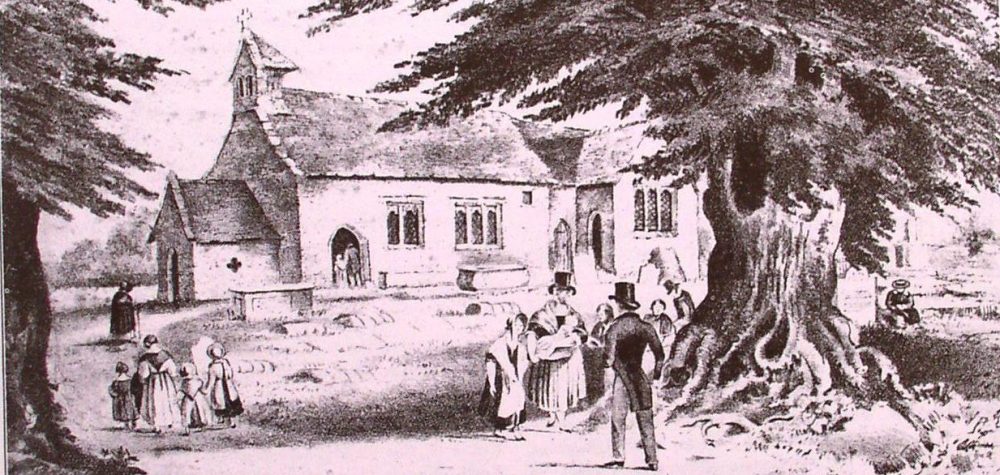
| 1869 | Goytrey National Mixed Boys and Girls | 1869 |
| Mar-03 | Expelled Mary, Ellen, Annie + John Williams for insolent messages from their parents: also Sarah + Matilda Watkins for the same reason | |
| Mar-08 | Miss E Mathews entered upon her duties as sewing mistress | |
| Nov-12 | Resigned charge of the school – Wm Franklin | |
| Nov-15 | Mon: opened school today with 41 children: George Thomas Bright: Admitted Charles Rosser Pengroesoped | |
| Nov-23 | Tues: Annie Bevan wrote very badly this morning at the commencement of her copybook | |
| Dec-07 | Expelled Annie Bevan for her determined disobedience and insolent language to the master | |
| Dec-08 | Having seen Mrs Bevan, I received Annie on certain conditions with her respect to her behaviour | |
| 1870 | ||
| Feb-18 | Fri: 6 boys stayed away from school without leave viz: Joseph + Oliver Charles: John Morgan: John Harris: James Jones: Charles Rosser | |
| Feb-21 | Admitted 6 children today: reproved John Morgan, James Jones + Charles Rosser for staying away last Friday: The remaining 3 mentioned did not come today | |
| Feb-22 | Admitted 2 today: attendance 53: Catherine Meade and her 2 sisters left, the distance being so far as they lived in Monkswood parish | |
| Feb-24 | Joseph + Oliver Charles cautioned today about truant playing the 2nd time | |
| Mar-28 | admitted Frank and Reece Prosser | |
| Mar-29 | admitted Emily + John Dekin | |
| Apr-04 | admitted Sarah, Annie + Emily Watkins | |
| May-09 | admitted John + Mary Morris | |
| May-10 | Mathew and John Heath played truant today | |
| Jun-29 | John and Mathew Heath played truant 2nd time | |
| Jul-14 | Anne Morgan’s mother used insulting language because the girl was confined yesterday for bad behaviour and used several threats | |
| Jul-21 | Rebecca Phillips who was reprimanded for having told many falsehoods absented herself this afternoon and went home | |
| Jul-26 | Rebecca Phillips was sent by her parents to school this morning | |
| Sep-05 | attendance 22: sewing mistress absent it being very wet: admitted Annie Griffin | |
| Sep-08 | Margaret Rosser, James Jones and John Evans not in school today | |
| Oct-04 | admitted Wm Evans in 3rd class | |
| Oct-14 | Fri: att 14: two boys, John + Wm Morris came at 10.35 after the register was marked: Rev Thos Evans visited | |
| Oct-17 | admitted Ruth Phillips | |
| Nov-17 | Eliza Evans, Ruth Phillips and Matilda Mathews reproved for loud laughing during masters absence for 2 minutes | |
| Jan-25 | reproved the boys and girls for their disorderly conduct yesterday evening and especially Elizabeth Bevan for not telling | 1872 |
Ivanhoe
Ivanhoe
The first mention of Ivanhoe is on the 1933 electoral register when Ivor and Doris Hopkins are in residence.
Ivor was born in Monmouth in 1897. On the 1911 census he is living at Cinderhill Street Monmouth with his parents William and Matilda and nineteen year old brother Joseph. William and Joseph were both farm labourers.
Ivor married Doris Badham in 1921 at Monmouth. Their children are Cyril Ivor born 1921, Joan 1923, and Leslie John in 1926.
The 1939 register gives Ivor as a roadman, and Doris as an unpaid domestic servant. Living with them at Ivanhoe are Leslie John who is at school, Catherine Arnold who is 8 years old, and William Badham, a contractors general labourer. (I assume William is a relation of Doris.)
In 1944 Leslie John was fined for stealing from Hilda Maud Gill of Nantyderry and again in 1945 for the theft of a chicken. (Full stories in the 1944 Free Press and 1945 Free Press.)
In October 1945, 24 year old Airman Cyril John Hopkins wins the DFC for his numerous operations against the enemy  in which he displayed the utmost fortitude, courage and devotion to duty. Cyril was educated at Abersychan Secondary School and before going to war was employed by Dean tailors in George Street, Pontypool. He now lives in Llandefeilog, Carmarthen with his wife and three children.
Ivor and Doris remained at Ivanhoe, the last details I have are in 1947.
Ivor Hopkins died in December 1970, followed by Doris in 1990.
T26 – Samuel Bird Cash Account
T26 – Cash account of Samuel Bird
1792
Aug 10th Paid interest to James Hutchinson 280 00
Aug 17th To paid Thomas Clare 1000 00
Aug 17th To paid Wm Pearce costs in the
Chancery suit 141 13
23rd To paid James Hutchinson the like 59 19
Dec 31st To paid Joseph Bird principal int.t 336 12
Balance due to Samuel Bird and which, since
His death hath been paid to his widow and
administration as will appear in Mrs Bird’s
administration account 2443 16
Title with the account general at the time of his death
1791
Jan.y by cash received of Isaac Leferne 352 3
20th By received 6 months dividends on the
£4666 13 4d South Sea Stocks to 5th Janry
1791 – £1 13 4d
July 23rd
By 6 months to 5th July 1791 £1 13s 4d
1792
Jan 20th – by 6 months due 1st Jan £1 13s 4d
July 23rd – by by 6 months due 5th July £1 13s 4d
Aug 6th – By receipt of James Hutchinson 100£ being
So much directed to before 100£ allowed by the master.
Aug 15th – by received on sale of 1190 10s part of the above South Sea Stock
Aug 25th – by cash received of Isaac Leferne £462 4s 0d
Statement of the stock received for Mr Samuel Bird’s share of the legacy bequeathed to him by Mr Elias Bird’s will and the manner they have been appropriated.
1790 Dec – By South Sea Stock transferred into Samuel Bird’s name
£466 13s 4d
1792 Aug 8th – transferred to James Hutchinson £2000
15 sold out to pay off debts £1190 10s
Mrs Bird hath received the dividends of this stock upton July 1794 and will appear in her administration account since which she hath transferred the stock as follows:
One half therof into her own name £733 17s 4d
One eighth to Henry Bird Esq., £100 9s 4d
The like to Wm Symons Esq
The like to W H Winstone
The like to Miss Elizabeth Bird
1793 Aug
By stock interest transferred into Mrs Bird’s name £3676 17s 11d
September sold out to pay debts £1300
Mrs Bird hath also received the dividends of this stock up to 5th July 1794. I carried them to the administration account since which she hath transferred the principal.
One half in her own name £4000 0s 11d
One eighth into the name of Henry Bird, Wm Symons, Wm Winstone and Miss Elizabeth Bird each receiving £297 2s 3d
1794 July
By bank 37pc by annuities transferred into Mrs Bird’s name in two sums £1205 12s 2d and £106 11s 9d together which in thus appropriated £1312 3s 11d
One half remaining in her own name £656 1s 11d
One eighth transferred to as above each receiving £164 0s 6d
1795 Aug
By more South Sea Stock transferred into Mrs Bird’s name who is thus appropriated £3019 0s 9d
One half remaining therof in her own name one eighth transferred to the like as before.
T214 – Coffee Plantation Partnership, Kandy 1840
Reply
T214
27th May 1840 Kandy
Between Lieut Henry Charles Bird and 2nd Lieut Adjutant Charles Crabbe both of her Majesty’s Ceylon Rifles.
Charles Bird holds 262a 1r 250/100 square perches situated in Pulsellawe in district Udapa purchased by deed from the government dated 3rd August 1838.
To go into a partnership with Charles Crabbe of 150a bounded on the north by the Galpatayshe Ella on the east and south by Laneapohunebura on west by property of Henry Bird.
To share the profits.
Cost of partnership £37 10s sterling paid to Henry Bird.
T39 – Itemised Solicitors Bill to H.C. Byrde Esq.. – 1862
| T39 | H.C. Byrde Esq., £16 1s 2d | ||||||
| 1862 Nov | Re Change of Name | £ | S | D | |||
| attending on you conferring and taking instructions for your change of name | 6 | 8 | |||||
| draw deed of declaration to change to be enrolled in Chancery | 1 | 1 | 0 | ||||
| copy for perusal | 5 | 0 | |||||
| draw notice to be inserted in the newspapers | 7 | 6 | |||||
| fair copy for perusal | 3 | 6 | |||||
| draw affidavid of execution of deed | 7 | 6 | |||||
| fair copy to be sworn | 3 | 0 | |||||
| attending on your reading over draft | 6 | 8 | |||||
| expressing deed on parchment | 7 | 6 | |||||
| paid for stamp and parchment | 1 | 18 | 0 | ||||
| for fair copy of notice to be inserted in several newspapers | 14 | 0 | |||||
| signature of deed and notices | 6 | 8 | |||||
| preparing affidavid and deed and signature of notice | 5 | 0 | |||||
| attending on commission and serving two affidavids on execution of signature | 6 | 8 | |||||
| paid for oaths | 3 | 0 | |||||
| sending deed and notice by London agents and desiring them to ensure the deed | |||||||
| in chancery and to insert the notice in the Gazette ot Times and to get your name | |||||||
| on the Sheriffs list altered and paid postage | 3 | 10 | |||||
| Brought Over | 7 | 9 | 1 | ||||
| Dec 3rd | sending notice to the editor of the Free Press with instruction to insert same | 3 | 7 | ||||
| sending notice to The Merlin | 3 | 4 | |||||
| having heard from the agents that the proprietor of the London Gazette would | |||||||
| not insert this notice writing them to instruct it once in the Times instead of the | |||||||
| Gazette | 3 | 7 | |||||
| paid agents bill of costs and expenses | |||||||
| attending to privy council | 6 | 8 | |||||
| attending stamping | 6 | 8 | |||||
| attending master of the rolls | 6 | 8 | |||||
| attending for same | 6 | 8 | |||||
| attending levy deed for enrollment | 6 | 8 | |||||
| letter as requested by the enrollment chief clerk | 5 | 0 | |||||
| attending the Times office | 6 | 8 | |||||
| paid for insertion in paper | 1 | 5 | 5 | ||||
| attending for deed enrollment | 6 | 8 | |||||
| letter to chief clerk of privy council requesting change of name at sherifs court | 5 | 0 | |||||
| clerk attending therewith and with deed for inspection | 3 | 4 | |||||
| letter returning deed | 3 | 6 | |||||
| letter posting and cab hire etc | 10 | 0 | |||||
| paid advertisement local paper | 6 | 17 | 0 | ||||
| 2 | 0 | 0 | |||||
| 16 | 1 | 2 |
T310 – Elizabeth Bird Diary of Family Events 1775 -1837
| T310 | ||
| 1775 | 23rd Mar | brother Henry went to America |
| 13th Feb | sister Dolly married to Wm Symons of Martin Gate Plymouth afterwards Chaddlewood | |
| 5th Dec | grandmother Bird died | |
| 8th Dec | Dolly a son – William | |
| 1780 | 7th June | riots in London – Newgate and other prisons burned down |
| 1781 | 1st Aug – Wed | Dolly a daughter Elizabeth Maria (Mrs Saltare) |
| 1782 | 11th Feb – Mon | I was married at Ridgeway Church to William Hayward Winstone of Albany Court, present, father, Wm Symons and cousin Maria Biggs |
| 24th Nov – Sun | Henrietta Winstone born | |
| 1785 | 3rd Jan | brother Henry came |
| 31st Jan | Dolly a daughter Doroty ( Mrs Strode) | |
| 8th Feb | Mrs Henry Bird a daughter Maria at Hotwells | |
| 17th Mar | brother Henry went to Monmouthshire with his family | |
| 1789 | 16th Sept | Henrietta Coinstone died |
| 1793 | Bird family moved to the Priory Plymton | |
| 1794 | 13th Sept – Sun | Mrs Henry Bird a daughter Fanny |
| 11th June | left Oldbury Court | |
| 1st July | slept first time in new house 1 Bedford Street Bath | |
| 29th Sept | Sally, George, Samuel and Frances christened by Revd. Williams | |
| 1800 | 4th Apr | brother Henry died of dystentry 4 days after leaving Spithead to join expedition to Egypt |
| 22nd Sept | heard of the above event | |
| 18th Oct | left Goytre with George and Fanny | |
| 28th Oct | William Symonds died | |
| 1801 | 12th Oct | grand illumination for peace |
| 19th Oct | Mrs Saltare a son Henry | |
| 1803 | 8th Apr | Mrs Samuel Bird died |
| Maria Bird married Cpt Witherington | ||
| 8th July | our family left Bath for Quedgley near Gloucester | |
| 1804 | 1st Aug – Wed | Mrs Witherington a daughter Maria (Mrs Towgood) |
| 1805 | 29th Jan | aunt Biggs died (mothers sister Miss Biggs) |
| 9th Sept | my dear mother moved from Stonehouse to Chaddlewood | |
| 8th Oct | spoke to me fort he last time. Took to her bed | |
| 10th Oct | my dear mother died | |
| 21st Oct | Lord Nelson victory and death | |
| 1807 | 1st July | left Goytre with Fanny and Louisa Bird |
| 1808 | 25th Feb | Maria Witherington died. Buried in Goytre churchyard |
| 27th May | Left Goytre with Louisa | |
| 1809 | Betsy Bird died. Buried at Goytre | |
| 1st Dec | Harriet died at Hotwells. Buried in the Chapel yard Clifton | |
| 1810 | 30th Sept | Sally Birch died. Buried in Plympton church yard |
| 1811 | 22nd June | brought Georgina to Quesdgley |
| 1812 | 20th Nov | my nephew Henry came with wife, children Fanny and nurse |
| 1814 | 29th Oct | my dear sister Dolly a daughter (Mrs Symons) – Mrs Salter a daughter – Henrietta |
| 1815 | 18th June | battle of Waterloo |
| 1816 | 7th Dec | Henry, a son Henry. Mrs Salter twins, one died. Charles Bird married to Miss Ann Crook |
| 1817 | 13th June | Henry put on full pay in the 87th |
| 1818 | 24th Mar | left Bath with Fanny and Louisa for Exmouth |
| 18th May | the dear blessed Louisa breathed her last. Buried in Littleham church yard near Exmouth | |
| 20th Oct | my dear husband Wm Hayward Winstone died | |
| 27th Oct | funeral at Quedgley | |
| 2nd Nov | left Quedgley for lodgings in St James’s Bath | |
| 31st Dec | this concludes a year of much sorrow and strange happenings | |
| 1819 | Salter family left Ridgeway | |
| 18th May | Mr Salter died | |
| 31st Dec | this year thanks to Almighty God has been far more happy than the last. My dear child (Fanny Bird) in perfect heath and I have a more comfortable home | |
| 1820 | 25th Mar | took no. 18 Park Street Bath. Rent £73 10s. Taxes £35 11 5d |
| 31st Dec | this year thanks be to God has passed more free from trouble than any preceeding one in my remembrance. A greatful heart and contented mind are my thankful offerings | |
| 1821 | 28th May | dreadful storm of thunder and lightenings so dark that candles were needed for an hour at mid-day |
| 1822 | 9th Mar | uncle Biggs died |
| 26th May | cousin Ann Gwyn died. Mrs Henry Bird a daughter | |
| 12th Sept | Dorothy Symons married Mr George Strode of Newnham Park | |
| 31st Dec | blessed to be God. This year has passed in health and comfort | |
| 20th Jul | went to Glasgow with Fanny | |
| 1st Aug | went to Edinburgh | |
| 24th Aug | went to Worcester bought a teaset to Royal Strode? | |
| 1823 | 15th Jul | rain every day till August 27th 40 days of rain |
| 2nd Sept | left Bath. Met my dearest child Fanny at Gloster, went on to North Wales. Rev Wm Walters died. Mrs Strode a daughter Georgina. | |
| George Saltare married Miss Fanny Culsac. Henry and George left for Ceylon. Mrs Henry Bird and family left Goytre | ||
| 1824 | 4th Feb | Fanny Bird married to Rev Walter Marriott. God grant that this may be a happy day. 15 at breakfast |
| 5th Mar | my dear child and Mr Marriott left for Babbicombe | |
| 1825 | 23rd Mar | left 18 Park St for number 31 |
| 12th Sept | Mrs Strode a daughter Florence | |
| 22nd Oct | Walter Marriott went to take duty at Holt | |
| 2nd Dec | Fanny drank tea at Wm Wilberforce’s | |
| 1826 | 6th Jan | my beloved child went to Holt |
| 1st Aug | Mrs Wm Holt died nee Caroline Marriott | |
| 17th Nov | my dear child and little Wm Walters arrived from Goytre | |
| 1827 | 22nd Nov – Thurs | my dear child returned to Bath at 4pm after an accident in the carriage on Bradford Hill on the way to Holt. Walter came with her |
| 12th Apr | Mrs Harvey Marriott a daughter ( Caroline) | |
| 30th Apr | my dear child came down to breakfast. God be praised for her amendment | |
| 9th May | Fanny went to Walcot church to the christening of Mr Harvey Marriotts child | |
| 11th May | Walter and Fanny returned to Holt | |
| 25th May | Mr Peter Marriott a daughter (Ellen?) | |
| 14th Sept | Fanny and Walter came | |
| 10th Oct | my beloved child a daughter at 4pm | |
| 7th Nov | went to Walcot church to the christening of Louisa Jane | |
| 27th | Fanny, Walter and baby went to Holt. Maria Witherington married Mr Towgood of Dartford | |
| 1828 | 19th Feb | Ann Hayward married to Mr Harvey. Elizabeth and her brother Frederick sailed for India in May |
| 3rd Oct | Mrs Peter Marriott a daughter (Annie) | |
| 16th Sept | Fanny, Walter and baby left Bath for Goytre | |
| 14th Nov | All returned from Goytre | |
| 20th Nov | Maria Towgood a son (William) | |
| 1st Dec | Mrs Harvey Marriott a daughter Sophia | |
| 6th | Ann Niblet a daughter (Anne) | |
| 26th | George Bird married to a daughter (Charlotte) of Col. Hook at Colombo Ceylon | |
| 1829 | 3rd Aug | my dear child and family came to Bath |
| 5th | my nephew Henry Bird died | |
| 24th | my dear Fanny a daughter 5.30 am | |
| 22nd May | child christened at Walcot church Albina Caroline | |
| 29th | all went to Holt | |
| 19th Aug | heared of the death of my nephew Henry Bird | |
| 31st | Walter and family went to Goytre | |
| 1830 | 22nd Apr | Mr Peter Marriott a daughter (Fanny Adelaide) |
| 8th July | Mr Henry Bird’s 4 children with Lucy, Fanny and Louisa came from Holt and dined with me | |
| 29th Dec | Mrs Henry Bird married Mr Richard Mais | |
| 1831 | 1st Jan | I began the new year in bodily pain but blesses be God in mental comfort hearing this day heard of the welfare of those most dear to me |
| 5th Apr | Mr Basil Marriott married Miss Charlotte Bough. Walter and Fanny went to the wedding | |
| 8th July | all left Bath for Goytre | |
| 5th Aug | returned from Goytre | |
| 20th Oct – Thurs | my beloved child a son early this morning | |
| 29th | dreadful riots in Bristol and some in Bath | |
| 20th Nov | dear baby christened Walter Henry | |
| 1st Dec | the dear family came from Holt | |
| 16th Sept | my dear child returned home | |
| 1832 | 16th Aug | all the children with whooping cough |
| 21st | Louisa in the measles | |
| 30th Oct | Mrs Harvey Marriott a son (Herbert) | |
| 1st July | Georgina Dix a daughter (Charlotte Georgina) | |
| 1833 | 23rd Mar | my dear child removed from Holt to Trowbridge |
| 9th Aug | my dear child with Louisa and Henry Bird went to Goytre | |
| 28th Sept | Mrs Peter Marriott a daughter (Agnes) | |
| 1834 | 16th Feb | my dear child a daughter |
| 31st Mar | Mrs Briggs died | |
| 10th | my dear Fanny, Louisa and baby came | |
| 26th | Lucy Bird married to Rev Thomas Davies (of Trevethin) | |
| 1st Aug | Mrs Harry Nisbet and children returned to India | |
| 30th Sept | Henry Bird sailed for Ceylon a Lt. In the rifle corps | |
| 1835 | 22nd Apr | little Walter was lost in the street of Bath for over an hour |
| 30th | Fanny and family left Bath for Goytre | |
| 6th June | all passed through Bath on the way home. Left Louisa with me | |
| 16th | my dear Fanny came with little Bess | |
| 9th Sept | dear little Walter broke his arm | |
| 24th Nov | The arm broken again | |
| 31st Dec | blessed be God the year has passed without any material cause of affliction and in no more pain than might be expected from my advanced time of life. | |
| 1836 | 17th May | my dear family from Trowbridge dined with me on their way to Clifton |
| 30th | Prior Park in Bristol burnt down | |
| 28th June | my dear Fanny andfamily returned from Clifton. | |
| Nothing particular recorded after this date | ||
| 1837 | 18th Apr | Elizabeth Hayward Winstone died. Buried in the Winstone vault under Stapleton church where her only daughter Henrietta has been buried |
Elizabeth Bird – 1843
Elizabeth Bird – Goytrey
Ll/1843/51
Know all men by these presents that we Charles Elias Bird of the parish of Goytre in the county of Monmouth esquire and the Reverend WilliamEvans of Usk in the county of Monmouth Clerk are held and firmly bound unto the right Reverend father in God Edward by divine permission Lord Bishop of Llandaff in the sum of Forty Pounds of good and lawful money of Great Britain to be paid unto the said Lord Bishop or to his certain Attorney his executors administrators or assigns to which payment well and truly to be made. We oblige ourselves and each of us by himself for the whole our and each of our heirs, executors and administrators firmly by these presents. Sealed with our seals, dated the twenty seventh day of October in the seventh year of the reign if our sovereign Lady Victoria by the grace of God of the united Kingdom of Great Britain and Ireland , Queen, defender of the faith and in the year of our Lord One thousand eight hundred and forty three.
The condition of this obligation is such that if the above bounden Elias Bird the lawful son one of the next of kin and administrator of all and singular the goods chattels and credits of Elizabeth Bird late of the parish of Goytrey in the county of Monmouth, widow deceased. Do make or cause to be made a true and perfect inventory of all and singular the goods, chattels and credits of the said deceased which have or shall come into the hands possession or knowledge of him the said Elias Bird or into the hands or possession of any other person or persons for him and the same so made exhibit or cause to be exhibited into the Registry of the Consistory court of Landaff at or before the last day of April next ensuing and the same goods, chattels and credits of the said deceased at the time of her death which at any time after shall come to the hands, possession of the said Elias Bird or into the hands and possession of any other person or persons of him do well and truly administer according to law And further do make or cause to be made a true and just account of the said administration at or before the last day of October in the year of our Lord one thousand eight hundred and forty four. And all the rest and residue of the said goods, chattels and credits which shall be found remaining upon the said administrators account the same being first examined and allowed of by the judge or judges for the time being of the said court shall deliver and pay unto such persons respectively by he said judge or judges by his or their decree or sentence pursuant to the true intent and meaning of a late act of parliament in the two and twentieth and three and twentieth years of the reign of our late sovereign Lord King Charles the second instituted an act for the better settling intestate estates shall limit and appoint and if it shall hereafter appear that any last will and testament was made by the said deceased and the executors therin named do exhibit the same into the said court making request to have it allowed and approved accordingly if the said Elias Bird above bounden being thereunto lawfully required do render and deliver the said letters of administrations approbation of such testament being first had and made in the said court then this obligation to be void or else to remain in full force and virtue.
Charles Elias Bird
Signed, sealed and delivered in the
Presence of:
William Evans
H Powell
T247 – Lineage Henry Bird b.1695
T247
Lineage
Henry Bird of St Marys Rotherhithe was born in 1695 and died in 1757.
He was the brother of Elias Bird of Roehampton Park, Sheriff of Surrey 1744, died in 1767.
He was also the brother of Edward Bird Lieut., obit on 26 or 23 February 1718, hanged for pinking a waiter.
They were the children of Henry Bird and Elizabeth nee Fitzgerald.
He claimed descent from Bird of Broughton Hall.
(Dictionary Note: to pink is to pierce with a rapier or the like; stab.)
T199 – Title to Goytrey House 1864
T199
Letter from Goytrey House January 11th 1864.
Dear Sir, in reply to your letter of the 31st inst., I gladly avail myself of the opportunity of detailing the circumstances connected with the title to the Goytrey property.
By will of my Grandfather dated 10th March 1799 his property was bequeathed to his children, to be converted into money on the youngest coming of age and an equal division made.
In the year 1822 the division of my Grandfathers property took place- when all the parties interested executed a conveyance to my father and he became the purchaser; and to receive part of the purchase money he mortgaged the property to his mother and sisters, Lucy, Fanny, Maria and Charlotte.
The account numbered 1 Details the above arrangement as referring to one sister, Dorothy Charlotte, a copy or similar account having been placed in the hands of each mortgagee (my aunt Mrs Marriott having had her own copy). – My father having paid off my uncle George in full and some of the other legatees in part.
My father died in Ceylon on the 3rd April 1829, leaving his property to his wife in trust for his children. A copy of his will is enclosed numbered 2.
An agreement was negotiated, by which it was intended that some of the mortgagees, viz; my grandmother, aunts Lucy and Dorothy Charlotte should become the purchasers for £3000 – the document setting this forth in full (number 3)
The mortgagees however refused to notify the proposed agreement preferring to put the mortgage in suit and accordingly filed a Bill in Chancery. Mr Waddington, as agent, or trustee for the mortgagees being the party who in law took proceedings.
The document (no 4) is a copy of the minutes of the decree of the Court of Chancery followed by other orders &c.
No 5 is the account of Mr Waddington the mortgagee in possession by trust and on behalf of the family – in account current with my father’s estate showing a balance due to the mortgagees of £2385-7-6. This account formed the foundation on which the proceedings were taken.
I also send for your information the advertisement of the sale of the property by auction (no. 6.) The sale was made and the purchase affected by Alexander Waddington as trustee for the mortgagees. There being no other bid an order was made to confirm the sale to Mr A Waddington by the Vice Chancellor – a further order was made to convey the property to the individual mortgagees as Lucy Bird, Elizabeth Bird, Walter Marriott, Dorothy C Bird and Mathew Towgood.
There are two deeds bearing even date. Viz: 26th Jan.y 1835 conveying the property to Dorothy Charlotte Bird and in one of them the following clause recites:-
“That in consideration of the sum of one thousand four hundred and forty six pounds to the said Thomas Davies and Lucy his wife, Elizabeth Bird, Walter Marriott and Mathew Towgood, in hand, well and truly paid by the said Dorothy Charlotte Bird at or immediately before the sealing and delivery &c”. The receipt of which said sum, they, the said Thomas Davies and Lucy his wife,
Elizabeth Bird, Walter Marriott and Mathew Towgood do hereby severally and respectively acknowledge of and from the same and every part thereof, doth release, exonerate and forever discharge the said Dorothy Charlotte Bird her heirs &c.
The usual receipt is applauded to this deed and the signatures of the Rev’d Walter Marriott was affixed to the deeds and receipt at Trowbridge, in presence of Frances Fulford & Wm Nightingale.
The document I enclose, marked no. 7 is Jones & Waddington’s bill of costs for the conveyance as above and mortgage to Miss Jenkins in further proof of these transactions.
In order to pay expenses of transfer, liquidate debts and complete the payment to the mortgagees as above, upwards of £300 worth of timber was cut down and sold by my aunt Dorothy Charlotte and £14 was borrowed on mortgage from Miss Jenkins and £100 from Mr Jones. Next several amounts and Miss D C Bird’s own interest in the property enabling her to effect the purchase early in the year 1835 son after my departure for Ceylon.
My aunt subsequently wrote to me in Ceylon to declare her inability to pay Mr Jones’s debt which was demanded and the interest on the mortgage and maintain herself and her mother and brothers on the farm and that it must be sold unless I could make an arrangement to pay the interest on the mortgage, which was then in arrears and the £100 owed to Mr Jones: and was disposed to do so with the view of securing the property to myself, no mention being their made of any further claim upon it beyond those above mentioned.
Upon receipt of this communication I made arrangement after some difficulty through y agents in London, Messrs Price and Bousted, to pay the interest on the mortgage and Mr Jones’s claim and the payments were thereafter regularly made to Mr Waddington my aunts solicitor on the understanding that it was to be a charge upon the property and in the year 1850 when I had returned to England my aunt D C Bird executed a deed, conveying to me the equity of redemption of the mortgage in consideration of the sum of £751-5-9 so advanced by me and which was then forwarded by my agents.
My payments subsequently amounted to £1089-12-8 in payment of interest up to the year 1857.
A further sum of £300 was remitted at various periods for the service of the farm and a debt incurred of £150 afterwards paid by me, making a total advance of £3041-1-8 including the mortgage. The actual payments in money up to Feb 2nd 1857, when I took over the farm, having been £1539-12-8 and mortgage and interest due that date £1501-9-0 making a total of £3041-1-8.
Mr Davies is a professional land agent and valuer residing at Usk then valued the property on my behalf at £2400 and Mr Mathews a railway engineer having been asked by my aunt and uncle to value it made his estimate between £2500 and £2600. A transfer or conveyance was then executed in my favour for the higher sum of £2600 accordingly by my aunt Dorothy Charlotte Bird and forms my title to the property free from any liability.
Having thus disposed, as I believe, in a satisfactory manner of the legal part of the question that has arisen between my aunt and myself, I am bound to add a few observations on the facts connected with it.
In the first instance I cannot but feel that the forced sale of the property by an order in Chancery was a very harsh recourse to have been adopted by the mortgagees; though the remembrance of it and the feelings it engineered have been lost in oblivion and would not be referred to now but for the purpose of explanation. That measure was rendered the more severe from the fact that my father had purchased the property from his mother and sisters and brothers at a full value and had paid a
considerable portion of the purchased money. One chief object in the purchase having been to secure to his mother the family residence for the remainder of her life at the request and solicitation of his mother and sisters. Secondly, the rejection of the mortgagees of the proposed agreement for the purchase of the property at a fair value was certainly a rejection with it of all the former considerations connected with the sale to my father.
A second proposal that the mortgagees should retain possession as an equivalent to the interest on the mortgage until I came of age and could join in a conveyance without reference to Chancery was also rejected. The mortgages acting with reference to their own interests under professional advice.
My aunt Fanny though probably not consistent of their proceedings and leaving them in the hands of others was nevertheless a party to the suit in Chancery. The rejection of a conciliatory settlement as well as the purchase of the property by the mortgagee at public sale and re-conveyance to my aunt Dorothy Charlotte.
You will thus see that as far as my father’s estate was concerned, my aunt Fanny as one of the mortgagees received the full amount of her share by the sale of my father’s property and by any arrangement subsequently made with my aunt Dorothy charlotte she could not by any possible process fall back on my father’s estate or that of my grandfather.
My aunt will no doubt find it difficult invest her mind of the idea after so long a prepossession that she has not received her share of my father’s property. The same may be said of my aunt Dorothy Charlotte who has also no longer an interest in the estate of her father or any remains of it but the satisfactory reflection that so long as she had the property she sheltered her mother & her brothers in it, though in so doing she sacrificed her own living.
I think you will not fail in arriving at the conclusion, after perusing the foregoing statement, that my aunt Fanny has no claim on me or my father’s estate, had there been any – and that in contributing to aid my aunt D Charlotte to purchase the property she contributed a legitimate quote to a mothers comfort in her old age.
You will also see that in addition to paying the full value of the property I have advanced upwards of £400 beyond it. And finally I feel sure that could my aunt Fanny see the matter in its fair and proper light she would be the last person in the world to advance the claim.
Should you desire to have any further documentary evidence I shall be most happy to furnish you with it.
I remain, my dear Sir,
Yours faithfully
(Signed) Henry C Byrde
To: Harry Nisbet Esqre
T193 – Martha Arnold Court Case
T193
Court Case King’s Bench between Hughes Minet & Rekar Fector and Martha Arnold, widow.
Defendant sets forth – John Arnold late City of Canterbury dec.d late husband of defendant.
On 21st May 1769 was indebted to the plaintiff for goods and merchandizes for £137 8s.
Also on the 20th Sept.r 1773 at Maidstone aforesaid was indebted to the sd plts in other £653. 2s for divers, other goods, weares and merchandise.
Cummings Attorney
(Very long and involved but repetitive)