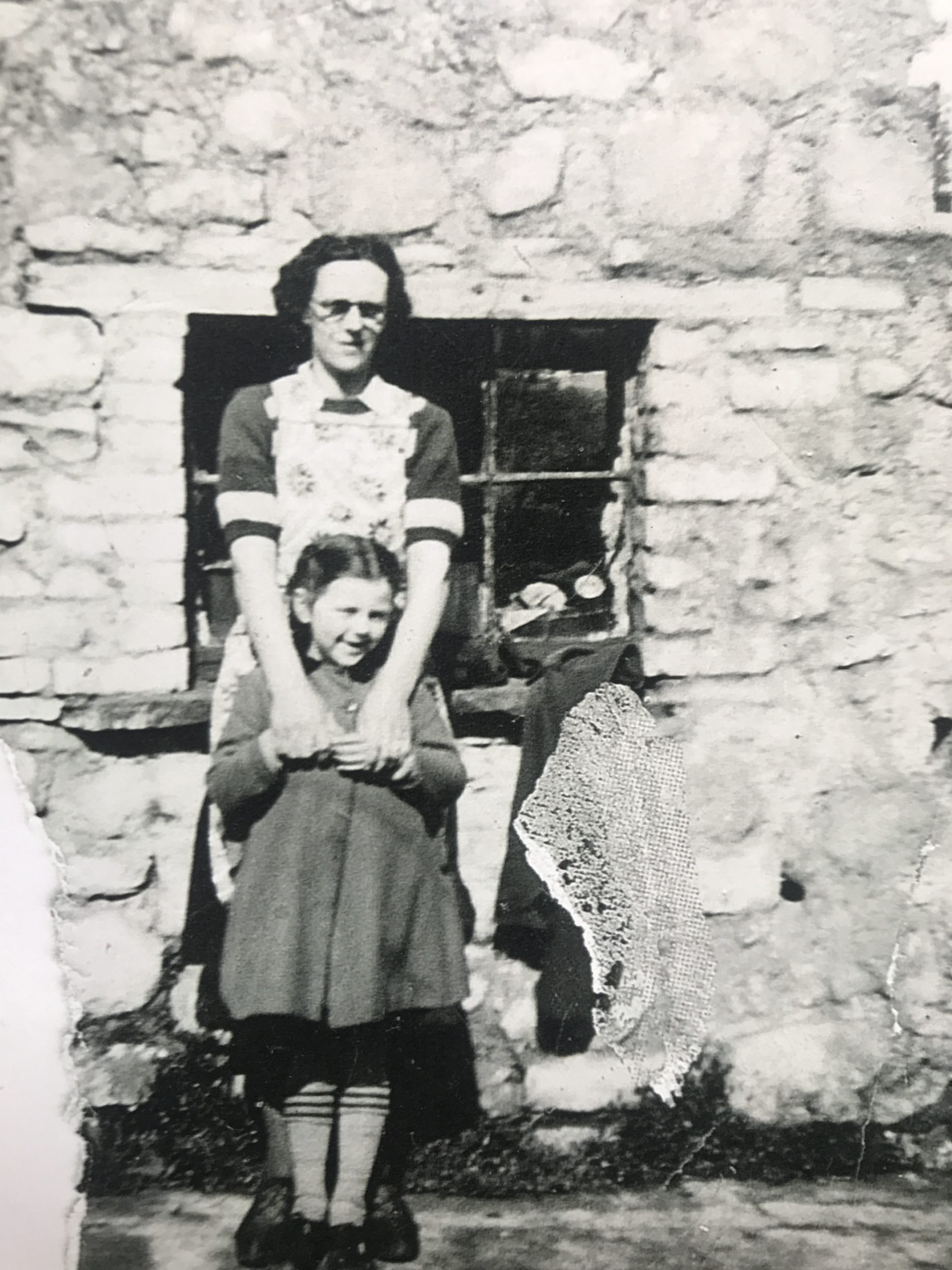
Maesyberyn

Maes-y-berryn – (I have seen many spelling variations) – 728 on the 1841 Tithe Map.

The owner of Maes-y-beryn was the Earl of Abergavenny who leased it to Edward James in 1786 for the lives of William James 22, and Morgan James 17. Edward James was re-granted the lease again in 1800. Prior to Edward James the occupier was William Valentine. In 1818 Edward James was the constable for Thomas David of Upper House and on the 1821 Earl of Abergavenny survey Edward James was shown as the leaseholder.

Edward James died in October 1836 and was buried in St Peter’s churchyard. The new occupier was John Tuffley but the lease was granted to the Rev John Evans, the vicar of Llanover.

On the1841 tithe the owner was the Earl of Abergavenny and the lease for lives by the Rev John Evans, the occupier was John Tuffley.

On the 1841 census John Tuffley is aged 50, a labourer, Ann his wife is 44, their children are Emma 10 and Ann 5. John Tuffley died in 1848 aged 60 (according to the burial record) and was buried at Saron Chapel.

William Jones and his family became the new occupiers and on the 1851 census he was aged 43, a plasterer, and was born in Cwmcarven. His children were Thomas 10 and William 8. Both children were born in Llanover where William Jones was then living with his wife Mary, a dressmaker.

In 1852, Lewis Edmund wrote in his diary “at the Rev John Evans whitening for Wm Jones.” The same year, on the vicar’s tithe account is written “William Jones of Maesyberyn, 10a 2r and 34p.”

About 1855, John Herbert Gwyn Owen (he was the solicitor who defended John Frost in the Chartist Riots) took the tenancy. The leaseholder was still the Rev John Evans of Llanover, the connection being that Mr Owen was living with Mrs Kingston, who was the daughter of the Rev Evans, by whom he had two sons.

John Owen had taken the lease in his own name by 1860 on the lives of Clara Thackwell, daughter of James Seabright, Thomas Howell of Gloster aged 20 and his two sons, David 8 and John 10. John Owen and family were not living here but at Goytrey Cottage (Oak Cottage.)

John Owen collapsed outside Pontypool Town Hall in 1864, the same year Maesyberyn was occupied by a Mr Williams.  In 1868 an advert in the Free Press was placed for the sale of the lease at the Crown Hotel Pontypool on the 9th January. The advert mentioned the lease was still in the possession of Mr Owen, the annual rent was 10/- and the land contained 23acres 15rood and 11perches. On the 1870 land tax, Maesyberyn was rated between £12 and £50 pounds and the occupier at this time was John Williams.

On the 1871 census John Williams is aged 46, a teacher, born in Hereford. Ann his wife is 41, born in Grosmont and his daughter Mary is 16, a dressmaker, and was born in Llanvetherine.

In 1879 John Griffiths was named on the electoral register for Maesyberyn and in May 1891 Henry Chalken took the lease, he was aged 64, a gent, born in Middlesex, his wife Susanna was 56, who was born in London.

Henry Chalken remained at Maesyberyn and on the 1901 census he was aged 74, his wife Susanna was 66, his sister Sedley was 76 and their servant was Rachel Jenkins 24, born in Goytre.

By 1911 James Griffiths, a station master aged 61 from Radnor along with his wife Annie, also 61 were living at Maesyberyn.

The Earl of Abergavenny sold many properties in 1921, Maesyberyn was included, being lot 24 – A house with pasture and orchard lands, in the occupation of James Griffiths containing 10a 3r which was in lease to Mrs E Williams. The land was purchased by Richard Davies for £230.

James Griffiths is still in occupation on the census of 1921, he is 71 from Old Radnor, a retired station master, his wife Mary is 51, born in Cardiff and gives her occupation as home duties.

By 1927 Elias Francis Morgan had taken occupancy of Macs-y-beran, he died in on the 14th January 1934. He was a retired builder and left the gross sum of £20, 452.
In his will he left various bequests to his three sons, to Wyndham, £1,200, and a property called Thistle Park. To his son Thomas John Morgan, Macs-y-beran and 4 more properties in Crown Street Crumlin. To his son Stanley Adin Morgan he leaves Goytre House Farm and a specified house. To his grand-daughter Mary Catherine Edmunds he leaves £300 and to his housekeeper, Edith Mary John, £150.

In January 1935 Measyberyn was sold again, to Messrs Davies and sons, Newport for £1,950. The tithe was £1 17s 6d, land tax 2/3d.

There is an obituary for a Mr Charles Morgan of Maesyberyn who died in 1935, a native of Abercarn.

Nutshell

Nutshell

I know virtually nothing about the Nutshell, (although I remember it well as I lived next door in Arrow Cottage) other than in 1910 the owner was Arthur Jenkins of Harrow Cottage and the gross value was £7 and the rateable vale was £5 5s.

On the 1911 census Sidney Jenkins aged 41, a warehouse man, and his wife Laura 42 were living there with their children, Frances 9, and Ivor Sidney, both born in Pontypool, and Evelyn 3 who was born in Goytre.

The 1914 poor rate says Arthur Jenkins is still the owner and Sidney is still the occupier.

On the census of 1921 Henry J Selway is living at The Nutshell with his family. Henry is 32, born in Manchester and a colliery stoker at Crumlin Valley Colliery but out of normal employment at the time. Hannah, his wife is 35, born in Bristol, they have a son Ronald aged 5 who was born in Crumlin.

Taken from the electoral register I have Jack and Florence Davies in 1918 and Henry and Hannah Selway in 1922.

On the 1st June 1925 a wedding took place at St Peter’s church between Charles Henry Denner, a butcher of Finchley N.3 and Annie Gwendoline Collins of the Nutshell Goytrey.

No. 11 on 1841 tithe map

No. 11 on 1841 Tithe Map.

This property of 36 perches was owned by John Rosser and was situated at the top of Bwrgwm. A small triangular piece of land still exists where the cottage once stood.

In 1841 William Poiskin aged 60 and William Poiskin aged 15 were living there along with Ann Jones 70, a servant.

In 1845 John Hart 18, a labourer married Ruth Lewis aged 18 at St Peter’s Church and made their home in this cottage. In 1850 John Hart voted against the police (the reason for the vote has not been explained.)

By 1851 John Hart was 27, a labourer born in Abergavenny, Ruth was 24 and born in Goytre. They remained at number 11 for many years and were next mentioned on the 1881 census when John was aged 63, born in Crickhowell, and was a basket and broom maker. Elizabeth died in 1888 aged 57 and was buried at St Peter’s on February 17th.

John Hart was last mentioned on the electoral register in 1889.

Beech Cottage No. 2

Beech Cottage No. 2.

On the 6th February 1860 William Jenkins of Bridge Farm sold to Richard Williams of Llanvihangel, Pontymoile “a piece of orchard land or pound, situate or lying in the parish of Goytre and adjoining 40 perches (more or less) together with two messuages or dwelling houses in course of construction theron, adjoining other part of the orchard belonging to one William Jenkins.”

Richard Williams took a £100 mortgage from Mary Watkins on the 2nd April 1860.

In 1867 Richard Williams sold to Thomas Watkins “the property leading from the canal to Pantygoitre and the cottage and garden of Thomas Lewis on all or most parts and sides, appurtenances  granted and conveyed unto the use of Thomas and Margaret Watkins.”

On the 1870-74 electoral register Owen Davies was listed as tenant of house and land of number 2 Beech Cottages.

Cecilia Susan Jones who was born at Beech Cottage in 1880.

The 1881 census lists Thomas Jones aged 33, born in Marshfield as living there with his wife Amily (Emily?) 31, born in Trevethin, and their children Mary 7, Ada 6, Clara 2 and Cecilia 3 months, along with Emily’s brother and sister Mary, and Walter St Clare.

There was a new occupier by 1891, he was Evan William Edwards.

Again in 1901 a new family, George Dobbs aged 28 from Hereford, a plate layer, along with his family Sarah Ann, 27 born in Talywain. Their daughter Ivy May was baptised on the 13th December 1907 at St Peter’s Church.

The owner in 1910 was John Williams of Blaenavon, gross value was £4, rateable value was £3.

L. to R. Reginald Dobbs, Rebecca Dobbs, Ivy Dobbs, Sarah Dobbs (nee James) and Ivor Dobbs, circa 1910. This photo was kindly given by Dot Jones.

On the 1911 census George Dobbs and his wife and family were still at Beech Cottage number 2, which had 3 rooms, where they continued to live  for many more years.

On the 1921 census it says the Dobbs family are living at No. 1 Beech Cottage, but I have decided to enter the details here.

George Dobbs id now 48 and still working for GWR as a sub ganger at Nantyderry Station, Sarah his wife is 47, their children are Ivor G aged 21 who is a goods guard with GWR, Reginald J 17 who is a blacksmith’s labourer working at Wilks, 14 year old daughter Ivy M is at home doing home duties. There is a visitor staying with them, Rose May (no surname given) aged 19, Rose is from Hammersmith and works for the Board of Trade at St James’s Park London. All the Dobbs children were born in Goytre.

Beech Cottage No. 1

Beech Cottage No. 1.

On the 6th February 1860 William Jenkins of Bridge Farm sold to Richard Williams of Llanvihangel, Pontymoile “a piece of orchard land or pound, situate or lying in the parish of Goytre and adjoining 40 perches (more or less) together with two messuages or dwelling houses in course of construction theron, adjoining other part of the orchard belonging to one William Jenkins.”

On the 2nd April 1860 Richard Williams took a £100 mortgage to finance the build from Mary Watkins.

In 1867 Richard Williams sold to Thomas Watkins “the property leading from the canal to Pantygoitre and the cottage and garden of Thomas Lewis on all or most parts and sides, appurtenances  granted and conveyed unto the use of Thomas and Margaret Watkins.”

On the 1871 census Richard was aged 33 and a labourer, born in Mamhilad, his wife is not mentioned but his children are Martha 11, John 9, and Rachel 6.

Richard continued to live at Beech Cottages, he was a roadman. In 1891, living with him is his married daughter Martha who had married Edwin Williams a flannel weaver, he was born in Usk and they had a one year old daughter, Elizabeth.

On the 21st January 1897 Richard was admitted to the Pontypool Union, (I can’t find his release date) but on the 1901 census he was aged 73, a road repairer, living with him is his daughter Elizabeth Jenkins then aged 38.

By 1907 Beech cottage had a new occupier, one Walter Lawrence, a builder. His wife was Rose May ( Rosser). Their children, Ivy, Olive, Rose and Jesse were all baptised on the 13th February 1907 at St Peter’s Church.

At this time the owner was John Williams of Estavarney, Blaenavon, the rateable value was £3 15s, the gross value was £5.

In 1911 Walter May and his family were living at Beech Cottage number 1, he was aged 34, a house carpenter (journeyman), born in Fulham. His wife Rose was 36 and born in Chelsea. They had been married 12 years, and had 5 children, all alive, Olive 10, Rose 9, Ivy 6, Iris 4 and Cyril 1.

On the 1914 poor rate John Williams is still the owner and William James was the occupier.

By 1920 the occupier was John Robert Rosser and his wife May. The same year May died and was buried at St Peter’s Church on the 4th November.

On the 1921 census Robert John Rosser is 37, born in Goytre and working as a painter and decorator for Mrs Wilks Penpelleny, living with him is Laura Harding aged 41 who is employed for house duties, Laura was born in Abergavenny.

Ynys-y-picca

Ynys-y-Picca – 985 on the 1841 Tithe Map.

The first mention I can find is in 1780 when William Williams was the constable for Iniss y pike. His name appears again in 1797 as having land for the late Jenkin Daniel.

David Phillips of Crumlin is the owner in 1798. In 1815 Jane Phillips aged 74 of Ynys y pwcca died and was buried in St Peter’s churchyard.

A new name is mentioned in 1816, Elizabeth Jenkins, the owner still being David Phillips, Elizabeth paying 10/- land tax in 1828, but by now the owner of Ynys-y-picca is Thomas Phillips (son of David?)

The next mention I can find is on the 2nd June 1835 when John Jones aged 72 of Ynys-y-picca is buried at St Peter’s Churchyard.

By 1839 Thomas Watts and his family from Monkswood have moved to Ynys-y-picca and in 1841 Thomas paid the rector £3 12s tithe, the owner is still Thomas Phillips. On the 1841 census Thomas Watts is aged 35, a farmer, his wife Mary, is also 35, their children are Ann 15, Martha 12, Thomas 10, Joseph 6, and Mary 1.

Joseph Watts was baptised, aged 9, on the 21st May 1843 at St Peter’s church.

On the 31st October 1846 a fight occurred between Thomas Watts and Thomas Morris (my 5 x great uncle) outside the Royal Oak, apparently over cheating whilst playing cards. Thomas Morris died of a ruptured bladder and Thomas Watts was indicted for the “killing and slaying of Thomas Morris.” The case was heard at Monmouth assizes but Thomas Watts was not convicted of any offence.

On the 1851 census for Henes u Picha, Thomas Watts is aged 53, a farmer of 40 acres, born Goytrey, Mary his wife is 56 born in Monkswood, living with them are their children Ann 24; Martha 22, a dressmaker; Mary 11; Thomas 19, a farm labourer; Elijah 8, and a farm servant Walter Jenkins aged 17.

In 1856 Thomas Watts purchased from the Earl of Abergavenny vast quantities of Elm and Oak trees at a cost of £19 2s for the Elm and £171 18s for the Oak.

Thomas Watts (the younger) was put on bail in March 1857 for stealing £6 2s 0d from John Roberts of Goytrey. (John Roberts was the son of James Roberts of Lower Cae Coed, Goytrey.)

The rateable value of Ynys-y-picca in 1860 was £13 10s, the same year Thomas Watts voted for Thomas Jenkins to be the new highways assessor, Thomas Jenkins winning the vote.

Thomas Watts died in 1861 aged 65 and was buried at St Peter’s on December 22nd.

On the 25th July 1862 Thomas Watts the younger was fined for obstructing the highway.

On the 21st August 1866 Thomas Watts was caught stealing 5lbs of veal from John Richardson, a butcher in Usk, even though he had £65s 1d on his person. He was committed for trial at the next quarter sessions where he was found guilty but recommended to mercy as he was in drink at the time of the offence and also as he was supporting his mother. He was sentenced to one month’s imprisonment.

The following year, 1867, Thomas Watts took a court case against Thomas Jeremiah for the purchase of chains, this case was dismissed.

The 1871 census gives Mary Watts as aged 68, a widow and head of the household, Ann is 43 and unmarried, living with them is a grand-daughter Emma Mary aged 7 and a 41 year old servant William Forty.

(Mary Watts died in 1883 aged 83, she was living at Penpederhoel.)

In 1880 Ynys-y-picca had a new occupier, the Edgar family. Lewis Edmund wrote in his diary in this year that he was at Mrs Watts, looking at repairing of the house and the cottage for David Phillips.

The 1881 census says Alexander Edgar is aged 41, born in Llangibby and a farmer of 35a, Mary his wife is 40 and born in Goytre, (Mary is Mary Watts) their children are Thomas 12, Edwin 9, Sydney 6, and Joseph 4.

On the 20th August 1881 Alexander Edgar was prosecuted for cruelty to a horse by working it in an unfit state, the horse had a fore-foot badly swollen and a sand crack in its foot. Fined 10/-

The next ten years seemed quite uneventful, Alexander Edgar said in the 1891 census that he was born in Llanhenoc and was 60 years old, Mary his wife was 50, Sidney was 16, Joseph 14 and with them is 19 year old Alice Cam, a servant.

Edwin Alexander was summoned for not maintaining his father in 1899. He said he owned 20 acres of land in Goytrey, he was ordered by the court to pay 1s a week. On the 25th May the same year Alexander Edgar was sent to Pontypool Union then removed to Abergavenny asylum. The reason stated “as an imbecile.”

In June 1899 Mary Edgar was fined for not having a dog license, she pleaded guilty and was fined 5s.

In 1901 on the census, Edwin Edgar was aged 30, born in Mamhilad, his wife Sarah was 28 and born in Ferndale. In 1905 Edwin Edgar purchased Plough Cottages and in 1910 was given an order by the court to repair them.

In 1911 Edwin Edgar said he was aged 41, a farmer, born Goytrey, Sarah Ann his wife was 40, they had been married 9 years had 2 children only 1 was alive.

There was a court case held in Pontypool in April 1920 between John Guppy, a milk vendor from Monkswood and Edwin Edgar, over John Guppy’s horse that went missing overnight and was found in Edgar’s field. Edwin Edgar would not release the horse until John Guppy paid 8s 6d damages, the court found for Edwin Edgar the sum of 2s 6d for damage caused by the horse.

Edwin Edgar found himself in court once more in July 1920 for allowing a bull at large in a field where there was public access. Fined 20s.

In 1918-20 The Marquis of Abergavenny sold most of his properties in Goytre including Ynyspicca which he sold to Edwin Edgar for the sum of £470 with Edwin Edgar paying a deposit of £47.

On the census of 1921 Edwin Edgar is 49, a farmer, Sarah Ann is 43, their son Joseph Edwin is 25 and is assisting father on the farm.

In June 1925 Edwin Edgar sued Philip Williams for £8 3s 4d for damages to his property, Brook Cottage, claiming he had damaged it during his occupation, the judge said it was “a most trivial and trumpery claim.”

Again in June 1925 Edwin Edgar sued Joseph Greening of Helmaen Cottage, Llanbadoc, for £5 damages caused to a meadow by his fowls.

In August 1929 Mrs Edgar applied to the court for possession of 2 cottages called Plough, due to unpaid rent by the occupiers, Pitt and Crozier, permission was granted.

Sarah Ann Edgar died aged 70 in 1943 and Edwin Edgar in 1955.

The sale of 71 acres including Cae Susanna lands, Plough Farm, Ynyspwcca land, wooden bungalow were held at the Goytre Arms on the 31st August 1955.
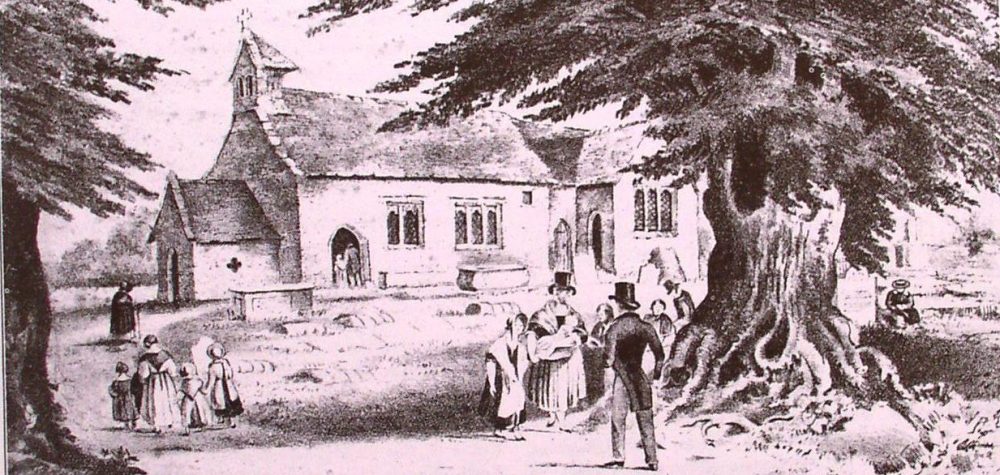
Llwyn Celyn

Loyncelin – Llwyn Celin – 311 on the 1841 Tithe Map.

The parish register at St Peter’s Goytre says John Jenkins, a labourer was living at Llwyn Celin, he had a son Roderick baptised in 1733 and another son Edward baptised in 1738.

In 1756 William Jenkins was the overseer of the poor for Llwyn Celin, in the same year Morgan Jenkins, husbandsman wrote the following:

The Rev’d Mr Williams curate of Geottre

S’r, You are hereby desired to publish banns of matrimony between us, Morgan Jenkins husbandsman that now live at Lwyncelin and Anne Griffiths spinster that live with her father Walter Griffith at Penpellenig both within the parish of Goytrey.

Given under our hands this 27th day of May in the year 1756.

Married 16th day of July 1756

In the presence of Walter Griffith; Rachel Williams both by x

In 1782 Roderick Jenkins married Catherine Morgan of Goytre House Farm, a daughter Mary was baptised in October 1782 followed by William in November 1784.

Roderick Jenkins died at Llwyn Celin and was buried at St Peter’s on 31st January 1787.

1831 the owner/occupier was Thomas Jenkins, he was the constable for Llwyn Celin.

Between the years of 1833 to 1837 a pauper, Mary Jones occupied a part of Llwyn Celin, she was allowed by the overseers of the poor a rate of 1/- per week plus coals. I cannot find a burial for her.

Walter David in 1837 was both overseer of the poor and land tax collector for Llwyn Celin. Confirmed as the owner on the 1841 tithe was Rebecca Harry and the occupier Walter David, who, on the 1841 census was aged 50 and a farmer. Mary his wife was 45, and their two children, Thomas 13 and Ann 16 were living with them.

Walter David continued living at Llwyn Celin, being the overseer of the poor in 1850 and also stated his religion was a Baptist.

The owner of Llwyn Celin was now James Harry of Newport (I assume the son of Rebecca) he was entitled to vote as the owner of freehold land in the parish of Goytre called “Llewyn Celyn”. In an undated document The rateable value of Llwyn Celin was £2 10s this increased to £12, again it was not dated.

The 1851 census gave a little more information, Walter Davies was now aged 57, a farmer of 19a and born in Goytre, Mary his wife was 50 and born in Mamhilad, their children Ann, 25 was born in Trevethin and their son Thomas, 23 was born in Goytre.

By 1866 Llwyn Celin had a new tenant, Thomas Lewis, who along with Benjamin Jeremiah was appointed overseer of the poor. On the 1870 electoral register Thomas Lewis was named as the occupier of a house and land known as tenant, his age on the 1871 census was 61, he was a widower and had a servant called Hannah Matby aged 55.

In 1875 Thomas Lewis’s son John married Margaret Thomas of Pentre Cottage who was the daughter of John Thomas, a copper man.

I am unable to say with certainty who was living at Llwyn Celin on the 1881 census but by 1891 it was Charles Jones, 37, a wheelwright who was born in Dixon, and Mary 31, his wife who was born in Monkswood.

By 1901 Thomas Jones 31, a farmer, his wife Sarah, 30 and their two children, Edith 8 and Albert 5, were residing at Llwyn Celin. All were born in Goytre.

In June 1908 Llwyn Celin was advertised for sale in the Free Press, offering a farm of 22a 2r 16p, a house, land and buildings in the occupation of Thomas Jones, yearly tenant at a rent of £16 per annum (and undertenant of the late Col. Henry Byrde) tithe paid last year was £1 14s 4d

The same year Thomas Jones sold his Live and Dead stock in a sale.

A tragic accident occurred in 1910 when Mr Frank Jones, 38, of Llwyn-Celyn farm Goytre, a married man with three children was found dead at the bottom of a quarry. He was shooting on the land of Mr Roberts, Penystair Farm when it appears that he slipped and the gun went off accidentally. He was buried at Monkswood Church.

On the electoral register for the years 1912-1919 Richard Dobbs was the occupier. For the years 1921-1922 it was Harriet and Alfred Godfrey.

The 1921 census says Richard Dobbs is 62, born in llangarron,  a roadman working for Pontypool rural district council, he is also a farmer. Harriet his wife is 55,  daughter Mary Jane is 32, both were born in Cwmcarvan. Sons Alfred 24 and Evan 17 were both born in Goytre. Alfred is a blacksmith journeyman working for Wm Wilks, Evan is a farm hand assisting his father.

Gelli

Gelli – 509 on the 1841 Tithe Map.

Owner the Earl of Abergavenny and containing 13a 2r 20p.

A marriage took place on the 6th April 1767 between William Prosser bach and Judith Morgan at Mamhilad church, after the wedding they lived at Gelli. They had several children, James baptised in December 1769; William in February 1771; Edward July 1774; Thomas 1776; Philip December 1779, and Richard May 1782.

In 1798 Judith Prosser paid land tax for Gelli. In 1806 Thomas Prosser was the constable for Gelli for his lease and he was mentioned again on the 1821 Barony of Abergavenny survey.

When Thomas died in 1834 the tenancy passed to Jacob Prosser, he is the constable in 1837 and in 1840 he holds the lease of land for lives called Gelly.

The 1841 tithe says Jacob is paying £1 3s 10d to the rector and the owner is the Earl of Abergavenny.

The 1841 census “on the main road between the road from Penpellenny to Goytre Hall.” Jacob Prosser 35 farmer, Mary 30, Lewis 5, William 3, Thomas 1.

The 1851 census says Jacob Prosser is a farmer of 13a. In 1855 the Rev Thomas Evans wrote to Gabb, the Earl of Abergavenny’s agent asking him to renew the lease for Gelli to Jacob Prosser as he was a hard working man and that it’s value is £6 6s not £12 as originally thought. The parochial rate and rent charges amount to £2. The cottage and garden he valued at £1 16s and mentioned that thatch cottages are a perpetual source of expense.

On the front of the envelope the Rev Thomas Evans wrote “The bearer is a very good man – one of the oldest communicants I have. I should be glad to see him continue in the parish inhabited by so many of his forebears.”

In 1859 Jacob Prosser signed the petition against paying taxes for the widening of Newport Bridge and in 1861 he takes a lease for the lives of the Prince of Wales.

Jacob Prosser is 75 years old in 1871 and now a labourer, they are boarding William Evans 7, and Rebeka Thomas 5 months, and have a maid servant, 12 year old Jane Austin.

In 1885 Hugh Johnson was charged with stealing 3/6 the property of Mary Prosser Goytrey. He and his mother were allowed to sleep in the barn and go in and out of the house.

In 1898 Mary Ann Williams 45, of the Gelly died and in 1899 Ann Williams aged 73 of Griffithstown, late the Gelly died and were buried at St Peter’s church.

By 1899 a James Green was renting a dwelling house and smiths called Gelly, and in 1900 10 pigs were offered for sale by Cornish of the Gelly. The 1991 census says Charles Cornish was aged 45 and a market gardener, born in Somerset, married to Hannah for 19 years and had 6 children all alive.

David Hugh Morgan of the Gwynedd was renting Gelly in 1914 and when the Earl of Abergavenny held his property sale in 1918 Gelli, containing 13a 3r 20p was purchased by the leaseholder David Hugh Morgan for £350.

In November 1943 Mr Wm Powell of the Gelli was fined for allowing a bull to roam in a field with a public right of way and fined 20s

Upper Woodlands

Upper Woodlands – 13 on 1841 Tithe Map.

The original owner was the Earl of Abergavenny

The first mention I can find is in 1771 when James Jones, a pauper of Woodland Cottage was buried at St Peter’s church.

A document that says it was late in the possession of Mary Frederick, a pauper, commonly called Mary James, widow; she was buried at St Peter’s on October 6th 1778

After Mary Frederick’s death the lease is held by William Jones for the lives of William 26, Vaughan 17 and Charles 15. William Jones still holds the lease on the 1821 Earl of Abergavenny survey.

Gwellian, daughter of William Jones married Henry Lewis on the 27th September 1822 and lived at Upper Woodlands.

The 1841 tithe says Henry Lewis,  on the  census of 1841 Henry is  50, Gwellian 45, their children are Ruth 15, Elizabeth 10 and Ann 2.

Ruth married John Hart in 1845 and they lived in John Rosser’s house (no. 11 on the 1841 tithe) which was very close to Upper Woodlands.

Henry and Gwellian are still at Upper Woodlands on the 1851 census, Henry is aged 60, a labourer born in Llantrissant and Gwellian is 59 and also living with them is their daughter Elizabeth aged 19.

There is a report in the Usk Observer in February 1859 in which Henry and Elizabeth are charged with trespass on the land of Henry Bird and fined 10s. The fine was paid by his employer Samuel Harris of Gwenffrwd factory.

On the 7th November 1859 Elizabeth married Robert Williams a widower aged 39 of Llanover; the witnesses were Richard Pruett and Elizabeth’s father, Henry Lewis.

By 1861 there was a new occupier, William Jones aged 28, born in Llanvair, his wife Mary Ann 22, who was born in Rhymney and their 4 months old son John born in Goytrey.

By 1871 this had changed once again to Rachel Davies as head of the household, she was maintained by her son Francis who was 28, born Goytrey, and her 12 year old granddaughter Margaret Wood.

On the 1881 census Walter Jones aged 65, a woodward, and Mary his wife 51 born in Scotland were living at Upper Woodlands. Walter Jones died in June 1900 aged 84 and was buried at Blaenavon.

The 1891 census gives John Williams 49, a woodman born Llanover and Mary his wife 42, married for 6 years and have 3 children, Alice, William and Ivor all born in Goytre.

By the census of 1921 the residents of Woodland Cottage is William Arthur James, William is 27, a coal miner at Viponds but out of work, Gladys his wife is 25, born in Varteg, they have two children Eveline 4, Ceredwn 2, William and the two children were born in Goytre.

Cill or Kiln Farm

Cill ( Kiln) Farm – 300 on the 1841 Tithe Map.

The 1798 land tax says John Hughes is the owner and William Phillips is the occupier and the parish records until 1801 also say the same.

William Phillips dies in 1808; he was buried at St Peter’s Church. After his death the new occupier is Thomas Jenkins.

The owner, John Hughes of The Reddings, Llangwm Isaf dies in 1807 leaving “all that messuage, tenement called Kiln House, barn, twelve closes of land, arable, and meadow to Mary his wife. (John Hughes also owned Parc Bach.) Mary Hughes is listed as the owner on the land tax until 1823.

In 1816 William Lloyd is living at Kiln he had a child called Martha who was baptised at St Peter’s Church and also buried at St Peter’s in 1818.

Edward Edwards of Caerleon takes the lease of Kiln on August 2nd 1818 with William Lloyd still being the occupier.

In 1823 another child called Martha the daughter of William and Mary Lloyd, a farmer at Kiln farm, is baptised at St Peter’s Church.

William Lloyd and his family move to Church Farm in 1829.

The 1831 land tax for Kiln says William Morgan is occupying late Mary Hughes house, barn and land and the present owner is Rachel and Mary Mathews.

Another change has occurred by the 1841 tithe, the new owner of 17a and 26p, paying £2 13s 10d to the rector is Richard Seaforth. John Meredith 35 and Susannah 50 are farming at Kiln on the 1841 census.

In 1847 William Williams takes the lease of both Kiln and Vedw (Vedw is now missing) on the 1851 census William Williams is 41

Lewis Edmunds (the local builder) writes in his diary on the 10th May 1855 that he is at Cill plastering inside and repairing outside for William Cocker.

At the spring assizes in 1859 is a court case Seamark v Williams, declarations are given by Richard Pruett and William Plaisted.

William Cocker is still the occupier in 1860 and is also overseer of the poor and he also voted for William Harris to be the highway overseer. On 1861 census William Cocker is 49, a farmer, his wife Mary is also 49.

There is a court case in the Usk Observer on the 22nd October 1864 where William Cocker claims 5/3d from Herbert Edwards a shoemaker of Goytre for goods obtained – Herbert Edwards was ordered to pay within a week.

Richard Seamark died in 1866, the new owner in 1870 is Robert Thomas.

An advert in the Free Press of 21st October 1876 says there is a stock and furniture sale, the property of Mr John Turner who is leaving Kiln Farm, some time before this date John Turner signs a petition to object to the removal of the quarter sessions from Usk to Newport.
The sale consists of implements, hay, straw, 9 tons of fodder, 5 tons of hay, wagons and carts, various agricultural implements, a mare in foal, ewes and poultry. Also household furniture including an oak table, chest of drawers, feather beds, 8 day clock, writing desk any many other items.

By 1879 John Davies is the new occupier and on the 1881 census he is aged 51, a farmer, Mary his wife is 50, both were born in Brecon, their children are William 25; John 17; Thomas 10 and Margaret 5, all born in Blaina. In 1882 Thomas received a school certificate for freehand drawing, science and art.

John Davies was summoned in 1883 by the board of  guardians for the non-attendance of school by his daughter Margaret Jane.

William Rosser takes the lease in 1884 (previously held by Thomas Roberts of Great Oak Farm Tydee,) the farm has now 45a 3r 11p, the rent is £45.

Thomas Roberts decided to sell to Lady Llanover in 1887 and William Rosser was given notice to quit.

The new tenant under Lady Llanover was Daniel Davies from Carmarthen. He stayed until 1902 and at that time placed an advert in the Free Press for the sale of live and dead stock as he as leaving Kiln Farm.

David Jones becomes the new tenant and on the 1911 census he is aged 70, a farmer from Cardigan, Margaretta his wife is 55, they have been married for 12 years and have 2 children, Margaret and John who attended Llanover school.

David Jones is still at Cil farm on the 1921 census, he is now 81 and still a farmer, Margaretta is now 66, their children, Margaret is 22 her employment is assisting on the farm, son John is 19 and is a plough and Waggoner on the farm.