Fred.k Rosser – Stranded Taxi-Driver 1926

Friday January 8th 1926 – Stranded Taxi-Driver

Fredk. Rosser, bus proprietor, Llanover was summoned for driving a motor taxi on the highway after hours without a light at Goytre on Dec. 22nd.

Pleading in mitigation of the offence, he said he was unable to light his lamps owing to the roughness of the weather, and that he was stuck for three hours owing to the snowstorm.

A formidable list of previous convictions for various offences were proved against him, after which a fine of 30s was imposed.

Joseph Edgar 1926

Friday March 12th 1926 – The First Time

At Abergavenny of Wednesday, Joseph Edgar Goytre, was summoned for using a motor-car without a road fund license.

P.C. Griffiths said that when he asked by witness about the license, the defendant replied “this is the first time I have let her out this year. I was going to the Post Office for the license this morning”.

Witness then asked for his driving license, and he replied that he had left it at home. Later he showed witness a driving license that had expired on December 31st last year. Defendant was fined £2 for the car without a road fund license.

He was not summoned for not having a driving license.

Charles Morgan – Non-Payment of Poor Rate 1903

Friday March 20th 1903 – Poor Rates

Charles Morgan, farmer on the Llanover Estate, was summoned for non-payment of 8s 7d poor rate due to the overseers of the parish of Goytrey. – Ordered to pay in 14 days.

John Williams, farmer, was summoned by E.W. Gwatkin for non-payment of £3 18s 7d poor rate due to the overseers of the parish of Mamhilad.- He was further summoned for non-payment of 3s 11d poor rate due to the overseers of the parish of Goytrey. – The cases were withdrawn, defendant having paid the money.

Elizebeth Thomas – Getting into a House at Goytrey 1869

Usk Observer 30th January 1869 – Getting into a House at Goytrey

(Yew Tree Cottage Rhydloyfan)

Getting into a house at Goytre. – Elizabeth Thomas was charged with stealing 2s 6d., the moneys of George Watkins at Goytre on the 16th inst., Mrs Watkins stated that on her return home on the day named, she found that her house , which was left locked had been broken open. Prisoner was found in one of the bedrooms, and had put the half crown and some other things into the holes in the wall, where the police discovered them; the girl had been in the habit of going into the house and had been very kindly treated. Sentenced to three weeks hard labour.

Good Friday at Chapel Ed 1871

15th April 1871

What was to be done on Good Friday? There were cheap excursions to Clevedon and Weston-Super-Mare, and there was the widely celebrated tea party at Chapel-ed, which should I choose? Certainly not the excursions for there is always some draw back about them, some sticking on a mud bank, some bewilderment of a steamer in a fog, some getting left behind or unable to reach home until an unreasonable hour.

And then I had already “done” Chapel-ed and the charm of novelty had worn off. I was rather inclined to stay home for a change, when, strolling undecided down the road towards Pontymoile and wishing myself with some Surrey friends, who, I knew were sailing joyously down the Thames at Richmond, I was hailed by a party of young men who wanted to know whether I was not going to Chapel – ed. Of course they were going. And lots in front were going and lots behind were going. Everybody seemed going. And I went. And having gone I know a great many will be disappointed, if I don’t give account of my experiences.

Alas this time I had not the pleasure of moving about incognito. We called to have a needful drop of beer at the Wainyclare inn (and, faith, it’s hoping that I am the busybodies who are meddling so much with the poor man’s pint of beer, while they themselves get gloriously drunk on wine at their dinner parties will some day find that the poor man won’t stand to much humbug and a couple of rustics in a corner began discussing my style of writing in whispers, but as audibly that I was bound to turn my head and have a quiet laugh.

And it was the same throughout the day. Everybody had my name as pat as possible, and a hundred times did I hear the remark “he will have us all in the paper.” The lady in the blue dress who loudly expressed herself to that effect will here find that she has won that public mention which she invited.

No. I am not going to repeat the “ten-a-penny” joke. I know how to spell the name of the place now. Penplenny. It looks simple enough in print, but it is an awful mouthful pronounced by some people. At Penplenny there was the usual merry making in the orchard attached to the inn, but no band mustard courage enough to attend this year. And the memory of the “swipes” which was sold there twelve months ago deterred me from calling. I am told that this house generally supplies what is good and wholesome, and perhaps I happened to meet with an unlucky tap.

The narrow lane leading from Penplenny to Chapel-ed was thickly studded with primroses and purple violets and it was impossible to resist putting a few in one’s button hole. The little chapel gleamed white and fresh in the glorious sunshine beneath the cloudless blue sky, and a few loungers hung about the gate leading into the tiny graveyard.

In the adjacent field comparatively few folks had assembled when I arrived. One knot of youths was playing rounders and another was leaping over sticks, but their sport seemed to lack vitality, and the girls went wandering up and down in twos and threes in a very moping and dejected manner.

Turning back I went to the chapel in quest of tea and found all the pews closely packed except the one at the very front row. In that were two acquaintances looking as innocent as angels and consuming tea and cake in an earnest minded manner. With them I obtained a seat and gave myself up to creature comforts under the eyes of the pastor and a row of buxom young ladies who filled the cups and saucers.

I don’t know how much my companions had stowed away, but the merry-faced young gentlemen who waited upon us seemed staggered and turned them over to another waiter. The tea was so good and the cake was so good, and the long walk brought on such a thirst that people didn’t seem able to stop themselves. I plead guilty of having swallowed five cupfuls and the waiters (who were most obliging and deserve thanks) apparently thought that everyone had unlimited capacity for cake.

We got into the open air at last, and by that time the folks in the field had increased in numbers hand plucked up more spirit. The lads had joined the lasses and were playing at kiss-in-the-ring merrily, a damsel in a scarlet jacket taking up a good deal of the running. A few joined in a very insipid and milk-and-water game called twos and threes, but that soon came to an end.

Eh! What! Was it possible? A harp in the field? Sure enough! The veto against music had seemingly been removed, and a good job to. Two harpers made their appearance, but one did not strike up. The other did not “take” at first but some young men joined in a quadrille, Spurgeon –style and danced it very well to; and after the dancing went on in earnest and I failed to see any wickedness about it.

Rounders and jumping were vigorously carried on, but the most popular movement was decidedly kiss-in-the-ring. One ring was by no means big enough to accommodate the lovers of the game. About half a dozen, and large ones to were in full operation at the same time, and I should think that some of the girls had so much kissing that they will not require any more for the next twelve months.

Capital girls for fun are those Goytrey girls; blooming as hebe; swift footed as Camilla; and praise be to them all the best eschewed chignons and wore their own hair and some of them had such a wealth of beautiful natural curls as would have sent Hovenden the famous barber into ecstasies.

As for their running, I have cause to remember it, for after resisting a thousand invitations I did at least join one charming circle, and was fairly winded the dead-beat in about a quarter of an hour. And what made me join? Did you ask Mrs Grundy? Well, just this some very nice ladies were much afraid that I was closely related to you, looked upon me as a sort of bug-bear, I believe, although evidently dying to join in the fun were afraid to do so in my presence. And so, just to convince them that it is always my wish to promote sport instead of spoiling it, I led the way into the ring, and quickly had the satisfaction of seeing them enjoying themselves to their hearts content, and am inclined to think that there was real gratitude in the taps which afterwards the lasses showered upon my back.

All pleasures must have an end. The grey shades of night closed in; the stars twinkled forth one by one; and I bode adieu to the field. A homely pint of beer at the Nantyderry refreshment room was most acceptable and I was glad to see that the proprietor looked better after his change than he did last year. The arrangement to prevent confusion at the railway station were again most creditable and praiseworthy. We were rather overfull in our carriage, but if the lady who rode to Pontypool on my knee did not mind it, I am sure I did not.

Glad am I that I did not return by the road as I abhor seeing disturbances and think it very foolish that a pleasant day cannot be ended with friendly feelings. The same sort of silly prejudice which gets up the “town” and “gown” frays at Oxford led I am told, to a “town” against “railway” row at Wainyclare. This is both ridiculous and deplorable. “Town” is rather indebted to “railway”, the only thing on which it had to depend on for trade but a few months ago, and this ought not to be forgotten.

The railway officials in this neighbourhood are a civil, orderly and well conducted class of men, and, for goodness sake let there be no unfounded jealousies and beginning of a lengthened feud on part of the “town” boys against them.

As I came back by rail, I could not call on my worthy friends at the Horse and Jockey but I hear that old John the ostler is doing wonders again in the gardening line this spring and must go and see them.

W H Grundy

15th July

John Williams of Goytre charged with riding i a waggon without reins – fined 10s

5th August

Sale of the estate of John Gwynne Herbert Owen solicitor, late of Oak Cottage Goytre

Thomas Prosser charged with assault on Isaac Wilks at Goytre – fined 24s

Mr Prosser also charged with breaking into the public house of Ann Price Mamhilad – fined 12s or 7 days hard labour.
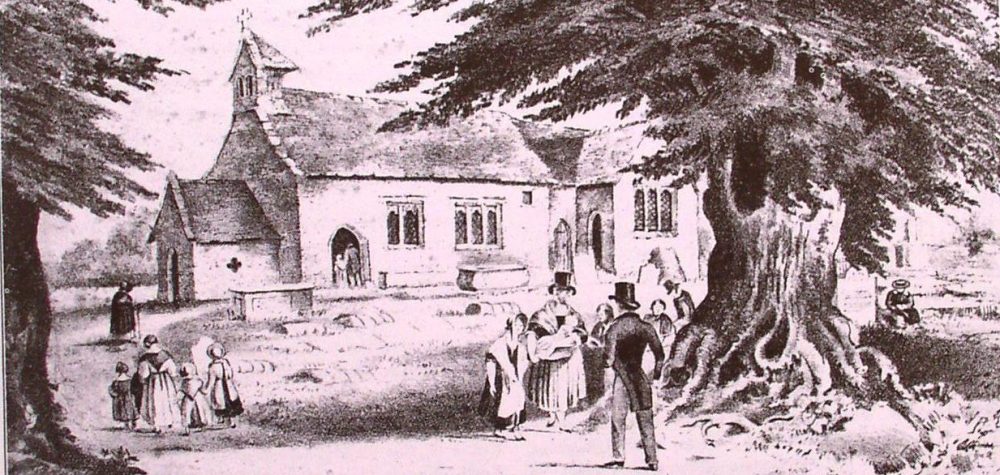
Goytrey Cymordorian 1861

13th April 1861 – Goytre Cymrodian

Easter Monday being the anniversary of the Cymrodorian society, the members of this club as usual assembled at the Half-Way House to celebrate their festal day. Additional interest was felt in the proceedings, as it was known that the worthy proprietor of Goytre House, Leuit. Col. Bird intended to present a new banner to the society.

Accordingly, the members dressed in their scarves &c and proceeded by the Newport factory band, marched in procession to Goytre House, to receive their promised present. Here they met the gallant Colonel and his sons, Messrs C & T Bird in readiness to receive them. The officers of the club then came forward, and received the banner from the hands of the Colonel who then addressed them as follows:

‘My friends, in presenting this banner to your club, permit me to accompany it with my earnest wishes for the prosperity of the Goytre Cymrodorian society, whose property is it now to become. I greatly rejoice in the success that has now attended your society, and I am thankful to see many old friends among the members as well as others who have become personally known since it has been my happiness to reside among you. I trust that the mutual regard which has arisen, will be maintained among us, and this banner may be a token that cordial and friendly feeling will ever exist between us.

I am especially delighted to see a friendly society established in the old parish of Goytre, to which memories of the past, and pleasures of the present, so much endear me. I have carefully studied your rules, and they are all that are proper and beneficial to such an institution, and I hope all the members will do their utmost to maintain them in their integrity, and thus contribute to the welfare of the whole club. In all countries and institutions, ‘union is strength’ and I trust we shall ever be united in true charity, one towards the other, and in our efforts for the general good.

There is a union I pray may also increase amongst us all – the union of faith in the one and only saviour of our souls- that when time and bodily ailments shall be no more, we may be united in that world where there is no more sorrow, sickness or death; but where I trust we who now meet together on earth, may be united in an endless eternity’.

Mr Wm. Gwatkin, the secretary, on behalf of the members, returned thanks to the Colonel on behalf of the members, for the honour he had done them in presenting them with such a handsome pledge of his goodwill and wishes for the prosperity of their society.

Three hearty cheers were then given for the kind donor, and, “For he’s a jolly good fellow &c”, was sang in such strains as evinced that one and all responded from their hearts, and wished to convey to their kind and generous friend that they duly appreciated his gift.

The banner is of blue silk, deeply fringed; on it is beautifully painted the plume of feathers, the well known crest of the Prince of Wales, and his motto ‘Ich Dien’ – I serve, underneath, on a scroll. Encircling this is another scroll, on which is inscribed, presented to the Cymrodian society by Col. H.C. Bird.

The men now reformed their procession and walked to the parish church. The service was read by the Rev. M. Morgan, the incumbent of Mamhilad, and an eloquent and impressive sermon was preached by the Rev. T. Evans from Prov. xxii.3, “A prudent man foreseeth the danger and hideth himself”.

After the service, the club returned to the Half-way house and sat down to a good substantial dinner, which the host, Mr Evans had prepared for them. The Rector and Col. Bird occupied the chief places at the table, supported by the Rev. M. Morgan and C & T Bird.

Ample justice being done to the good things of this world, and the cloth removed, the rector, in a handsome manner, proposed the health of Col. Bird, truly remarking that in their kind friend they all found a willing and steady supporter of anything that could possibly contribute to the temporal and spiritual improvement of the parish, of which they had substantial evidence that day.

(Drunk with cheers!)…. The Colonel in acknowledging the warm and enthusiastic manner, in which the toast had been received, expressed the great pleasure he felt, after a long residence in the East, to find himself again, an inhabitant of the old parish of Goytre. He felt especial pleasure in being among them on that day and hoped to be spared for a long time to help them in their endeavours to assist each other in anything that be beneficial to them. He begged to propose ‘health and prosperity to the Cymrodorian society’, loud cheers…..The same stentorian voices also gave a vigorous “three” for Mrs Bird and family. Mr Gwatkin then proposed the health of the vicar of Goytre and requested him to accept their sincere thanks for the excellent sermon he had given them that day….The Reverend gentleman, in acknowledging the compliment remarked that it gave him great pleasure to be among them at their annual feast. As for his sermon he could only say that he felt it to be no more than his duty, as minister of the parish to render them such services on these occasion; and since several of the members had expressed a strong wish that he would give them his support, he felt much pleasure in complying, and begged they would regard him as an honorary member. This was enthusiastically received.

The evening was spent in a most pleasant manner, and the cordiality with which the day commenced, continued to the close. The band gave great satisfaction: the readiness of them men, their desire to please and their admirable conduct throughout the day were such as to be generally noticed.

At their departure, the hearty thanks and cheers given them told how well they had sustained their reputation….at the earnest request of the club Col. Bird consented to be treasurer and an honorary member of this well conducted and excellent society.

Highways Board v Overseers of Goytrey 1867

THE COUNTY OBSERVER AND MONMOUTHSHIRE CENTRAL ADVERTISER

Saturday January 26 1867

NON PAYMENT OF CALL – The Pontypool and Usk Highway Board v The Overseers of Goytrey, for non-payment of a call made by the Board.   Our readers will remember that this case was adjourned five weeks ago for the purpose of obtaining the opinion of the Home Secretary on a point of construction of the Highway Act, raised by Mr. Llewellin for the defendants. Mr. Blount for the Highway Board, handed in the reply of the Home Secretary to the application that had been made to him, wherein he said the magistrates must decide the question. The Chairman said they would have been glad if they had been relieved of the duty of deciding a point on which two learned advocates differed; but as it was left to them they must deal with it as well as they could, and which they should do with all diffidence. What they had to do was decide the proper construction to be put on the words “no contribution to be paid by any parish at any one time in respect of highway rates shall exceed the sum of ten-pence in the pound.” It was admitted that the contribution ordered to be paid by the Overseers of Goytrey exceeded ten pence in the pound, but it was contended that as the contribution was in the precept ordered to be paid in two instalments neither of which exceeded ten pence in the pound, the limitation had not been exceeded. Now he had carefully gone through the Highway Acts and could not find any authority for dividing a contribution which had been ordered, into instalments, neither the word instalment nor its equivalent could be found in the acts connected with the payment of contributions; it might be very convenient to the overseers of a parish to be authorised to pay a contribution in instalments, and he did not mean to say that the Board had not the power of giving that convenience, but he did think that the act never intended that a contribution exceeding ten pence in the pound could be ordered and afterwards broken up into instalments so as to keep all payments within that limited sum; if so, there is nothing to prevent a contribution of 30d in the pound, the full amount in any year the board of its own power can order, and then calling on the parish to pay it in three equal instalments in three consecutive weeks or days – that is an extreme view, but if the principle of instalments contended for be good, it is as good for that view of the case, which never could be intended. After several further remarks, the Chairman said the Bench felt the more satisfied that they were putting a reasonable construction on the act because they found that the overseers are to pay the contribution out of a rate to be levied by them, if they have not money in hand to pay it. If therefore the Highway Board cannot order a contribution to be paid by any parish at any one time that exceeds ten pence in the pound, it follows that the overseers cannot make a rate that exceeds ten pence in the pound, which the Goytrey overseers would have to do to meet this call which is made on them, the overseers being only empowered to levy a rate for “the sum to be contributed by the parish,” that sum being the contribution ordered, not the instalments of that contribution, for levying a rate for which we do not find any power or authority given to them by the Highway Acts. We therefore decline making any order, and dismiss this summons. Mr Blount asked if the bench would give him a case for the opinion of the superior courts. The Bench said if they could give him a case he should have it, as they had no objection to having their opinion reviewed.

The Goytrey Grievences 1867

 January  26th  1867 – USK PETTY SESSIONS FRIDAY

Before G. R. Greenhow-Relph, Esq., chairman, Major Stretton, S. Churchill, and E, Lister, Esq.

THE GOYTREY GRIEVENCES – THE AGRIEVED WIN THE FIRST BATTLE

On the 5th of the present month we published a full report (the only one which appeared in any newspaper) of a case brought before the Usk bench of Magistrates, by the Usk and Pontypool Highway Board, against Mr Thos. Jeremiah, overseer of the parish of Goytrey, for having neglected to pay to Wm. Davis, Esq., at the Bank of the Provisional Banking Corporation, Usk, the treasurer of the said Board, towards the repairs of the highways of the parish of Goytrey, and such other expenses as are chargeable by the said Board on the said parish, the sums of £140, on the days following, that is to say, the sum of £100 on the 5th day of November, and £40 on the 17th day of December last, in compliance with an order made by the said Board.

On the 22nd of October last, a vestry meeting of ratepayers of the parish of Goytrey was convened for the purpose of considering what steps it was their duty to take in reference to the greatly increasing pressure upon them of road rates, caused by the unprecedented expenditure on the Star road. The ratepayers – who are, generally, small payers – had been called upon to pay, during the last three half-years, in road and poor rates, a sum amounting to a total of not less than £954 17s and that within the last twelvemonths and two days, their road rates had amounted to £322, whilst an order had again been made upon them by the Highway Board to pay, within the ensuing two months, not less than £140, making a total of £462 within the short space of fourteen months!

The rateable value of the parish of Goytrey is £2,955, and the number of ratepayers about 150. Of these about 25 are rated under £20 and over £10; and about 60 are rated under £10 and over £2. Any person possessed of common sense and reason can easily imagine how heavily and sorely such a taxation pressed upon and oppressed a large class of small agriculturalists and agricultural labourers in the parish.

The ratepayers, feeling deeply aggrieved by the unprecedented road-rates laid upon them, and by what they deemed to be a gross mis-application of their rates on the Star hill, resolved at the vestry-meeting previously alluded to, to see in what way they could get redress, be protected, or protect themselves.

A communication embodying the above facts was sent to the Usk Highway Board, but no reply having been received, a vestry meeting was called on the 1st of November, at which it was resolved that the chairman should write to the Board of Waywardens, and offer to have the matter in dispute between the parish and the Board, in reference to the cost of the improvement of the Star Pitch, referred to the decision of the Usk Bench of Magistrates, or to the Pontypool Bench, or to the Chairman of the said Benches, provided the Board would abide by such decision as the referees arrived at; and the parish would agree to such decision as final and conclusive, as to the liability of Goytrey to the expenditure incurred; and the parish agreed that the Magistrates should decide the question in the capacity of private gentlemen, and not judicially, as magistrates, and that they were at liberty to decide the points upon their legal merits, the Waywardens appearing to view the matter in an Act of Parliament light only. The above proposal was made with the object of bring the difficulty to a peaceful solution, but without avail.

At the hearing of the case before the Usk magistrates, Mr Blount appeared for the Highway Board, and Mr Llewellin of Newport, for the overseers, and contended that the Board had no right to call for £140, as an Act stated that no call at any one time should exceed 10d. in the pound, and that calling for £140 was a little over 10d. in the pound.

The Bench reserved their decision in order that the Secretary of State should be obtained respecting the objection raised by Mr Llewellin, and the case was adjourned till, this day (Friday), when a large number of the ratepayers of Goytrey assembled in the Town Hall for the purpose of hearing the decision of the Magistrates.

Mr Blount appeared for the Highway Board, and said the Secretary of State declined giving an opinion, and handed the letter he had received from the Home Office to the Chairman, of which the following is a copy:-

Whitehall, January 11th, 1867

Gentlemen, – I am directed by Mr Secretary Walpole to acknowledge the receipt of your letter of the 7th instant, inquiring as to the interpretation of the 33rd Section of the Highway Act, 1864, in reference to a case in which the officer of the parish had been summoned by the Usk Highway Board for non-payment of a sum pursuant to their order, and I am to state in reply the Secretary of State has no authority to decide such a point. The magistrates must act according to their own judgement subject to an appeal subject to the Courts in Westminster Hall.

I am, Gentlemen, your obedient Servant, H. Worthington.

Messrs Blount & Davis, Solicitors to the Usk and Pontypool Highway Board, Usk

Prinnell, Mrs Harriet – 1863

GOYTREY. – SUDDEN DEATH.

On Thursday an inquest was held before C. M. Ashwin, Esq., deputy coroner, at the house of Richard Prinnell, whose wife, under the following circumstances, expired suddenly on Monday last.

Mary Painter said that she saw the deceased on Friday, when she complained of being ill. She said she had left her husband, and had been sleeping in barns, and such places, during the last few nights, and that she was afraid to go home … Mary Lewis said she had heard the deceased complain of being unwell, when she (witness) went to the husband and asked him to take her home, to which he consented … Richard Prinnell, labourer, and husband of the deceased, said that on Friday last his wife was very unwell, and that he had offered to send for a doctor, which he did not do in consequence of her being indifferent about it …. Ann Williams, who, since the separation of Prinnell and his wife, had acted as a servant, said that on Monday, the day on which deceased died, she gave her some tea, which she drank, having something to eat, which had also been provided for her.

At about half-past twelve, when she went upstairs to deceased and found her dead …. Dr F. Steel, Abergavenny, who had seen the body, and said that deceased died from jaundice and other internal disease. – Verdict, “Natural Death.”

28th February 1863