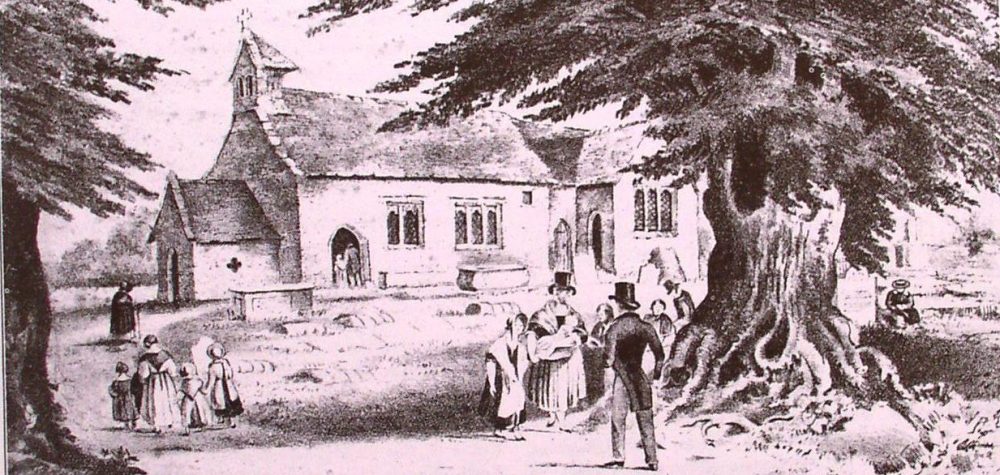
Isaac Jeremiah – Apples and Eggs 1866

24th November 1866 – Apples v Eggs

A young lad named Isaac Jeremiah appeared at the instance of a man called Jones for stealing his apples. The parties reside at Goytrey, Jones had some apples on a barn floor and on looking through a crevice in the door he saw the lad putting some of them in a basket. On speaking to him he put them back whence he had taken them. Mrs Jeremiah said she had some hens laying in the barn, of which they were tenants until the month of May next year and she sent her son with a basket (produced) to gather the eggs. Jones said that the last witness had three hens laying in the barn. The bench said that although the lad might have been sent to look for eggs, yet he might have taken an apple or two. Case dismissed; complainant to pay 6s. 6sd costs.

Brithllandwid 1865

17th June 1865 – Brithllandwid, Goytrey near the Little Mill

Mr J. Phillips will sell by auction on Friday the 23rd day of June instant

At the above farm the following farming Stock & Effects the property of Mr Lewis

One cart mare

Two yearling colts

One heifer

Six ewes and lambs

One ram

Sow and six pigs

Narrow wheel waggon

Two ditto carts

Plough

Harrow

Harness

Dairy utensils

And other effects

Sale to commence at 4 o’clock in the afternoon, promptly

Redvers Prosser – Cycle Accident 1924

Friday 24th September – CYCLE ACCIDENT AT GOYTREY – GRIFFITHSTOWN CLERKS NARRROW ESCAPE

An Alarming accident which might have proved fatal befell Mr Redvers Prosser of Goytrey on Wednesday morning. Mr Prosser who resides at Canal House was proceeding on his push bike to Griffithstown [where is employed in the clerical department at Messrs Baldwin’s works] when he collided with a motor vehicle at the dangerous corner near the Carpenters Arms.

He was conveyed to his home where it was ascertained that he was suffering from severe bruises and shock. Mr Prosser is well known in Goytrey as an active playing member of the local Association Football team.

Reference was made recently in the ‘Free Press’ to this corner as a potential death-trap.

Pritchard, Mr D – 1923

December 11th 1923 – Mr D Pritchard

Of Goytre House A Long and Useful Life

The death occurred at Goytre House near Pontypool of Mr David Francis Pritchard JP managing director of Messrs D F Pritchard Ltd., Western Valleys Brewery, Crumlin.

The deceased gentleman was the son of Mr & Mrs Edward Pritchard and was born at Llanfeigan, Brecknockshire [41/2 miles south east of Brecon] on August 17th 1848.

On June 22nd 1880 he married May Durant Gibbins who preceded him by 13 years. His heir is Mr Richard Pritchard MFH of Peterstone Court Ross.

As a young man Mr Pritchard settled in the Rhymney Valley and became a representative and subsequently manager of the Rhymney Brewery Company and while there he was a member of the Urban District Council and of the Bedwelty Board of Guardians, its first and only chairman, and his death marks the passing of probably the last of its founders.

Mr Pritchard moved to Crumlin Hall in 1899 and started the Crumlin Brewery business which in 1905 became a Limited Company. In 1912 Mr Pritchard moved to Goytre House and the opportunity was taken on the part of the inhabitants of Crumlin and of the Crumlin RFC [of which he was President up to the time of his death] to present him with a life sized portrait of himself on horseback and with an illuminated address testifying to his philanthropic work in the district.

The deceased gentleman was a freemason, a conservative and a gentleman and invariably presided at political meeting held at Crumlin under the auspices of the Conservative Association during electoral campaigns.

Until ten years ago he was a keen follower of the Gelligare hounds and was fond of shooting.

Some years ago he purchased the Monkswood Estate near Usk which he subsequently sold to Mr C H Bailey of Newport.

Wherever he resided he identified himself with the most social recreative, religious and philanthropic organisations of the district. He was a keen supporter and subscriber to the Royal Gwent Hospital and other similar institutions in the County.

The funeral will take place at Myniddislwyn Church tomorrow, [Wednesday]

Highways Board 1866

Free Press December 8 1866 – USK HIGHWAY BOARD

A meeting of the above was held at the Town Hall, Usk, on Monday, the following members being present: Messrs Thomas Watkins, (chairman), Gwatkin, Walter Blower, W. Price, Jno.Williams, John Morgan, James Powell, C. J. Watkins, E. Lister (Ex Officio,) Moseley, E. J. Williams, Gough and W. Fisher. In addition to the foregoing there were several of the principal ratepayers from Goytrey and the adjoining parishes present.

The Clerk read several letters, copies of which appeared in the Free Press, and in addition he read the following:-

Blaenafon Parsonage, near Pontypool,

Nov 19, 1866.

Gentlemen,- I beg to enclose a rough tracing of a portion of a map of the parish of Goytrey, and to call your attention to Penstair’s Road, coloured Red in the tracing, This road, nearly a mile long, connects two glebe farms belonging to me, one called Cwm in occupation of Thomas James, the other called Caen Cryddion, rented by Mrs Ann Prosser. This road is the only access to the Cwm Farm. Four gates have lately been put up on this road, and a portion of the fence has been pulled down.

If the parish officers have sanctioned the putting up of the gates they have acted illegally, and very unjustly towards those who have farms in that neighbourhood.

I, therefore, beg to ask whether the Board of Roads sanctions the putting up of the gates, and if not, whether they will take steps for their immediate removal. Begging the favour of an early reply,

I am, Gentlemen, yours truly,

JOHN JONES

Incumbent of Blaenafon, and Chairman of the Blaenafon Local board.


Kandy, Ceylon, Sept 28th 1866

To the Chairman of the Highway Board, Usk, Monmouthshire.

Dear Sir,- Your clerk has kindly forwarded to my son, now resident at Goytrey, the copy of a letter addressed by the Rev. Thomas Evans, rector of Goytrey, to the District Surveyor, respecting certain gates in the old abandoned which passes the cottages belonging to Pentrebach and Penystair farms, and which are represented by re Rector as causing very great dissatisfaction, though who are included in the “we” of his letter, or who besides himself “feels aggrieved in the matter,” does not appear by his communication.

I much regret that I did not, at once, avail myself of your kind offer to inspect the lane in question, and had I known that I should so soon have found it necessary to return to Ceylon. I would not have delayed the proposed inspection a single day, for by this unfortunate postponement I have subjected myself to a renewed attack on the part of the Rector of the Parish, and your Board to additional trouble.

I will now proceed to show you how far credence is to be given to his representation, by a detail of a few facts connected with this lane.

1.- In the first place I have a tolerably distinct recollection of this lane at various periods for thirty-five years, and it never was in different condition to what it is now, over-grown, dilapidated and unused.

2,- There never were, within my recollection, any fences, other than at present, along the fields of the Penystair and Pentrebach farms adjoining that lane.

3.- I have never seen, during the period of my residence in Goytrey, either a horse, mule, or ass, traversing that lane that I can recall to my own remembrance.

4.- Neither have I met with any parishioner who can remember any parish outlay on this old lane.

5.- And I can prove to your Board, and to any one open to conviction, that this lane is of no use to anyone, and ought to be abandoned by the parish as a highway to be maintained by it.

On the other hand, it is not true that the lane has been partially taken into my land, or that it is a channel of communication of value to the parish. Nor can I believe there has been the “complaint or dissatisfaction” represented, that the gates in question have been allowed to remain, for though I have personally spoken of them to many in the parish, I never heard one single word of objection expressed to their existence; nor has the land by these gates withdrawn from public use, and there is nothing really to restore to the public, for the gates are always open, and form no impediment to any one desiring to use lane, if such a desire exists, and it is impossible that the rector or anyone else can really fell aggrieved in the matter in the correct sense of this term, and some other motive than a praiseworthy desire to maintain the interests of the parish must be looked to for the rector’s championship of this abandoned highway.

I will now trouble you briefly with the occasion of my putting up these gates, that the Board may have perfect understanding of the whole matter.

I had found on taking possession of the Pentrebach farm and Graig Ddu rough lands had been perpetually grazed and over-run by stray sheep, cattle, and donkeys; and my bailiff had great difficulty in repairing the pathways for the use of my own stock and at one of the meetings of the parishioners I stated this grievance, and expressed a wish to place two latch gates at either end of the lane, similar to those on the parish lanes opening upon the mountain common, to save useless hedging along it; and though no vote was taken on the subject, or opinion recorded, no objection was expressed, and I felt satisfied that my fellow-parishioners would at any time, under their common sense of right, form a correct judgement in such a matter, and to their unbiased sense of what is due to themselves and to me, I am willing to leave the question, with perfect confidence; for surely there could be no great hardship to anyone who should, perchance, desire to use this old lane, to put out his hand and open the gate if he should pass through it, or to let it shut-to after him.

I will now further prove to you that it is quite a useless line of communication.

1.- Anyone going from Llanvoer to the upper part of the parish, would not go out of his way to choose this lane, when he had a more direct and better route up the Burgwm road.

2.- Anyone going from Llanover to Pontypool would surely not go so far from the main road, which invites them in preference.

3.- Even anyone going from Penwern farm, which also belongs to me, would go up the lane by the new barn or Bwrgwm road

In fact it is impossible to suggest any motive that could influence anyone in making use of that lane for any purpose that would not be better accomplished by other means more readily available and it would puzzle the ingenuity of the parish clerk himself to conceive any public use that the lane can be of to the parish. It is virtually abandoned to traffic, and in consideration of the uselessness of this lane I should, on behalf of the parish, be very unwilling that it should be subjected to any taxation for improvement or repair, especially when the ….tions in road rates are beyond all precedent, and form an oppressive burden upon the small farmers and cottagers.

Finally, I have a distinct remembrance of one or more conversations with the rector himself in times past, on the subject of the uselessness of that lane, and on my liability to trespass on it; and I can recollect a remark by him that now I had the farms adjoining it, it was of no use to anyone else, but might be required if the farms were again possessed by separate owners.

I am, therefore, unwillingly forced to the conclusion that the interference of the rector in this matter can only be attributed to some other cause than to a disinterested desire to maintain parish rights, which I have no desire to infringe, and I feel satisfied that the Board will not suffer advantage to be taken of my absence, in acting without full inquiry on the representation which has the appearance, at least, of being influenced any private feelings, and that, too, on the part of the clergyman towards a parishioner who has power willingly given him cause of offence, but who on the other hand, so far from evincing an oppressive spirit has given proofs that he has been influenced by a desire to promote the interests of the people of the parish of Goytrey, since his lot has been cast among them.

I remain, dear sir, yours faithfully,

HENRY C. BYRDE

The first business that came before the Board was with respect to the adoption by the Parish of the road made by Col. Byrde, from Goytre Church to Penpellenny farm, the largest portion of the said road running parallel with the railway. A meeting of the ratepayers, it appeared, had been held, at which it was resolved that the road should be taken and adopted by the parish.

The Chairman said it did not state who was at the meeting in favour of it, or who was not.

A Member: It was agreed to do so at a parish meeting.

The Chairman: Is it intended that the Board should take the necessary steps for the adoption of the road?

Mr Gwatkin: There is a copy of the resolution sent.

The Chairman: There is nothing sent, only that it was agreed at a parish meeting to do so.

A Member: The parish agreed to do so.

The Chairman: Who is the parish?

A Member: Why the inhabitants.

The Chairman: Oh, no.

Mr John Morgan: If the parish wishes the road to be adopted, and it is put in proper repair, there can be no objection to do so.

Mr Gwatkin: The parish will do everything in their power to meet the case.

Mr John Morgan: The road has been travelled over by the public for the past two or three years , and if it is not a public road I do not see why the public should travel over it. I dare say the chairman himself has travelled over it

The Chairman: Yes, I have travelled over it many times.

Mr John Williams, farm bailiff to Mr Logan, attended on the part of his employer to state that when he granted the land for the making of this road, it was on the condition that the fences were kept in repair by the parish, but there were no fences there. They got the grant of the land in 1858, but it was not made use of until 1862. Mr Logan was quite prepared to carry out what he agreed to do, and that was, that the parish should keep the fences in repair if he gave them the land.

A Member: It was not said at the meeting that the fences were to be kept in repair by the parish.

The Chairman (to Mr John Williams): Were you at the parish meeting?

Mr John Williams: No sir, I was not.

The Chairman: Was it understood by Mr Logan that the fences should be kept in repair?

Mr John Williams: Yes sir, it was

Mr John Morgan: I don’t think we could undertake such a responsibility.

The Chairman: What, to keep the fences in repair?

Mr John Morgan: Yes, the fences are of no use to us, and we cannot use the road very much.

Mr Gwatkin made an observation regarding this road but his remark did not reach our reporter’s ears.

Mr John Morgan: It is unusual to keep fences in repair.

Mr John Williams: Mr Logan is a gentleman whose word can be relied on. It was agreed that if he should give the land the fences should be kept in repair and unless that unless that was adhered to he would put up a gate and stop it up.

The Chairman: It shows how uprightly the Board should act in al matters.

The Clerk then read the 23rd section of the Highway Act, 5th and 6th Wm. IV.., cap 50, which says, – (long quote from Highway Act)

Mr John Morgan: No individual should make a road for his own use, and then call upon the public to repair it. There is no doubt that if it is properly represented to Mr Logan, everything will be made right.

The clerk having called attention to the lower part of the section of the Act previously given,

Mr John Morgan said – That proves that the parish shall be protected from the encroachment of any influential individual.

A Member: If there is any cavilling about the road it shall be shut up.

The Clerk: Three’ months notice must be given to the Surveyor.

Mr John Morgan: That is intended as a protection for the parish.

The Clerk: Then who is the parish?

Mr John Morgan: Why, the vestry. It is intended to prevent the parish being imposed upon; but here it does not come within the meaning of the Act, as the parish is willing to take the road if you make it properly.

The Chairman: Then the surveyor will say whether the road has been made the proper width or not.

The Surveyor: I am not prepared to give an answer at present.

Mr John Morgan: The parish will do what is reasonable, and you ought not to do what is unreasonable.

Mr John Williams: Mr Logan is a gentleman who will do what he says, and I know that he will stop the road up if the fences are not kept in repair.

Mr John Morgan: Does this involve any other fences?

A Member: Yes it does.

The Chairman: The question is, whether the Board will take it or not?

Mr John Williams: The new piece of road is 33 chains long.

The Clerk: The maker of the road has to give notice and get a certificate.

Mr John Morgan: The parish does not wish to have a private road for persons, and then be called upon to contribute towards it.

Mr Lister: I they want the road adopted by the parish, and it is taken by the parish, it must be certified by the magistrates.

Mr John Morgan: I differ from you, sir; I have read the clause over, and this road is not of public utility.

The Chairman: You have no objection to giving notice?

Mr John Morgan: Mr Logan says he will stop the road up.

The Clerk: If it was a road made by the parish it would be a very different thing.

Mr Gwatkin: It is a road made by subscription.

The Chairman: Mr Logan can be heard, and the magistrates will hear him, if things are not right.

Mr John Williams: Mr Logan does not wish to shut the road up; all he wants is to have the fences kept in repair.

Mr John Morgan: The road having been made, it was quite right for the parish to accept it.

Mr Gwatkin: The parish is willing to take the road.

Mr John Morgan: Well then, let the meeting decide whether the road shall be taken or not.

The Clerk: To adopt it as a highway?

The Chairman: Yes, I think so.

Some remarks having been given regarding the length and situation of the road: –

The clerk read the following resolution:-

“That the legal steps be taken at the expense of the parish of Goytrey, to adopt a certain new highway in Goytrey , running parallel with the railway there, about 33 chains in length, and to have same certified by Justices, and the certificate enrolled according to the road section of the Highway Act. 1862.”

Mr Gwatkin: That will not do.

Mr John Morgan: The question is whether the Bench will accept the road or not.

The Chairman:: Well let it read thus: – That the necessary legal steps be taken —–

Mr John Morgan: That is absurd. I shall propose that the new road made by Colonel Byrde be taken, adopted, and repaired by the Board. You are really worse than a lot of pettyfogging lawyers. (Laughter.)

The Chairman: We meet here under an Act of Parliament, and we have no power to adopt the road.

Mr John Morgan: If you are wanted to take the road you can do so.

The Chairman: The object is to prevent any cavilling hereafter

Mr Watkins said he would second the propositions.

Mr John Morgan: I differ from you, Mr Chairman, altogether; I think the parish can take the road directly.

The Chairman: But we have no right to take it in any other way.

Mr Price: Would it not be better to call a parish meeting?

The Chairman: The is one of the steps towards it.

The amendment was then put to the Board, but was lost by a large majority.

The Chairman called attention to the letter forwarded by the Rev J. Jones, of Blaenafon, and said the question was whether there was any right to put up the gates.

The Surveyor said it was impossible to haul much up the road.

After some remarks by Mr Byrde, jnr.,

The Chairman said the putting up of the gates had not been sanctioned by the Board, and the question to decide was what should they do in it?   There was no doubt that the gates should be removed.

A letter signed by several persons respecting the gates on the Penystair road, having been read.

Mr Price asked if there was an objection to adjourn the subject until Col Byrde’s return, as they would only have a short time to wait.

The Chairman: Are the gates kept shut?

The Surveyor: They are always shut, but not fastened.

Mr Gwatkin: I will have them down, or I will put a gate by Goytrey church.

Mr Lister: I think it will be better to adjourn it until Col. Byrde’s return, and let it be understood that the gates shall not be locked.

It was then agreed that the subject of the removal of the gates on the Penystair road be adjourned tp the next meeting, it being understood that the gates are not to be locked.

The Chairman said their calls were due on the 5th of December, and not one parish had paid the call.

Mr Walter Blower said there was money due to them, and their collector was in the room and he said he could not get the money in, and he thought it would be hard to summon half the people in the parish, when there was a balance in the bank in their favour, and the money was not wanted.

The Chairman: But the money is wanted; and if not paid, we had better dismiss Mr Williams and every one of them.

Mr W. Blower: But we have £20 more than is wanted. I will guarantee that the money is paid when it is wanted.

The Chairman: The calls must be paid, or the parties must be summoned.

Mr B. J. Williams:   I shall object to that.

Mr Gwatkin: I shall object to any summons taken out against Goytrey.

The Chairman then went through the various parishes comprise din the highway district, every on of which had failed to pay the call made.

Mr John Morgan: When the last contract for the Goytrey road was let, I never knew that it was done.

A Member: I thought that you were on the committee.

Mr John Morgan: I heard that it was let, but knew nothing of it at the time.

The Clerk referred to a minute of a previous meeting, and said that the Chairman and Mr Gwatkin were empowered to let about eight chains of the road leading to Pontypool.

Mr Gwatkin: That was put in unknown to me. It was said seven chains. But now it is said eight or nine chains. The road was impassable, and I thought that the money would be got by subscription.

The Chairman: Who was to do it?

Mr Gwatkin: I would have subscribed for one.

The Clerk: It is resolved that the parishes in arrear be summoned.

Mr John Morgan: Who Proposed that?

The Chairman: Why the Board.

Mr John Morgan: Then I object to it. I think it is a monstrous thing for Goytrey to pay so much money. Let the people pay when the money is wanted.

The Chairman: I think we should have a general resolution of the Board.

Mr Price: Is the object to get out of debt?

The Chairman: Yes.

The Surveyor: If the roads are left for a time, they will get into such a state that it will take a lot of money to get them repaired.

Several members:   Yes, they will get into a very bad state.

The Surveyor: You should have borrowed the money, and made the repayment extend over several; years.

In reply to a member,

The surveyor said that the work could be done for £150.

Mr Gwatkin: Will you do it for that? It will take from £400 to £600 to do ti, and it will not be done for less.

The Clerk: It is proposed that the parishes in arrear be proceeded against.

Mr John Morgan: Who proposed it?

The Chairman: Well, then, let it come from the Chair.

The proposition was then put by the Chairman.

Mr Gwatkin: I shall second Mr Morgan’s motion, and let everybody pay —

The Chairman: When they choose.

Mr Gwatkin at this stage of the proceedings rose and left the table.

The Chairman: Is there any wish to stop the work?

Mr John Morgan: It is better to stop than to go on in the reckless manner that we have been going on in.

Mr Gwatkin: It is the most scandalous thing I have ever heard of.

The Chairman: Is there any opposition to the proposition?

Mr Gwatkin: Mr Morgan has made a motion.

The Chairman: What was the motion?

Mr John Morgan: I beg to move that no summons be issued against Goytrey.

Mr Gwatkin: I beg to second that.

The resolution was then put, when eight were in favour of summoning, and five against it.

The Chairman then moved that professional assistance be obtained for the occasion, as it was only a cover for some parties to say that the parish took it up, and as they would employ professional assistance, it was only right to meet them on their own grounds.

Mr Morgan: Have you no confidence in your clerk?

The Chairman: He is not engaged to do it.

A few more remarks, of no public interest, were made, and it was agreed that professional assistance should be engaged to conduct the Goytrey case before the magistrates; and after signing some cheques, the Board rose shortly after five o’clock, the meeting having lasted upwards of three hours.

Rector’s Reply 1866

Free Press December 22 1866

THE RECTOR OF GOYTREYS REPLY TO COLONEL BYRDES LETTER

23 Half-Moon street, Piccadilly, Dec 13th 1866.

To the Editor of the Free Press

Sir,- Before I left home this week, I observe red in your paper of Saturday last, an attack upon me in a letter addressed by col. Byrde to the Usk Highway Board. I feel obliged to your correspondent, who, it appears was present at the last meeting of that body, when the letter was read, for having procured a copy of it. But for this, to one fortunate circumstance, I should have remained in entire ignorance of the entire burden of that communication, which, doubtless, the writer had no idea when penning it, would ever have found its way to the Press, to give the assailed party an opportunity of repudiating his undeserved attack, and of showing to the public that the dissatisfaction stated by me to exist in the upper part of my parish, respecting the gates on the Penystair road is real, and that, consequently, the representation to the Board is not only calculated to mislead, but (of course from ignorance of the case) wholly inconsistent with the fact. When, owing to the chance of proper grounds and reasons, argument fails, abuse is convenient, and often resorted to.

I had no idea of interfering with the Penystair road question, although long aware of discontent about it, until I accidentally saw the surveyor, some time ago, near my church, when two of my parishioners, the one a freeholder, and the other a leaseholder in Bwrgwm, were having an excited conversation with him about road matters, and also about the three gates put up by col. Byrde on the Penystair road. We represented to the Surveyor that it was illegal, and a positive injustice to the owners and occupiers of land on the side of the hill in Goytrey and Llanover, to allow these gates to remain on a parish road.

He observed that he could do nothing in the matter when a complaint was made – and suggested that one of the two more particularly interested, should write to the Board or to him, and formally complain of the objection. Some hesitation being, however, felt by my two parishioners in reference to the task of writing to the Board, I offered to write for them. Hence “the Rector’s championship,” volunteered in a matter so evidently disinterested to Col. Byrde.

I can truly say, I hope that whatever the Rector sees the attempt of might to overcome right, he will never be wanting in his duty to his parishioners to maintain their ancient and just right to all parish thoroughfares.

I distinctly remember the conversation at a parish meeting on the subject of putting gates on the road, and I well remember the caution, on the part of the few present, with which Col. Byrde’s wishes were received and the entire absence of response to those wishes. He thus tells the Board – “Nor can I believe there has been ‘the complaint or dissatisfaction’ represented that the gates in question have been allowed to remain, for though I have personally spoken of them to many in the parish, I never heard one single word of objection expressed to their existence.”

I distinctly remember a parishioner, who had always felt aggrieved on the point, expressing to him his dissatisfaction and objection, and also the dissatisfaction felt by others in the upper part of the parish, that gates had been put on the road. – and, surely, Col. Byrde’s memory must be exceedingly defective if he does not recollect when at a parish meeting he was much annoyed at having been told, in my hearing, by one of the farmers, in alluding to interference with the road in question, that “it was a monopoly.”

I never said to col. Byrde that this road was useless. I could not say so with truth – but could and might have said that it was “comparatively useless” – like two other roads in Bwrgwm.

Since such road are occasionally used they cannot with justice to the public be shut up, or so interfered with as to have gates put on them. A few sheep may, perchance, stray along the roads and get into Penystair fields, but where the “young cattle and donkeys” are to come from I am unable to conceive. But col. Byrde has no more reason to complain than others on this head. Has no the lord of the manor provided for such an evil? Has he not put a good gate on top of the main lane leading to the mountain in order to prevent sheep coming down? And if they should jump the gate, has he not provided for each parish a pound in which they can easily be lodged? Farmers on the hill side are not in the habit of taking the law into their own hands by putting gates on the adjacent roads, and thus infringing public rights, but trust to the mountain gate, or have recourse to the pound. Why should not Col. Byrde be satisfied with the same manorial provisions and keep his fences in good order? It is well known in Goytrey that a parish road cannot legally be shut up except by Court of Quarter Sessions – and, I believe, that Court cannot do it – if there should be an objection raised by a landowner who is interested in such a road – unless a better and, in all respects, and to all parties, a more convenient one is made with a view to supersede it. But let a landowner pull down one fence along a parish road and put up a few gates at certain distances, and in no time let him put up Notices at each end to this effect:: “any one found trespassing on these lands will be prosecuted, “ the parish road is then practically lost to the public. There might still remain to tell the tale, a pathway where the old lane was, but who would venture to send his young stock to market through what he is forced to regard as the property of a gentleman rising in the neighbourhood?

Now for the extraordinary proofs given that the road is of no use.

  1. Col. Byrde says, “Anyone going from Llanover to the upper part of the parish would not go out of his way to choose this lane when he had a more direct and better route up the Bwrgwm road.”   Of course not – it would be absurd in him to do so., unless he wishes to have a very fine view of the surrounding country. But any one going from Rhyd-y-llwyfen, and the region beyond, in the upper part of Llanover, with young cattle or sheep, towards Mamhilad, or to Usk, or to Pontypool markets, would he not go along the Penystair road rather than round by Pencroshopped, and then along the turnpike road, and, thus, much increase his distance?
  2. The following is the second proof that the road in question is of no use. “Any one going from Llanover to Pontypool would unsurely not go so far from the main road which invites them in preference.” Certainly, not unless the person were after the Llangibby or the Monmouthshire hounds, and wished to take that direction, in which case, the Penystair road would be very serviceable in saving the fields of the neighbouring farmers.
  3. The third and last proof is the following – “Even anyone going to Pantyscan farm, which also belongs to me, would go up the lane by New Barn or the Bwrgwm road.” Let those acquainted with the locality judge whether there is any proof of the uselessness of the road in questioning this remark. Any one going from Newbarn or from the Cwm in Mamhilad, to Bwrgwm in Goytrey, would take this road as his direct and nearest way. Such are the proofs!

Now for a “detail of a few facts connected with the road to show how far credence is to be given to my representation.” Destroy the Rector’s credibility as a witness, and his testimony is of no value.

1.Col Byrde tells the Board that he has a tolerably distinct recollection of that lane at various periods for 35 years, and it never was in different condition to what it is now, overgrown, dilapidated, and unused.”

He has forgotten to add that he has spent about 25 years out of the 35 out of the country. The road during my incumbency of about 24 years has never has never been so neglected as it is now. Before the farms referred to were bought for Col. Byrde a few years back, the road was in a better condition, notwithstanding the heavy hauling of stones along it from the Penystair quarry for the rebuilding of Goytrey church- for the erection of my school-room and teacher’s residence and for the making of various railway bridges.

  1. The second fact is – “There never were within my recollection any fences other than at present., along the fields of the Penystair and Pentrebach farms, adjoining that lane.”

I can only say that last Monday I walked the whole of the lane myself and found fully 180 yards of the fence pulled down, entirely cleared away, and converted into arable or meadow land. Col. Byrde can hardly be aware of this, for he tells the Board that “it is not true that the lane has been partially taken into his land.” He also says that “the gates are always open.” If so, what is the use of them? I found the three shut, and between the second and the third, three hurdles placed across the road which I had to get over.

  1. The third fact adduced is – “I have never seen during my residence at Goytrey either a horse or mule, or ass travelling that lane that I can recall to my own remembrance.” Col. Byrde will surely admit that those who have regularly resided, from year to year, in the parish, during his long absence of about 25 years in India, must have seen traffic along the road – such as carrying lime from the mountain in Llanover to Newbarn, to Upper Goytrey House, and to farms in Mamhilad, to say nothing of the fact that farmers from the said farm used, in former years, to send their young cattle along the Penystair road to their coedoa, or rough pasture on the hill-side in Llanover.
  2. The fourth fact is – “Neither have I met with any parishioner who can remember any parish outlay on this old road.”

Col. Byrde has certainly taken no pains to ascertain this point. For any old ratepayer who has attended, for some years, parish meetings would at once set him right. Neither has he taken much, if an, trouble, to consult the Parish Books, to see whether any entries have been made, from time to time, o fpayment of labour on this undoubtedly parish road. The Parish books, which I have examined, would convince any one on this point, and also show that the sums expended on it, at distinct intervals, and explicitly entered, have been very trifling. Besides, this road has, within my recollection and at my suggestion, been repaired by the parish.

In conclusion, I will observe that, however plausibly it may be insinuated that I was actuated by unworthy feelings in addressing the Surveyor, and not by a disinterested desire to maintain parish rights, the several members of the Board, at their last meeting, had before them the fact, that others had remonstrated with that body against the continuance of the gate s, and the damage done by Col. Byrde to the Penystair road – which was a complete refutation of all his insinuations.

Having, I think, convincingly replied to the various particulars to the Highway Board, the readers of the Press can now judge whether I have not fully shown that there is another side to the Penystair-road question, whereby is verified a saying of old, as it is true –

“One tale is good until another is told.”

I shall feel obliged, Mr Editor, by your kindly inserting this letter – and, I remain,

Yours truly, THOMAS EVANS, Rector of Goytrey

Highways Board 1867

County Observer Feb 23 1867 – USK

HIGHWAY BOARD

An extraordinary meeting was held at the Town-hall on the 16th inst., when there was present a large attendance of waywardens beside three ex-officios, for considering the financial position of the board and other purposes, and to reconsider the resolution of the previous meeting, and to rescind any one or more of them if though expedient. Mr John Morgan took the chair in the absence of Mr. Watkins. On the motion of Mr. Watkins, seconded by Mr. Price of Usk, the resolution passed at the last meeting staying proceedings against the parish of Goytrey for an undefinate period was rescinded by a considerable majority. Mr. Relph and Mr. Lister, two of the magistrates, did not vote. It was found necessary to make some further calls, – viz   on Glascoed £16; Gweresney £6, Llangeview £15: Llantrissent £20, Llanbaddock £20, and Usk £50, to be paid on or before the 15th March.

Fire at New House 1925

Friday 16th January 1925 – Fire at New House

On Friday night between 11 and 12 o’clock, a fire occurred at New House Farm, shortly be to tenanted by Mr Herbert E Morgan and his bride-to-be, and formerly in the occupation of the late Mr Phillips.

The flames were fortunately noticed by a near neighbour Mr “Wick” Thomas, who quickly informed Mr D H Morgan {Gwynedd], who with Mr N E Morgan [his nephew] and other help, were soon at work quelling a rick fire, which had started burning in several places and was in close proximity to the house and outbuildings.

Had the discovery of the fire been delayed, even for a short time, the damage would have been disastrous. As it was, only about one ton of hay was spoiled.

We are pleased to state that all losses are covered by insurance.

1867 Free Press

February 16th – Thomas Watts v Thomas Jeremiah

This was an action brought to recover from the defendant, a contractor, living at Mamhilad, the sum of £2, being the value of some chains belonging to a timber carriage, purchased by the defendants off plaintiff’s mother.
The case was adjourned at the previous court, for the purpose of enabling defendant to call as a witness the man to whom the chains were delivered by plaintiff, who contended that he agreed to sell chains to defendant, who, on the other hand, contended that when he purchased the timber carriage, he purchased all belonging to it, and the chains were an appendage to the carriage.
Mr E B Edwards appeared for the defendant and called:
Mr Henry Crump, who said, I was in the employ of Mr Jeremiah, he sent me to Watts for some chains, I went and asked him for them, and they were delivered to me. There was nothing said about paying for them, I took them to Mr Jeremiah.
Plaintiff: I let the man have the chains on condition Mr Jeremiah and I agreed upon.
His Honour: It now rests with me the which of the two I shall believe, and unfortunately for you, you have been convicted of felony.
Plaintiff: There are many others besides myself.
His Honour: Yes, but it goes against a person when he comes into court, and in this case I cannot give you a verdict.
Plaintiff: Then I shall get nothing for the chains?
His Honour: No.
Plaintiff: Then I think it is not justice.
His Honour: You may think it is not. I do not say that I am right. You may have told the truth – and he an un-truth, perhaps it is so; but when two persons come into court and swear quite the reverse to each other, I prefer the statement of the man whose character is beyond reproach to that of a man who has been convicted of felony. I may be wrong. Possibly I am.

(Thomas Watts indicted for the manslaughter of Thomas Morris October 1846)

June 8th – Paying Dear for his Watercress

Charles Jenkins was charged with assaulting Charles Jenkins at Mamhilad on the 25th ult.
The complainant, it appeared was greatly afflicted, and on the day named his sister saw the defendant coming over the hedge of their meadow, in which watercress were very plentiful.
They never objected to any person picking the watercress if they asked permission to do so. When complainant spoke to the defendant about breaking the hedge, the latter struck him and told him to go home.
The chairman told the defendant that he not only broke their hedges but that he defied them on their own land.
He would have to pay a fine of 20s.

June 29th – Monmouthshire

To be sold by Auction
by Mr J Graham, jun
at the Golden Lion Inn Usk
on Friday July 6th 1867 at two o’ clock
The Following Desirable Freehold Property
In two lots viz:

Lot 1.

Cottage and Garden and Three Pieces of Arable Land, situate in the parish of Goytrey and containing by estimation 3a 1r 31p
Now in the occupation of William Bevan as yearly tenant
This lot adjoins the road leading from Chain Bridge to Penpellenny
And the lands of John Logan esq.,

Waddington & Gustard, solicitors, Usk

August 3rd – Assault

Thomas Roberts was charged on remand with an assault on Lucy Mercy on the 13th inst., at Goytrey.
Mr Alex Edwards appeared for the defendant.
Lucy Mercy was again examined; her evidence was given last week; she now stated that on Wednesday deft. came with a stick and swore he would kill her.
Cross-examined: did you not walk up to him first?
No, sir.
Did you not say anything to him before he came up to you?
Not a sentence, sir.
Did you not say, “I’ll spoil your face before you get married”
No sir, I did not.
Was anybody near at the time?
Martha Davies and my niece were five yards from me.
Did they see all that was passing?
Yes.
Are you quite certain?
Yes, sir.
Did you speak to Martha Davies before you went up the road?
Yes.
What did you say to her then?
Nothing, I only asked her if she knew her brother was in prison and she said no.
Did you tell her anything about your daughter?
No.
Not that she was to be married that morning?
No.
That you would have the clothes off her back?
No.
That you would stop it?
No.
Did you make any threats about her?
No, not on that day, or just before I went up the road.
Elizabeth Watkins, niece of the complainant was sworn. Her evidence was the same as given by her last examination. It will be remembered that she then stated she was close by them, and saw the commencement of the assault.

Martha Davies said she kept house for her father in Goytrey. A fortnight that morning she was at the top of the cross-roads. She saw Lucy Mercy and Elizabeth Watkins, some conversation passed between them, and Lucy went up the road. Did not see commencement of the row. No one could have witnessed it. Elizabeth Watkins said to me “I bet sixpence there will be a row,” I heard Thomas Robert’s tongue, and Lucy screamed. I stood on the road, I did not see defendant before the assault began. I saw Thomas “scuffing” Lucy Mercy off the ground by the back, and then she went up the road, they were both down, I could barely tell in what position. I only saw the man and woman “scuffling” but not a blow struck.

Mr Alexander Edwards: Complainant went up on purpose to have a row. Defendant admits striking a blow but only in self-defence.

Elizabeth Watkins re-called by the bench: she has been to defendant’s house several times.

Mr Alexander Edwards: You are the niece, are you not, of the complainant?
Yes, sir.
The other witness is no relation?
No, sir.
James Morgan said that on the morning in question he was coming from Nantyderry and heard the women screaming. He spoke to two men about it, saying that defendant was going to be married, and had been beating his mother-in-law that morning. When defendant was told of it he said “D….. her eyes, I will break her neck”
A witness named Martha Roberts was called, but as she was present at the assault, her evidence was not taken.
Mr Alexander Edwards said that defendant had been insulted and badgered by complainant for a long time.
The Bench: we have no doubt complainant gave you some considerable provocation, not only at that time, but for those many months. You have no excuse on any occasion to strike a woman, or, in fact to strike anybody. We do not want to be very severe with you in this case, you will have to pay a fine of 10s at 14 days.
Defendant: I would rather take it to a further court.

December 14th – “Hisht, Thomas”

Thomas Watkins was summoned by Thomas Roberts for leaving work on 30th November, before expiration of the contract into which he had entered.
Complainant is a timber haulier and beer-house keeper at Goytrey, and defendant was a simple looking countryman, who, it appears, was looking for a job of work, and met complainant who wanted “a smart young man” to look after his horses and cart.
Defendant has worked for complainant last year, it seemed, but appeared to have left, as complainant wished him to go out and help him to steal fodder for the horses.
This assertion would have dumbfounded most people, but Mr Roberts, with a smile of conscious innocence, looked towards the representatives of the press and said, “never mind about that Thomas; you don’t report these things here.”
The parties appeared to have come to an understanding, for the day after they met defendant complainant’s service at 5s a week, with board and lodging.
Defendant, while admitting the terms, said he only meant it for the day; to which complainant replied persuadably, “by the week, Thomas; by the week, it’s no use you saying that, why did you work a day at all Thomas? It’s no use Thomas being nasty.”
Defendant now said that when he worked for complainant before he was not properly paid: and that it couldn’t be expected that a wife and family could be supported on 5s a week: to which complainant replied “Well, Thomas, you supported your family before.”
Complainant seemed to think that he had been wronged, for on Thomas stating his grievances he said, “Well, it’s no use of you Thomas saying that: you left the carriages in one place, and the materials in another. Hisht Thomas!
The clerk: will you go back to work for a week?
Defendant: No, sir.
The clerk: then you will have to go to jail.
Defendant: no sir, I will not go with a man of that sort.
Complainant: it is very likely you would say that Thomas.
Defendant: I never had anything before my character before this.
Complainant: it’s no disgrace to you Thomas.
Defendant: I suppose you thought you would get somebody else to go with you?
Complainant: no Thomas.
The patronising way in which complainant “Thomas’d” defendant at every sentence caused some amusement in the court.
The Bench, considering that some arrangement had been entered into, ordered defendant to pay 6s.
Defendant: no I won’t.
The clerk: pay the 6s and have done with it.
Defendant: no, no.
The clerk: don’t be foolish.
Defendant: (obstinately) no I won’t, he wants me to do some thieving with him all the time.
Defendant seemed to think he would have to go back to work on paying the money, and evidently preferred going to prison to having anything more to do with complainant, and this idea seeming to please him, he consented to her paying the money for him, and left the dock remarking “very well, I can summon you up for a good lot.”

December 23rd – Stealing Lead

James Morgan, who described himself as a labourer, was charged with stealing 45lbs of lead, the property of James James, Mamhilad on the 17th inst.
Pc Burden proved finding the lead at Smith’s marine store on Wednesday morning.
Sarah Smith, of the marine store, proved buying the lead from prisoner on Tuesday afternoon for 5s 6d.
Prisoner said he lived at Goytrey and gave the name William Thomas for entry in her book. The entry was made at the time of purchase.
Prisoner denied giving witness a false name.
Alfred Compton said he met prisoner at the Three Horseshoes on the Abergavenny road, on Tuesday morning. After some conversation witness agreed to take some lead in a cart to Pontypool.
Prisoner got over into a field and brought the lead from the “Old Oak” by a farm on the left hand side going to Abergavenny. When they got to George Street prisoner left him, taking the lead with him.
James James, the prosecutor said that he missed the lead last Tuesday from his back premises where it had been used as a shelter for some beehives, and where he had seen it on the previous Monday.
Prisoner asked this witness a few questions as to his sobriety on the day the lead was taken: whether he could swear to the lead &c, and finished by saying that he had stabbed his daughter with a knife.
It appeared however, that the prisoner had been in jail for stabbing a man, or by hitting him with a pike. He had at first denied taking the lead, but now pleaded guilty to save going to the sessions, and was sentenced to two months hard labour.