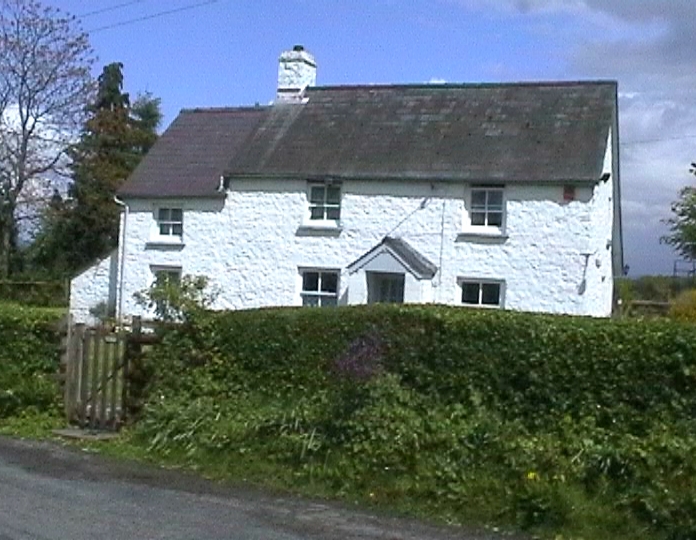
Church Farm

Church Farm – 655 on the 1841 Tithe Map.

This  beautiful Farm House (now a listed building) is still a working farm. The first mention I can find is a letter to the Rector in 1755:
Church Farm.

Sir, you are desired to publ’ih Banns of Matrimony between us Thomas Roger’s of the parish of Pan teg in the County of Monmouth who live near New Inn in the said parish and Mary Williams spinster of your said parish of Goettre, that now live and have resided there at my father’s house near the Church for above four weeks.

Immediately preceding the date hereof given under our hands this 15th day of November in ye year of our Lord 1755.

Thomas Rogers of the Parish of Pant-teg and Mary Williams of the Parish of Goettre were married in the Church of Goettre by banns this 20th day of December in ye year of our Lord 1755 by me E Williams, Curate.

In the presence of Francis Williams

The mark of Richard Edward

This marriage was solemnized by us Thomas Rogers

The mark of Mary Williams15th November 1755

The Rev’d Mr Williams curate of the parish of Goettre


Another letter in 1762 again asking the curate to publish the marriage bans;

1st May 1762

To the Rev’d Mr Williams Curate of Goettre

Sir, we William Powel, late churchwarden of your said parish and Ann James that live with my parents in the house next to the church where I have lived constantly for several years last past do desire you to publish Banns of Matrimony between us with all convenient speed.

Given under our hands this first day of May 1762.

William Powel and Ann James both of the parish of Goettre were married in the church of Goettre by banns this 26th day of May in the year of our Lord 1762 by me E Williams curate.

In the presence of the mark of John Andrew

The mark of Ann Edwards

This marriage was Solemnized by us the mark of William Powel the mark of Ann James


In 1768 Joseph Watkins is overseer of the poor for the house by the church and in 1774 John Powell is constable for “ye house by ye church.”

An entry in St Iltyd Church Mamhilad on the 10th October 1775 says a marriage, by license was conducted between Richard Jeremiah of Church Farm Goytrey and Mary Philips of Mamhilad.

In 1790 Richard Jeremiah is mentioned as being the occupier of Church Farm and the owner is Capel Hanbury Leigh of Pontypool.

In 1804 at St Peter’s, William Jeremiah married Martha Jenkins, their children being baptised at St Peter’s.

William Lloyd became the occupier in 1823. In 1830-31 he had a salary for being an overseer of the poor for the parish.

On the 1841 tithe Church Farm has 59 acres 1 rood and 15 perches, £6 9s is payable to the rector and the owner is still Capel Hanbury Leigh. On the census William Lloyd is aged 55, Mary his wife is 55 and their children Martha and William are 15 and 11 respectively.

Mary Lloyd had died between the 1841 and 1851 census but I am unable to find an entry of a burial at St Peter’s. The 1861 census says William is a widower aged 61 born in Glascoed, the rateable value of Church Farm being £24 5s. William Lloyd died in 1854 and was buried at St Peter’s.

Shortly afterward John Preece became the new occupier. His son William was baptised on the 30th April 1855. Also about this time he swaps farms with William Gwatkin of Abergwellan.

William Gwatkin is mentioned frequently in the parish records, he has a salary of £20 in
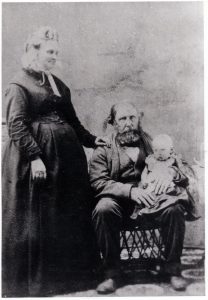
This wonderful photo of William and Eliza has kindly been passed to me by Clive Jenkins, grandson of Rosa.

1855 for collecting rates, that is, income tax, land tax and assessed rates for the parish. On the 3rd July 1856 he sat on the grand jury quarter sessions. His mother Elizabeth died in 1864 aged 79 and was buried at Kemys Commander.

On the 1871 census William Gwatkin is 50, a farmer of 60 acres, his wife Eliza is 51 and born in Mamhilad, their children, Ann, John, George, Richard Thomas and Edmund were all born in Goytre, also living with them is Eliza’s mother Joanne Williams 86, who was born in Monkswood.

William remained overseer of the poor for many years until he retired with a pension in 1881. The Gwatkin family on the 1881 census had moved to Glascoed. It appears that  Church Farm was not occupied in 1881, but by 1891 David Morgan 42, a haulier born Glascoed, with his wife Martha 41, born in Llanover, had moved into Church Farm. He is also on the electoral register in 1894.

By 1901 George Gwatkin, 45 born Goytre, and his wife Jane, 47 born Hereford, had moved into Church Farm with their children Fred, Herbert, Rosa,
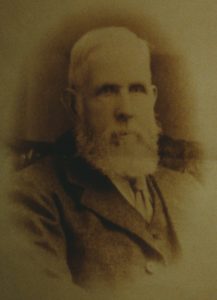
George Gwatkin

Caroline, Sophia, Amy and Gilbert, all the children being born in Goytre. They were still living there on the 1911 census and paying poor rate in 1914.

George Gwatkin died in April  was buried at St Peter’s on 17th April 1917 aged 61. He left £329 to his son Herbert Frank William Gwatkin. Jane his wife died in October 1919 aged 66, Amy their daughter died in 1920 (there is an obituary for Amy in the Free Press,) they were all buried at St Peter’s.

The census of 1921 says 24 year old Gilbert Gwatkin, a farmer working on his own account along with his sister Sofie aged 28 are living at Church farm, both were born in Goytre.

On the 25th March 1927, Gilbert and Sophia,
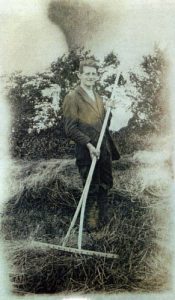
Gilbert Gwatkin

two of George and Jane’s children had a “leaving do” at Nantyderry schoolroom, they were moving to farm in west Wales.

The electoral register in 1927 now says William Percival Edwards is farming Church Farm and in 1945 Thomas C Edwards, Thomas was born in October 1907, Elsie his wife in 1911.

Oriel Garn

Oviel Garn (2)

Recorded as holding number 174 on the 1841 tithe map, Oriel Garn was a small property consisting of a house, garden and orchard covering 1 rood and 38 perches. Despite its modest size, the cottage was home to several local families and was the setting for one of the most dramatic incidents recorded in nineteenth-century Goytre.

The 1841 tithe survey records the owner as Albert Adams William. Earlier records include the burial of William Phillips in 1817, but little else survives until the 1841 census, when John Lewis and his wife Elizabeth Lewis were living at Oriel Garn.

By 1851 the property was occupied by Elizabeth Hughes, a widow and former innkeeper from Llanover, together with her son John Hughes. The family remained at Oriel Garn for over twenty years. By 1871 John had become head of the household while his mother, then aged seventy-five, continued living with him. Elizabeth died the following year and was buried at Mamhilad.

A new chapter began when the Rosser family moved from Upper House, Goytre. The 1881 census records James Rosser, aged 46, living there with his wife Keturah Rosser and their large family. Their children included James, Ann, Rachel, Richard, Sarah, Ruth and Jenkin. Over the following years the family became firmly established in the parish. In 1885 Anne Rosser married Alfred Purnell at Mamhilad, and in 1896 Richard Rosser married Ellen Lusty in Cardiff, and Sarah married Francis Poulson.

DSCN0005 (2)

The following is from the Free Press;

18th May 1883

Shooting Affray at Goytre On Tuesday evening last a serious shooting affray occurred at Goytre. It appeared that a man named Samuel Turner a blacksmith’s striker, living at Pontypool was coming home from Abergavenny fair when he called in at the house of his brother-in-law James Prosser (reported as Prosser but it is Rosser) a labourer living in Goytre.

Between seven and eight o’clock in the evening at altercation took place between the two and finally they had a fight. It is alleged that Turner became very violent and that Prosser in self-defence got his gun and shot him. Whether this really was the case it is as yet impossible to say, however in the heat of the quarrel Prosser sent for his gun, a double barrel one, which was already loaded with mixed shot and discharged one barrel into his brother-in-law’s left thigh inflicting a terrible wound about 11 inches in length.

Prosser occupied two houses which were attached and at the time of the quarrel the gun was in the premises adjoining those in which the scuffle took place. The fight must have been a very brutal one for Prosser did not come out of it until he had two ribs broken.

Information was conveyed to the police at Pontypool by means of the driver of the Abergavenny mail cart, with as little delay as possible and superintendent Whitfield accompanied by Dr Essex set out in a few minutes to the scene of the affray.

The injured man was attended to and Prosser taken into custody and brought to the police station at Pontypool. On Wednesday he was brought before J C Llywellin and remanded for 1 week. Dr Essex who is now attending Turner certified that under the most favourable circumstances it would be at least a month before he would be able to give evidence. The injured man who now lies in Pontypool union is progressing satisfactory.

In Court answering  to Mr. Watkins witness said he had been to a fair that day, he liked to go to fairs.

He did know that the row had commenced about Robert Davies or that he called him bad names. He said that he wasn’t much good. The prisoner came into the house about 2 minutes after he got there. He was then ‘having words’ with his sister. George Young was also there. But he did not attempt to make peace between him and his sister. They kept on quarrelling. He did not put up his fists. Prisoner got up and “scienced” before him, and struck him. He did not “science” before the prisoner, but tried to make his sister sit down. He did not call her any bad names. Prisoner struck him down but when on the ground wit was not very violent though he tried to keep the prisoner off. He pushed him away with his feet. He did not know how prisoner ribs were broken. He was in a bad temper on the ground but did not threat to murder anybody. He knew better than to do that. He did not throw the knife box at prisoner. But ‘shot’ something at him. He did not break any chairs. He did not remember when in his brothers’ house in Trosnant a week before threatening to do worse than anything he had ever done before.

He had been in this court for assaults many times before, worse luck but had never been convicted of assault in Abergavenny. Perhaps he had been convicted in this court 6 different times. He had had 14 days at Pontypridd for begging but that was no harm. He had ‘done’ a month at Liverpool but that was nothing at all.

George Young whose depositions taken at the previous hearing, were read, was next examined. In reply to Mr. Watkins wit said he felt a lump on Rosser’s ribs immediately after the assault. He had been in the house about half an hour before prosecutor, who was followed in about 10 minutes by the prisoner. During the interval he was quarrelling with his sister and was quarrelling with her when the prisoner came in. Prisoner clenched his fists and witness expected he would have struck his sister. Prisoner said his wife then held him down on the ground. Prior to that wit was making most use of violent threats and wit persuaded them to let him get up to see what he would do.

Dr J R Essex said that on the 15th May he was called to Goytre arriving there about 10 o’c. he saw prosecutor at prisoners house. He examined him + finding a large lacerated wound on upper part of thigh. The wound was about 5” ac extending about 11” down towards the knee. The edge of the wound was very much riddled, it was a gunshot wound. He also ex prisoner who was suffering from severe injury to the ribs, 2 of which were broken. He had seen the prosecutor since at the workhouse. With ref to prisoners injuries he should say they were caused by a blow given with a good deal of force. One rib had been forced underneath the other; it was a most unusual injury, a kick would have caused it. The prosecutor was doing well and was now out of danger.

By Mr. Watkins, it must have been a violent blow to have caused injury to the ribs. Prisoner said he had shot Turner + that he had waited for his opportunity so as not to shoot him in the body. He also said that of he did not shoot him they would all have been murdered.

PC Price proved apprehended the prisoner who said “this is a bad job here” what are you going to do with me? I can’t walk, he had broken some of my ribs or something” in and to the charge prisoner said if he hadn’t shot him Turner would have murdered the lot of them.

Wit: took possession of the gun – a double barrel one – one barrel of which had recently been discharged. Witness produced the gun, prosecutors’ trousers + the charge found in the other barrel.

The charge was handed to the magistrates who were of the opinion that it was a very small one. Prisoner was committed to take his trial at the ensuing assizes bail being fixed at – himself £100 + 3 surety of £50 each.

Despite this notoriety, life at Oriel Garn continued. Records show James Rosser appearing before the magistrates in 1897 for unpaid poor rates and for keeping a dog without a licence. In 1900 Mrs Rosser successfully won compensation after her trap was damaged by Henry Knipe.

The family remained closely connected with the district. Further marriages followed, including Jenkin Rosser’s marriage to Morris in 1902 and Clara Rosser’s marriage to William Crump of Pengroesoped Farm later the same year. An advertisement in 1900 offered pigs for sale from the Rosser household, evidence of their small-scale farming activities.

By 1915 the property, now recorded as Oviel Garn, was occupied by Richard Jones. Three years later, Albert Adams Williams sold the property to Thomas Jenkins of New Barn for £180. Thereafter a succession of tenants and owners occupied the cottage, including George Davies and Margaret Davies, William Parsons, and later Bertie Paginton, Daisy Paginton and Ethel Paginton.

One member of the Rosser family whose life is particularly well documented is Sarah Poulson (née Rosser). Her obituary, published in January 1934, records her death after a long illness at her home in Pentrepoid. She was buried at Goytre and survived by her husband Frank Poulson, daughters Frances, Olive, Ethel, Clarice and Iris, sons Leonard and Roland, and numerous members of the Rosser family still living in the area. The long list of mourners and floral tributes reflects the family’s deep roots within the local community.

Although small in size, Oriel Garn witnessed many of the dramas of rural life: family celebrations, local disputes, court appearances, marriages, tragedies and changing ownership. Through the stories of the Hughes and Rosser families in particular, it provides a vivid glimpse into everyday life in nineteenth- and early twentieth-century Goytre.

From 1918 to 1924 George and Margaret Davies resided there followed by William Parsons to 1926; Bertie Paginton, Daisy and Ethel from 1926 to 1930.

Tire Common Bach – Court y Monos

Tier Common Bach – 460 on the 1841 Tithe Map.

The owner in 1812 was Ann Pritchard of Pandy Farm Goytrey. In 1821 Margaret James is holding a house &c and a ruin.

On the 1841 tithe Tire Common Bach shows two ruins. One property appears to have been rebuilt by 1851, Walter Davies is the owner and the rateable value for Tire Common Bach is £2 10s; containing the ruins of a house, clover piece 3 roods 23 perches;  wheat 1 acre 1 rood 14 perches;  with 1 rood and 21 perches being taken by the canal embankment and a piece of cut-off 14 perches; and taken by the canal 1 rood 18 perches.

By the 1871 census Philip Jenkins aged 41, unmarried is living at Tier Common Bach with his brother James aged 33, also unmarried.

The 1888 tithe update says the owner is now Thomas Evans and the occupier is David Hutchinson. On the 1901 census he is aged 44, a galvanising sheet metal inspector born in Llanover, his wife Mary was born in Panteg.

By the 1905 electoral register the new owner is Thomas Davies of Upper Cae Coed. This changes again by 1910 when the new owner is Francis Prosser of Upper House Goytre, the gross value of Tire y Common Bach was £6 18s and the rateable value £6 5s .

The poor rate of 1914 says the owner is Prosser. This lovely photo of ‘Rees the Police’ was sent to me by Nigel Purches, I believe him to be Nigel’s  great-great-grandfather who lived at Common Bach. The second photo is also of him and described by Nigel as ‘Old Rees.’ He was born in 1866, the son of Thomas and Ann Prosser, Upper House Goytrey.


The census of 1921 says Ress Prosser is 56, a smallholder born in Goytre, Ethel his daughter is 28, sons Edgar  21 and Ernest 25 both are out of work, also with them on the night of the census is Rees’s grand daughter Joyce Bowen and 1 year and 8 months who was born in Goytre.

A wedding took place at St Peter’s church between Edwin Gordon Phillips of New House Goytrey and Ethel Mabel Rachel Prosser of Court-y-Monos on the 4 August 1924, Edwin’s occupation is given as blacksmith.


Prosser Rees Police

‘”Rees the Police”

Pontymoel Corner Again – Friday 7th April 1936

Goytrey Woman Cyclist Crashes into Shop Window

A woman cyclist was involved in an accident at Pontymoel corner, Pontypool on Friday and again a plate glass window at the shop of Mr W.T. Herbert [Herbert Bros.] was broken.

Mrs Phillips of Canal Cottage Goytrey, the cyclist sustained cuts to the face, a hand and a leg. She received attention at the shop and was treated at the surgery of Dr T J McAllen and was afterwards taken home.

Gafr Llwyd (The Grey Goat)


Gafr Llwyd – [The Grey Goat] – 282 on the 1841 Tithe Map.

The first reference to Gafr llwyd is the lease dated 29th September 1807 granted to Richard Cadogan for the lives of the lessee [dead] and Henry Waldon now of Abergavenny, fisherman, then aged 13 years. Lives in being, Henry Walden. Present holder Lord Llanover, sold to him by the Earl of Abergavenny, rent 1/-, Herriot 5/-, 2 acres 3 roods.

In the 1821 Barony of Abergavenny Survey, the occupier is Richard Cadogan occupying a house, garden and plock.

The 1841 tithe gives us Benjamin Hall as the owner and the occupier is Ann Price of the house and garden. Ann is 35, of independent means living with her are her daughters  Lavinia 15, and Rosina 14. Also living there on the 1841 census  is Ann Walters 65, of independent means..

On to the 1851 census Thomas Lewis and his family are in occupation, Thomas is a labourer aged 55, his son William is 11, he was born in Llanover,  his daughter Jane is 9, Jane was born in Goytre, as were his two other sons, Thomas 7 and John 4.

The 1861 census is missing for this part of the parish, but on the 1871 census we see John Jones a woollen spinner aged 63 from Cardiganshire along with his wife Elizabeth who is 60 from Caerphilly living at Garfr Llwyd, They have two lodgers both woollen spinners living with them, Morgan Jones 63 and Daniel Jones 28.

On an undated letter from Llanover estate: Gafr Llwyd and some land let to James Jones for the rent of £12

1210 1407 2

On the 1881 census James Jones a woodcutter aged 46  born in Goytre, his wife Mary 50 was born in Llanellen.

James Jones also appeared at the inquest in favour of a welsh speaking vicar for the parish on 19th March 1887. He was still living at Gafr Llwyd in 1889 but had left by 1891.

Ink deposits on the 1891 census make it difficult to read but there was a Thomas aged 46, Ruth 49, William 11, all born in Hereford, Christina 4, Florence 2, Ethel 7 months and John 9, all born in Goytre.

Another undated lease from Llanover Estate made to Joshua Hughes at a rent of £6 10s payable quarterly. Rates of £1 13s 4d being paid by the owner.

The 1901 census at Gafr Llwyd says living at Gafr Llwyd is Joshua Hughes 60, a plasterer born in Flint, his wife Amy is 49.   1903 he was paying £6 10s pa rent, the rates, paid by the owner were £1 13s.

George Jones and his family were in occupation by 1907 when the Goytre poor rate assessment was done, the poor rate for the property was £10, with £1 being payable and the land assessment value was 10s, paying 6d. George Jones had a son Willie who was born in June 1903.

By 1910 James Voyce was the new occupier, he was 43, a mason born in Hereford, his wife Sarah was 40 and their two children Hedley and Trevor were born in Blaenavon.

James Voyce was still living at Gafr Lloyd on the 1921 census, he is now 53 a stone mason at Llanover estate. his wife Sarah Ann is 50, they have a 12 year old daughter called Teresa Elizabeth who was born in Llanover.

On the register of 1939 living at Gafr Llwyd is Richard Thomas who was born on the 14th September 1885, he is a general labourer on a private estate, Gertrude his wife was born on the 2nd May 1897, there are two closed accounts, then children Evan M who was born on 28th April 1928, George, born on the 23rd August 1930, also listed is Muriel Legg, born on the 15th July 1936.

Gafr Llwyd is now in the parish of Llanover.

Twyn Shinydd

Twyn Shinydd – 887 on the 1841 Tithe Map.

DSCN0012 I remember Twyn Shinney, (there are several spellings of T.S.) a cottage tucked into the hillside on star pitch. The cottage was demolished and sadly there are no photos (I asked Carol if she had one.)

65 year old John Jenkins and his wife Susannah and son William were living there on the 1841 census and the owner on the tithe was T.E. Cooke (Thomas Eborall).

John Jenkins remains at Twyn Shinydd on the 1851 census, he is now 75 ,a labourer, born in Gloucester, Susannah is 59 and was born in Llangibby,  William their son is 35, unmarried also a labourer born in Llangibby.

In 1854 John Jenkins died and was buried at St Peter’s on December 15th aged 80, Susannah his wife died shortly afterwards in 1855, she was buried at St Peter’s on December 15th aged 68.

William their son remained at Twyn Shinydd; in 1859 he signed the petition against the increases of taxes for the widening of Newport Bridge.

By 1851 William had left and on the census John Jenkins 38 and his wife Mary 47 with their children Eliza 9, and Cousin William born Llanfrechfa were living at Twyn Shinydd.

In 1866 Twyn Shinney was sold for £60 to Miss M. A. Cooke, it contained 1 rood and 21 perches.

By 1881 Abraham Williams 61, born in Glascoed, along with his family were living here. Ann his wife was 39, born in Monmouth, their children Martha 21, Arthur 13, Rebekah 12 and Ada 7 months were all born in Goytre.

James Scammel aged 86 from Wiltshire and Eliza 75, his wife were at Twyn Shinydd on the 1901 census.

On the 1910 parish assessment William Collins is the occupier and Albert A Williams of Llangibby is now the owner, the gross value is £3 15s and the rateable value is £3.

The 1911 census gives a little more information, William Collins is 34, he has been married to Eliza 28 for 10 years and they have 2 children, Fred 9 and Anne 7 both born in Thornbury and they are occupying 4 rooms.

By 1921 Albert Randle has moved to Twin Shynydd, he is married to Annie, Albert is 37 from Peterchurch and a farm labourer at Lower house farm Lanvair for Williams’s. Annie came from llangattock where their two children were also born. Jessie 9 and Phylis 5.

A report in the Western Morning News:

27th December 1932

William John Harwood was found unconscious by his pedal cycle Xmas eve on the road between Pontypool and Abergavenny, he died later in hospital on the 24th December 1932. In his will dated January 1933 he left £556 13s 4d to his wife Martha Harwood widow. (He lived at Twyn Shinney from about 1925)

The following names are on the electoral register for Twyn Shinney over the following years;

1918 – 1920 George Herbert;

1921 – 1923 unoccupied

1924 – Thomas John Hickery

1925 – 1929 William John Harwood

1930 – Adelaide Ellaway

1931 – 1934 William Harwood

1935 – Martha, George and Doris Harwood

1936 – 1937 Frank and Frances Payne

Ynys-y-bwlch

Ynys y bwlchYnys-y-Bwlch – now in the parish of Llanover

The first recorded mention of Ynys y Bwlch is a lease dated 1590 in which Lewis Watkin, husbandsman, and his wife Margaret, rent nine kevers of land from the Right Honourable Edward Neville, Lord Bergavenny.

Another Lewis Watkin, who died in 1624, was holding the lease. In his will of 1624 he passes the lease to his son William containing a messuage, barn, and several parcels of land being part of Gwern y buelly in the parish of Goytre and the Lordship of Bergavenny.

In 1673 Walter Harry holds one parcel of land called Tyre y Beallt, lately Thomas James and before that William Lewis ap Powell and formerly William ap Jenkin and Llewellin Goughe Vachan, and pays 3d per year.

In the will of Joan Richard in 1703 she gives £1 to Ann the wife of William Watkin and her son Richard.

In 1751 Richard Watkin is constable for his lease; his wife Catherine was buried in St Peter’s churchyard on the 3rd March 1752.


Gwn 1In 1754 Richard Watkin married Susanna Philips at Goytrey Church, he died in June 1762 followed then by his wife Susan in April 1763.

The lease is then taken by William Jones in 1772 for the lives of Catherine his wife aged 44, daughter Mary 3. A William Jones was the constable in 1809.

The lease in 1809 is held by John Phillips 47,  for the lives of his nephew John Phillips aged 16 months and James Lloyd aged 3.  John Phillips holds the lease for many years and in 1827 he is paying 5s land tax for Wern-y-buallt.

In 1831 William Phillips is mentioned at the property but on the 1841 census Philip Rees of Tyr Ewen is the tenant he holds the lease until 1852, and is farming 15a 2r 25p at Ynys-y-bwlch.

Another lease dated 10th June 1851 is granted to Philip Rees for the same amount of land.

On the tithe update of 1889 Josiah Lewis of Dan-y-graig holds the lease but no occupier is named.

By the 1901 census Thomas Lewis 30, a farmer, and Elizabeth his wife aged 24 are at Gwen–y-Buallt.

In 1910 the owners are Hodges and Cunliffe Solicitors of Abergavenny, the gross value is £7 10s and the rateable value is £6 10s.

Thomas Lewis is still at Ynys-y-bult on the 1911 census it has 4 rooms, Thomas is 42, a farmer born in Llanover, Elizabeth his wife is 32, and their children are Thomas 11, Maud 10, Ivor 7, Brenda 5, and Arthur who is 2. All the older children are attending school.

The 1914 poor rate mentions Thomas Lewis still at the property.

The 1921 census says Thomas Lewis Jones is in occupation, Thomas is 53, a farmer, his wife Elizabeth is 42, Elizabeth was born in Llanellen, their eldest son Thomas is 21, another son William Ivor is 18, both are  out of work coal hewers, working at Viponds colliery. Daughter Brenda Mary is 15, son Arthur Cyril is 12 and a 7 month old baby Iris Priscilla complete their family. Also visiting them on the night of the census is Gilbert Davies, Gilbert is 15 from Merthyr, he is a coal miner at Black Pit Merthyr.

In 1920 the property was sold to Llanover Estate and on the 1944 land tax Herbert is the owner and T Lewis the tenant.

Lower Cae Coed

Lower Cae Coed

The earliest reference currently identified appears in the 1832 electoral register, where Walter David is recorded in connection with Cae Coed. By the time of the 1841 tithe survey, ownership was divided between Walter David and James Roberts. A valuation undertaken in August 1844 confirms that Walter David owned two cottages, known as Upper and Lower Cae Coed.

The 1841 census provides the first detailed glimpse of life at Lower Cae Coed. The occupier was James Roberts, a 48-year-old timber haulier, living with his wife Tammy Roberts, who had been born in Trevethin. Also in the household were their sons Thomas Roberts, William Roberts, and young John Roberts, together with six-year-old grandson John Cooke. The family reflects the importance of timber hauling and transport in the local economy during this period.

The Roberts family appears again in local court records. In March 1857, a case was heard against Thomas Watts of Ynyspwcca, accused of stealing £6 2s 0d from John Roberts of Goytrey, one of James Roberts’s sons. Such cases offer rare glimpses into the everyday challenges faced by working families in rural Monmouthshire.  

James Roberts remained active in parish affairs and took part in local elections. In 1860 he voted for William Harris in the contest for Highways Assessor, although Harris was unsuccessful. Later life proved less fortunate. James died in the Pontypool Workhouse in 1877 and was buried at Trevethin. As was common practice, workhouse inmates who died there were usually buried in the parish associated with the institution rather than being returned to their home parish.

The occupants during the 1860s are uncertain, but by 1871 Lower Cae Coed was home to the Morris family. William Morris, originally from Kidderminster, lived there with his wife Martha, who was born in Pembroke, and their children. Their daughters Ann and Mary worked as a dressmakers while their son Morris was employed as a weaver, illustrating the variety of occupations found within rural households.

A further change of tenancy occurred by 1891 when Jonah Waters, an agricultural labourer born in Goytre, occupied the cottage. Living with him were his wife Elizabeth Waters, who came from Talgarth, and their daughter Catherine Waters, born in Abersychan.

The most enduring association in the twentieth century appears to have been with the Hanbury family. Alan Hanbury appears on the electoral roll in 1900 and was recorded in the 1901 census as living at Lower Cae Coed with his wife Rachel Hanbury. Both had been born in Goytre, giving the property a continuing connection with long-established local families.

By 1910 Alan Hanbury was recorded not only as occupier but also as owner. The property then had a gross value of £5 15s and a rateable value of £4 10s.

The 1911 census provides a final snapshot of family life at Lower Cae Coed. The cottage contained four rooms and was occupied by Alan and Rachel Hanbury, who had been married for seventeen years. Their three children, Irene Hanbury, Ivor Hanbury and Beatrice Hanbury, were all living at home.

Alan Hanbury is still at Lower Car Coed on the 1921 census, he is 47, born in Bryngwyn and working at Baldwins as a sheet worker, although he says he is out of work at present. Rachel his wife is now 51, born in Goytre.

Although just a cottage, Lower Cae Coed represents the history of ordinary working people in Goytre. From the Roberts timber-hauling family of the 1840s to the Hanburys of the early twentieth century, the cottage provides a valuable record of the labourers, craftsmen and local families whose lives formed the backbone of the parish community.


Melin-y-coed

Melin-y-Coed  – 877 on the 1841 Tithe Map.

DSCN0032 (2)There is a lease  dated October 4th 1492 from The Duke of Bedford, Earl Pembroke and Lord Bergavenny to his kinsman Richard ap Llewelyn Morgan for two mills with their suit of tenants lying within the fees of Llannonour and Pellenne called Orogon is Mill and Goytrey is Mill.

In 1512 John ap Howel is renting Melyn Coed paying two terms a year at 15s.

John Harry’s will, proved in Usk in November 1617, states he is the reputed son of Harry Cadogan called John, the reputed sonne of Mary Geathen ,  the owner of Melin y Coed which he leaves to his wife Caterine, this includes the water grist mill, floodgates and ponds etc., also mentions after the death of Johan Carpenter the lands she owns to be returned to him and then to Caterine.

To his sonne James, reputed sonne of Elizabeth he leaves twentie pounds to be paid to him by his wife Caterine.

The 1661/2 land tax: Robert Jenkin holds one messuage scitu called Melyn y Coed lately Catherine Verch William, widow and before that John Harrie Cadogan. Before that Henry Cadogan, before that time Jane verch Hoyskyn and William David ap Jenkin then formerly Rici Luis Morgan, and pays 1s per year.

Lewis Williams was the overseer of the poor for Melin y Coed in 1751.

To the  Rev’d Mr Williams curate of Goettre is a request in December 1759 for the marriage of William Jenkins and Elizabeth Jones who say they  have each  been resident in your said parish of Goettre for 28 days and upwards before the date hereof and both of us live at Melin y Coed do desire you to publish banns of matrimony between us,  William and Elizabeth were married at St Peter’s on the 3rd day of January 1760.

In 1768 Easter: 9 George III
On this date Richard Jones sold Melin y Coed for £120 to Henry Rogers, clerk, and Mary his wife. This consisted of 3 messuages, 1 watercorn grist mill, 3 barns, 3 stables, 3 gardens, 3 curtillages, 80 acres of land, 10 of meadow, 80 acres of wood, 20 of furze and heath, and common pasture in the parish of Goytrey.

From 1772 to 1779 John Edwards was both the constable and in 1779 overseer of the poor for Melin y Coed.

John Morgan was the overseer of the poor for Melin y Coed in 1817; he died in 1818 aged 66 and was buried in Mamhilad Churchyard.

The 1829 land tax was £1 7s 6d, the owner was Capel Hanbury Leigh, the occupier was Mary Morgan; in the 1830’s the occupier was John Lewis.

On the 1841 tithe Melyn-y-Coed comprises 48 acres 31 perches, paying £5 13s 5d tithe to the rector.

The census of 1841 says William Jenkins aged 50 is the occupier, he is a farmer and miller, Maria his wife is 45, children William and Maria are 15, Abraham 14, David 12, John 11, Martha 8, Rachel 7, and Ann 4. William Jenkins and family remain  at Melyn-y -Coed until 1844.

By 1850 John Williams had moved to Melyn-y-coed,  he voted along with many parishioners against the police on October 24th, he says his religion is Church. He was 51 on the census of 1851 and born in Llantrissant, his wife  Margaret is 56 born in Usk, he remains farming Melyn-y-Coed until 1872. At various times he was an overseer of the poor.

An advert in the Free Press of November 1875 says there is a farm sale two minutes walk from Nantyderry Station.

An undated document says Felyn-y-Coed has a rateable value of £25 and the Grist Mill has a rateable value of £7 10s.

By 1881 Merrick Jenkins is farming 56 acres of land at Melin-y-Coed, he is 53 born in Llansoy, his wife Elizabeth is 50, children John 24, Richard 23, Edward 9, Margaret 3. Also with them is a niece Elizabeth Evans 14, from Llangwm.

In 1884 Merrick is a constable and in 1886 he gives evidence for a welsh speaking vicar for the parish, but did not appear in person.

At St Peter’s Church on June 24 1885 Richard Jenkins, 26, miller, son of the above Merrick, married Martha Elizabeth Evans aged 18.

In 1901 Edward Jenkins, the son of Merrick, was farming Melyn-y-Coed, he was married to Catherine who was born in Goytre, they also had a niece Rosa Rees 13 living with them.

Merrick Jenkins died in 1902 but by then he was living at White House Farm Mamhilad.

Two of Edward and Catherine’s children died, Gladys aged 9 in 1909 and Henry aged 16 in 1912.

The gross value of Melyn-y-Coed in 1910 was £10 5s and the rateable value was £9, the owner was still Capel H Leigh of Pontypool.

By 1911 Richard Jenkins, son of Meyrick was the tenant he was 53  from Clytha, Martha his wife was 44 and from Llansoy, she died in 1914 aged 47 and was buried in St Peter’s churchyard.

The 1914 poor rate says the owner is J G Harding (I cannot find a sale date).

On the 1921 census Richard Jenkins is 63, a miller and farmer on his own account, he had remarried since the death of Martha, his new is wife Emily Frances 65, born in Bath, living with them is stepson 35 year old George Bandfield, born in Usk, he is assisting his step father in farming duties. Two more step children, Gwen 22 and Ann 31 are living with them, Gwen is a corn merchants clerk for Nibberley in Abergavenny.

On September 3 1920 the wedding of Cecilia Bandfield of the Mill Nantyderry took place at St Peter’s Church, Cecelia married George Jennings, a GPO engineer of Lion Street Abergavenny.

Another wedding took place on December 26 1922 between David Charles Williams, a carpenter of the Star Goytrey and Ella Blandfield of the Mill Nantyderry.

In 1940 Richard Jenkins of The Mill, Nantyderry, died aged 82 he was buried at St Peter’s.

Royal Oak

Royal Oak – 977 on the 1841 Tithe Map.

William Watts was the alehouse keeper of the Royal Oak from 1810, the surety of £10 was paid by William Morgan; in 1812 John Llywellen paid the £10;  in 1813 it was paid by William Williams; in 1814 Thomas Jones and Edwin Williams paid the £10 and in 1814 it was paid by Henry Richards and John Court.

In 1834 Margaret Roderick of the Royal Oak was buried at Monkswood Church, she was 46 years old.

The 1841 tithe says John Morgan is the owner of the Royal Oak alehouse and the occupier is Roderick Roderick, the ground is 1 rood and 21 perches, and paying 1s 10d to the rector. On the 1841 census Roderick Roderick is 40, his two sons were William Roderick 20, John 20 and they are all shoemakers, also a daughter Mary who was 8.

In 1845 a fight broke out in the Royal Oak after accusations of cheating, this was between Thomas Morris (one of my ancestors) and Thomas Watts (lots more about him) of Ynyspwcca. Thomas Morris was badly beaten and died a few days later. Thomas Watts was indicted for manslaughter and held at Monmouth but was found not guilty.

A baptism at St Peter’s in February 1845 of John, the son of David Davies and Elizabeth, says he an alehouse keeper at Penpaitheol.

Mary Roderick died aged 14 in April 1847, and Roderick Roderick died in February 1848 they were both buried in Monkswood Churchyard.

In 1847 David Davies was the collector of land tax for the Royal Oak; he was a victualler and timber dealer. In 1853 David and Elizabeth had a son Thomas who was baptised at St Peter’s.

The owner of the Royal Oak in 1853 was John Wood of Newport. In 1859 the rateable value was £2 10s.

In 1860 David Davies voted for Thomas Jenkins to be the new highways surveyor, he won the vote. At this time David Davies left the Royal Oak.

I am unable to say for certain who was at the Royal Oak on the 1861 census but in August 1868 Thomas Price of the Royal Oak was charged with permitting gambling at his house.

An application was made by Thomas Smith in April 1876 to transfer the license for the Royal Oak to Thomas Arthur, this request was refused on the grounds that Thomas Arthur was not a sober man, but the vicar said he had improved. The license was finally transferred to James Howard in February 1878.

The 1881 census says Thomas Jenkins is 65 and a publican and landlord, and his sister Mary Lewis is 68.

In 1891 Mary Lewis is the innkeeper and living with her is her granddaughter Mary Taylor.

On June 4th 1895 at St Peter’s church,  John Lewis, 30 of the Royal Oak, a woodman, married Sarah Ann Thomas, 20, of Pontymoile Shop.

An advert in the Free Press in March 1906 offers a reward for the return of their dog Bess – Royal Oak Goytrey.

William Howells 29, a wood turner born in Monmouth, was living at the Royal Oak with Florence his wife in 1911, she was 26 and born in Bristol, they had been married for 6 years and had two children, William Dennis 6, and Phyllis 4.

The 1921 census shows Arthur Leonard Williams occupying 2 Royal Oak Cottages, He is 34 a GWR plate layer from Herefordshire, Amy his wife is 32 from Monkswood, their children are Ethel 11, Murial 9, Alfred 6, Phillis 2, living with them is Arthur’s sister-in-law Florence Rosser 32 and niece Evelyn Rosser one month old.

Cefn Mynog

Cefn Mynog 2Cefn Mynog – 570 on the 1841 Tithe Map.

12th December 1639 an Earl of Bergavenny lease says “lands of David ap Evan called Yr Gworlod & Keven Mynog”.

25th day of January 1757 – A letter to the Rector requesting banns are read.

The Rev’d Mr Williams, curate of Geottre S’r We Francis William now living with John Morgan near Pont Kemys and Frances Charles of Kevenmeniog, both of your parish of Geottre have resided there for more than 28 days, before the date hereof do desire banns of matrimony be published between us according to law, with all speed after your receipt hereof. Given under o’’ hands this 25th day of January in ye year aforesaid 1700 & fifty seven

They were married on 12th February 1757

William Edwards married Ann Griffiths on the 22nd February 1780 at Mamhilad Church. A 1797 lease says William Edwards 45 and Ann his wife, daughter Mary has a lease from the Earl of Abergavenny for a cottage and garden on the waste called Cefn Mynog.

Ann Edwards died in 1814; she was 69 and lived near the mansion house, (Goytrey Hall).

The 1821 Survey taken by the Earl of Abergavenny says William Edwards is occupying a house, garden and 3 plocks. The same year William married Ann Jenkins a spinster, he died in 1831 and left a will in which he mentions leaving a square table and a bedstead to his kinswoman Mary William, the remainder of his property to his wife Ann.

1859 Feb 2nd – Owner, Earl of Abergavenny, granted a lease to Daniel Jones of Rhydymerch Llanover, innkeeper, for the lives of Eleanor his wife 41, Sarah and Thomas Lewis, children of the said Eleanor by a former husband, then aged 16 and 14 years, present holder Mrs Jones.

The electoral register for the years 1861 to 1894 is Daniel Jones of Cefn Mynog Cottage.

I am unable to work out who is living at Cefn Mynog on the 1871 census, but in 1881 Elizabeth Preece 53, late farmer’s widow born in Gloster, along with her children Thomas 22 a timber haulier, Elizabeth 20 a domestic servant, Henry 18 a farm labourer, Emily 15 a domestic servant, Rhoda 10, Fanny 8, and a granddaughter Annie 3, were living at Cefn Mynog.

By 1887 Abraham Williams was occupying Cefn Mynog. He appeared on the 19th March 1888 for the application for a welsh speaking vicar for the parish of Goytre.

On the 1891 census Abraham Williams is 71 a labourer, his wife Mary who was 50, James 17, Arthur 23 ag lab, Rebecca 21, all were born in Goytre.

In 1895 Eleanor Jones died, in her will she says she is from Cefn Mynog and the wife of Daniel Jones. Her executors were named as Ebenezer Rees of Blaenavon and William Lewis of Lan Farm Goytre, she gives them £5 each for their trouble. She gives the lease to Daniel Jones her husband, and to her daughter Sarah Morgan of the “King of Prussia” £100.

sale to Llanover 1918 0301901 census says John Williams 53, a cowman on a farm, Isabella is 53, the owner is the Earl of Abergavenny, gross value is £8 and the rateable value is £7 15s.

The census of 1921 gives the following details of the family at Cefnmynog.

Harry Vimpany from Churchdown Gloucester is 54, he is a general farm worker for LD Whitehead at Goytre Hall. His wife Alice is 45 from Llangattock, Abergavenny. Son Harry is 22, a horseman farm labourer, also working for LD Whitehead, son Harold is 14, born in llanthewy Rhytherch, daughter Flossie is 11, Flossie was born in Usk and daughter Ema is 7, born in Llangibby.

There is a headstone in St Peter’s Churchyard on which is written – Isabella, beloved wife of John Williams of Cefn Mynog in this parish aged 72. Also John died March 27th 1935 aged 88.

On the 5th December 1958, an article in the Free Press says Mrs Gertrude Williams of Cefn Mynog died and was buried at Saron Chapel.