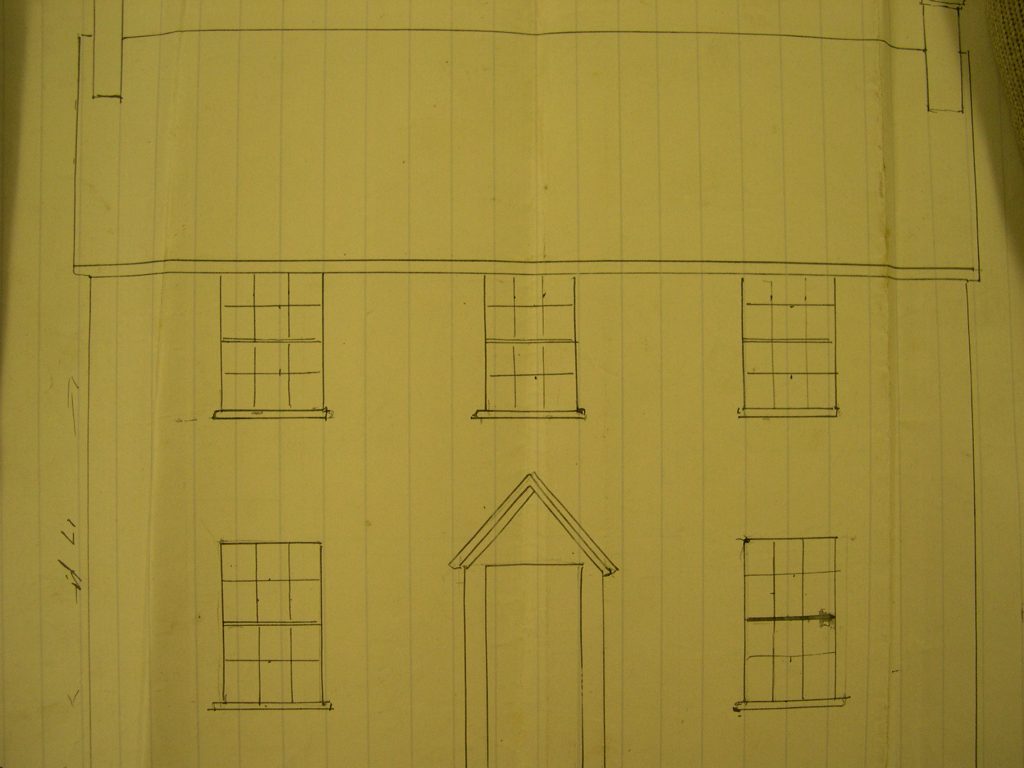
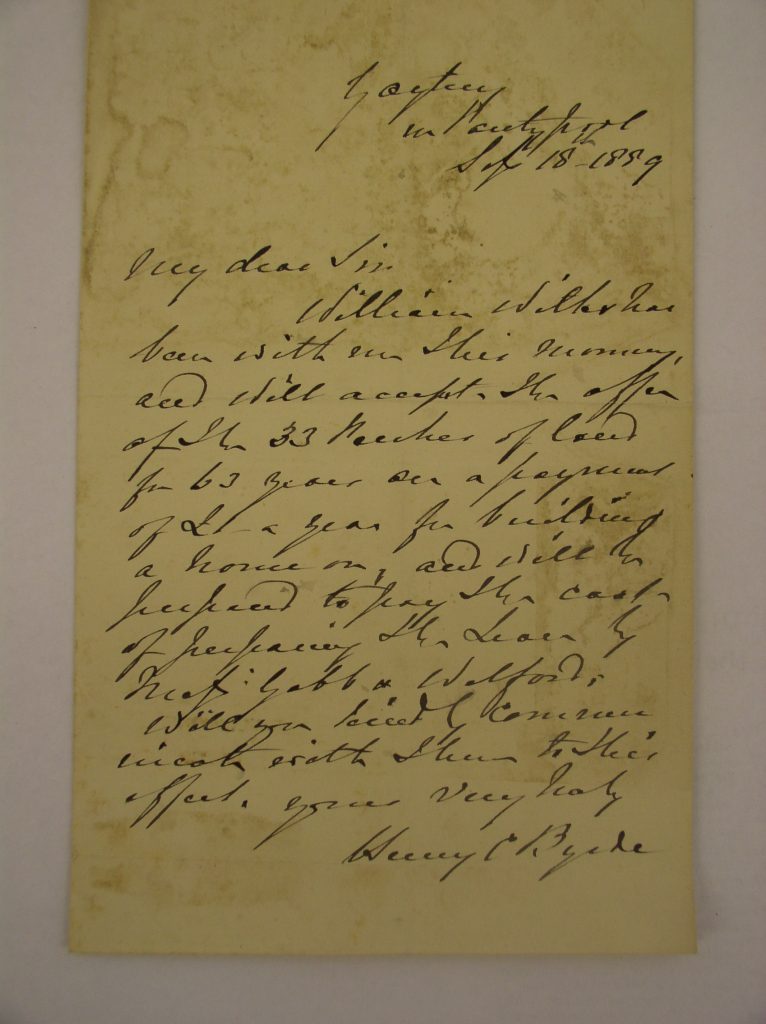
Lapstone Cottage

Lapstone Cottage – 291 on the 1841 Tithe Map. 27 perches.

Lapstone Cottage is now in the parish of Llanover.

The 1661 Land Tax says that John Morgan and William Howell hold 1 messuage, 1 barn and certain lands, and before them Valentine Pritchard.

A letter to the Rev. Mr Williams, curate of Goytrey asking him to publish the banns of William Howell labourer and Mary Saunders who lives with her father at his dwelling house between Croshoped and Cefnmynog. William and Mary were married on the 19th July 1755 at St Peter’s.

Another letter to the Rev. Williams in 1762 asking for the banns to be published for the marriage between William Long and Barbara Saunders, both living at the house of her father, William Saunders, they were married on the 16th October at St Peter’s.

There was another marriage in 1819 between William Griffiths and Mary Morgan, they had two daughters whilst living at Lapstone, Margaret who was baptised at 6 months of age on the 31st January 1822 and Mary on the 23rd July 1824.

There is an indenture dated 1831 between Edward Hoskins, Alexander Waddington and Henry Frederick. Edward Hoskins died on the 24th March 1832, this ties in with the 1841 tithe that says Mary Hoskins is the owner and William Griffiths the occupier. (Mary Hoskins died on the 6th October 1855 and sometime after this date their daughter Eliza sold Lapstone to Lord Llanover for £85.)

Lewis Edmund the local builder wrote in his diary on 20th November 1855 “At John Jones Lapstone Bridge repairing the house.” (John Jones is my great-great-grandfather.) He married Jane James at Bettws Newydd and their children, Jane (my great-grandmother) Emily, Edwin and John were born there before she died in 1865 aged 30. John was also the clerk at St Peter’s for nearly 40 years.

In 1875 William Williams was renting Lapstone at a cost of £4 10s. Lady Llanover’s agent, Turner, wrote her a letter asking if he, William Williams, could swap houses with Prosser who lives at Pencaffyl. Lady Llanover agrees to the arrangement as long as he works for her.

James Parry was next to sign up for Lapstone, this he did on the 6th March 1879, again paying a rent of £4 10s. He was there in 1881 with his wife Harriet and children James, Ann, William and Alfred. Later that year he also sends a letter to Lady Llanover saying he to cannot pay the rent and has gone to live in one of Pruett’s old cottages (Woodlands). James Parry died, and was buried on the 28th September 1881. His wife Harriet later married James Jenkins and lived at Ty Llwyd.

On the 1911 census Thomas Hudson a 43 year old estate worker is living at Lapstone along with his 39 year old wife Marie and Marie’s uncle John Lewis 75, who is a retired general labourer on the estate, Marie and John were both born in Monmouth, also staying with them is Marie’s sister 26 year old Kate Goode who was born in Blaenavon.

The census of 1921 says David Thomas a 59 year old quarryman born in Monkswood and Margaret 39 born in Cwmcarvan are the occupiers.

Murder of Margaret Thomas

Lapstone Cottage Goytrey – 26th October 1921

When morning broke on Wednesday 26th October 1921, it was a predictable start to the day for David Thomas and his wife Margaret.  The couple lived at Lapstone Cottage, a small stone built house on the Llanover Estate, at Pengroesoped near Abergavenny.  Having risen as usual just before 6am, David washed and readied himself for work, whilst his 48 year old wife prepared their breakfast of fried potatoes and bacon.  This finished and having exchanged their goodbyes, David Thomas left for work.  It was 6.45am.

David worked at Ffawydden Quarry about a mile and a half from his home. He was responsible for the removal of topsoil prior to the quarrying of stone.  He returned home to the most horrible sight – the dead body of his wife on the kitchen floor bespattered with blood. Nearby was a piece of iron which was blood stained and there is no doubt that it was with this the brute – man is to good a name for such a villain.

Mr. Thomas found his wife was beyond human aid and went to raise the alarm, meeting on his way the village postman, he detached him to summon the local policeman P.C. Preece, who resided about 1 mile from the scene.

Critical investigations have and are being conducted. Yesterday the little white cottage was visited by a number of well known people in the locality and a good many of the women were overcome.

All evidence points strongly to the fact that the murder must have been committed early in the day – probably soon after the husband left for his work. Mrs. Thomas’s routine would be to let the fowl and pigs out shortly after breakfast, but on his return Mr. Thomas fond the animals still locked in their pens. Neither had she commenced her daily chores.

The husband, attired in ordinary everyday labourer’s clothes was a pathetic picture.

The inquest was held in the village Temperance Hotel at Pengroesoped, the husband was called as the first witness, he said he was David Thomas of Lapstone Cottage and his wife’s age was 43, he had left the cottage at 6.40 and returned at 5.30pm, when on gaining access to the house he found his wife dead. On the way to work he saw young Billy Thomas and spoke to him. On his return home unable to get into the house, thinking his wife had gone for milk or water, he discovered the pigs had not been fed and were ravenous, after a while he tried the other door and found it to be on the latch, when he got into the house he found an iron bar about a foot long lying by his wife’s right hand.

Missing from the house were several items; a silver watch of his wife’s; a metal watch of his own; a navy blue suit; navy blue waistcoat and trousers; a pair of light black boots; a tie; 19s; a pair of pants; a singlet; two good razors and bar of shaving soap. In the house they found a tin can close to the wall. In the bedroom witness said he found a folded handkerchief, also missing was £4 in treasury notes.

He had seen a strange man about several days before on the canal bank.

Mrs. Thomas sometimes worked for Mrs. Rosser Llanover and on the 13th October on arriving at work she seemed very upset and said about 8am that day she had seen wet footprints on her path leading to the door of her house. She then went up to the door of her shed and found a big man sitting there and it frightened her. She asked him what he wanted and he said some sticks to light a fire. She told him to be off as she had to carry her sticks a long way. She did not see him again.

William Williams of Llanover said he saw Mr. Thomas working at the quarry on the day of the murder and passed the time of day with him. Alfred Thomas, son of the last witness said he also saw Mr. Thomas in the quarry on the day in question.

Mrs. Elizabeth Evans, widow, Pengroesoped said that Thomas had come to her house to see if his wife had come for water, he then went back home and half an hour later came rushing back shouting someone has murdered Maggie, he then went to Henry Jones for help.

The body was covered in a red quilt and lots of mats but you could still see her legs, nurse Saunders of Tredegar examined Mrs. Thomas and found her dead.

Critical investigations are and being conducted but nothing tangible has been discovered. The murder must have been committed early in the morning, soon after the husband left for work.

Mr. Bryn Morgan of Glan-y-nant Farm said he had seen a man washing himself in the brook, asked if he knew Mrs. Thomas he said she was one of the most jolly women you could wish to know. At one time Mrs. Thomas was housekeeper for Mr. Charles at Park-y-brain Farm.

The funeral of Mrs. Thomas, which took place at Saron Baptist Chapel, a distance of one and a half miles from her cottage was lined with about two thousand people, many to pay genuine respects and many from morbid curiosity.

Friday November 4th 1921 – Funeral of the Victim

Thousands Witness the Sad Ceremony

On Sunday afternoon when the weather was in its most beneficent mood I rode out to the scene continues our reporter.

Naturally expectant of a large crowd I was nevertheless surprised at the traffic on the highways.

Hundreds upon hundreds of visitors, drawn from far and near in the county and many outside invaded the customary Sabbath quietude of the picturesque little village when the funeral took place of the victim.  The country roads and lanes were thickly lined with motor cars, motor cycles, ordinary pushbikes and scores more walked the distance from Pontypool and Abergavenny and intermediate villages.

Around the pretty little white Lapstone Cottage, where the murderer, at the time of writing unknown, committed his gruesome task and on the way to Saron Baptist Chapel, a distance of approximately a mile and a half, there would be, at a moderate computation a concourse of two thousand people, many to pay genuine respect and many methinks were drawn there from a morbid curiosity, as was evidenced by the way they passed in queues through the graveyard to get a glimpse of the coffin.

Service at the Cottage

The officiating minister the Rev Leonard Collin Edwards Baptist minister who showed me an exquisite bouquet from Lord and Lady Treowen, officiated at a short service inside the cottage ground, where the unfortunate woman had spent thousands of happy hours in attending to her household duties – where the poultry and the farm stock generally knew her and her voice.  Somewhat inured to unusual and pathetic scenes I was appreciably moved by the singing of ‘Jesu, lover of my soul’ to the welsh tune of Aberystwyth – deep in its emotionalism and particularly so, as this was the first time I had ever heard it rendered by welsh men, women and children.  The tragedy which had been enacted in that little lonely cottage – the diminutive coffin enveloped by a mass of chrysanthemums, roses and characteristic country flowers – the large concourse of people the majority of the male suasion bareheaded – some smoking cigarettes – the hooting of motors as they dashed madly along the main roads – women, young and old attired in gay summer array – who had motored or cycled to the scene – were a peculiar admixture of human nature – some impressed – temporarily undoubtedly – others there from a torrid  pulse of interest.

Taken along the country lanes to the last resting-place.  Crowds lined the thoroughfares as the last mortal remains were carried, in relays by workmen on the estate.

Headed by an appreciable number of workpeople employed on the Llanover Estate the mournful procession wended its way to the Chapel. Bearers carrying the coffin followed and then was to be seen the husband leaning on the arm of a lady relative.  At the occasional halts he was the picture of pathos.  There was poignant attitude depleted on his features. Intermittently there was an apparent tremulous and hesitation in his walk – but throughout he bore up bravely – as fulfilled a soldier.


At The Chapel

Wending my way to the comparatively small Church I found hundreds of people congregated there.  The ubiquitous ‘man in blue’ the village policeman respectfully asked the large concourse to move further up the hill and they readily acquisteed.  Inside the chapel everything possible had be done to make the necessary preparations, and the chief mourners

William Sullivan, 42, a tramping labourer from Cwmbran was charged with the murder of Margaret Thomas.

George Henry Smith, milk seller, Mamhilad said on Friday October 21st he saw prisoner and asked him where he was going; he said he had come from Newport workhouse and was going to Abergavenny workhouse. He again saw him on October 26thheading towards Pontypool. Florence Smith, wife of witness also identified Sullivan as the man seen on the dates mentioned.

A pair of boots left at Lapstone Cottage along with a dirty pair of pajamas and a very dirty handkerchief were discovered by Mr. Thomas and handed to the police. These items were identified as belonging to Sullivan.

Annie Jones of the Forge Hammer Inn, Cwmbran, said Sullivan was drinking in her pub on the 26th October paying 2s 6d for his first drink and later £1 note for drinks with his brother.

Lily May Groves (14) Albion Road, Pontypool, indentified Sullivan as the man who called at her home asking her to ask her mother if she would like to buy a pair of boots and a coat. He wanted 2/6d for the boots and 2/- for the coat. He was told to come back at 6pm. He left the boots and coat on a chair.

Hannah Eliza Groves, 54 of Albion Road Pontypool said she purchased the items from him.
Sullivan was found guilty of the murder of Margaret Thomas.

(Full article can be read in the Free Press)

William Sullivan, 42, a tramping labourer from Cwmbran was charged with the murder of Margaret Thomas.

George Henry Smith, milk seller, Mamhilad said on Friday October 21st he saw prisoner and asked him where he was going; he said he had come from Newport workhouse and was going to Abergavenny workhouse. He again saw him on October 26thheading towards Pontypool. Florence Smith, wife of witness also identified Sullivan as the man seen on the dates mentioned.

A pair of boots left at Lapstone Cottage along with a dirty pair of pajamas and a very dirty handkerchief were discovered by Mr. Thomas and handed to the police. These items were identified as belonging to Sullivan.

Annie Jones of the Forge Hammer Inn, Cwmbran, said Sullivan was drinking in her pub on the 26th October paying 2s 6d for his first drink and later £1 note for drinks with his brother.

Lily May Groves (14) Albion Road, Pontypool, indentified Sullivan as the man who called at her home asking her to ask her mother if she would like to buy a pair of boots and a coat. He wanted 2/6d for the boots and 2/- for the coat. He was told to come back at 6pm. He left the boots and coat on a chair.

Hannah Eliza Groves, 54 of Albion Road Pontypool said she purchased the items from him.


Nyth Catty

DSCN0011Nyth Catty was Goytrey poorhouse, so a little more is known about it’s history. It was replaced by Penwern Cottages between 1864 and 1871.

Goytrey Church overseers of the poor accounts.

From the account of Walter Griffiths, overseer of the poor for the office 12th day of May 1802 to 11th day of July 1802: To Candy Morgan for a piece of ground whereon it is intended to build houses for poor persons and hedging the same 1/-.

At a parish meeting held the 4th day of May 1808 it was agreed by the major part of the parishioners then present to build a house for Catherine Jenkins immediately on part of ground belonging to the parish at the expense of the parish under the direction of the overseers to be called Nyth Catty.

Joshua Davies Clk; William Morgan; James Prosser; Edward Jones; John Moses – x; William Jeremiah – x; Thomas Jenkins – x;

Account of Thomas Jenkins overseer of the poor from the 19th April 1809 to 27th day of April 1810 – hedging Catty’s Nest 2/-.

The account of Vaughan Jones overseer of the poor from the 8th day of May to the 19th day of May 1809;

David Jones mason for building a house for placing a poor person £3; Francis Morgan carpenter for 9 days work at 2/9 per day; A lock for the door 2/2; Nails 1/-; Pair of hinges, 2 plugs and 1 staple 3/-; Thomas Prosser for the thatching 6/-; William David for 28 cartloads of stone already risen for the building 9/4; 4 days halling the said stone £1 4s; A labourer filling them, 2 days 4/-; A load of lime at the kiln 10/-; Halling the lime 15/-; William Morgan for timber and halling it 15/6; James Prosser for 4 thraves and a half of straw at 6/-; Thrave £10 1s 9d; Candia Morgan coal 12/-:

Catherine Jenkins a pauper was buried on December 20th 1812.

At a parish meeting on the 10th April 1813, it allowed £7 1s 8d for enlarging the cottage called Kitty’s Nest.

The poorhouse also took in paupers from the surrounding parishes, the following people were mentioned:- Candia Morgan’s funeral cost £1 1s 0d; Richard Evans from the workhouse aged 61 was buried on the 20th January 1816; on the 27th Samuel Saunders from the workhouse was buried aged 40;  on the 6th February 1816, Peter Edwards aged 32; and Margaret Watkin aged 90 from the poorhouse on 25th May 1819. The last person named in 1836 was Francis Morgan aged 90.

On 25th September 1835, Richard Jones takes Catty’s Nest at a rent of £2 per annum and in 1836 the thatcher repaired Catty’s Nest at a cost of £1 4s 3d. On the 1841census Richard Jones was 50 years old, a shoemaker, Ester his wife was 40, their daughters are Hariett 5 and Eliza 10 months.

An undated document says Richard Jones was the occupier and the rateable value for Nyth Catty was left blank as it was owned by the parish. Richard remains at Nyth Catty until he dies in 1864. After his death his wife Ester sold Nyth Catty to James Morgan for £10. To avoid his creditors, James Morgan put the property into the name of his son Roger, who at that time was living with his brother Henry aged 28, a farmer of 100 acres in Llanellen.

On the 1871 census James Morgan was a labourer aged 45, Charlotte his wife 46, and their children Ellen 16, Ann 14, Louisa 8, and John aged 10.

A document I have says there was a case in 1870 stating Richard Jones an old man moved into the property about 1834 and was given permission  to live there instead of becoming chargeable to the parish. Jones took the cottage and begged a few loads of straw from the neighbouring farms, thatched the cottage and made it habitable. He subsequently received parish relief and lived in the house until his death without paying rent.

James Morgan erected two substantial dwelling houses (now Penwern Cottages) and assigned them to his son.

Brook Cottage

Brook Ctg

Brook Cottage – 666 on the 1841 Tithe Map.

Lease for a house, shop and garden, quarter of an acre on the highway leading from Abergavenny towards Pontypool dated the 29th September 1701 to William Thomas a joyner for the lives of George, Mary and Elizabeth, the children of Thomas William. Rent 6/- and heriot 6/-

On 30th July 1765 Thomas Lewis married Sarah Williams, their children were Mary who was baptised on 14th February 1768, Thomas on the 5th May 1771, Henry on the 9th April 1773 and Michael on the 17th May 1778.

William Lewis married Elizabeth Edwards on 2nd May 1790 and the following children were born at Brook Cottage and baptised at St Peter’s; Ann on the 13th February 1791, Martha on the 5th May 1793, Elizabeth on the 26th January 1796, William on the 12th January 1800, John on the 22nd August 1802, Mary on the 2nd November 1806 and finally Sarah on the 26th February 1809.

The 1821 Earl of Abergavenny survey states Dr Hobbs is the leaseholder of Brook Cottage, the tenant is Thomas Lewis.

dscn0042-2The 1822 Court Leet says Thomas Lewis died seized of a lease, the 1825 land tax says William Lewis is the occupier of the Lords land previously held by Thomas Lewis, William died and was buried at St Peter’s on the 4th September 1827, the lease is then transferred to John Lewis.

The 1840 electoral register gives John Lewis, near Twmpyn, and on the 1841 census he is aged 35, his wife Elizabeth is 30 and their children are William 11, John 7, Thomas 5 and two daughters Anne 9 and Elizabeth 1.

At a rent of £4 10s John Lewis is occupying a cottage garden and beer shop with land of 1 acre 2 rood and 37 perches.

In 1851 John Lewis is 48 and a woodcutter born Goytre, Elizabeth is 40, and 6 children. Brook on this census was called Ty Will Morgan.

The 1861 census for parts of the parish is missing and Brook Cottage is not listed.

1871 census sees a new tenant, James Cobner who is aged 55 and a carpenter living with Martha 18, Mary 8, James 7 and Thomas 4. He is married to Cathleen, who on the 18th July 1878 on the order of Col. Henry Byrde is sent to the Abergavenny Asylum suffering from melancholia.

Ownership of Brook changed by 1889 when the tithe update says Alex Edgar is the owner and Samuel Twissel is the occupier, this fits with the 1891 census as Samuel is a widower aged 59 and living at Brook with his daughter Edith 19.

In 1901, Mary Edgar, a grocer, is living at Brook cottage.

A Free Press article dated 15th October 1909 says the stiles at Brook Cottage were renovated by Pontypool Rural District Council. On the 1910 valuation of the parish, Edwin Edgar of Ynyspicca is the owner and the value of Brook Cottage is £6 10s and the rateable value is £5 15s.

On the 1911 census there are 4 rooms in the cottage and Mary Edgar is aged 71, a widow, and living there with Philip Jenkins a lodger aged 82, formerly a woodman, both being born in Goytre. Mary Edgar died and was buried on the 25th April 1912 at St Peter’s Church.

The poor rate of 1914 says Edwin Edgar is the owner and Brook is occupied by Philip Williams.

In June 1915 there was an advert in the Free Press for a cottage to let on the main road, apply Edgar, Ynyspicca.

The next tenant was Charles Jones whose son Vernon died on the 10th October 1915 aged 8 hours, (see infant deaths, Usk).

In residence on the 1921 census is 44 year old Oswald Court from Mamhilad and his family, Oswalds occupation is a castrator, Ruth his wife is 44, born in Goytre, They have three daughters,Lena 18, born in Mamhilad  an apprentice dressmaker at Miss Orchards Pontnewynydd,  Louisa 15, born in Mamhilad is helping in the garden and home duties and  Linda 7 born in Goytre.

The Court family must have left Brook by 1922 as the occupier on the 1922 electoral register is David Williams.

Two more adverts were placed in the Free Press, one in May 1927 – “for sale – rudge perfect working order, apply Brook Garage Goytre” and on the 24th February 1933 “house and garden, roadside, close to bus,” apply with references Edgar, Goytre.

Abergwellan

Abergwellan – 606 on the 1841 Tithe Map.

For many hundreds of years Abergwellan was in the parish of Goytre. 

After Lady Llanover purchased many properties in the parish of Goytre the boundary changed and Abergwellan became part of Llanover Parish

From 1690 to 1724 Abergwellan was used as a non-conformist meeting house. In 1724 the meeting house was moved to the Wern.

In 1755 Thomas James was overseer of the poor for Abergwellan

From 1808 until at least 1829, David Francis was the constable and occupier of Abergwellan,  Iltyd Nichols was the owner and paid land tax for the property.

In 1832 Philip Morgan became the tenant, the information on the 1841 tithe states he was farming 20 acres 1 rood and 27 perches and  paying £1 17s 1d to the rector. His age on the 1841 census was 65, his wife Elizabeth was 50.

Sometime in the 1840’s William Gwatkin (son of James) became the tenant, the rateable value was £10 15s. William married Eliza Williams on the 8th May 1845 at Monkswood Church. Eliza was the daughter of John Williams, a hoopshaver. In 1850 William added his name to a list of Goytrey parishioners who were voting against the police. By the 1851 census the family had increased by two children, Edwin 4 and Ann 1. Another son William was born in 1853 and at this time William was also listed as overseer of the poor for Abergwellan.

In 1853 Abergwellan was given to Lady Mary Wyatt as part of her marriage settlement. A recent law had been passed where it stated that each county had to have it’s own reformatory and in 1856/7 there was a draft lease drawn up by Iltyd Nichols, Benjamin Hall, Col Byrde and others to turn Abergwellan into the reformatory for the county. A petition was drawn up against this and Lewis Edmunds the local builder from Llanover wrote in his diary on the 28th January 1857 “about the parish of Goytrey with a petition about the proposed new reformatory school and collected 91 names.” The petition worked as the new reformatory was opened in Little Mill.

In 1855 John Preece became the new tenant and on the 1861 census he is living with his mother-in-law Elizabeth Lloyd aged 64, a farmer’s widow. John is 44 and a farm bailiff born in Hereford, Elizabeth his wife is 32 and born in Gloster, their children are William 7, John 5, Thomas 3, and Elizabeth 1. Also living there are John’s brother Samuel who is 20, and a servant Mary Morris born in Goytrey.

More children were born to John and Elizabeth Preece, Henry in September 1863, Emily Margaret in November 1866 and May Sarah in May 1868, all being baptised at St Peter’s church. 

Edmund Lewis wrote in his diary in 1868 that he spent May to July working at Abergwellan on the outside of the house and again in 1873 when he put the crest on the barn and also spent time repairing the house and stable.

John Preece died in May 1875, Elizabeth his wife died in 1882, they were buried at Chapel Ed Goytrey.

The owner of Abergwellan (freehold house and land) is listed on the Electoral Register as Sir Mathew Digby Wyatt. (His death is recorded as the 21st May 1877.)

The new occupiers in the 1881 census were John Jones 52, born Carmarthen, his wife Elizabeth 54, and daughter Elizabeth 14.

There is an indenture of Abergwellan being conveyed to Lady Llanover from Lady Mary Wyatt in 1886.

On the 19th March 1887 John Jones appeared as a witness for a welsh speaking vicar for the parish of Goytrey, in 1888 he becomes a tenant of Lady Llanover.

The 1901 census says John Jones is aged 57, daughter Elizabeth is 34. A son Thomas Evan is born on the 11 May 1901, he later attended Llanover school. John Jones died and was buried on the 6th February 1907 at Llanover.

The 1911 census gives a little more information than previous and says Abergwellan has 4 rooms and living there was Emma Jane Jones 44, a farmer’s widow, Thomas 9, Mary 5, and William Sadler, a boarder aged 40, a woodcutter.

On the 4 August 1920 a marriage took place at St Peter’s church between Thomas Shaw a postman of Flannel Street Abergavenny and Elizabeth Williams of Abergwellan.

On the census of 1921 head of the household is widow Emma J Davies, Emma is 54 born in Llangattock Brecon, her son Thomas Evan Jones, an assistant school master is 20, daughter Mary Jones is 15, both Thomas and Mary were born in Goytre.

An article in the Free Press tells the story of Thomas Evan Jones’ achievement of a Master’s degree, this I have put separately. Another article is that of an accident in 1936 involving John and his mother Emma.

Thomas married Irene May Evans on the 13th September 1940 at Llanafan, Builth Wells.

Abergwelfan is now a listed building in the parish of Llanover.


Ancient Thatched Cottage

Ancient Thatched Cottage – 294 on the 1841 Tithe Map.

Containing 11 perches – orchard 26 perches and garden 19 perches.

This cottage is no longer standing, it was in the centre of Pengroesoped, at the top of Lapstone lane on the right.

Before 1766 the cottage was owned by Francis Morgan of Llanover,   he gave it to his daughter Margaret on her marriage at St Peter’s on the 18th July 1766 to William Mathews. There is an examination of William Mathews in 1774 to his right to reside in the parish as he was born in Llanthewy Vach, he said he had gained the right as a servant to Francis Morgan of Llanover, his father -in-law.

In 1793 Margaret, the daughter of Margaret and William Mathews  married William Jeremiah. That same year her mother Margaret Mathews, widow, died and was buried at St Peter’s.The 1841 census and tithe says William Jeremiah is the owner of freehold land and cottage, he is aged 70,  a wood collier, living with him is Maria 35 and Margaret 2.

On the 20th June 1849 William Jeremiah sells Thatch Cottage for £30 to William Williams,  coal merchant of Goytre Wharf.

I am not certain who was living at Thatch on the 1851 census as most of the house names have been left blank but about this time the new owner William Williams built a pair of cottages in the garden of Thatch Cottage, they are called Pengroesoped Cottages, the cottages are still here today.

In 1860 William Williams of the wharf moved to Hereford and sells Thatch Cottage to Sarah Price of the Wain-y-clare for £220.

On the 1861 census the occupier is David Morris 25,  a woollen spinner, David was born in Cardigan,  his wife Mary is 21, along with his son also called David. By 1881 David Morris and family had moved to the Old School House where he gave his occupation as a tailor, the family remained in Llanover until his death in 1905.

This ties in with the fact that Samuel Harris, the woollen manufacturer of Gwenffrwd was renting the garden cottage from Sarah Drinkwater (nee Price).

In 1871 another spinner, John Jones aged 63, his wife Elizabeth 60 and a lodger, Morgan Jones 31,  also a weaver were living at Thatch Cottage, but the 1872 land tax says Ann Jarret is renting the property.

Sarah Drinkwater died in 1881, her son William Price made a declaration as to his right of title to the property.

The following occupying families were Francis Herbert a labourer in 1887, Morgan Davies from 1888 to 1896, then William Evans, woollen spinner, with his wife Elizabeth. The next information I have is that by 1914 Llanover Estate are liable for the poor rate and the occupier is Jane Higgs.

Chestnut Cottage

Chestnut Cottage

(Also mentioned many times as Ton Cottage.)

Chestnut (2)In 1841 Chestnut Cottage was owned by T E Cooke and the occupier was William Watkins, he was paying 10s per annum with a rack rent of £2 10s.

At a parish meeting held on the 11th March 1847 it was agreed to reduce the assessment of Thomas Jones’s property by £2 and put it on the cottage of Thomas Watkins.

The next mention is that of Elizabeth Hughes and her son John, a gardener, who were living at Chestnut from 1861 to 1872. Elizabeth died and was buried at Mamhilad Church on 30th May 1872.

An advert in the Free Press on the 3rd November 1877 says there is a sale of household goods and effects for sale at Chestnut Cottage on instruction of the owner John Lewis who is leaving the property.

John Jones then became the occupier and in 1881 he was living there with his wife Elizabeth 59, Isabella 19, and Isaac Jones their grandson.

Isabella married William Lindsay in 1894 and on the 1901 census they are living at Chestnut Cottage with their children Elizabeth 5, Emily 3, and Margaret 2. Isabella was baptised as an adult on 6th April 1906 at St Peter’s Church. More children were born, Agnes and Laura both being baptised in 1905 and a son Francis who died in 1907 when he was 10 months old.

A tragedy struck in 1909 when Emily aged 9 had a terrible accident and drowned in the canal when walking to Pontymoile to meet her mother. In the same year William Lindsay died aged 43. In 1910 Isabella had an illegitimate daughter and called her Winifred Edith. Isabella continued to live at Chestnut with her children.

dscn0008-2The gross value of Chestnut Cottage was £4 10s and the rateable value was £3 10s.
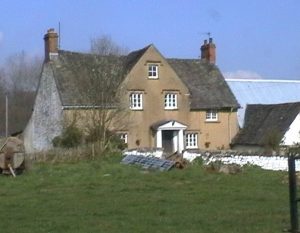
In 1918 Alfred Adam Williams was the owner and he sold the property to Edward Henry Charles of Park-y-brain for £85, the tenant was still Isabella Lindsay, paying 2s rent and land tax of 1s 9d with the commuted tithe being 4d.

I checked the electoral records as there are few other records are available after the 1911 census and found that Isabella moved to Woodland Cottage Llanvihangle Pontymoile where she died aged 56 in December 1927 and was buried at St Peter’s.

In residence on the 1921 census is George Mills 49, George was born in Manchester and employed as a bricklayer at Sweet and sons Usk but is out of work, Elizabeth his wife is 38  born in Llangattock Carmarthenshire, their children, six year old Daniel and four year old Reece were born in Bettws Newydd.

Over the following years  George Mills and his wife Elizabeth remained at Chestnut until about  1927. Followed by Edwin and Doris Price from about 1930.

Church Farm

Church Farm – 655 on the 1841 Tithe Map.

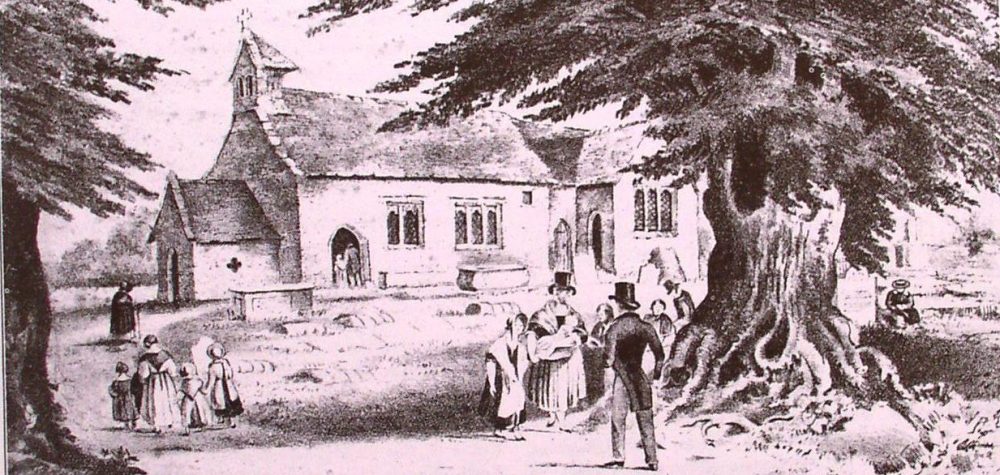
This  beautiful Farm House (now a listed building) is still a working farm. The first mention I can find is a letter to the Rector in 1755:

Church Farm.

Sir, you are desired to publ’ih Banns of Matrimony between us Thomas Roger’s of the parish of Pan teg in the County of Monmouth who live near New Inn in the said parish and Mary Williams spinster of your said parish of Goettre, that now live and have resided there at my father’s house near the Church for above four weeks.

Immediately preceding the date hereof given under our hands this 15th day of November in ye year of our Lord 1755.

Thomas Rogers of the Parish of Pant-teg and Mary Williams of the Parish of Goettre were married in the Church of Goettre by banns this 20th day of December in ye year of our Lord 1755 by me E Williams, Curate.

In the presence of Francis Williams

The mark of Richard Edward

This marriage was solemnized by us Thomas Rogers

The mark of Mary Williams15th November 1755

The Rev’d Mr Williams curate of the parish of Goettre


Another letter in 1762 again asking the curate to publish the marriage bans;

1st May 1762

To the Rev’d Mr Williams Curate of Goettre

Sir, we William Powel, late churchwarden of your said parish and Ann James that live with my parents in the house next to the church where I have lived constantly for several years last past do desire you to publish Banns of Matrimony between us with all convenient speed.

Given under our hands this first day of May 1762.

William Powel and Ann James both of the parish of Goettre were married in the church of Goettre by banns this 26th day of May in the year of our Lord 1762 by me E Williams curate.

In the presence of the mark of John Andrew

The mark of Ann Edwards

This marriage was Solemnized by us the mark of William Powel the mark of Ann James


In 1768 Joseph Watkins is overseer of the poor for the house by the church and in 1774 John Powell is constable for “ye house by ye church.”

An entry in St Iltyd Church Mamhilad on the 10th October 1775 says a marriage, by license was conducted between Richard Jeremiah of Church Farm Goytrey and Mary Philips of Mamhilad.

In 1790 Richard Jeremiah is mentioned as being the occupier of Church Farm and the owner is Capel Hanbury Leigh of Pontypool.

In 1804 at St Peter’s, William Jeremiah married Martha Jenkins, their children being baptised at St Peter’s.

William Lloyd became the occupier in 1823. In 1830-31 he had a salary for being an overseer of the poor for the parish.

On the 1841 tithe Church Farm has 59 acres 1 rood and 15 perches, £6 9s is payable to the rector and the owner is still Capel Hanbury Leigh. On the census William Lloyd is aged 55, Mary his wife is 55 and their children Martha and William are 15 and 11 respectively.

Mary Lloyd had died between the 1841 and 1851 census but I am unable to find an entry of a burial at St Peter’s. The 1861 census says William is a widower aged 61 born in Glascoed, the rateable value of Church Farm being £24 5s. William Lloyd died in 1854 and was buried at St Peter’s.

Shortly afterward John Preece became the new occupier. His son William was baptised on the 30th April 1855. Also about this time he swaps farms with William Gwatkin of Abergwellan.

William Gwatkin is mentioned frequently in the parish records, he has a salary of £20 in

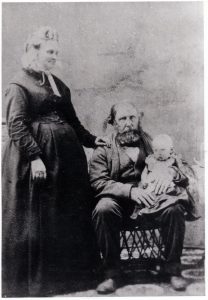
This wonderful photo of William and Eliza has kindly been passed to me by Clive Jenkins, grandson of Rosa.

1855 for collecting rates, that is, income tax, land tax and assessed rates for the parish. On the 3rd July 1856 he sat on the grand jury quarter sessions. His mother Elizabeth died in 1864 aged 79 and was buried at Kemys Commander.

On the 1871 census William Gwatkin is 50, a farmer of 60 acres, his wife Eliza is 51 and born in Mamhilad, their children, Ann, John, George, Richard Thomas and Edmund were all born in Goytre, also living with them is Eliza’s mother Joanne Williams 86, who was born in Monkswood.

William remained overseer of the poor for many years until he retired with a pension in 1881. The Gwatkin family on the 1881 census had moved to Glascoed. It appears that  Church Farm was not occupied in 1881, but by 1891 David Morgan 42, a haulier born Glascoed, with his wife Martha 41, born in Llanover, had moved into Church Farm. He is also on the electoral register in 1894.

By 1901 George Gwatkin, 45 born Goytre, and his wife Jane, 47 born Hereford, had moved into Church Farm with their children Fred, Herbert, Rosa,

George Gwatkin

Caroline, Sophia, Amy and Gilbert, all the children being born in Goytre. They were still living there on the 1911 census and paying poor rate in 1914.

George Gwatkin was buried at St Peter’s on 17th April 1917 aged 61, Jane his wife died in October 1919 aged 66, Amy their daughter died in 1920 (there is an obituary for Amy in the Free Press,) they were all buried at St Peter’s.

The census of 1921 says 24 year old Gilbert Gwatkin, a farmer working on his own account along with his sister Sofie aged 28 are living at Church farm, both were born in Goytre.

On the 25th March 1927, Gilbert and Sophia,

Gilbert Gwatkin

two of George and Jane’s children had a “leaving do” at Nantyderry schoolroom, they were moving to farm in west Wales.

The electoral register in 1927 now says William Percival Edwards is farming Church Farm and in 1945 Thomas C Edwards.

Oriel Garn

Oviel Garn (2)Oriel Garn – 174 on the 1841 Tithe Map.

A house, garden and orchard containing 1 rood 38 perches, the owner is Albert Adams Williams.

A burial at St Peter’s says William Phillips aged 56 of Oriel Garn was buried in 1817, I can’t find any further mention until the 1841 census when John Lewis 45 and Elizabeth his wife are living at Oriel Garn.

In 1851 Elizabeth Hughes 56, a widow, formerly an innkeeper born in Llanover and her son John 28 are living at Oriel Garn, they remained there through to 1871 when John becomes the head of the family and his mother Elizabeth is 75, she died the following year and was buried at Mamhilad.

By 1881 the Rosser family had moved into Oriel Garn, from Upper House Goytrey, James was 46, Keturah his wife 38, and children James 18, Ann 16, Rachel 14, Richard 12, Sarah 8, Ruth 6, and Jenkin 3.

In 1885 Anne Rosser married Alfred Purnell at Mamhilad, and in 1896 Richard Rosser married Ellen Lusty in Cardiff, and Sarah married Francis Poulson.

DSCN0005 (2)


The following is from the Free Press;

18th May 1883

Shooting Affray at Goytre On Tuesday evening last a serious shooting affray occurred at Goytre. It appeared that a man named Samuel Turner a blacksmith’s striker, living at Pontypool was coming home from Abergavenny fair when he called in at the house of his brother-in-law James Prosser (reported as Prosser but it is Rosser) a labourer living in Goytre.

Between seven and eight o’clock in the evening at altercation took place between the two and finally they had a fight. It is alleged that Turner became very violent and that Prosser in self-defence got his gun and shot him. Whether this really was the case it is as yet impossible to say, however in the heat of the quarrel Prosser sent for his gun, a double barrel one, which was already loaded with mixed shot and discharged one barrel into his brother-in-law’s left thigh inflicting a terrible wound about 11 inches in length.

Prosser occupied two houses which were attached and at the time of the quarrel the gun was in the premises adjoining those in which the scuffle took place. The fight must have been a very brutal one for Prosser did not come out of it until he had two ribs broken.

Information was conveyed to the police at Pontypool by means of the driver of the Abergavenny mail cart, with as little delay as possible and superintendent Whitfield accompanied by Dr Essex set out in a few minutes to the scene of the affray.

The injured man was attended to and Prosser taken into custody and brought to the police station at Pontypool. On Wednesday he was brought before J C Llywellin and remanded for 1 week. Dr Essex who is now attending Turner certified that under the most favourable circumstances it would be at least a month before he would be able to give evidence. The injured man who now lies in Pontypool union is progressing satisfactory.

22 June 1883

Shooting Affray at Goytre

James Rosser of Goytre was charged with feloniously wounding Samuel Turner by shooting him with a gun.

Mr. T. Watkins appeared for the defendant. Prosecutor said he was a labourer living Trosnant Pontypool; he went to the prisoner’s home on 15th May. After going into the house his sister (prisoner’s wife) asked him to sit down. They had some words and the prisoner “took it up”.

Prisoner called him a “—-“ scamp and he called him a liar.

His sister got up and struck at him. Witness got up off the chair to prevent her striking the blow and the prisoner then interfered and hit him down a good bit.

Witness tried to keep him off his feet he got up and they all ran away for fear he should murder them he supposed, prisoners daughter then said “fetch the gun father and shoot him”. The daughter brought the gun to witness who shot witness “smack” the charge striking him in the leg.

Witness did not stand on his feet and the postman came to his assistance. Dr Essex saw him afterwards, he was in awful pain.

In answer to Mr. Watkins witness said he had been to a fair that day, he liked to go to fairs.

He did know that the row had commenced about Robert Davies or that he called him bad names. He said that he wasn’t much good. The prisoner came into the house about 2 minutes after he got there. He was then ‘having words’ with his sister. George Young was also there. But he did not attempt to make peace between him and his sister. They kept on quarrelling. He did not put up his fists. Prisoner got up and “scienced” before him, and struck him. He did not “science” before the prisoner, but tried to make his sister sit down. He did not call her any bad names. Prisoner struck him down but when on the ground wit was not very violent though he tried to keep the prisoner off. He pushed him away with his feet. He did not know how prisoner ribs were broken. He was in a bad temper on the ground but did not threat to murder anybody. He knew better than to do that. He did not throw the knife box at prisoner. But ‘shot’ something at him. He did not break any chairs. He did not remember when in his brothers’ house in Trosnant a week before threatening to do worse than anything he had ever done before.

He had been in this court for assaults many times before, worse luck but had never been convicted of assault in Abergavenny. Perhaps he had been convicted in this court 6 different times. He had had 14 days at Pontypridd for begging but that was no harm. He had ‘done’ a month at Liverpool but that was nothing at all.

George Young whose depositions taken at the previous hearing, were read, was next examined. In reply to Mr. Watkins wit said he felt a lump on Rosser’s ribs immediately after the assault. He had been in the house about half an hour before prosecutor, who was followed in about 10 minutes by the prisoner. During the interval he was quarrelling with his sister and was quarrelling with her when the prisoner came in. Prisoner clenched his fists and witness expected he would have struck his sister. Prisoner said his wife then held him down on the ground. Prior to that wit was making most use of violent threats and wit persuaded them to let him get up to see what he would do.

Dr J R Essex said that on the 15th May he was called to Goytre arriving there about 10 o’c. he saw prosecutor at prisoners house. He examined him + finding a large lacerated wound on upper part of thigh. The wound was about 5” ac extending about 11” down towards the knee. The edge of the wound was very much riddled, it was a gunshot wound. He also ex prisoner who was suffering from severe injury to the ribs, 2 of which were broken. He had seen the prosecutor since at the workhouse. With ref to prisoners injuries he should say they were caused by a blow given with a good deal of force. One rib had been forced underneath the other; it was a most unusual injury, a kick would have caused it. The prosecutor was doing well and was now out of danger.

By Mr. Watkins, it must have been a violent blow to have caused injury to the ribs. Prisoner said he had shot Turner + that he had waited for his opportunity so as not to shoot him in the body. He also said that of he did not shoot him they would all have been murdered.

PC Price proved apprehended the prisoner who said “this is a bad job here” what are you going to do with me? I can’t walk, he had broken some of my ribs or something” in and to the charge prisoner said if he hadn’t shot him Turner would have murdered the lot of them.

Wit: took possession of the gun – a double barrel one – one barrel of which had recently been discharged. Witness produced the gun, prosecutors’ trousers + the charge found in the other barrel.

The charge was handed to the magistrates who were of the opinion that it was a very small one. Prisoner was committed to take his trial at the ensuing assizes bail being fixed at – himself £100 + 3 surety of £50 each.


On the 2nd April 1897 James Rosser was summoned for non-payment of 14s 11d poor rates and again on the 14th May for not having a dog license and was fined 7s 6d.

On August 29th 1897 Sarah Rosser, 25,  of Oliver Gardens married Francis Henry Poulsom, a 25 year old coal miner from Pontnewynydd

A court case in the Free Press on the 16th November 1900 says Mrs Rosser’s trap was damaged by Henry Knipe – she won £3 compensation.

More marriages, Jenkin married Elizabeth Morris in 1902 and Clara married William Crump of Pengroesoped Farm the same year.

In March 1900 an advert in the Free Press offers 5 twelve week old pigs, one 5 month old, good growers; apply Rosser Ty Cooke Goytre.


DSCN0002By 1915 Richard Jones is living at the now named Oviel Garn and in 1918 Albert Adams Williams sold Oviel Garn to Thomas Jenkins of New Barn for £180.

From 1918 to 1924 George and Margaret Davies resided there followed by William Parsons to 1926; Bertie Paginton, Daisy and Ethel from 1926 to 1930.

Tire Common Bach – Court y Monos

Tier Common Bach – 460 on the 1841 Tithe Map.

The owner in 1812 was Ann Pritchard of Pandy Farm Goytrey. In 1821 Margaret James is holding a house &c and a ruin.

On the 1841 tithe Tire Common Bach shows two ruins. One property appears to have been rebuilt by 1851, Walter Davies is the owner and the rateable value for Tire Common Bach is £2 10s; containing the ruins of a house, clover piece 3 roods 23 perches;  wheat 1 acre 1 rood 14 perches;  with 1 rood and 21 perches being taken by the canal embankment and a piece of cut-off 14 perches; and taken by the canal 1 rood 18 perches.

By the 1871 census Philip Jenkins aged 41, unmarried is living at Tier Common Bach with his brother James aged 33, also unmarried.

The 1888 tithe update says the owner is now Thomas Evans and the occupier is David Hutchinson. On the 1901 census he is aged 44, a galvanising sheet metal inspector born in Llanover, his wife Mary was born in Panteg.

By the 1905 electoral register the new owner is Thomas Davies of Upper Cae Coed. This changes again by 1910 when the new owner is Francis Prosser of Upper House Goytre, the gross value of Tire y Common Bach was £6 18s and the rateable value £6 5s .

The poor rate of 1914 says the owner is Prosser. This lovely photo of ‘Rees the Police’ was sent to me by Nigel Purches, I believe him to be Nigel’s  great-great-grandfather who lived at Common Bach. The second photo is also of him and described by Nigel as ‘Old Rees.’ He was born in 1866, the son of Thomas and Ann Prosser, Upper House Goytrey.


The census of 1921 says Ress Prosser is 56, a smallholder born in Goytre, Ethel his daughter is 28, sons Edgar  21 and Ernest 25 both are out of work, also with them on the night of the census is Rees’s grand daughter Joyce Bowen and 1 year and 8 months who was born in Goytre.

A wedding took place at St Peter’s church between Edwin Gordon Phillips of New House Goytrey and Ethel Mabel Rachel Prosser of Court-y-Monos on the 4 August 1924, Edwin’s occupation is given as blacksmith.


Prosser Rees Police

‘”Rees the Police”

Pontymoel Corner Again – Friday 7th April 1936

Goytrey Woman Cyclist Crashes into Shop Window

A woman cyclist was involved in an accident at Pontymoel corner, Pontypool on Friday and again a plate glass window at the shop of Mr W.T. Herbert [Herbert Bros.] was broken.

Mrs Phillips of Canal Cottage Goytrey, the cyclist sustained cuts to the face, a hand and a leg. She received attention at the shop and was treated at the surgery of Dr T J McAllen and was afterwards taken home.

Gafr Llwyd (The Grey Goat)


Gafr Llwyd – [The Grey Goat] – 282 on the 1841 Tithe Map.

The first reference to Gafr llwyd is the lease dated 29th September 1807 granted to Richard Cadogan for the lives of the lessee [dead] and Henry Waldon now of Abergavenny, fisherman, then aged 13 years. Lives in being, Henry Walden. Present holder Lord Llanover, sold to him by the Earl of Abergavenny, rent 1/-, Herriot 5/-, 2 acres 3 roods.

In the 1821 Barony of Abergavenny Survey, the occupier is Richard Cadogan occupying a house, garden and plock.

The 1841 tithe gives us Benjamin Hall as the owner and the occupier is Ann Price of the house and garden. Ann is 35, of independent means living with her are her daughters  Lavinia 15, and Rosina 14. On the 1841 census Ann Walters 65, of independent means is also living at Gafr Llwyd.

On to the 1851 census Thomas Lewis and his family are in occupation, Thomas is a labourer aged 55, his son William is 11, he was born in Llanover,  his daughter Jane is 9, Jane was born in Goytre, as were his two other sons, Thomas 7 and John 4.

The 1861 census is missing for this part of the parish, but on the 1871 census we see John Jones a woollen spinner aged 63 from Cardiganshire along with his wife Elizabeth who is 60 from Caerphilly living at Garfr Llwyd, They have two lodgers both woollen spinners living with them, Morgan Jones 63 and Daniel Jones 28.

On an undated letter from Llanover estate: Gafr Llwyd and some land let to James Jones for the rent of £12

1210 1407 2

On the 1881 census James Jones a woodcutter aged 46  born in Goytre, his wife Mary 50 was born in Llanellen.

James Jones also appeared at the inquest in favour of a welsh speaking vicar for the parish on 19th March 1887. He was still living at Gafr Llwyd in 1889 but had left by 1891.

Ink deposits on the 1891 census make it difficult to read but there was a Thomas aged 46, Ruth 49, William 11, all born in Hereford, Christina 4, Florence 2, Ethel 7 months and John 9, all born in Goytre.

Another undated lease from Llanover Estate made to Joshua Hughes at a rent of £6 10s payable quarterly. Rates of £1 13s 4d being paid by the owner.

The 1901 census at Gafr Llwyd says living at Gafr Llwyd isJoshua Hughes 60, a plasterer born in Flint, his wife Amy is 49.   1903 he was paying £6 10s pa rent, the rates, paid by the owner were £1 13s.

George Jones and his family were in occupation by 1907 when the Goytre poor rate assessment was done, the poor rate for the property was £10, with £1 being payable and the land assessment value was 10s, paying 6d. George Jones had a son Willie was born in June 1903.

By 1910 James Voyce was the new occupier, he was 43, a mason born in Hereford, his wife Sarah was 40 and their two children Hedley and Trevor were born in Blaenavon.

James Voyce was still living at Gafr Lloyd on the 1921 census, he is now 53 a stone mason at Llanover estate. his wife Sarah Ann is 50, they have a 12 year old daughter called Teresa Elizabeth who was born in Llanover.

Gafr Llwyd is now in the parish of Llanover.