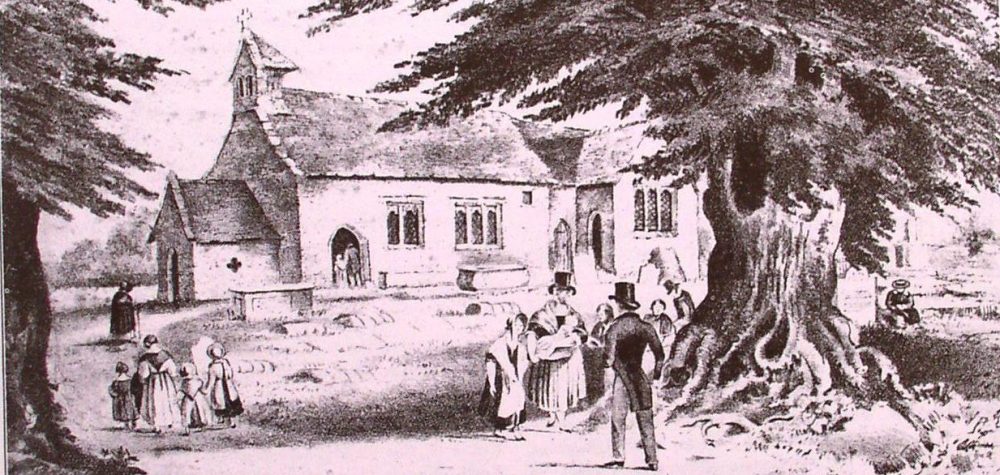
Another Wolf in Gwent 1866

Oct 13 1866 – ANOTHER WOLF IN GWENT

Not the first legend whose foundation lies in the sand of romance, rather than on the rock of fact, is that which gave Mr C.H. Williams the ground-work for his clever ballad. But the wolf which went scraping his paws, grinding his jaws, through brake and flood to Goytrey wood, where he got that ugly lick from Mr Herbert’s staff, was not the last of his race. Another wolf remains to be slain in Goytrey – so we are credibly informed – but no descendant of the brave Earl of Pembroke appears to give him chase.

Rides Stretton from Bryn derwen,

Rides Relph from hill of beech.

But then, ‘tis smaller vermin that you hunt nowadays, unless you go to France with His Grace of Beaufort.

The wolf of this our new Legend of Gwent

stated to ravage the country by force of law.

Created by Act of Parliament, brought into the district by Barons and Justices, held in charge by its own Wardens, our wolf notwithstanding all these accessories of respectability, works much mischief, spreads wide discontent, and evokes stern maledictions from the farmers and cottagers of Goytrey.

“Ho! bring the wolf-staves from the wall,

See that your knives are keen;

Come, men of hearts and sinews strong,

No child’s-play this, I ween.”

Certainly not- no child’s-play at all; but then wolf-staves and knives wont do the business. Our wolf is proof against edged tools, or there are pikes and bill-hooks which would have stopped his depredations before now.

But – to throw off our wolf’s clothing – what our neighbours complain of is the too vigorous measures (as they consider) which the Usk and Pontypool Highway Board is taking to improve their roads. The Goytrey people admit that their ways needed mending, and they may have been contumacious in not obeying certain Justices’ Orders for their improvement; but Nemesis has overtaken them, and the ratepayers begin to think that Goytrey is being “improved” too much entirely. Nearly £300 called for by the Highway Board, for the reconstruction of less than half-a-mile of road at one extremity of the parish, they think is pretty well to begin with, and seeing that there are nearly twenty miles of road, the repair of which lies either wholly or in part upon them, there seems good scope for further operations. “But” say the Board, “you needn’t make rates to amount we require at once. A beneficent Legislature has provided facilities for your borrowing the money, to be re-paid by instalments in twenty years.” Goytrey replies, “We can’t see it. Once let us begin borrowing, and when will you let us stop? If we borrow “500 for making this road to Pontypool, you may next call upon us, with equal reason, to make a new road to Blaenafon.” Our only chance for economy is to keep a tight grip upon our purse-strings, and we mean to do so.”

The road now under “repair” is near Kemeys Suspension Bridge, and while it is important only to one or two farms in Goytrey, it forms the shortest route to Pontypool from the parishes of Llanvair Kilgeddin, Bettws Newydd, and Kemeys Commander. Consequently, the Goytrey people argue that it is unfair that they should have to bear so great an expense for providing their neighbours a good road to market, while many of their own parishioners can hardly get a cart to their doors. They ask that the parishes receiving the benefit shall contribute towards the outlay, and the Board is said by some persons to have the power so to apportion it. The Board either cannot or has not done so, and an appeal for voluntary contributions is therefore contemplated by Goytrey, to which we cannot doubt there will be a liberal response.

To complete the road now in hand as far as Penpellenny – near Col Byrde’s residence – a distance of a mile and three-quarters, it is expected that a total cost of £500 will be incurred, which will represent more that 3s. 6d. in the pound on the rateable value of the parish. The calls already made amount to about 2s. in the pound: and the pressure upon the ratepayers being found to be very great, a vestry meeting was held on the 5th inst., the Rev Thos. Evans, rector, presiding, for the purpose of protesting against the proceedings of the Highway Board. Resolutions were passed, denouncing, as gross injustice, the borrowing of money, and the alleged excessive and unnecessary outlay on the road to |Pontypool; and a proposition for appointing a deputation to wait upon the Board was adjourned to another meeting to be held in a fortnight, in order that the Waywarden might be able to give information as to the call last made.

“Your money or your life,” was a challenge to which our ancestors sometimes had to respond. Goytrey seems to think it doesn’t even get the chance of the grim alternative but reads the demand, “Your money and your life.”

“ _________ You take my life

When you take the means by which I live.”

Rejoicings at Goytrey 1866

 12th May 1866 – Rejoicings at Goytrey

The return of Lieutenant Colonel and Mrs Byrde from Ceylon, to their residence at Goytrey was enthusiastically celebrated on Wednesday week. The inhabitants for some time had been awaiting the news of their arrival, and every one was wishful to do all in his power to getting up some public expression of their good wishes and affection.

When the suggestion was made, it was met with a ready and cheerful response from all. Accordingly at 3 o’clock in the afternoon of the above day, about 150 children met at Penpellenny, formed in procession, headed by the Goytrey band, went around Goytrey House and were warmly received.

Thence they made their way to Goytrey Co-operative Stores, where Mr & Mrs Jenkins, assisted by several ladies had provided a good drop of tea and cake for the young.

Having regarded ourselves (writes our correspondent) with the good provisions, we found that our time was rather short to reach Nantyderry Station for the train. We found, when approaching the station that every place was well timed with lookers on.

For Sale – New House Goytre 1924

12th September 1924 – Sale by Auction

GOYTRE, near PONTYPOOL

Messrs Pitten, Bunning & Russell

Under instruction from the executors of Abraham Phillips, deceased, will OFFER for SALE on the premises

NEW HOUSE, GOYTREY,

[Near Saron Canal Bridge]

WITHOUT RESERVE

ON Thursday 2nd October Next

The Whole of the

LIVE AND DEAD FARMING STOCK

AND FARM IMPLEMENTS

Including


SEVERAL COWS; PIGS;

CART HORSE; YEARLING COLT;

10 LAMBS; 150 HEAD POULTRY

PRIME MEADOW HAY;

POULTRY HOUSES; CHAFF CUTTER;

CHEESE PRESS; SPRING CART;

COVERED SHEEP RACK;

GENERAL FARM TOOLS;


Together with the complete

FURNISHINGS AND EFFECTS

For further particulars see later advertisement or

Apply to the Auctioneers at their office


NP Bank Chambers 26, Dock Street

Pontypool Newport

September 12th 1924

John Harvey – Servant and Master 1861

7th December 1861 – Servant and Master

John Harvey, farmer, charged with assaulting Joseph Howells, farm servant at Goytrey on November 28th.

Mr Greenway appeared for defendant. Complainant said he was at plough on Thursday when the horses turned stubborn, and he gave one of them a stroke with the plough line. His master said that if he struck the ‘harses’ again he would strike him. He did not strike them again, but told his master he should do no more with them, and he then struck him on the face.

By Mr Greenway, the horses ran away a day or two before, he could not keep the plough in the right place with them, so he threw it down and let them go. Did not kick them. His master scolded him for beating the horses with the plough line. Did not challenge him to fight. Had a fight with a fellow servant a short time since, and ‘got a bit of a scrat on my nose’. Never was threatened to be turned away for ill-treating the horses before this time. Did not call his master a dead fool, but said he was as big a fool as he was.

Thomas Jones, farm servant said he saw defendant strike complainant.

Mr Greenway then addressed the bench on behalf of his client, when he considered he had received sufficient provocation to chastise complainant, who had ill-used his horses, challenged him to fight, and threatened him with his fist…..the magistrates did not consider the defendant was justified in the course he had taken and fined him 20s for the assault or 14 days.

Mr Greenway then complained that p.c. Lewis had exceeded his duty in that he had given the parties advice when he served the summons, for which he was censured by the magistrates.

Thomas Watts – Stealing Meat 1866

1st September 1866 – A Charge of Stealing Meat

Thomas Watts, timber haulier, Goytre, was charged with stealing 5lbs of veal, the property of John Richardson, butcher, Usk on the 21st of August. Mr Henry Roberts appeared for the prisoner, Charles Coleman, miller Llanbaddock, said he was riding on the walk down Bridge street Usk on the evening of the day named about eight o’clock, when he saw, by the light of the gas, the prisoner take a piece of meat from a hook in the shop of prosecutor and put it under his coat; witness at first thought it was a joke, but he waited a short time to see if it was so or not, and seeing the prisoner walk away with another man who was with him, he told prosecutor that he had seen. In cross examination thos witness said he was sure it was Watts took the meat, not the other man – Francis Young, who is in the employ of the prosecutor said he missed part of a neck of veal off a hook in the shop; he had just before served the prisoner and a man called Rosser with 23/4 lbs of chops, part of which he had cut off the neck in question; Watts paid for the chops with a sovereign and witness went into another room to get the change; he afterwards saw the prisoner apprehended and the piece of veal, which was the same as he had cut the chops from, taken from his pocket. John Richardson, the prosecutor, deposed to giving information to the police, and to being present when the prisoner was apprehended, at the foot of the Usk bridge; when he (prosecutor) took the piece of meat from his pocket – P C Hill proved to apprehending the prisoner, and added that he found £6 5s 1d on him. Under cross examination this witness said; We forcibly searched the prisoner and took away everything we found on him; we did not take the knife from him because he was drunk; he was not drunk. – Mr Roberts in addressing the bench contended that the prisoner had taken the meat in a lark, as the witness Coleman had first supposed it was; and this idea he submitted was favoured by the fact that the prisoner was in a respectable position as a timber haulier; and further by the circumstances that he was returning towards Usk when he was overtaken by the policeman. The prisoner, after being duly cautioned was committed for trial at the quarter sessions bail being taken.

Wm Jones – Charge of Stealing £14 1866

24th November 1866 – A charge of stealing £14

William Jones plasterer &c., Nantyderry, appeared on remand to answer a charge of having stolen £14. The property of the trustees of the Pontypool Park Estate. Mr Alexander Edwards for the prosecutors and Mr Greenway for defendant, the first mentioned gentleman briefly stated the facts of the case which were, that a letter containing two £5 notes and 4 sovereigns was sent from the estate office on the 3rd inst., by a messenger, to the park house, which accidentally fell out of the hat unobserved by him whilst taking off the same to bow to a gentleman who was passing him in the street. Prisoner having been suspected of picking the letter up denied having done so when questioned on the matter by Sergeant Brook, and when at the police-station he said he only had £12 in his possession and the notes bearing the same numbers of those lost, and four sovereigns, were found upon him.

The fact of his denying having the letter he (Mr Alexander Edwards) contended was a proof that he intended to keep the money. In answer to the chairman, Mr A Edwards said the letter was directed to Mr Tomlinson, Pontypool Park. Mr Greenway asked for the production of the envelope. Mr Edwards said prisoner had destroyed it. The chairman wished to now if there was any evidence to shew that prisoner knew that the letter dropped out of the hat, when it appeared that no evidence of that nature had been obtained. In answer to the magistrate’s clerk, it was stated that the letter was dropped at twenty minutes to one, and the money found at about two o’clock in the afternoon. Mr Alexander Edwards observed that he was aware it must be proved that prisoner had the means to knowing to whom the letter belonged, which he had from the envelope. Mr Greenway said he had only been consulted on the case since he came into court. He did not mean to deny that prisoner had not picked the letter up, but he says that he did not know that what he was doing wrong, and was very sorry for what he had done. The fact of the matter was, that he (prisoner) had taken too much drink at the time, and on the policeman coming up and questioning him as he did he became irritated and would not give any information about the letter but when you have such a character given him as that produced by a gentleman of such standing, you cannot think for a moment that he intended to appropriate the money, and if he had become a little more sober, he no doubt would have acknowledged the possession of the letter. Mr Greenway added that he was not instructed to withhold anything. In the course of some general remarks the chairman said prisoner had been taken up for larceny, but there were motives why he might deny having the letter in his possession.

He might deny having it in the hopes of receiving some reward for finding it, and unless it could be proved that he had a felonious intention he must be discharged.

Whatever the bench might think of the act itself, they must keep within the law; there was no evidence to shew that he saw the letter fall from the hat, addressing prisoner the chairman told him that he had placed himself in a position that every honest man would be ashamed to be placed in. He had received a good character, but many a man get well spoken of simply because he has had the tact to keep his dark deeds from coming to light. After being cautioned as to his future proceedings, prisoner was discharged. The money of course was given to the owners.

Sale of Goods and Cattle- Wern Farm 1925

The Wern Goytrey – sale on Friday 15th August 1924

Mid way between Abergavenny and Pontypool

SALE of DAIRY CATTLE, IMPLEMENTS, DAIRY UTENSILS, Fodders and GRASS KEEP to April 1st 1925, for Mr E Davies who is retiring

Sale at 2.30

Full particulars in sale poster

J Straker, son & Chadwick FAI

Auctioneers, Abergavenny

James Morgan – To the Editor of the Free Press 1865

To the Editor of the Pontypool Free Press

25th February 1865

Sir, I have been informed that one James Morgan of Monkswood, stated on oath, last Saturday, before the justices of Pontypool, that my old bailiff, David Evans, was dismissed by me for some theft, with which I had charged him.

In that statement is not a particle of truth. Evans was dismissed simply because he happened, (though by no means an habitual drinker) to come to the house under the influence of drink, and it was the second offence.

Yours truly,

Thomas Evans

Rector of Goytrey