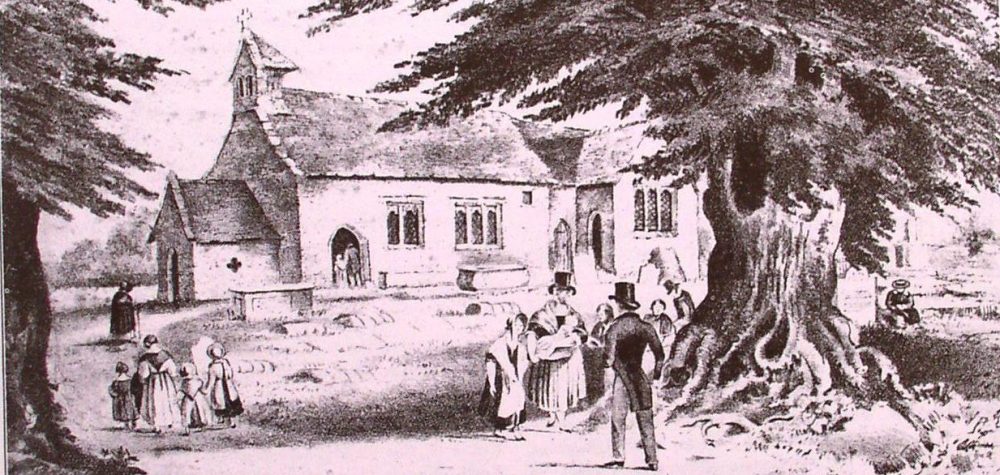
Free Press December 8 1866 – USK HIGHWAY BOARD
A meeting of the above was held at the Town Hall, Usk, on Monday, the following members being present: Messrs Thomas Watkins, (chairman), Gwatkin, Walter Blower, W. Price, Jno.Williams, John Morgan, James Powell, C. J. Watkins, E. Lister (Ex Officio,) Moseley, E. J. Williams, Gough and W. Fisher. In addition to the foregoing there were several of the principal ratepayers from Goytrey and the adjoining parishes present.
The Clerk read several letters, copies of which appeared in the Free Press, and in addition he read the following:-
Blaenafon Parsonage, near Pontypool,
Nov 19, 1866.
Gentlemen,- I beg to enclose a rough tracing of a portion of a map of the parish of Goytrey, and to call your attention to Penstair’s Road, coloured Red in the tracing, This road, nearly a mile long, connects two glebe farms belonging to me, one called Cwm in occupation of Thomas James, the other called Caen Cryddion, rented by Mrs Ann Prosser. This road is the only access to the Cwm Farm. Four gates have lately been put up on this road, and a portion of the fence has been pulled down.
If the parish officers have sanctioned the putting up of the gates they have acted illegally, and very unjustly towards those who have farms in that neighbourhood.
I, therefore, beg to ask whether the Board of Roads sanctions the putting up of the gates, and if not, whether they will take steps for their immediate removal. Begging the favour of an early reply,
I am, Gentlemen, yours truly,
JOHN JONES
Incumbent of Blaenafon, and Chairman of the Blaenafon Local board.
Kandy, Ceylon, Sept 28th 1866
To the Chairman of the Highway Board, Usk, Monmouthshire.
Dear Sir,- Your clerk has kindly forwarded to my son, now resident at Goytrey, the copy of a letter addressed by the Rev. Thomas Evans, rector of Goytrey, to the District Surveyor, respecting certain gates in the old abandoned which passes the cottages belonging to Pentrebach and Penystair farms, and which are represented by re Rector as causing very great dissatisfaction, though who are included in the “we” of his letter, or who besides himself “feels aggrieved in the matter,” does not appear by his communication.
I much regret that I did not, at once, avail myself of your kind offer to inspect the lane in question, and had I known that I should so soon have found it necessary to return to Ceylon. I would not have delayed the proposed inspection a single day, for by this unfortunate postponement I have subjected myself to a renewed attack on the part of the Rector of the Parish, and your Board to additional trouble.
I will now proceed to show you how far credence is to be given to his representation, by a detail of a few facts connected with this lane.
1.- In the first place I have a tolerably distinct recollection of this lane at various periods for thirty-five years, and it never was in different condition to what it is now, over-grown, dilapidated and unused.
2,- There never were, within my recollection, any fences, other than at present, along the fields of the Penystair and Pentrebach farms adjoining that lane.
3.- I have never seen, during the period of my residence in Goytrey, either a horse, mule, or ass, traversing that lane that I can recall to my own remembrance.
4.- Neither have I met with any parishioner who can remember any parish outlay on this old lane.
5.- And I can prove to your Board, and to any one open to conviction, that this lane is of no use to anyone, and ought to be abandoned by the parish as a highway to be maintained by it.
On the other hand, it is not true that the lane has been partially taken into my land, or that it is a channel of communication of value to the parish. Nor can I believe there has been the “complaint or dissatisfaction” represented, that the gates in question have been allowed to remain, for though I have personally spoken of them to many in the parish, I never heard one single word of objection expressed to their existence; nor has the land by these gates withdrawn from public use, and there is nothing really to restore to the public, for the gates are always open, and form no impediment to any one desiring to use lane, if such a desire exists, and it is impossible that the rector or anyone else can really fell aggrieved in the matter in the correct sense of this term, and some other motive than a praiseworthy desire to maintain the interests of the parish must be looked to for the rector’s championship of this abandoned highway.
I will now trouble you briefly with the occasion of my putting up these gates, that the Board may have perfect understanding of the whole matter.
I had found on taking possession of the Pentrebach farm and Graig Ddu rough lands had been perpetually grazed and over-run by stray sheep, cattle, and donkeys; and my bailiff had great difficulty in repairing the pathways for the use of my own stock and at one of the meetings of the parishioners I stated this grievance, and expressed a wish to place two latch gates at either end of the lane, similar to those on the parish lanes opening upon the mountain common, to save useless hedging along it; and though no vote was taken on the subject, or opinion recorded, no objection was expressed, and I felt satisfied that my fellow-parishioners would at any time, under their common sense of right, form a correct judgement in such a matter, and to their unbiased sense of what is due to themselves and to me, I am willing to leave the question, with perfect confidence; for surely there could be no great hardship to anyone who should, perchance, desire to use this old lane, to put out his hand and open the gate if he should pass through it, or to let it shut-to after him.
I will now further prove to you that it is quite a useless line of communication.
1.- Anyone going from Llanvoer to the upper part of the parish, would not go out of his way to choose this lane, when he had a more direct and better route up the Burgwm road.
2.- Anyone going from Llanover to Pontypool would surely not go so far from the main road, which invites them in preference.
3.- Even anyone going from Penwern farm, which also belongs to me, would go up the lane by the new barn or Bwrgwm road
In fact it is impossible to suggest any motive that could influence anyone in making use of that lane for any purpose that would not be better accomplished by other means more readily available and it would puzzle the ingenuity of the parish clerk himself to conceive any public use that the lane can be of to the parish. It is virtually abandoned to traffic, and in consideration of the uselessness of this lane I should, on behalf of the parish, be very unwilling that it should be subjected to any taxation for improvement or repair, especially when the ….tions in road rates are beyond all precedent, and form an oppressive burden upon the small farmers and cottagers.
Finally, I have a distinct remembrance of one or more conversations with the rector himself in times past, on the subject of the uselessness of that lane, and on my liability to trespass on it; and I can recollect a remark by him that now I had the farms adjoining it, it was of no use to anyone else, but might be required if the farms were again possessed by separate owners.
I am, therefore, unwillingly forced to the conclusion that the interference of the rector in this matter can only be attributed to some other cause than to a disinterested desire to maintain parish rights, which I have no desire to infringe, and I feel satisfied that the Board will not suffer advantage to be taken of my absence, in acting without full inquiry on the representation which has the appearance, at least, of being influenced any private feelings, and that, too, on the part of the clergyman towards a parishioner who has power willingly given him cause of offence, but who on the other hand, so far from evincing an oppressive spirit has given proofs that he has been influenced by a desire to promote the interests of the people of the parish of Goytrey, since his lot has been cast among them.
I remain, dear sir, yours faithfully,
HENRY C. BYRDE
The first business that came before the Board was with respect to the adoption by the Parish of the road made by Col. Byrde, from Goytre Church to Penpellenny farm, the largest portion of the said road running parallel with the railway. A meeting of the ratepayers, it appeared, had been held, at which it was resolved that the road should be taken and adopted by the parish.
The Chairman said it did not state who was at the meeting in favour of it, or who was not.
A Member: It was agreed to do so at a parish meeting.
The Chairman: Is it intended that the Board should take the necessary steps for the adoption of the road?
Mr Gwatkin: There is a copy of the resolution sent.
The Chairman: There is nothing sent, only that it was agreed at a parish meeting to do so.
A Member: The parish agreed to do so.
The Chairman: Who is the parish?
A Member: Why the inhabitants.
The Chairman: Oh, no.
Mr John Morgan: If the parish wishes the road to be adopted, and it is put in proper repair, there can be no objection to do so.
Mr Gwatkin: The parish will do everything in their power to meet the case.
Mr John Morgan: The road has been travelled over by the public for the past two or three years , and if it is not a public road I do not see why the public should travel over it. I dare say the chairman himself has travelled over it
The Chairman: Yes, I have travelled over it many times.
Mr John Williams, farm bailiff to Mr Logan, attended on the part of his employer to state that when he granted the land for the making of this road, it was on the condition that the fences were kept in repair by the parish, but there were no fences there. They got the grant of the land in 1858, but it was not made use of until 1862. Mr Logan was quite prepared to carry out what he agreed to do, and that was, that the parish should keep the fences in repair if he gave them the land.
A Member: It was not said at the meeting that the fences were to be kept in repair by the parish.
The Chairman (to Mr John Williams): Were you at the parish meeting?
Mr John Williams: No sir, I was not.
The Chairman: Was it understood by Mr Logan that the fences should be kept in repair?
Mr John Williams: Yes sir, it was
Mr John Morgan: I don’t think we could undertake such a responsibility.
The Chairman: What, to keep the fences in repair?
Mr John Morgan: Yes, the fences are of no use to us, and we cannot use the road very much.
Mr Gwatkin made an observation regarding this road but his remark did not reach our reporter’s ears.
Mr John Morgan: It is unusual to keep fences in repair.
Mr John Williams: Mr Logan is a gentleman whose word can be relied on. It was agreed that if he should give the land the fences should be kept in repair and unless that unless that was adhered to he would put up a gate and stop it up.
The Chairman: It shows how uprightly the Board should act in al matters.
The Clerk then read the 23rd section of the Highway Act, 5th and 6th Wm. IV.., cap 50, which says, – (long quote from Highway Act)
Mr John Morgan: No individual should make a road for his own use, and then call upon the public to repair it. There is no doubt that if it is properly represented to Mr Logan, everything will be made right.
The clerk having called attention to the lower part of the section of the Act previously given,
Mr John Morgan said – That proves that the parish shall be protected from the encroachment of any influential individual.
A Member: If there is any cavilling about the road it shall be shut up.
The Clerk: Three’ months notice must be given to the Surveyor.
Mr John Morgan: That is intended as a protection for the parish.
The Clerk: Then who is the parish?
Mr John Morgan: Why, the vestry. It is intended to prevent the parish being imposed upon; but here it does not come within the meaning of the Act, as the parish is willing to take the road if you make it properly.
The Chairman: Then the surveyor will say whether the road has been made the proper width or not.
The Surveyor: I am not prepared to give an answer at present.
Mr John Morgan: The parish will do what is reasonable, and you ought not to do what is unreasonable.
Mr John Williams: Mr Logan is a gentleman who will do what he says, and I know that he will stop the road up if the fences are not kept in repair.
Mr John Morgan: Does this involve any other fences?
A Member: Yes it does.
The Chairman: The question is, whether the Board will take it or not?
Mr John Williams: The new piece of road is 33 chains long.
The Clerk: The maker of the road has to give notice and get a certificate.
Mr John Morgan: The parish does not wish to have a private road for persons, and then be called upon to contribute towards it.
Mr Lister: I they want the road adopted by the parish, and it is taken by the parish, it must be certified by the magistrates.
Mr John Morgan: I differ from you, sir; I have read the clause over, and this road is not of public utility.
The Chairman: You have no objection to giving notice?
Mr John Morgan: Mr Logan says he will stop the road up.
The Clerk: If it was a road made by the parish it would be a very different thing.
Mr Gwatkin: It is a road made by subscription.
The Chairman: Mr Logan can be heard, and the magistrates will hear him, if things are not right.
Mr John Williams: Mr Logan does not wish to shut the road up; all he wants is to have the fences kept in repair.
Mr John Morgan: The road having been made, it was quite right for the parish to accept it.
Mr Gwatkin: The parish is willing to take the road.
Mr John Morgan: Well then, let the meeting decide whether the road shall be taken or not.
The Clerk: To adopt it as a highway?
The Chairman: Yes, I think so.
Some remarks having been given regarding the length and situation of the road: –
The clerk read the following resolution:-
“That the legal steps be taken at the expense of the parish of Goytrey, to adopt a certain new highway in Goytrey , running parallel with the railway there, about 33 chains in length, and to have same certified by Justices, and the certificate enrolled according to the road section of the Highway Act. 1862.”
Mr Gwatkin: That will not do.
Mr John Morgan: The question is whether the Bench will accept the road or not.
The Chairman:: Well let it read thus: – That the necessary legal steps be taken —–
Mr John Morgan: That is absurd. I shall propose that the new road made by Colonel Byrde be taken, adopted, and repaired by the Board. You are really worse than a lot of pettyfogging lawyers. (Laughter.)
The Chairman: We meet here under an Act of Parliament, and we have no power to adopt the road.
Mr John Morgan: If you are wanted to take the road you can do so.
The Chairman: The object is to prevent any cavilling hereafter
Mr Watkins said he would second the propositions.
Mr John Morgan: I differ from you, Mr Chairman, altogether; I think the parish can take the road directly.
The Chairman: But we have no right to take it in any other way.
Mr Price: Would it not be better to call a parish meeting?
The Chairman: The is one of the steps towards it.
The amendment was then put to the Board, but was lost by a large majority.
The Chairman called attention to the letter forwarded by the Rev J. Jones, of Blaenafon, and said the question was whether there was any right to put up the gates.
The Surveyor said it was impossible to haul much up the road.
After some remarks by Mr Byrde, jnr.,
The Chairman said the putting up of the gates had not been sanctioned by the Board, and the question to decide was what should they do in it? There was no doubt that the gates should be removed.
A letter signed by several persons respecting the gates on the Penystair road, having been read.
Mr Price asked if there was an objection to adjourn the subject until Col Byrde’s return, as they would only have a short time to wait.
The Chairman: Are the gates kept shut?
The Surveyor: They are always shut, but not fastened.
Mr Gwatkin: I will have them down, or I will put a gate by Goytrey church.
Mr Lister: I think it will be better to adjourn it until Col. Byrde’s return, and let it be understood that the gates shall not be locked.
It was then agreed that the subject of the removal of the gates on the Penystair road be adjourned tp the next meeting, it being understood that the gates are not to be locked.
The Chairman said their calls were due on the 5th of December, and not one parish had paid the call.
Mr Walter Blower said there was money due to them, and their collector was in the room and he said he could not get the money in, and he thought it would be hard to summon half the people in the parish, when there was a balance in the bank in their favour, and the money was not wanted.
The Chairman: But the money is wanted; and if not paid, we had better dismiss Mr Williams and every one of them.
Mr W. Blower: But we have £20 more than is wanted. I will guarantee that the money is paid when it is wanted.
The Chairman: The calls must be paid, or the parties must be summoned.
Mr B. J. Williams: I shall object to that.
Mr Gwatkin: I shall object to any summons taken out against Goytrey.
The Chairman then went through the various parishes comprise din the highway district, every on of which had failed to pay the call made.
Mr John Morgan: When the last contract for the Goytrey road was let, I never knew that it was done.
A Member: I thought that you were on the committee.
Mr John Morgan: I heard that it was let, but knew nothing of it at the time.
The Clerk referred to a minute of a previous meeting, and said that the Chairman and Mr Gwatkin were empowered to let about eight chains of the road leading to Pontypool.
Mr Gwatkin: That was put in unknown to me. It was said seven chains. But now it is said eight or nine chains. The road was impassable, and I thought that the money would be got by subscription.
The Chairman: Who was to do it?
Mr Gwatkin: I would have subscribed for one.
The Clerk: It is resolved that the parishes in arrear be summoned.
Mr John Morgan: Who Proposed that?
The Chairman: Why the Board.
Mr John Morgan: Then I object to it. I think it is a monstrous thing for Goytrey to pay so much money. Let the people pay when the money is wanted.
The Chairman: I think we should have a general resolution of the Board.
Mr Price: Is the object to get out of debt?
The Chairman: Yes.
The Surveyor: If the roads are left for a time, they will get into such a state that it will take a lot of money to get them repaired.
Several members: Yes, they will get into a very bad state.
The Surveyor: You should have borrowed the money, and made the repayment extend over several; years.
In reply to a member,
The surveyor said that the work could be done for £150.
Mr Gwatkin: Will you do it for that? It will take from £400 to £600 to do ti, and it will not be done for less.
The Clerk: It is proposed that the parishes in arrear be proceeded against.
Mr John Morgan: Who proposed it?
The Chairman: Well, then, let it come from the Chair.
The proposition was then put by the Chairman.
Mr Gwatkin: I shall second Mr Morgan’s motion, and let everybody pay —
The Chairman: When they choose.
Mr Gwatkin at this stage of the proceedings rose and left the table.
The Chairman: Is there any wish to stop the work?
Mr John Morgan: It is better to stop than to go on in the reckless manner that we have been going on in.
Mr Gwatkin: It is the most scandalous thing I have ever heard of.
The Chairman: Is there any opposition to the proposition?
Mr Gwatkin: Mr Morgan has made a motion.
The Chairman: What was the motion?
Mr John Morgan: I beg to move that no summons be issued against Goytrey.
Mr Gwatkin: I beg to second that.
The resolution was then put, when eight were in favour of summoning, and five against it.
The Chairman then moved that professional assistance be obtained for the occasion, as it was only a cover for some parties to say that the parish took it up, and as they would employ professional assistance, it was only right to meet them on their own grounds.
Mr Morgan: Have you no confidence in your clerk?
The Chairman: He is not engaged to do it.
A few more remarks, of no public interest, were made, and it was agreed that professional assistance should be engaged to conduct the Goytrey case before the magistrates; and after signing some cheques, the Board rose shortly after five o’clock, the meeting having lasted upwards of three hours.